The Wish That Wasnt What It Seemed
Maya Rodriguez was ten years old and had learned long ago that magic didn't exist. Her older brother had told her so, very seriously, when she was six and still believed in Santa Claus and the Tooth Fairy. "Magic isn't real, Maya," he had said, looking down at her with the kind of pity only an older sibling can muster. "It's just stories people make up."
Maya had cried that night, not because Santa wasn't real, but because something wonderful had been taken from her. The world had seemed a little less colorful, a little less full of possibility. She had packed away her fairy costumes and her magic wands and tried to be practical, the way her brother was practical.
But deep down, in the part of her heart where she kept her most secret hopes, Maya still wished for magic. She wished for it when she saw rainbows after storms. She wished for it when she found four-leaf clovers in the grass. She wished for it when she looked up at the stars and wondered if somewhere, somehow, impossible things might still be possible.
It was a Saturday in late summer when Maya found the wishing stone. She had gone to the river behind her house to skip stones, a game her grandfather had taught her before he passed away. The river was her favorite place to think, with its constant murmur and the way the sunlight danced on its surface.
She was searching for flat stones along the muddy bank when her foot knocked against something hard. At first, she thought it was just another rock. But when she bent down to pick it up, she gasped.
The stone was smooth and oval, fitting perfectly in her palm. It was a deep, rich purple—the color of twilight—and inside it were tiny sparkles that caught the sunlight and threw it back in a thousand directions. It looked like someone had captured a piece of the night sky and polished it until it fit in a child's hand.
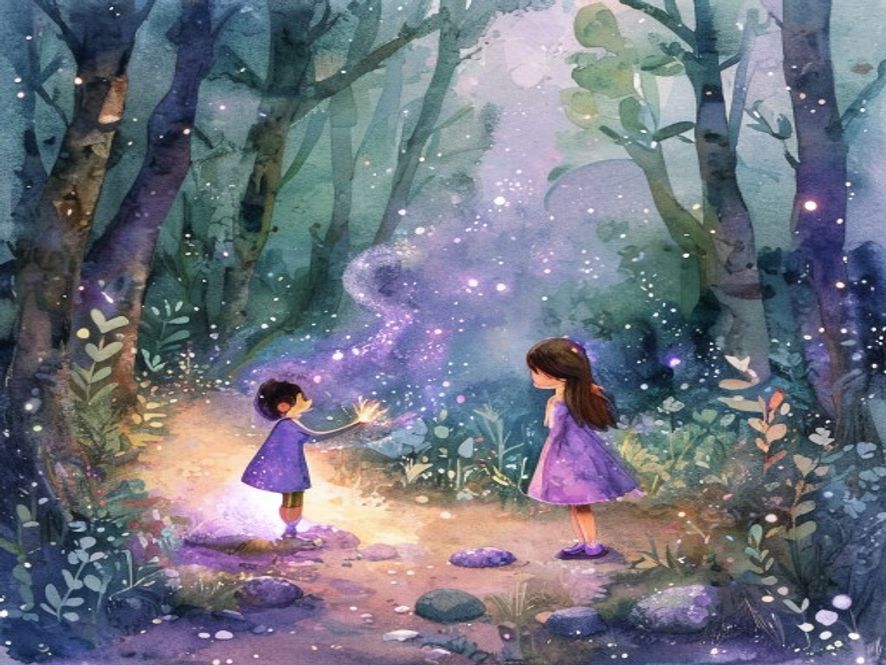
"One wish," a small voice said.
Maya jumped, nearly dropping the stone. She looked around wildly, but there was no one there—just the river, the trees, and the summer breeze.
"Down here," the voice said again.
Maya looked down. Perched on a nearby reed was a ladybug—but not an ordinary ladybug. This one had seven spots instead of the usual six, and it was looking at her with what could only be described as intelligence.
"The stone grants one wish," the ladybug said, its voice like wind chimes in a gentle breeze. "But be careful—wishes have minds of their own. They don't always turn out the way you expect."
Maya's heart hammered in her chest. Magic. Real magic. She wasn't crazy. It was real.
"One wish?" she repeated, her voice barely a whisper.
"One wish," the ladybug confirmed. "Choose wisely."
Maya thought hard. She could wish for toys—a whole room full of them. She could wish for candy that never ran out. She could wish to be the fastest runner in her class, or the smartest student, or the most popular girl in school.
But as she stood there on the riverbank, the purple stone warm in her hand, Maya realized that none of those things were what she truly wanted.
Ever since her grandfather died, Maya had felt lonely. Her parents worked long hours. Her brother was always busy with his friends. She had school acquaintances, but no one she could truly talk to—no one who understood her love of old books, her fascination with the stars, her habit of talking to herself when she thought no one was listening.
What she wanted most was a friend. A real friend. Someone who truly understood her.
"I wish for a best friend," she said firmly, looking at the stone. "Someone who will understand me. Someone who will be there for me. Someone who... who just gets me."
The stone began to glow. It started as a faint pulse of purple light deep within the stone's heart, then grew brighter and warmer until Maya had to squint against its brilliance. The light enveloped her hands, warm as sunlight, soft as a whisper.
Then, just as suddenly as it had begun, the light faded. The stone went dark and cool in her hands. Maya stood there for a long moment, waiting for something to happen.
Nothing did.
The ladybug was gone. The river flowed on, indifferent. The trees rustled in the breeze. And Maya felt a little sad, though she wasn't sure why. Maybe her brother had been right after all. Maybe magic was just stories.
She put the stone in her pocket and walked home.
The next morning, Maya woke to the sound of scratching at her front door. She ran downstairs, still in her pajamas, and threw the door open.
There, sitting on her porch, was a dog.
He was scruffy and mud-colored, with one ear that stood up and one ear that flopped down. His tail wagged so hard his whole body wiggled, and his eyes—one brown, one blue—were fixed on Maya with an expression of pure, unconditional love.

"I didn't wish for a dog," Maya said, confused.
But the dog didn't seem to care about her confusion. He trotted inside as if he owned the place, sniffed her shoes, and then curled up in a patch of sunlight on the living room rug and fell asleep.
Maya's parents were skeptical. "We can't just keep a stray dog, Maya," her mother said. "He must belong to someone."
They put up flyers. They checked with the animal shelter. They asked around the neighborhood. But no one claimed him. And every time someone suggested taking him to the pound, Maya would look at the dog—who had already learned to fetch her slippers and wake her up in the morning with gentle licks—and her heart would ache.
"Please, Mom? Please, Dad?" she begged. "He's not just any dog. He's... he's special."
In the end, it was the dog himself who convinced them. When Maya's father came home from work looking tired and defeated after a terrible day, the dog didn't jump on him or demand attention. He simply walked over, pressed his head against the man's knee, and stayed there. And for the first time in weeks, Maya's father smiled.
They named him Rusty, for his reddish-brown coat, and he became a member of the family.
As the days turned into weeks, and the weeks into months, Maya began to understand what the stone had given her. Rusty wasn't just a dog. He was exactly what she had wished for—a best friend.
He listened when she talked about her dreams—about becoming an author, about traveling the world, about all the things she wanted to do when she grew up. He never interrupted. He never judged. He just listened, his head on her lap, his eyes looking up at her with complete attention.
He stayed close when she felt sad—when she missed her grandfather, when she had a fight with her brother, when the world felt too big and she felt too small. He would press his warm body against her side, and somehow, his presence made everything a little bit better.
He made her laugh with his silly antics—chasing his own tail, barking at his reflection in the mirror, trying to catch butterflies in the garden. He reminded her that joy could be found in simple things, that not everything had to be serious all the time.
And when she read books, he would rest his head on her lap as if he understood every word. Sometimes Maya would read aloud to him, sharing her favorite stories, and she could swear that Rusty had opinions about them. He would thump his tail at the happy parts and whine softly at the sad parts.
One evening, as the sun was setting and Rusty slept by her side, Maya whispered to him, "You're the best friend I could have ever wished for."
The dog opened one eye and thumped his tail against the floor.
And in her bedroom, in the drawer where she kept her treasures, the purple wishing stone gave a tiny, happy glow.
The End.