The Shiny Red Lunchbox: A Story About Honesty
In the sunny town of Maplebrook, where birds sang from every tree and flowers bloomed in every garden, there stood a cheerful school called Maplebrook Elementary. The school had a bright red roof, walls painted the color of buttercups, and a playground that stretched as far as the eye could see.
In Class 3B sat a young girl named Mia. She was eight years old, with curly brown hair that bounced when she walked and eyes the color of warm honey. Mia wore glasses with purple frames that matched her favorite sneakers, and she always carried a backpack covered in stickers she'd collected from her adventures.
Mia was known throughout the school for her bright smile and kind heart. She would help anyone who needed it—whether it was showing a new student where the cafeteria was, sharing her crayons when someone forgot theirs, or helping the librarian stack books at the end of the day. But more than anything, Mia was known for one very special quality: she was honest. Always.
One warm Tuesday morning in late spring, Mia arrived at school early. The sun was just peeking over the horizon, painting the sky in shades of pink and gold. The morning dew still clung to the grass, making everything sparkle like diamonds.
As Mia walked through the school gates, something caught her eye. There, sitting on the bench near the big oak tree, was the most beautiful lunchbox she had ever seen. It was shiny and red, with silver clasps that gleamed in the morning light. Little stars were painted on its surface, and a name tag dangled from the handle—though the name had been worn away by time.
Mia's eyes grew wide. She had never seen a lunchbox quite like it. Her own lunchbox was plain blue, a hand-me-down from her older brother. This one looked brand new, practically magical in its perfection.
She looked around. The playground was nearly empty. A few early teachers were walking toward the building, but no one was near the bench. The lunchbox sat there, alone and unclaimed.
Mia felt her heart beating faster. She walked slowly toward the bench, her backpack feeling heavier with each step. The red lunchbox seemed to glow in the morning sunlight, calling to her.
"Someone must have left it here," Mia whispered to herself. "Maybe they were playing yesterday evening and forgot it."
She stood before the bench, staring at the beautiful lunchbox. Her fingers itched to touch it, to open it, to see what treasures might be inside.
"It would be so easy to take it," a small voice whispered in Mia's mind. "No one is watching. No one would know. And it's just sitting there, waiting for someone to claim it. Why shouldn't that someone be me?"
Mia reached out her hand. Her fingers brushed against the cool, smooth surface of the lunchbox. It felt wonderful beneath her touch—smooth and perfect, like something from a dream.
But then Mia stopped. She pulled her hand back and took a deep breath.
"No," she said firmly, speaking aloud to the empty playground. "This isn't mine. Taking it would be wrong, even if no one saw me."
She thought about what her grandmother always told her: "Honesty isn't about being caught or getting caught. It's about who you are when nobody's watching. It's about being able to look at yourself in the mirror and know you did the right thing."
Mia sat down on the bench next to the lunchbox. She would wait. She would make sure this beautiful red lunchbox found its way back to its rightful owner.
Minutes ticked by. Students began arriving at school, their laughter and chatter filling the morning air. Mia watched them pass, hoping someone would come looking for the lunchbox. But no one did.
The first bell rang, echoing across the playground. Mia knew she needed to go to class, but she couldn't just leave the lunchbox here. Someone might take it—and not everyone had the same voice of honesty speaking in their heart that Mia had in hers.
Making her decision, Mia carefully picked up the red lunchbox. It was heavier than she expected. She held it close to her chest and walked toward the school building, her purple sneakers squeaking on the polished hallway floors.
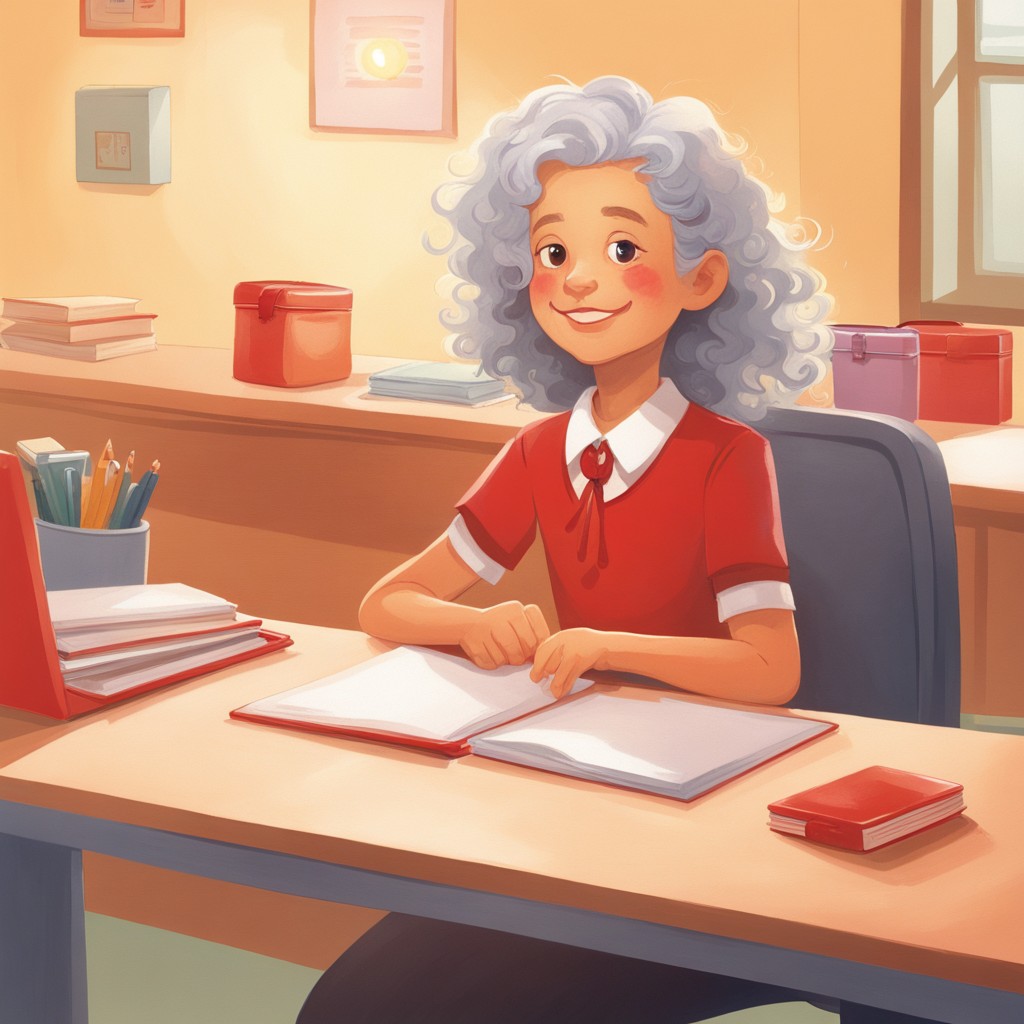
Mia went straight to the main office. Mrs. Patterson, the school secretary, looked up from her desk as Mia entered. She was a kind woman with silver hair and reading glasses perched on her nose.
"Good morning, Mia!" Mrs. Patterson said warmly. "You're here early today. Is everything alright?"
"I found something," Mia said, placing the red lunchbox carefully on the counter. "It was on the bench by the oak tree. I waited to see if anyone would come for it, but no one did. I thought I should bring it here, so it stays safe until the owner comes looking for it."
Mrs. Patterson's eyes softened as she looked at Mia, then at the beautiful red lunchbox. "That was very thoughtful of you, Mia. And very honest."
"I knew it wasn't mine," Mia said simply. "Even though it was very pretty, taking something that doesn't belong to you is wrong. My grandma says honesty means doing the right thing even when no one is watching."
"Your grandmother is a very wise woman," Mrs. Patterson said, smiling. "Let me check if anyone has reported a missing lunchbox."
She flipped through a notebook on her desk. "Ah! Here it is. A student named Lucas from Class 4A reported losing a red lunchbox yesterday evening. He was very upset—apparently, it was a gift from his grandmother who lives far away."
Mia felt a warmth spread through her chest. "I'm glad I brought it here, then. Lucas must be worried sick."
"He certainly was," Mrs. Patterson said. "I'll call his classroom and let him know his lunchbox has been found. Mia, would you like to wait and see his face when he gets it back? I think it would mean a lot to him to thank you personally."
Mia nodded, her curls bouncing. "I'd like that."
A few minutes later, a boy with messy black hair and freckles across his nose hurried into the office. His eyes were wide, and when he saw the red lunchbox on the counter, they filled with tears of relief.
"My lunchbox!" Lucas exclaimed, rushing forward. He turned to Mia, his face a mixture of gratitude and wonder. "You found it?"
"On the bench by the oak tree," Mia said, smiling. "I was going to wait there longer, but the bell rang. I didn't want anyone else to take it, so I brought it to Mrs. Patterson."
Lucas clutched the lunchbox to his chest. "Thank you so much. You don't understand—this was from my grandmother in Japan. She sent it for my birthday last month. It's the only thing I have from her, and I've been so worried I lost it forever."
"I'm really happy I could help," Mia said sincerely.
Lucas opened the lunchbox and pulled out a small photograph. It showed an elderly woman with a gentle smile, her arms wrapped around a younger Lucas. "This is my grandmother. I miss her so much. Having this lunchbox makes me feel like she's still close to me."
Mia felt tears prick her own eyes. She was so glad she had listened to her heart and done the honest thing. If she had taken the lunchbox, Lucas would have lost something precious—something that connected him to someone she loved who was far away.
"I have something for you," Lucas said suddenly. He rummaged in his backpack and pulled out a small origami crane, folded from beautiful silver paper. "My grandmother taught me how to make these. She says they bring good luck to good people. I want you to have it."
Mia accepted the crane with wonder. "It's beautiful, Lucas. Thank you."
"No, thank you," Lucas said, his voice thick with emotion. "You could have kept the lunchbox. No one would have known. But you didn't. You chose to be honest, and that means everything to me."
The second bell rang, signaling the start of classes. As Mia walked to her classroom, the origami crane clutched in her hand, she felt lighter than air. She knew she had done the right thing—not because someone was watching, not because she might get caught, but because honesty was simply who she was.
That afternoon, during sharing time, Mia told her class about finding the lunchbox. Her teacher, Mr. Henderson, asked her to stand before everyone.
"Class," he said, "Mia did something very important today. She found something valuable, something she really liked, and instead of keeping it, she made sure it got back to its owner. That takes a special kind of courage—the courage to be honest even when it's hard."
He turned to Mia. "Can you tell us why you decided to return the lunchbox?"
Mia thought for a moment. "Because it wasn't mine," she said simply. "And taking something that doesn't belong to you is wrong, no matter what. I wanted to be able to look at myself in the mirror and know I did the right thing. Plus," she added with a smile, "Lucas really needed it. It was from his grandmother, and it makes him feel close to her. That mattered more than having a cool lunchbox."
Mr. Henderson nodded proudly. "That's exactly right. Honesty isn't always easy. Sometimes we really want something that isn't ours. But being honest means we respect other people's belongings, their feelings, and their trust. When we're honest, we build strong friendships and strong communities."
He walked to the whiteboard and wrote a single word in big letters: HONESTY.
"Honesty," he said, "is one of the most important values we can have. It means telling the truth, keeping our promises, and doing the right thing even when no one is watching. Mia showed us today what honesty looks like in action."
The class applauded, and Mia felt her cheeks grow warm. She wasn't looking for praise—she had just done what felt right in her heart. But it did feel good to know that her classmates understood why honesty mattered.
From that day forward, Mia became known as the most trustworthy student at Maplebrook Elementary. When someone found something lost, they brought it to Mia. When teachers needed help distributing papers or organizing supplies, they asked Mia because they knew she would be honest about counting and keeping track of everything.

But the greatest reward came weeks later, when Lucas approached Mia at recess. He was carrying his red lunchbox, which now had a new name tag hanging from the handle. In neat letters, it read: "Property of Lucas—and friends with Mia."
"I wanted you to know," Lucas said, "that I pay attention now too. Last week, I found a dollar on the playground, and I turned it in to the office. The office said no one claimed it after a week, so they gave it back to me. But I didn't take it right away—I made sure to try to find the owner first. Just like you did with my lunchbox."
Mia beamed. "That's wonderful, Lucas! See how one honest act can spread?"
"Yeah," Lucas agreed. "My grandmother says that honesty is like a spark. When one person is honest, it inspires others to be honest too. Pretty soon, the whole world is brighter."
Mia looked around the playground—at the children playing tag, at the teachers supervising, at the birds singing in the trees. She thought about how many small choices for honesty were being made every day, choices that made the world a little better, a little kinder, a little more trustworthy.
She opened her own lunchbox—still the plain blue hand-me-down—and inside, nestled beside her sandwich and apple, sat the silver origami crane Lucas had given her. It caught the sunlight and sparkled like a tiny star.
Mia smiled. Being honest hadn't given her a fancy new lunchbox. It had given her something much more valuable: a true friend, the trust of her community, and the quiet pride of knowing she had done the right thing.
And that, she realized, was worth more than all the shiny red lunchboxes in the world.
As the school day ended and Mia walked home beneath the golden afternoon sun, she held her head high. She knew that honesty was a choice she would make again and again, every day of her life. Not because someone was watching. Not because she might get a reward. But because being honest was simply who she was—and who she wanted to be.
And in the pocket of her backpack, the silver origami crane seemed to glow with a light all its own, a reminder that when we choose honesty, we create something beautiful that lasts forever.
THE END
Related Posts
The Lost Lunchbox: A Story About Honesty

The Truth Blossom: A Story About Honesty