The Clever Crow’s Bright Idea: A Story About Creativity
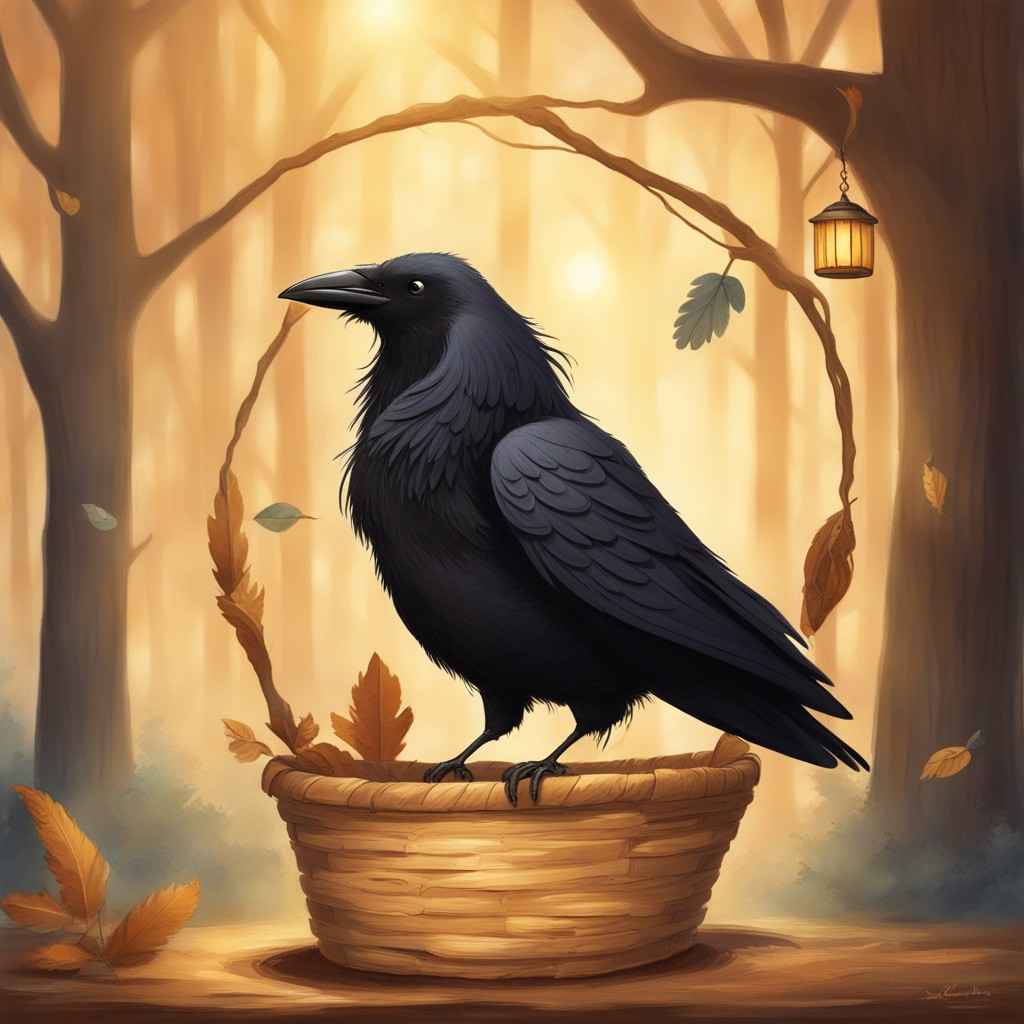
In the heart of an ancient oak forest, where morning mist curled between moss-covered branches and a sparkling stream sang its endless song, there lived a young crow named Corwin. He was a handsome bird with glossy black feathers that shimmered with hints of purple and blue when the sunlight touched them just so. Corwin took great pride in his appearance, smoothing his feathers each dawn with meticulous care, and he took even greater pride in doing things properly—the way they had always been done.
Every morning, Corwin would fly the same route through the forest, greeting his neighbors in the traditional manner. He would tip his head respectfully to the sparrows, bow low to the cardinals, and offer a dignified nod to the blue jays. He believed there was a right way to do everything, and that wisdom came from following the paths laid down by those who came before.
"The old ways are the best ways," Corwin would often say to his younger sister, Cora, who had a habit of trying new flying patterns that made their mother sigh. "Why waste time experimenting when we already know what works?"
Cora would flutter her wings and roll her bright eyes. "But Corwin, how do you know something better isn't waiting to be discovered?"
Corwin would simply puff out his chest and hop along the familiar branch paths, content in his certainty.
Then came the autumn when everything changed.
The forest had enjoyed a wet spring and a warm summer, and the berry bushes had grown wild and tall—taller than anyone could remember. Their branches reached toward the sky like green fingers, heavy with plump, juicy berries that ripened to a deep, tempting purple. But there was a problem: the berries had grown too high. The branches that once bowed low with fruit now stretched far above the reach of the small birds who depended on them.
Little Wren, who could fit in the palm of a human's hand, fluttered desperately at the base of the tallest bush, her tiny wings beating so fast they hummed. "I can almost reach," she chirped, leaping into the air again and again, only to fall short each time. "But almost isn't enough."
Finch, with his bright yellow breast, tried to climb the bush's thick stem, but his feet weren't made for gripping bark, and he kept sliding back down. "We've always picked berries from these bushes," he said, his voice trembling. "What are we going to do? Winter is coming, and our stores are empty."
The forest animals gathered in a worried circle beneath the towering berry bushes. Squirrel chattered nervously, his tail flicking back and forth. Rabbit twitched her nose, her brown eyes wide with concern. Even the usually confident Jay family looked distressed, their blue feathers ruffled with anxiety.
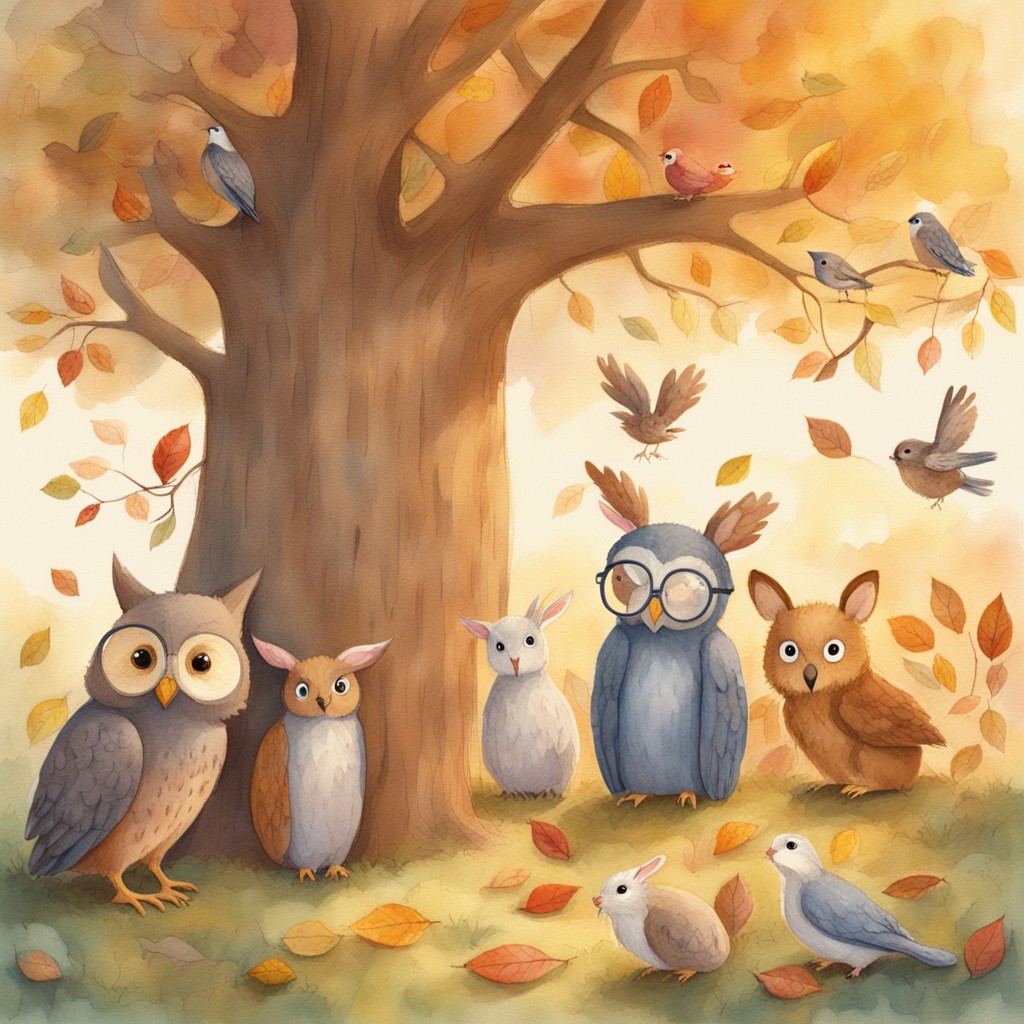
Corwin watched from his favorite branch, his sharp mind turning over the problem. This was a matter of tradition—there had always been berries for everyone. There must be a traditional solution.
"I'll help," Corwin called out, gliding down to join the gathering. "Follow me. We'll do what we've always done."
First, Corwin tried the classic approach. He instructed the small birds to form a line, each jumping off the back of the bird in front, creating a living ladder of feathers and determination. But the tower wobbled and collapsed before they could reach the lowest berry, and everyone tumbled into a soft, embarrassed heap of wings and apologies.
"Again," Corwin commanded, "but this time, hold steadier."
They tried three more times, but each attempt ended the same way—birds scattered across the grass, dizzy and berry-less.
Next, Corwin remembered how the elders spoke of shaking branches to make fruit fall. He gathered the strongest fliers—himself, two ravens, and a hawk—and together they beat their wings against the bush with all their might. The leaves rustled and swayed, and a single berry dropped... then another... then nothing more. The branches were too thick, too flexible, too high. The traditional methods weren't working.
Corwin sat on a low branch, his head drooping. For the first time in his young life, the old ways had failed him completely. He watched as the smaller birds huddled together, cold and hungry, and something unfamiliar stirred in his chest—a feeling he couldn't quite name.
"Perhaps," said a voice like rustling leaves, "the problem isn't that you need to try harder, but that you need to try differently."
Corwin turned to find himself face-to-face with Old Bramble, the great horned owl who lived in the hollow of the oldest oak tree. The owl's golden eyes gleamed with wisdom accumulated over many winters, and his feathery tufts swayed gently in the breeze.
"But Elder Bramble," Corwin said respectfully, "the traditional methods have always worked before."
"Have they?" the owl hooted softly. "Or have the circumstances simply never challenged you to grow? Look around you, young crow. The world changes. The seasons shift. The river carves new paths through stone. And yet you expect the same solution to fit every problem?"
Corwin felt his feathers ruffle with indignation. "Are you saying our ancestors were wrong?"
"Not at all," Old Bramble replied, his voice warm with patience. "I am saying they were creative. Every tradition began as an innovation. Someone, long ago, looked at a problem and imagined a new way. That is the truest wisdom—not to copy what came before, but to understand the spirit of invention that created it."
The owl spread his magnificent wings, and for a moment, he seemed to fill the entire clearing with his presence. "Creativity, young Corwin, is not about breaking rules. It is about finding new paths when the old roads no longer lead where you need to go. It is the courage to imagine what does not yet exist."
Corwin sat in silence, the owl's words turning slowly in his mind like autumn leaves in a stream. He looked at the berry bushes again, but this time, he tried to see them differently. Not as obstacles to be overcome with force, but as puzzles waiting to be solved.
And then he noticed something he had never seen before.
Near the stream, half-buried in mud, lay a collection of sticks and twigs that had been washed downstream by the recent rains. Among them were several long, straight branches—strong and sturdy. And scattered on the ground nearby were vines, tough and flexible, left behind by the retreating floodwaters.
Corwin's mind began to race. Sticks... vines... berries high above... birds below...
"I have an idea," he whispered, more to himself than anyone else.
He hopped down to the stream bank and began to gather materials. The other birds watched in confusion as Corwin collected sticks of various lengths, testing their strength, discarding the weak ones, keeping the strong. He gathered vines and began to weave them together, his beak working with a precision he didn't know he possessed.
"What are you doing?" asked Little Wren, tilting her tiny head.
"I'm not entirely sure yet," Corwin admitted, "but I think... I think I might be creating something new."
For an hour, Corwin worked. He lashed sticks together with vines, creating a frame. He wove smaller twigs through the frame, forming a flat surface. When the structure was complete, it looked like nothing anyone had seen before—a wide, sturdy platform with handles woven from tough grass.
"It's a... a berry-fetcher!" Corwin announced, though he wasn't quite sure that was the right name.
With the help of the stronger birds, Corwin carried his creation to the base of the tallest berry bush. Then, in a move that made his heart flutter with uncertainty, he instructed Little Wren and Finch to climb onto the platform.
"Now, everyone, lift together!"
The larger birds grasped the handles with their beaks and talons. On Corwin's count, they flapped their wings in unison, lifting the platform upward. Little Wren and Finch rode safely on the sturdy surface, rising higher and higher until they were level with the heavy berry branches.
"We can reach them!" Wren sang out, her beak already full of sweet purple fruit.
One by one, the small birds took turns on the platform, each ride lifting them to the bounty they thought was lost. Squirrel found he could climb the bush's stem now that the lower branches had been picked clean by the flying platform. Even Rabbit discovered that the fallen berries, shaken loose during the earlier attempts, made a feast on the ground below.
As the sun began to set, painting the forest in shades of gold and amber, the animals gathered around Corwin's strange invention. Their bellies were full, their storerooms were stocked, and their spirits were light.
"What do you call it?" asked Jay, his blue feathers gleaming with admiration.
Corwin looked at his creation—the rough platform, the woven handles, the simple but effective design. It wasn't elegant. It wasn't traditional. But it had worked.
"I call it... a lift-basket," he said, and then laughed at his own uncertainty. "Or maybe it's a bird-platform? I'm not sure. But I think... I think we could make it better. What if we added sides so nothing falls off? What if we made the handles longer so more birds could help lift?"
Cora nudged her brother affectionately. "Listen to you, talking about improvements already."
"Old Bramble was right," Corwin said, looking up at the owl who watched from his branch with an approving gleam in his golden eyes. "The ancestors weren't just following rules—they were solving problems. And the best way to honor them isn't to copy what they did, but to think as they thought. To look at the world with fresh eyes and imagine new possibilities."
From that day forward, Corwin became known throughout the forest as the Creative Crow. He built better versions of his lift-basket, adding features suggested by his friends. He invented new ways to store nuts and seeds that kept them fresher through winter. He even designed a warning system using hollow logs that could alert the whole forest when predators approached.
But his greatest creation wasn't any of these things. It was the change he inspired in others.
Little Wren started weaving tiny baskets from grass to carry more berries at once. Squirrel designed a new kind of nutcracker using two stones. Even the elders began to look at their old methods with fresh curiosity, wondering what improvements might be possible.
The forest flourished like never before, not because the animals worked harder, but because they learned to work smarter. They discovered that creativity wasn't a special gift given to only a few—it was a way of thinking available to anyone brave enough to question "the way things have always been done."
And whenever a young animal would say, "But we've never done it that way before," the elders would smile and tell the story of Corwin the Creative Crow, who learned that the most important tradition of all was the tradition of innovation.
For creativity is not about being the smartest or the bravest. It is about being curious enough to ask, "What if?" It is about being humble enough to admit that you don't have all the answers. And it is about being brave enough to try something new, even when you're not sure it will work.
Because sometimes, when the old ways fail us, the only way forward is to create a new path. And that path, walked with courage and imagination, can lead to places more wonderful than we ever dared to dream.
So the next time you face a problem that seems impossible to solve, remember Corwin and his lift-basket. Remember that every great invention started as a simple question. Remember that creativity lives in all of us, waiting for the moment when we need it most.
And who knows? Perhaps you will be the one to imagine something the world has never seen before.
The end.
This story is part of the Core Values Series, teaching children important life lessons through magical bedtime stories.