The Crow Who Painted the Sky: A Story About Creativity
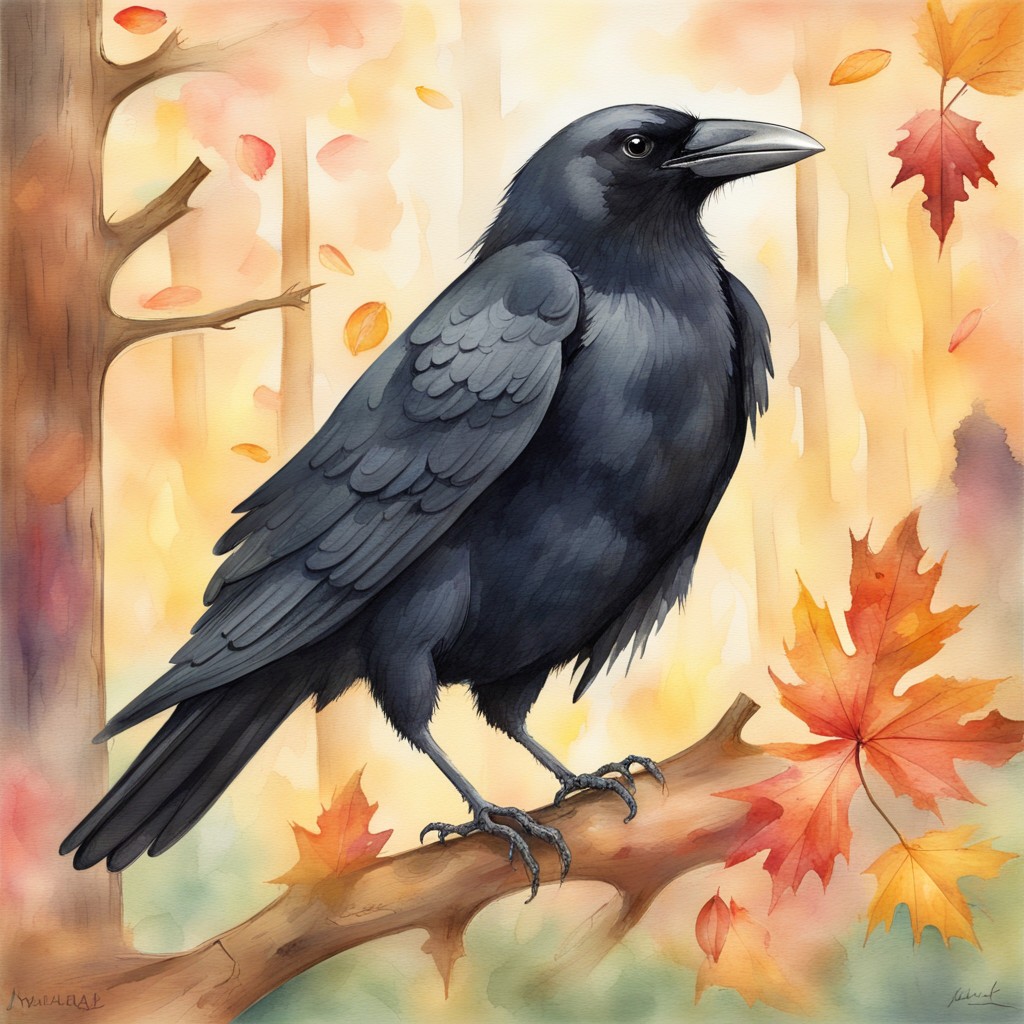
In the ancient forest of Eldergrove, where the trees grew so tall their tops disappeared into the clouds and the streams ran clear as crystal, there lived a young crow named Corvin who was different from all the other crows.
While his brothers and sisters spent their days learning the traditional crow arts—finding shiny objects, cawing loudly at intruders, and perfecting the elegant dive-bomb that made other birds scatter in terror—Corvin was always off by himself, doing things that made the elder crows shake their heads in dismay.
"Corvin!" his mother would call, her voice sharp with concern. "Stop playing with those berries and come practice your cawing! A crow who cannot caw properly is no crow at all!"
But Corvin wasn't "playing" with the berries. He was crushing them between two stones, mixing the juice with crushed flower petals and a bit of stream water, creating colors that no crow had ever seen before. Rich purples from elderberries. Deep blues from crushed cornflowers. Brilliant reds from wild strawberries. And he was using these colors to paint.
Not on cave walls or tree bark, as some animals did. Corvin painted on leaves. Large, flat maple leaves that he collected and preserved. He painted the forest as he saw it—not just the trees and streams, but the feeling of the place. The way morning light filtered through the canopy like golden threads. The way mist clung to the ferns at dawn. The way the wind seemed to dance when it played through the autumn leaves.
His paintings were beautiful. At least, Corvin thought so. But no one else seemed to agree.
"Wasting time," muttered Elder Crow Graywing, his feathers ruffled with disapproval. "A crow's job is to gather, to protect, to be practical. This... art... is foolishness."
"But don't you think it's beautiful?" Corvin asked, holding up a leaf painting of the sunrise over the eastern ridge.
Graywing peered at it with one cloudy eye. "I think," he said slowly, "that you could have spent that time gathering five more acorns. And acorns, young Corvin, will feed you in winter. A painted leaf will not."
The Great Drought came without warning.
For three months, not a single drop of rain fell on Eldergrove. The streams that had sung through the forest for centuries dwindled to trickles, then to dry beds of cracked mud. The ponds shrank, leaving fish gasping in ever-smaller puddles. The berries withered on their stems. The acorns failed to form.
The animals of the forest grew desperate. The deer traveled miles to find water, their tongues swollen with thirst. The squirrels dug frantically through their winter stores, finding them far too empty. The frogs buried themselves deep in the mud, entering a kind of sleep that might last until the rains returned—if they ever did.
The crows fared better than most. They could fly long distances, searching for water and food. But even they were struggling. The traditional gathering spots were dry. The fields where they had always found grubs and insects were barren.
"We must adapt," said Graywing at the emergency council of crows, his voice heavy with worry. "But I don't know how. We have always gathered from the eastern fields. We have always drunk from the Crystal Stream. Without them..."
He didn't finish. He didn't need to.
Corvin listened from the edge of the gathering, his head bowed. He knew what they were all thinking. The old ways weren't working. The traditional solutions weren't enough. They needed something new. Something different.
They needed creativity.
That night, Corvin couldn't sleep. He sat on his favorite branch, high in an ancient oak, and watched the stars emerge one by one in the darkening sky. The forest was eerily quiet without the usual sounds of streams and night creatures. Only the dry rustle of dying leaves broke the silence.
As he sat there, his eyes tracing the patterns of the stars, an idea began to form. Not a complete idea. Just a fragment. A seed. But it was enough to make his heart beat faster with excitement.
What if the problem wasn't that there was no water? What if the water was there, but they couldn't reach it?
The next morning, before dawn had fully broken, Corvin was flying over the dry stream bed, his sharp eyes searching. He found what he was looking for near the old willow tree—a place where the mud was slightly darker than the surrounding earth, a faint dampness that suggested water not far below.
He landed and began to dig. His claws weren't made for digging. They were made for grasping, for perching, for tearing food. But Corvin didn't give up. He dug and scratched and pulled, hour after hour, until his claws were cracked and bleeding and his wings trembled with exhaustion.
The other crows watched from the branches above, their heads cocked in confusion. "What is he doing?" asked Corvin's sister, Corona.
"Wasting energy, as usual," Graywing muttered. "When he gets hungry enough, he'll come to his senses and join the search like the rest of us."
But Corvin didn't stop. He couldn't. Something drove him, something deeper than hunger or thirst. A vision of what could be. A belief that there was a solution, if only he could find it.
By midday, he had dug a hole three feet deep. The earth was definitely damp now, cool and dark against his aching claws. He dug faster, fueled by hope. And then, just as the sun reached its zenith, water began to seep into the bottom of the hole.
Not a lot. Just a trickle. Just enough to form a small pool in the deepest part of the excavation. But it was water. Real, clear, life-giving water.
Corvin dipped his beak and drank, the cool liquid flowing down his throat like the most precious nectar. Then he flew to the gathering branch, his wings strong despite his exhaustion, and called out in his clearest caw: "Water! I've found water!"
The crows gathered around Corvin's hole, staring in disbelief at the small pool of water gleaming at the bottom.
"How did you..." Graywing began, then stopped. "How did you know to dig here?"
"I looked for signs," Corvin explained. "The darker mud. The way the willow's roots seemed healthier than the other trees. The slight depression in the earth that suggested water had pooled here before."
"But... no crow has ever dug for water. We drink from streams. From puddles. From rain."
"The streams are dry," Corvin said gently. "The puddles are gone. The rain isn't coming. So I had to think of something new."
He looked around at the faces of his flock, seeing wonder mixed with skepticism. "This hole won't be enough for all of us. But what if we dug more? What if we found other spots where the underground water comes close to the surface? We could create a network of wells, scattered throughout the forest, so no animal would have to travel far to drink."
"Dig wells?" Corona asked. "Crows don't dig wells."
"Crows didn't used to dig wells," Corvin corrected. "But that doesn't mean we can't start."
Graywing was silent for a long time, his ancient eyes studying Corvin with an expression the young crow couldn't read. Finally, he spoke. "You used to paint leaves. I thought it was a waste of time. But now I wonder... were you practicing? Training your mind to see things differently?"
Corvin tilted his head. "I just... I see the world differently, Elder Graywing. I can't help it. When I look at a leaf, I don't just see something to eat or discard. I see a canvas. When I look at a dry stream bed, I don't just see the absence of water. I see where the water might be hiding."
Graywing nodded slowly. "That is creativity," he said. "The ability to see not just what is, but what could be. I have spent my life dismissing it. Perhaps I was wrong."
The Well Project began the next day.
Corvin taught the other crows how to look for signs of underground water—darker earth, healthier vegetation, slight depressions in the ground. He showed them how to dig efficiently, using their wings for balance and their claws in short, powerful strokes.
It was hard work. The crows were not natural diggers. Many gave up after the first hour, their soft foot pads blistered and sore. But Corvin encouraged them, showing them his own bloodied claws, proving that perseverance and creativity went hand in hand.
"Every well we dig," he told them, "is a new solution. A new way of surviving. Don't think about how hard it is. Think about the animals who will drink from this well. Think about the lives we'll save."
Slowly, the wells began to appear throughout Eldergrove. Some produced only a trickle, barely enough for a single crow. Others flowed more freely, creating small pools that attracted deer and rabbits and foxes from miles around.
The crows became heroes of the forest. Animals that had once chased them away now greeted them with gratitude. The deer brought apples from distant orchards. The rabbits shared their scarce greens. The foxes, usually predators, patrolled the wells protectively, keeping larger predators at bay.
But Corvin wasn't satisfied. The wells were a good start, but they weren't enough. The drought was far from over, and the forest needed more than just water. It needed food. It needed shade. It needed hope.
So Corvin kept thinking. Kept creating. Kept looking at the world with eyes that saw possibilities.
The idea came to him while watching a spider weave its web.
The spider was a young arachnid, barely more than a hatchling, but its web was a masterpiece of engineering. Delicate threads arranged in a perfect spiral, strong enough to catch flies yet flexible enough to withstand the wind.
Corvin watched, fascinated, as the spider worked. And he thought: what if we could weave something? Not for catching prey, but for catching water?
He gathered the crows and explained his idea. They would weave large nets from spider silk, grass fibers, and thin strips of bark. They would hang these nets between the trees at night, when the air grew cool and moisture condensed on every surface. In the morning, they would collect the water droplets that had gathered on the nets, creating a supply of drinking water that didn't depend on finding underground springs.
"Nets?" Corona asked, her head tilted in confusion. "Crows don't weave nets."
"Crows didn't used to dig wells either," Corvin reminded her. "But we're doing that. And we're succeeding."
The weaving was even harder than the digging. Spider silk was sticky and fragile. Grass fibers broke easily. Bark strips were stiff and resistant. But Corvin showed them how to combine the materials—using the strength of bark for the main structure, the flexibility of grass for the cross-weave, and the stickiness of spider silk to hold everything together.
It took a week of failed attempts before they created their first successful net. It was lumpy and uneven, with holes and weak spots. But when they hung it between two oaks one cool night and checked it in the morning, it held a full cup of precious water.
A cup became a pint. A pint became a gallon. Soon, the crows had nets hanging throughout the forest, harvesting water from the very air itself.
Other animals began to copy them. The squirrels wove smaller nets for their tree homes. The rabbits created ground-level collectors from woven grass. Even the spiders, inspired by the crows' adaptations, began weaving larger, more complex webs that caught both prey and moisture.
The forest was changing. Adapting. Surviving. All because one young crow had dared to think differently.
The rains returned on the hundredth day of the drought.
They came softly at first—a gentle patter on the dry leaves, a whispered promise of relief. Then the sky opened, and the water poured down in sheets, filling the dry stream beds, reviving the withered plants, turning the cracked earth back into rich, dark soil.
The animals celebrated. The deer danced in the meadows. The frogs emerged from their mud-deep sleep, their songs filling the night with joyous chorus. The fish, rescued from their shrinking puddles and returned to replenished ponds, leaped and splashed in gratitude.
But even as the forest celebrated its survival, something had changed forever.
The wells remained, maintained now as emergency reserves. The nets continued to hang in the trees, collecting water on dry days, providing a safety net against future droughts. And the crows—once dismissed as noisy scavengers—were respected throughout the forest as innovators, problem-solvers, and creative thinkers.
Elder Graywing called a special gathering on the first clear day after the rains. The entire flock assembled, their feathers glossy and clean, their eyes bright with health.
"We survived," Graywing announced, his voice carrying across the clearing. "Not because we were the strongest. Not because we were the fastest. But because we learned to think in new ways. Because one of us dared to see the world differently."
He turned to Corvin, who stood at the edge of the crowd, uncomfortable with the attention. "Come forward, young Corvin."
Corvin stepped into the center of the gathering, his heart hammering against his ribs.
"When you painted your leaves," Graywing said, "I called it foolishness. When you dug your well, I called it impossible. But you kept creating. Kept imagining. Kept believing that there was always a solution, if only we could see it."
He spread his wings wide, a gesture of respect and admiration. "You have taught us that creativity is not a luxury. It is not foolishness. It is survival. It is hope. It is the ability to look at a problem and see not just what is missing, but what could be created."
The crows erupted in caws of agreement, their voices echoing through the forest.
"From this day forward," Graywing continued, "we will honor creativity in all its forms. Whether it is painting on leaves, digging wells, weaving nets, or finding solutions we have not yet imagined. Every crow who thinks differently, who sees differently, who creates differently, will be celebrated, not dismissed."
He bowed his head to Corvin. "Thank you, young artist. Thank you for saving our forest."
In the years that followed, Corvin became a teacher.
He established the Academy of Creative Thought in the highest branches of the ancient oak where he had first watched the stars. Young crows came from flocks near and far to learn from him—not just to paint (though he still taught that, and his students created works of astonishing beauty), but to think. To see. To imagine.
"Creativity," he would tell his students, his voice warm with the wisdom of experience, "is not just about art. It is not just about painting or singing or weaving. It is about looking at the world with fresh eyes. It is about asking 'what if?' instead of accepting 'what is.'"
A young crow raised her wing. "But what if our ideas don't work? What if we try something new and fail?"
Corvin smiled, remembering his bloodied claws, his torn wings, his countless failed nets. "Then you learn. Every failure is just information. It tells you what doesn't work, which brings you closer to what does. The only true failure is giving up on creativity altogether."
He looked out at the forest below, lush and green and thriving. The wells still dotted the landscape. The nets still hung in the trees. And new innovations appeared every season—solar ovens created from reflective stones, communication systems using patterned caws, medicine made from forest herbs.
"The world is always changing," Corvin said. "New challenges will always arise. Droughts and storms and dangers we cannot yet imagine. The creatures who survive will not be the strongest or the fastest. They will be the most creative. The ones who can adapt, who can imagine new solutions, who can see possibility where others see only problems."
He spread his wings, black feathers gleaming in the sunlight.
"So paint your pictures. Sing your songs. Build your inventions. Dream your dreams. And never, ever let anyone tell you that creativity is a waste of time."
His eyes twinkled with the memory of Graywing's disapproval, now softened by understanding.
"Because one day, your creativity might save the world."
THE END
Moral of the Story: Creativity is the ability to look at the world with fresh eyes, to see not just what is but what could be. It is not limited to art or music or traditional forms of expression. It is a way of thinking, a way of problem-solving, a way of finding solutions where others see only obstacles. Corvin's story teaches us that creativity often begins with being different. When he painted leaves while other crows gathered food, he was dismissed as foolish. But that different way of seeing the world—the ability to find beauty and possibility in ordinary things—was exactly what the forest needed when crisis struck. The drought was a problem that traditional solutions couldn't solve. The old ways of finding water didn't work anymore. It took a creative mind, one that had been "wasting time" experimenting with colors and patterns, to imagine a new approach. Corvin didn't just find water; he created a system for finding it, then expanded that creativity to nets, to community organization, to a new way of living. This teaches us an important lesson: creativity is not a luxury to be indulged only when practical matters are settled. It is a practical matter itself. The time Corvin spent painting leaves was not wasted. It was training. It was developing the mental flexibility, the visual imagination, and the willingness to experiment that would later save his entire community. Creativity also requires courage. Corvin faced mockery and disapproval. His ideas were called foolish, impossible, a waste of time. Yet he persisted, not because he was certain he would succeed, but because he believed in the value of trying. Every failed net, every bloodied claw, every dismissed idea was a step toward the solution that finally worked. But perhaps the most important aspect of Corvin's creativity was that it was generous. He didn't keep his solutions to himself. He taught others. He shared his methods. He created systems that the entire community could use and maintain. True creativity is not selfish; it wants to spread, to multiply, to make the world better for everyone. In our own lives, we face problems every day—big and small, personal and collective. The temptation is always to approach them with the same solutions we've used before. But as Corvin discovered, sometimes the old ways aren't enough. Sometimes we need to dig where no one has dug. Sometimes we need to weave what no one has woven. Sometimes we need to look at a leaf and see a canvas, at a dry stream bed and see hidden water, at a spider's web and see a way to catch the rain. So nurture your creativity. Paint, write, sing, build, dream—even if others don't understand. Because the skills you develop, the flexibility of mind you cultivate, the courage to try new things you practice, may one day be exactly what the world needs. And remember: creativity is not about being the best. It's about being willing to see differently, to try differently, to be differently. Every great innovation, every beautiful creation, every world-changing idea started with someone who dared to think: "What if?" What will your "what if" create today?