The Crow Who Painted the Sky: A Story About Creativity
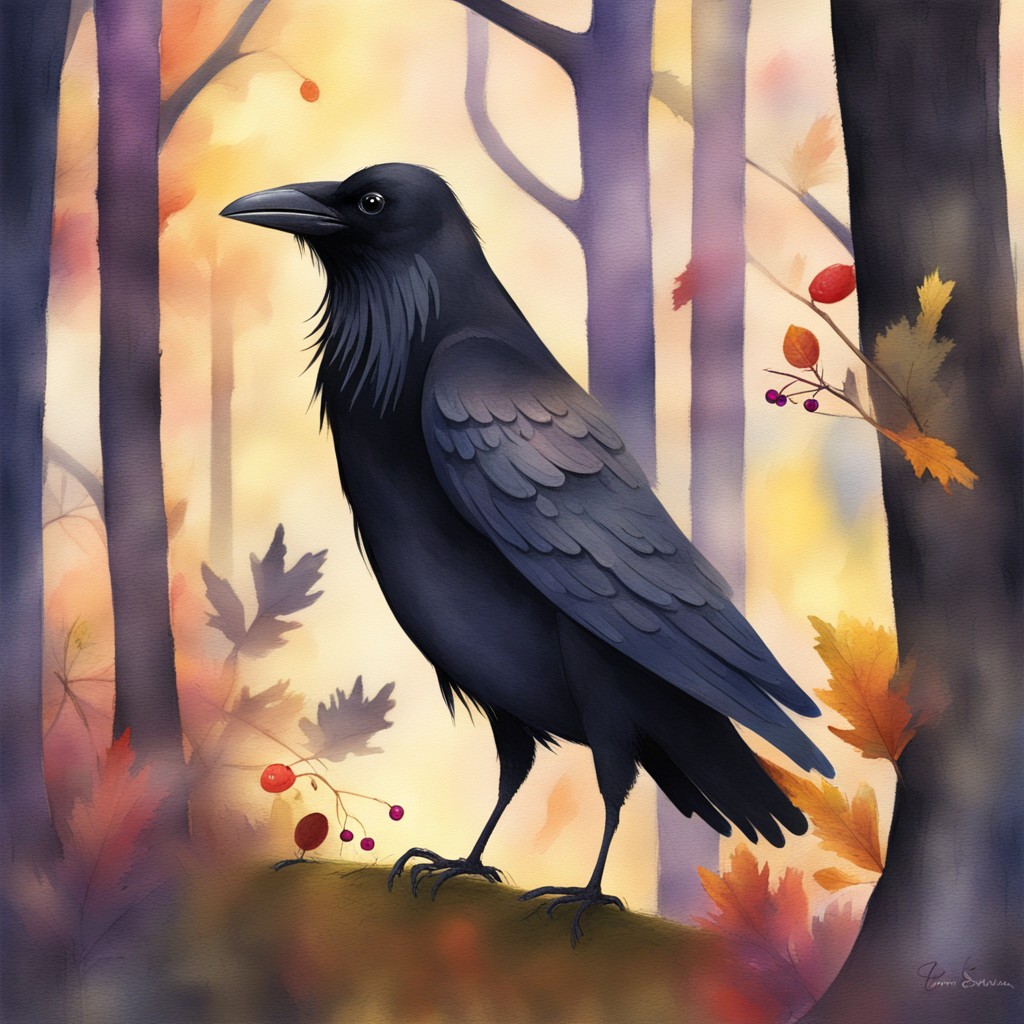
In the heart of Whisperwood Forest, where ancient oaks wore crowns of emerald moss and fireflies held their nightly lantern festivals, there lived a young crow named Corvin. Unlike his brothers and sisters, who were content to spend their days chasing beetles and squabbling over shiny trinkets, Corvin saw the world differently. Where others saw a muddy puddle, Corvin saw a mirror that could reflect the clouds. Where others saw a discarded eggshell, Corvin saw a boat that could sail across dewdrop seas.
"Stop daydreaming, Corvin!" his mother would caw, nudging him toward the food pile. "A crow's job is to find food, not to gawk at rainbows."
But Corvin couldn't help himself. He was fascinated by colors, shapes, and possibilities. He would spend hours arranging pebbles into spirals on the forest floor, or weaving wildflowers into the bark of trees to make them look like they were wearing festive coats. The other crows thought him peculiar, and the woodland creatures whispered that young Corvin had spent too much time pecking at mushrooms.
One crisp autumn morning, as golden leaves danced down from the canopy like nature's own confetti, a problem arrived in Whisperwood that no one knew how to solve. The great storm of the previous week had knocked loose a massive beehive from the oldest oak tree, and it had tumbled down to rest precariously on a ledge above the forest's only freshwater spring.
The bees were furious. Their home was tilted at a dangerous angle, dripping honey into the spring and making the water sticky and sweet. The deer couldn't drink without getting their noses coated in golden glue. The rabbits complained that their water tasted of flowers and made them sneeze. The fish in the spring's depths bobbed to the surface, confused by the sugary current.
The animals held an emergency meeting beneath the great willow tree. Elder Bramble, a badger who had seen forty winters, scratched his chin with a worried paw.
"We must move the hive," he declared. "But who among us can reach it without being stung?"
The deer were too tall and too afraid of the buzzing swarm. The rabbits were too small and too fast to maintain balance. The squirrels could climb, but the hive's position on the smooth rock face offered no branches to leap from. The owls could fly, but they were nocturnal hunters, and the bees were most active during the day.
Corvin watched from a branch above, his head tilted in that curious way he had. He noticed something no one else had: the hive wasn't just stuck—it was wedged between two rock outcroppings, with a narrow gap beneath it. He also noticed that the bees weren't angry at the animals; they were angry at their situation. They wanted their home restored, too.
"I have an idea," Corvin said, fluttering down to the council.
The animals turned. A few snickered. The squirrels exchanged glances. Elder Bramble raised a skeptical eyebrow.
"You, young crow?" the badger rumbled. "What can a bird who plays with pebbles possibly do about a beehive?"
"Sometimes," Corvin said, puffing out his chest, "the answer isn't about being the strongest or the bravest. Sometimes it's about seeing what others don't."
And with that, he flew off, leaving the council buzzing with curiosity nearly as loud as the displaced bees.
Corvin spent the rest of that morning gathering materials. He collected long, sturdy twigs from the hazelnut bushes—straight ones that could serve as rods. He picked wild blueberries and crushed them into a brilliant purple paste. He found discarded spider silk, strong and sticky, and wove it into thin ropes. He gathered bright petals: red from poppies, yellow from buttercups, and blue from cornflowers.
His siblings watched him with confusion as he worked at the forest's edge, painting the twigs with his berry paste and tying the petals along their lengths with spider silk.
"Have you lost your mind, brother?" asked his sister, Cora. "The council needs solutions, not decorations."
"These ARE the solution," Corvin chirped, dipping a twig into his berry paint and admiring the streak of purple it left on a stone. "You'll see."

By afternoon, Corvin had prepared twelve painted twigs, each one a different color, each one adorned with fluttering petals. He had also collected a hollow reed from the marsh and filled it with clover nectar he'd sipped from the meadow at dawn.
The animals had begun to disperse from the council, convinced that no solution would be found that day. But Corvin called them back with three sharp caws and a flourish of his dark wings.
"If you will gather around the spring," he announced, "I will show you how to save both the water and the bees. But I need your help."
Elder Bramble, grumbling but curious, led the animals back. The bees, sensing a crowd, buzzed more aggressively. Honey continued to drip, plip-plop, into the spring.
Corvin first approached the spring with his reed of clover nectar. He squeezed drops onto a flat stone near the hive's ledge. The sweet smell drifted upward, and the bees—confused but intrigued—began to investigate. One by one, they descended to taste the offering, leaving their post at the hive's entrance.
"Now!" Corvin called to the squirrels. "Your acorn shells—fill them with mud from the riverbank and bring them quickly!"
The squirrels, though bewildered, did as he asked. They scampered off and returned with tiny acorn-capfuls of wet clay. Corvin directed them to pack the mud beneath the hive's tilted edge, creating a gentle ramp.
"Why mud?" asked a young deer named Fawnleaf.
"Because," Corvin explained, placing another painted twig, "we're not going to lift the hive. We're going to slide it."
With the bees distracted by the nectar, Corvin and the squirrels placed the painted twigs beneath the hive like colorful rollers. The mud ramp gave the hive a path to travel, and the painted twigs—now slick with honey and berry paint—acted as wheels that would help the heavy hive roll smoothly across the rock.
"Everyone, on my count," Corvin commanded, feeling bolder than he ever had. "One... two... three!"
The animals pushed. The hive groaned. The painted twigs spun—purple, red, yellow, blue—creating a rainbow beneath the golden home. Slowly, beautifully, the hive rolled down the mud ramp and settled onto a broad, flat boulder beside the spring, perfectly level, perfectly safe.
The bees, returning from their nectar feast, found their home restored. The dripping stopped. The spring ran clear once more. And the painted twigs, crushed and sticky and glorious, lay scattered around the hive like a crown of colors.
The animals erupted in cheers. The deer stamped their hooves in applause. The rabbits thumped their joy. Even Elder Bramble's gruff face cracked into a smile.

But the best moment came when the queen bee herself, her golden body gleaming in the afternoon sun, emerged from the hive and hovered before Corvin. She didn't speak in words that others could hear, but Corvin understood her dance—a figure-eight of gratitude, a waggle of wonder. Then, from the hive's entrance, worker bees emerged carrying a perfect hexagon of honeycomb, which they presented to Corvin like a trophy.
"For the crow who thought differently," the queen's dance seemed to say.
That evening, as the sun set over Whisperwood and painted the sky in colors that reminded Corvin of his twigs, the animals gathered at the spring for a celebration. The deer drank clear water. The rabbits danced in the clover. The squirrels performed acrobatics through the treetops. And the bees? The bees hummed a contented song that sounded almost like music.
Elder Bramble approached Corvin, who was pecking thoughtfully at a pebble arrangement by the water's edge.
"Young crow," the badger said, his voice softer than before, "today you taught us all something important. We were so busy looking for the obvious answer—the strong arm, the sharp claw, the brave heart—that we forgot to look for the clever one."
Corvin tilted his head. "The hive was too heavy to lift," he said. "But it wasn't too heavy to roll. I just had to stop thinking about how crows usually solve problems and start thinking about how THIS problem wanted to be solved."
"That's creativity," Elder Bramble said, nodding sagely. "The ability to see not just what is, but what could be. To find the path that others miss because it doesn't look like a path at all."
From that day forward, Whisperwood Forest changed. The animals began to look at their problems differently. When the river flooded, the beavers didn't just build higher dams—they created channels that turned the flood into irrigation for the meadow. When winter came early, the deer didn't just search harder for hidden grass—they learned to peel bark from birch trees, discovering a sweet food no one had known was there. When the owl's favorite hunting tree fell, the birds didn't just find a new tree—they hollowed out the fallen trunk and created an underground burrow that stayed warm all winter.
And Corvin? Corvin became the forest's first Inventor. He created maps made of woven spider silk that showed where the sweetest berries grew. He built a sundial from stacked stones that helped nocturnal animals know when it was safe to venture out. He even taught the young crows to see the beauty in broken things—a cracked acorn could become a cup, a fallen leaf could become a blanket, a snapped twig could become a bridge for ants.
Years later, when Corvin was an old crow with silver feathers at his temples, a young chick asked him the question that every child asks every elder eventually: "How did you become so wise?"
Corvin looked at the chick—so eager, so full of questions, so much like himself—and smiled.
"I am not wise, little one," he said. "I am simply curious. I never stopped asking 'what if?' and 'why not?' The world is full of problems waiting for someone brave enough to see them differently. Creativity isn't a gift that some birds have and others don't. It's a muscle. The more you use it, the stronger it grows."
He hopped over to a patch of mud and, with one claw, drew a simple shape: a spiral, just like the ones he used to make as a child.
"Every problem is a puzzle," he said. "And every puzzle has a solution. But sometimes—" he dipped his claw in berry juice and added a splash of color to the spiral, "—the solution looks like art."
The young chick tilted her head, considering this. Then she hopped over to a pile of pebbles and began to arrange them in a pattern no crow had ever made before.
Corvin watched her, his old heart swelling with joy, and whispered to the wind: "There she goes. Another dreamer. Another world-changer. Just like the little crow who once painted the sky."
And above them, the stars began to twinkle—each one a distant sun, each one a reminder that the universe itself is the most creative thing of all, endlessly inventing new worlds, new stories, and new possibilities.
Moral: Creativity is not about being an artist or having special talents. It is about looking at problems with fresh eyes and being brave enough to try unusual solutions. The world is full of possibilities waiting for someone curious enough to discover them. Never be afraid to think differently—your unique perspective might be exactly what the world needs.