The Kitten Who Asked Why: A Story About Curiosity
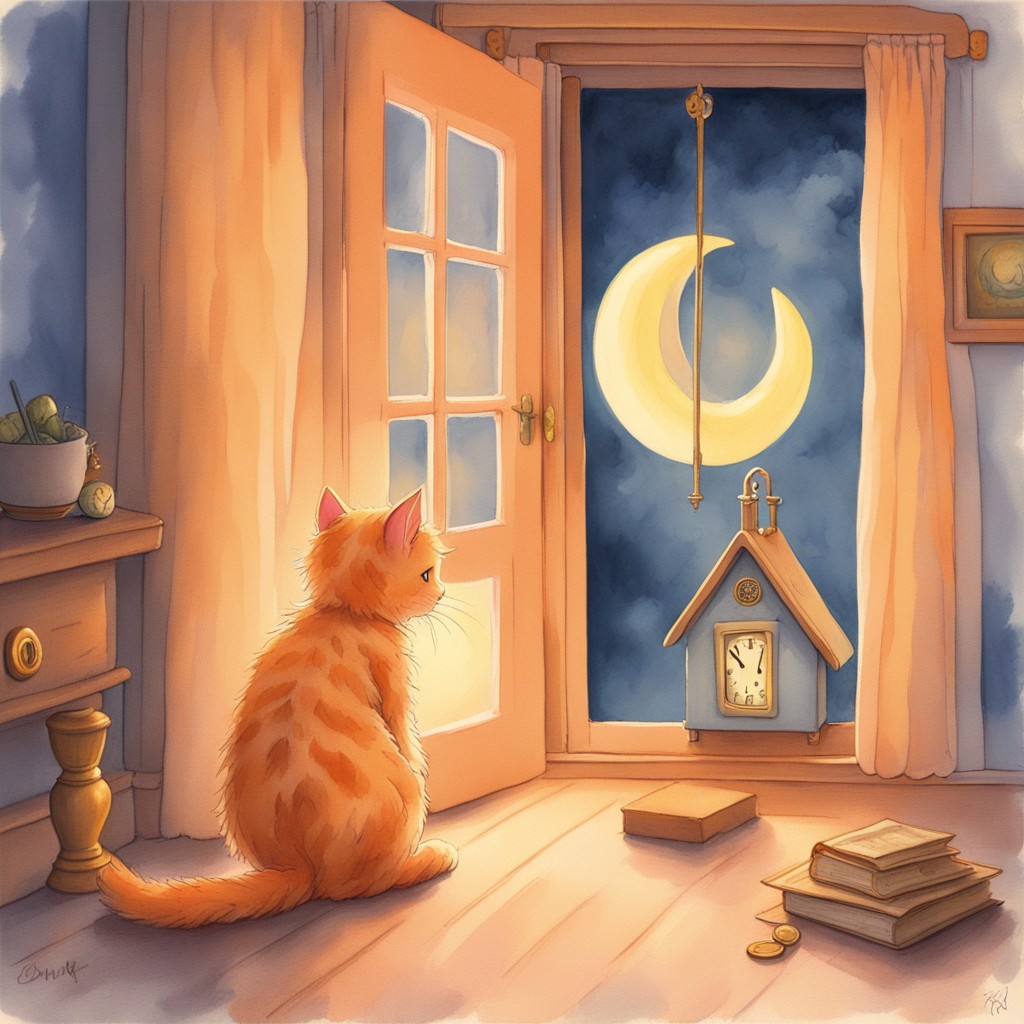
In a cozy little cottage at the edge of Willowbrook village, where morning sunlight poured through lace curtains like honey and the grandfather clock ticked a steady, comforting rhythm, there lived a small kitten named Whisk. She was not like other kittens. While her brothers and sisters were content to chase dust motes and nap in sunbeams, Whisk had questions. So many questions.
"Why does the clock tick?" she would ask her mother, tilting her head at the tall wooden timekeeper.
"It just does, dear," Mother Mittens would reply, licking Whisk between the ears.
"But WHY does it just do?" Whisk would press, her tiny tail flicking with frustration.
"Because that's what clocks do."
This answer never satisfied Whisk. She wanted to know the reason behind everything. She wanted to understand the world, not just live in it.
Whisk's siblings thought her strange. "Stop asking so many questions," her brother Paws would groan, batting at a ball of yarn. "Just play!"
But Whisk couldn't help herself. Every object in the cottage was a mystery waiting to be solved. The fireplace held flames that danced without music. The windows showed a world that changed colors from morning to night. The staircase creaked in spots that seemed to have no reason to creak. Even the kitchen held wonders: pots that sang when heated, spoons that stirred on their own in soup, and the great refrigerator—a magical cold box that kept milk perfectly chilled.
One rainy Tuesday morning, when the sky wept soft gray tears and the cottage smelled of cinnamon and old books, Whisk discovered something that would change everything.
She had been exploring the hallway, as she did every day, when she noticed a door she had never seen before. It was a small door, barely taller than Whisk herself, tucked behind the heavy velvet curtains in the sitting room. The paint was faded blue, and the brass handle was shaped like a tiny crescent moon.
"Where does this door go?" Whisk wondered aloud.
"Nowhere important," said her grandmother, Old Tabby, dozing by the fire. "It's just the storeroom. Full of dust and forgotten things."
But Whisk didn't believe that anything was "just" anything. Every room had a story. Every corner held a secret. And this door, hidden behind curtains, with a moon-shaped handle, was the most interesting thing she had ever seen.

She pushed the crescent handle with her paw. The door creaked open, revealing a narrow staircase that spiraled downward into darkness.
"Don't go down there," Old Tabby warned, one eye half-open. "It's dark, and dark places have answers you might not want."
Whisk considered this. But her curiosity was stronger than her fear. "How will I know if I don't look?" she whispered to herself. And with a deep breath and a flick of her whiskers, she padded down the stairs.
The staircase was older than the cottage itself. Whisk could feel it in the worn stone beneath her paws, in the damp air that smelled of earth and time. The walls were lined with shelves holding strange objects: glass jars filled with glowing powders, leather books with no titles, copper instruments whose purpose she couldn't guess, and tiny wooden boxes that seemed to hum when she passed them.
At the bottom of the stairs, Whisk found herself in a round room with walls covered in maps. Not maps of the village, or the country, or even the world. These were maps of questions. Each map showed a web of connected words: "Why is the sky blue?" connected to "Light and water," which connected to "Rainbows," which connected to "Prisms," which connected to "The sun." Every question led to another question, and every answer was just the beginning of a new journey.
In the center of the room sat an old wooden desk, and at the desk sat the most remarkable creature Whisk had ever seen. It was a cat, but unlike any cat in the village. Its fur was the color of midnight, but with starlight woven through it, so that it shimmered like the night sky. Its eyes were silver and ancient, holding the depth of a thousand answered questions.
"Ah," said the cat, not looking up from the map it was studying. "The little question-asker. I've been expecting you."
Whisk's fur stood on end. "You... you know me?"
"I know all the curious ones," the cat replied, finally meeting her gaze. "My name is Sage. I am the Keeper of Questions. And this—" it gestured to the room with a graceful sweep of its tail, "—is the Room of Whys."
Whisk approached the desk, her tiny paws making no sound on the stone floor. "What is the Room of Whys?"
Sage smiled, a slow, knowing smile. "It is where questions live before they find their answers. Every question ever asked by a child, a kitten, a bird, or a star begins here. And every answer, when found, returns here to connect with new questions."

"But is it okay to ask so many questions?" Whisk asked, her voice small. "Even when people say I shouldn't?"
Sage stood and walked to a map on the wall. It showed a tree, but instead of leaves, it had questions hanging from its branches like fruit.
"Consider this," Sage said. "Long ago, no cat knew why the sun warmed the earth. They just accepted the warmth. Then one kitten, much like you, asked 'Why does the sun shine?' That question led to understanding light. That understanding led to understanding fire. That understanding led to warm hearths in winter. One question changed the world for every cat who ever lived."
Whisk's eyes grew wide. "One question did all that?"
"One question always does all that," Sage said. "Questions are the seeds of discovery. Without them, the world stays small. With them, the world grows larger than anyone imagined."
Whisk spent the rest of the afternoon in the Room of Whys, exploring the maps with Sage. She learned that the sky was blue because light scattered through tiny water droplets. She learned that clocks ticked because gears measured the steady swing of a pendulum. She learned that stairs creaked because wood expanded and contracted with temperature, like the earth breathing.
Each answer led to three new questions, and Sage encouraged every one.
"The best answers," Sage explained, "are the ones that make you ask more. An answer that ends curiosity is a prison. An answer that expands it is a doorway."
As evening approached, Whisk knew she had to return upstairs. Her mother would be worried, and dinner would be waiting. But she didn't want to leave. The Room of Whys felt like home—more like home than the cottage above, in a strange way.
"Can I come back?" Whisk asked.
"The door is always open to those who seek it," Sage said. "But remember, little one: the Room of Whys is a wonderful place, but the real world is where questions matter most. Don't lose yourself in maps and answers. Go live. Go explore. Go ask the world directly. The breeze has secrets to tell. The river has stories to share. The stars have riddles older than time."
Whisk climbed the spiral stairs, her mind spinning with new knowledge and new questions. When she pushed open the blue door with the crescent handle, she found the sitting room bathed in golden sunset light. Old Tabby still dozed by the fire. Her siblings still chased yarn. Her mother still prepared dinner in the kitchen.
But everything looked different now.
The dust motes in the sunbeam weren't just dust—they were tiny worlds, full of mystery. The ticking clock wasn't just noise—it was the heartbeat of measured time. The creaky stairs weren't just old—they were breathing wood, expanding and contracting with the warmth of the day.
That night, as Whisk curled up in her basket by the hearth, her mother nuzzled her.
"Where did you go today, little one?" Mother Mittens asked softly.
"I found a room full of answers," Whisk said. "But it taught me that the most important thing isn't knowing. It's wondering."
Mother Mittens was quiet for a moment. Then she said, "When I was a kitten, I asked many questions too. But I stopped because others told me it was annoying. I forgot how beautiful wonder is. Maybe... maybe you can remind me."
From that day forward, Whisk became the village's most beloved question-asker. When the baker's bread didn't rise, Whisk asked if the yeast was cold—and solved the problem. When the weaver's thread kept breaking, Whisk asked if the humidity was too high—and solved the problem. When the mayor's garden wouldn't grow, Whisk asked if the soil was too sandy—and solved the problem.
She didn't always have the answers, but she always had the questions. And questions, she learned, were far more powerful than answers, because questions invited everyone to think together.

Years later, when Whisk was a grown cat with her own litter of kittens, one of her children—tiny and striped, with eyes full of stars—asked her the question that had started it all.
"Why does the clock tick, Mama?"
Whisk didn't say, "It just does."
Instead, she smiled and said, "That's a wonderful question. Shall we find out together?"
And they did. They explored the clock's workings, its gears and springs, its pendulum and weights. They learned about time and measurement, about engineering and design. And when they finished, the little striped kitten asked, "Why do we measure time at all?"
Whisk laughed, her heart full of joy. "That, my dear, is an even better question."
She led her kitten to the sitting room, pulled aside the velvet curtain, and showed her the blue door with the crescent moon handle.
"Behind this door," Whisk said, "is a room full of answers. But remember: the world itself is a bigger room, and every leaf, every raindrop, every star is an answer waiting to become a new question."
The little kitten pushed the crescent handle, just as Whisk had done so many years before. The door creaked open, and the spiral staircase waited below, full of mystery and wonder.
"Go on," Whisk whispered. "Ask the world. It loves a curious heart."
And the kitten went, tail high, whiskers twitching, ready to discover that every answer was just the beginning of a beautiful new question.
Moral: Curiosity is not annoying or childish—it is the spark that lights the fire of discovery. Never stop asking questions. The world is full of wonders waiting for someone brave enough to wonder about them. Every great inventor, every great thinker, every great dreamer started with a single question: "Why?" Your questions matter. Keep asking them.