The Girl Who Found the Silver Star: A Story About Honesty
The Girl Who Found the Silver Star: A Story About Honesty
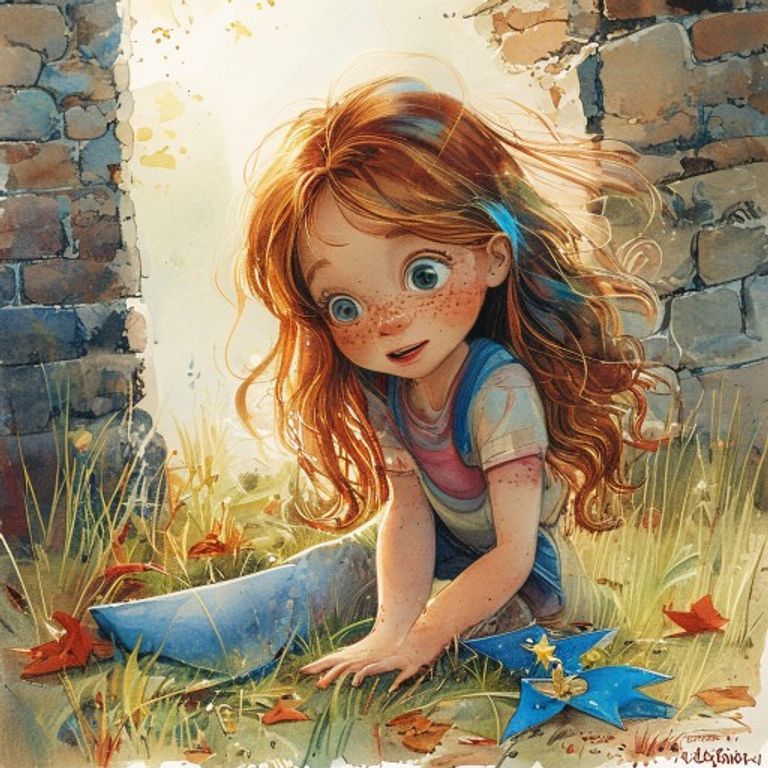
In the town of Maplebrook, where cobblestone streets wound between cottages with candy-colored doors and the bakery on the corner filled the morning air with the scent of cinnamon and warm bread, there lived a girl named Clara. She was nine years old, with freckles like scattered cinnamon across her nose and hair the color of autumn leaves that caught the sunlight in just the right way. Clara was not the fastest runner in her class, nor the loudest voice on the playground, but she had something rarer and more precious: she noticed things.
Clara noticed the way old Mr. Whitaker always paused by the rosebush on Elm Street to sniff the yellow blooms. She noticed how the school librarian, Mrs. Pemberley, arranged the books by the color of their spines when she was happy and by their subjects when she was worried. She noticed the tiny blue door at the base of the oak tree in the park—a door no one else seemed to see—and she noticed that the door was sometimes open a crack, and sometimes firmly shut.
But most of all, Clara noticed things that were lost.
A single mitten, dangling from a fence post like a lonely flag. A library card, half-buried in autumn leaves. A small brass key, glinting in the gutter after a rainstorm. Whenever Clara found something that did not belong, she did what her grandmother had taught her: she picked it up, she held it carefully, and she set about finding its home.
"Things have stories," Grandmother Rose had said, her hands warm and wrinkled around a cup of chamomile tea. "And when something is lost, its story is interrupted. It is our job, when we find it, to help the story continue."
Clara had nodded solemnly, though she was only five at the time. She understood. Stories were important. And lost things were stories waiting to be told.
One crisp October morning, as Clara walked to school beneath a sky so blue it looked painted, she noticed something shining in the grass beside the old stone wall that bordered the park. It was early, and the street was quiet. Dew still clung to the blades of grass, making them sparkle like a field of tiny diamonds.
Clara knelt down. She pushed aside a clump of clover. And there, half-hidden in the earth, was a star.
Not a real star, of course. The sky was far too bright for stars at this hour. This was a silver star, small enough to fit in the palm of her hand, with five perfect points and a surface so polished that Clara could see her own wide eyes reflected in its curves. It was attached to a faded blue ribbon, and on the back, engraved in letters so fine she had to squint to read them, were the words:
"For Bravery Beyond Measure."
Clara's breath caught. This was not a toy. This was not a coin or a key or a mitten. This was a medal. A medal for bravery. And someone had lost it.
She looked around. The street was still empty. The park was silent except for the chirp of sparrows and the distant clatter of the bakery's ovens firing up for the morning. There was no one to ask. No one to tell her where the star had come from or who it belonged to.
Clara slipped the medal into her pocket. It was cool against her palm, heavier than she expected, and she could feel the engraved letters pressing against her skin through the fabric. She would find its owner. She always did. But this time, something felt different. This time, the story felt bigger.

At school, Clara could not concentrate. During math, she traced the shape of the star on her desk with her finger instead of solving fractions. During reading, she stared out the window, imagining who might have worn the medal and what brave thing they had done to earn it. During lunch, she sat apart from her friends and turned the medal over and over in her hands, reading the engraving until she had it memorized.
"For Bravery Beyond Measure."
Who had been brave? Clara wondered. Had they saved someone from danger? Had they faced a fear that seemed impossible to overcome? Had they stood up for what was right, even when it was hard?
After school, Clara did not go straight home. She went to the library.
Mrs. Pemberley was at the front desk, arranging books by color. Clara smiled—Mrs. Pemberley must be having a good day.
"Hello, Clara," the librarian said, looking up. Her glasses were perched on the very tip of her nose, and her silver hair was pulled back in a bun that looked like a cinnamon roll. "You have that look. The lost-and-found look. What have you discovered this time?"
Clara placed the medal on the desk. It caught the afternoon light streaming through the tall windows and threw tiny rainbows across the polished wood.
Mrs. Pemberley's expression changed. She picked up the medal with both hands, as though it were made of glass instead of silver. Her eyes, behind her glasses, grew soft and far away.
"Oh, my dear," she whispered. "Oh, Clara. Do you know what this is?"
"A medal for bravery," Clara said. "But I don't know whose it is. I found it by the park wall this morning."
Mrs. Pemberley turned the medal over, her fingers tracing the engraving with a tenderness that made Clara's heart ache.
"This," she said softly, "belongs to Mr. Alden. He lives in the little cottage on Willow Lane, the one with the blue door and the garden full of sunflowers."
Clara knew the cottage. She passed it every day on her way to school. She had always admired the sunflowers, which grew so tall in summer that they seemed to be trying to touch the clouds.
"Mr. Alden was a firefighter," Mrs. Pemberley continued. "Forty years ago, before you were born, before your parents were born, there was a terrible fire at the old mill on the edge of town. The building was full of workers, and the flames spread faster than anyone could have imagined. Mr. Alden—he was young then, only twenty—ran into that burning building three times. Three times, Clara. He carried out six people. Six lives saved."
Clara's eyes were wide. "And he earned this medal?"
"He did." Mrs. Pemberley's voice was thick with emotion. "But more than that, Clara, he earned it for something else. On his third trip into the building, the roof began to collapse. A beam fell, and he pushed a young woman out of the way. The beam struck his leg. He nearly lost it. He walks with a cane now, and sometimes the pain is so bad he cannot sleep."
Clara thought of Mr. Alden. She had seen him sometimes, sitting on his porch, his cane beside him, watching the world go by with eyes that seemed to hold both sadness and warmth. She had never known his story. She had never asked.
"He wore this medal every day," Mrs. Pemberley said. "On his coat, on his lapel, on a ribbon around his neck for special occasions. It was his most precious possession. Not because of the silver, but because of what it represented. The bravery. The choice to help others, even when it cost him everything."
"Then why did he lose it?" Clara asked.
Mrs. Pemberley sighed. "Mr. Alden has been unwell lately. His memory is not what it was. Some days he remembers everything. Some days he forgets his own name. Last week, his niece came to visit and took him for a walk in the park. He must have dropped the medal then. He has been heartbroken ever since. He thinks he has lost his courage along with it."
Clara felt a lump form in her throat. She looked at the medal in Mrs. Pemberley's hands, this small piece of silver that held so much story, so much bravery, so much pain.
"I will take it to him," Clara said.
Mrs. Pemberley smiled, and there were tears in her eyes. "I thought you might say that."

The walk to Willow Lane felt longer than usual. Clara clutched the medal in her pocket, her fingers wrapped around the blue ribbon, and she rehearsed what she might say. Should she simply hand it over? Should she tell him what Mrs. Pemberley had told her? Should she say something about bravery, about courage, about how much his story meant to her?
When she reached the cottage, she saw Mr. Alden sitting on his porch, just as she had imagined. The sunflowers were mostly gone now, their heads bowed and brown with the coming winter, but a few late blooms still raised their golden faces to the sky. Mr. Alden was wrapped in a thick wool blanket, his cane across his lap, his eyes closed. He looked small and tired and very, very old.
Clara climbed the porch steps. They creaked beneath her feet, and Mr. Alden's eyes fluttered open.
"Hello?" he said, his voice thin and uncertain. "Who is there?"
"It's Clara, Mr. Alden. I live on Birch Street. I... I found something."
She held out the medal.
Mr. Alden stared at it. For a long moment, he did not move. Then, slowly, with trembling hands, he reached out and took it. His fingers closed around the silver star, and his eyes—those tired, uncertain eyes—filled with a light that Clara had never seen before.
"My star," he whispered. "My brave star. I thought... I thought I had lost it forever. I thought I had lost everything."
"You didn't lose your bravery," Clara said, and the words came out before she could stop them. "Mrs. Pemberley told me what you did. At the mill. How you saved those people. How you got hurt helping them. You didn't lose your bravery, Mr. Alden. You just... you just put it down for a little while."
Mr. Alden looked at her, really looked at her, and for the first time since Clara had known him, he smiled. Not a tired, polite smile, but a real one, warm and bright and full of life.
"You are a very special girl, Clara," he said. "Do you know that?"
Clara felt her cheeks grow warm. "I just... I just found something that didn't belong and brought it home. That's all."
"That is not all," Mr. Alden said firmly. He patted the bench beside him, and Clara sat down, her legs swinging. "You could have kept the medal. You could have sold it. You could have ignored it. But you didn't. You picked it up, you asked questions, and you brought it back. Do you know what that is?"
"Honesty?" Clara guessed.
"More than honesty," Mr. Alden said. "It is character. It is choosing to do what is right, even when no one is watching. Even when it would be easier to do what is wrong. That, Clara, is the truest kind of bravery. The bravery of an honest heart."
He pinned the medal to his blanket, right over his heart. "I am going to tell you a secret," he said. "A secret I have never told anyone. On the day of the fire, I was terrified. I was more scared than I had ever been in my life. Every step I took into that building, my legs shook. Every face I saw in the smoke, I thought would be the last. I was not brave, Clara. I was terrified."
"But you went in anyway," Clara said.
"I went in anyway," Mr. Alden agreed. "Because bravery is not the absence of fear. It is the choice to do what is right, even when you are afraid. Just like you, Clara. You were probably afraid to come here. Afraid of what I might say. Afraid I might not remember. But you came anyway. Because it was the right thing to do."
Clara thought about this. She had been a little afraid. But she had come anyway. And now, sitting on Mr. Alden's porch with the sunflowers nodding around them and the silver star gleaming on his blanket, she felt something she had never felt before. Not pride, exactly. Not happiness, exactly. Something deeper. Something that felt like the first warm day after a long winter.
"Will you come back?" Mr. Alden asked. "I have so many stories, and I would like to share them with someone who understands."
"I will come back," Clara promised. "Every week. And I will bring you cookies from the bakery. And I will listen to all your stories."
Mr. Alden laughed, and it was a sound like wind chimes in a summer breeze. "Then I am the luckiest old man in Maplebrook," he said. "For I have found my star, and I have found a friend. All in one day."
Clara walked home as the sun dipped below the horizon, painting the sky in strokes of rose and amber and gold. She thought about lost things and found things. She thought about bravery and honesty and the stories that connected them all. She thought about Mr. Alden's medal, now safe on his chest, and his stories, now waiting to be told.
And she thought about her grandmother's words: "Things have stories. And when something is lost, its story is interrupted. It is our job, when we find it, to help the story continue."
Clara smiled. She had helped a story continue today. Not just Mr. Alden's story, but her own. She had learned that honesty was not just about telling the truth. It was about doing the right thing, even when it was hard. It was about being brave enough to care, even when you were afraid.
As she turned onto Birch Street, she noticed something glinting in the gutter. A coin? A key? Another lost star?
She knelt down to look. It was a small glass marble, blue and swirling with white, like a tiny ocean trapped in a sphere. Someone's treasure. Someone's story.
Clara picked it up carefully, tucked it into her pocket beside her heart, and began to wonder whose story she would help continue tomorrow.
Moral of the Story: Honesty is not just about telling the truth. It is about choosing to do what is right, even when no one is watching and even when it would be easier to do what is wrong. When we find something that does not belong, returning it is an act of kindness that helps someone else's story continue. True bravery is not about being fearless—it is about doing the right thing even when we are afraid. And the smallest acts of honesty can lead to the greatest friendships, the deepest connections, and the most beautiful stories of all. So when you find something lost, remember: you are not just returning an object. You are returning a piece of someone's heart.
Age Range: 4-8 years | Reading Time: ~10 minutes | Core Value: Honesty