The Boy with the Magic Jar: A Story About Gratitude
The Boy with the Magic Jar: A Story About Gratitude
In a small village nestled between two gentle hills, where the river sang lullabies to the willows and the wind carried the scent of wild honeysuckle, there lived a boy named Milo. He was eight years old, with hair the color of wet sand and eyes the gray of river stones after rain. Milo lived in a tiny cottage at the edge of the village, just where the cobblestones turned to dirt and the gardens grew wild and free.
The cottage had only two rooms: one for sleeping and one for everything else. The roof leaked when it rained, and the chimney smoked when the wind blew wrong, and the floorboards creaked a song that Milo had learned to love. But Milo did not mind these things. He had learned, from his mother, that a house was not made of walls and roofs. A house was made of warmth and laughter and the smell of bread baking.
Milo's mother, Elara, was a weaver. She sat at her loom from dawn until dusk, her fingers dancing across the threads like birds across a morning sky. She wove scarves for the village folk, blankets for the babies, and tapestries that told stories of ancient forests and forgotten kings. For her work, she was paid in coins, in vegetables, in jars of honey, in promises.
But lately, there had been fewer coins. Fewer vegetables. The honey jars had stopped coming, and the promises felt thinner than spider silk. A sickness had swept through the village the previous winter, and many of the families who once bought Elara's weavings had left for the city, seeking doctors and fortune and hope.
Milo and his mother had very little. Very, very little.
Their cupboard held a small sack of flour, half a wheel of cheese, three apples that were beginning to soften, and a jar of dried herbs. Their fire burned only in the evenings, when the cold became too sharp to bear. Their clothes were mended so many times that the original fabric was hard to find beneath the patches.
But every evening, as the sun bled into the hills and the stars began to prick the darkening sky, Elara would sit by the fire with Milo on her lap, and she would say: "Tell me three good things."
Milo would think. He would look around the small room, at the cracks in the walls and the threadbare rug and the empty shelves, and he would find three good things.
"The fire is warm," he might say. "Your hand is holding mine. And today I saw a fox with fur redder than sunset."
And Elara would smile, and the room would feel warmer, and the cracks in the walls would seem smaller, and the empty shelves would feel less empty.
"Gratitude," Elara would whisper, "is magic, Milo. Not the magic of wands and spells. The magic of seeing. Of noticing. Of knowing that even when we have very little, we always have something worth holding."
One morning, as autumn painted the hills in strokes of amber and rust, Milo went to the river to fetch water. The village well had dried up in the summer heat, and the river was a walk of twenty minutes through the birch wood. Milo did not mind the walk. The birch wood was his friend. He knew which trees had the sweetest sap, which hollows hid sleeping rabbits, which patches of moss were softest for resting.
As he knelt by the river, filling his wooden buckets, he noticed something glinting in the shallow water. It was small and round and caught the morning light like a captured star. Milo reached into the cold water and pulled it out.
It was a jar.
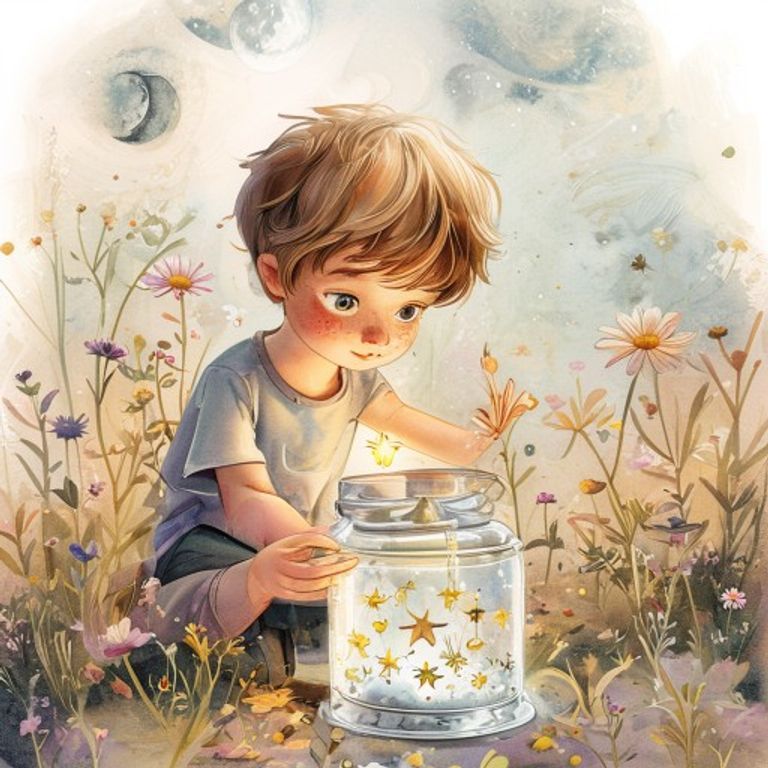
Not just any jar. It was the most beautiful jar Milo had ever seen. It was made of glass so clear it seemed invisible, with a lid of polished silver carved with tiny stars and moons and swirling galaxies. It fit perfectly in his small hands, and when he held it up to the light, the glass threw rainbows across his palms.
But it was empty.
Milo turned it over. He shook it. He held it to his ear. Nothing. Just a beautiful, empty jar.
He took it home and showed his mother. Elara turned it over in her hands, marveling at its beauty, at the craftsmanship, at the way the light danced through it.
"It is lovely," she said. "But what will we do with an empty jar, my little bird? We have nothing to fill it with."
Milo thought about this. He sat by the window, holding the jar, watching the afternoon light make patterns on the floor. And then, slowly, an idea began to form. Not a big idea. Not a grand idea. Just a small, warm idea, like a candle flame in a dark room.
He went outside. He walked to the edge of the garden, where the wildflowers grew in tangles of violet and gold and white. He knelt down. He picked a single daisy, its petals still fresh with morning dew, and he placed it carefully in the jar.
The jar began to glow.
Not brightly. Not dramatically. Just a soft, warm glow, like the first light of dawn. The daisy seemed to shine from within, its white petals luminous, its yellow center a tiny sun.
Milo stared. He blinked. He rubbed his eyes. But the glow remained, gentle and real and impossibly beautiful.
He ran inside. "Mama! Mama, look!"
Elara looked. Her eyes grew wide. She touched the jar with trembling fingers, and the warmth of it spread into her skin like summer sunlight.
"What is it?" Milo asked.
"I do not know," Elara whispered. "But it feels... it feels like happiness. Like the happiness you feel when you find something beautiful and you did not expect to."
Milo looked at the daisy in the jar. It was just a daisy. He had seen thousands of daisies. But this one, glowing softly in its glass home, felt different. It felt precious.
"Gratitude," Milo said slowly. "It feels like gratitude."

Over the next week, Milo filled the jar with small things. A smooth river stone that fit perfectly in his palm. A feather from a blue jay, striped like the sky. A leaf that had turned the exact color of a pumpkin. A piece of honeycomb given by the beekeeper's daughter. A drawing his mother had made of a horse, its mane wild and free.
Each thing he placed in the jar began to glow. Not all with the same light. The stone glowed a steady, earthy brown. The feather shimmered with blues and greens. The leaf burned with autumn orange. The honeycomb radiated a warm, golden light that smelled faintly of summer flowers.
And as the jar filled, something奇妙 began to happen.
Milo began to see things differently. The leaky roof was not just a leaky roof anymore. It was a roof that let him hear the rain's music. The threadbare rug was not just threadbare. It was a rug that had warmed generations of feet. The empty shelves were not just empty. They were shelves waiting for stories.
He began to notice things he had never noticed before. The way the morning light turned the dust motes into dancing stars. The way his mother's voice sounded when she hummed while she wove—like a lullaby and a promise all at once. The way the old cat from the neighbor's barn would come to sit on his windowsill every afternoon, purring loud enough to shake the glass.
Milo began to say thank you. Not just to his mother, though he said that often, wrapping his arms around her waist and burying his face in her skirt. He said thank you to the river, for its cool, clear water. He said thank you to the birch trees, for their shade and their secrets. He said thank you to the sun, for rising each morning without fail. He said thank you to the stars, for keeping watch while he slept.
And the jar grew brighter.
The villagers began to notice. They saw Milo walking through the streets, carrying his glowing jar, and they wondered. The baker, whose bread had been selling poorly, asked Milo about it one morning.
"What is in the jar, young Milo?"
"Things I am grateful for," Milo said simply.
The baker looked at the jar. He saw the feather, the stone, the leaf, the honeycomb, the drawing. Small things. Ordinary things. Things he would have walked past a thousand times without seeing.
"And they... glow?"
"Only when you are truly grateful for them," Milo said. "Not just saying thank you. But feeling it. Here." He touched his chest, right over his heart.
The baker thought about this. He went home. He looked at his bakery, which had seemed so empty, so failing, so hopeless. But now, with Milo's words in his ears, he saw it differently. He saw the ovens that still worked, warming the room with their heat. He saw the flour, still white and fine. He saw the smell of yeast and sugar, still hanging in the air like a promise.
He picked up a single loaf of bread. It was not perfect. It was a little lopsided, a little dark on one side. But it was bread. Real bread. Bread he had made with his own hands.
He held it to his chest. He felt gratitude, warm and unexpected, spread through him like honey in tea.
The next morning, the baker gave a loaf of bread to Milo and his mother. Not as payment. Not as charity. But as a thank you. Because Milo had taught him something he had forgotten: that even when you have very little, you always have enough to be grateful for.

Word spread. The village seamstress, who had been mourning the loss of her best needles, found gratitude for the ones she still had. The blacksmith, whose forge had grown cold, found gratitude for the strength in his arms. The schoolteacher, whose students had dwindled to four, found gratitude for the four bright minds still eager to learn.
One by one, the villagers began to change. Not because they had more. But because they saw more. They saw the good in what they had, instead of mourning what they had lost. They saw the beauty in the ordinary, instead of waiting for the extraordinary.
And slowly, like a garden after rain, the village began to bloom.
The baker began making bread again, and the smell drew travelers from the road. The seamstress began sewing again, and her work became famous for its care and detail. The blacksmith began forging again, and his tools were soon in demand in three neighboring towns. The schoolteacher began teaching with joy again, and her four students learned so well that they became teachers themselves.
Elara's weaving business returned. Not all at once. Not dramatically. But steadily. A scarf here. A blanket there. A tapestry for the mayor's new office. Each piece she wove was infused with a new quality—a warmth, a lightness, a glow—that people could not quite name but could certainly feel.
"What has changed?" a customer asked one day, holding a scarf that seemed to shimmer in the light.
Elara smiled. "Gratitude," she said. "My son taught me that when you weave gratitude into your work, the work itself becomes grateful. It gives back more than you put in."
As for Milo, he kept his jar. It sat on the windowsill of their cottage, glowing softly day and night, filled with treasures that no one else would have valued but that meant the world to him. The daisy, now dried but still luminous. The stone, still warm. The feather, still shimmering. And new things, added slowly, carefully, with love.
A button from his mother's favorite dress. A shell from the riverbank. A ticket from the village fair, saved from the first happy day they had had in months. A pressed four-leaf clover, found by accident and cherished forever.
The jar never stopped glowing. Not because Milo had more than he needed. He still had very little, compared to some. The roof still leaked. The chimney still smoked. The floorboards still creaked.
But Milo had learned the secret that the jar had taught him: gratitude is not about having everything. It is about seeing everything. It is about knowing that a single daisy, held with thankfulness, shines brighter than a diamond held with indifference.
One evening, as winter approached and the first snow began to fall, Milo sat by the fire with his mother. The jar glowed on the windowsill, casting dancing shadows across the walls. The room was warm. The bread was fresh. The cat purred on the rug.
"Tell me three good things," Elara said, just as she had every evening for as long as Milo could remember.
Milo looked around the small room. He looked at the cracks in the walls, which let in threads of silver moonlight. He looked at the threadbare rug, which held the warmth of the fire. He looked at the empty shelves, which had room for tomorrow's stories.
"The snow is falling," he said. "Your hand is holding mine. And I have a jar full of light."
Elara smiled, and the room felt warmer, and the cracks in the walls seemed smaller, and the empty shelves felt less empty. She pulled Milo close and whispered, "You are my greatest gratitude, little light. You are the thing I am most thankful for, today and always."
And outside, in the falling snow, the village of Maplebrook glowed softly, each window a small light of its own, each heart a little warmer, each soul a little fuller.
Because one boy, with very little, had learned to see the magic in what he had. And in doing so, he had taught everyone around him to see it too.
Moral of the Story: Gratitude is not about having everything you want. It is about seeing the value in what you already have. A warm hand to hold. A roof that keeps out the rain. A single flower in a field of grass. When we practice gratitude, even the smallest things begin to glow with beauty and meaning. Gratitude does not change what we have—it changes how we see. And when we see with grateful eyes, the whole world becomes brighter. So look around you. Find three good things. Hold them in your heart. And watch how the light grows.
Age Range: 4-8 years | Reading Time: ~10 minutes | Core Value: Gratitude