The Garden of Two Hearts: A Story About Friendship
The Garden of Two Hearts: A Story About Friendship
In the town of Maplebrook, where the streets were lined with trees that turned gold and crimson in autumn, and the river ran slow and silver through the valley, there was a school called Willow Creek Elementary. It was an old building, made of red brick and tall windows, with a playground that had seen a thousand games of tag and a library that smelled like vanilla and old paper.
On the first day of third grade, two children sat in the very back of Mrs. Meadow's classroom, as far apart as the room allowed. One was a boy named Samir, who had just moved to Maplebrook from a city across the ocean. He had dark skin like polished ebony, eyes that sparkled with curiosity, and hair that his mother braided each morning in intricate patterns. He wore a blue shirt with a pattern of tiny stars, and he carried a lunchbox with food that smelled of spices no one in the class could name.
The other was a girl named Lila, who had lived in Maplebrook her whole life. She had pale skin with freckles like scattered cinnamon, red hair that curled wildly no matter how many bows her mother used, and eyes the color of spring leaves. She wore overalls with patches on the knees and sneakers that had drawn-on stars because she liked the night sky.
Samir sat alone because he did not know anyone. Lila sat alone because she was shy, and the friends she had in second grade had been moved to other classrooms.
Mrs. Meadow, who had taught for twenty years and knew the language of lonely children, paired them together for a project. "We are going to plant a garden," she announced. "Each pair will get a plot of soil behind the school. You will choose what to plant, care for it together, and present your garden at the end of the semester."
Samir and Lila looked at each other. Samir's eyes were wary. Lila's were uncertain. But Mrs. Meadow's smile was warm, and the idea of a garden—of dirt and seeds and growing things—was too interesting to resist.
"I know about plants," Lila said, her voice barely above a whisper. "My grandmother has a garden. She taught me about soil and sun and water."
"I know about spices," Samir said, his voice polite but cautious. "My mother grows herbs in pots on our balcony. Basil, mint, cilantro. She uses them in our food."
"Herbs!" Lila's eyes lit up. "We could grow an herb garden! And flowers too. My grandmother says herbs and flowers help each other grow."
Samir smiled, a small, surprised smile. "That sounds... nice."
And so their friendship began, not with words, but with dirt.
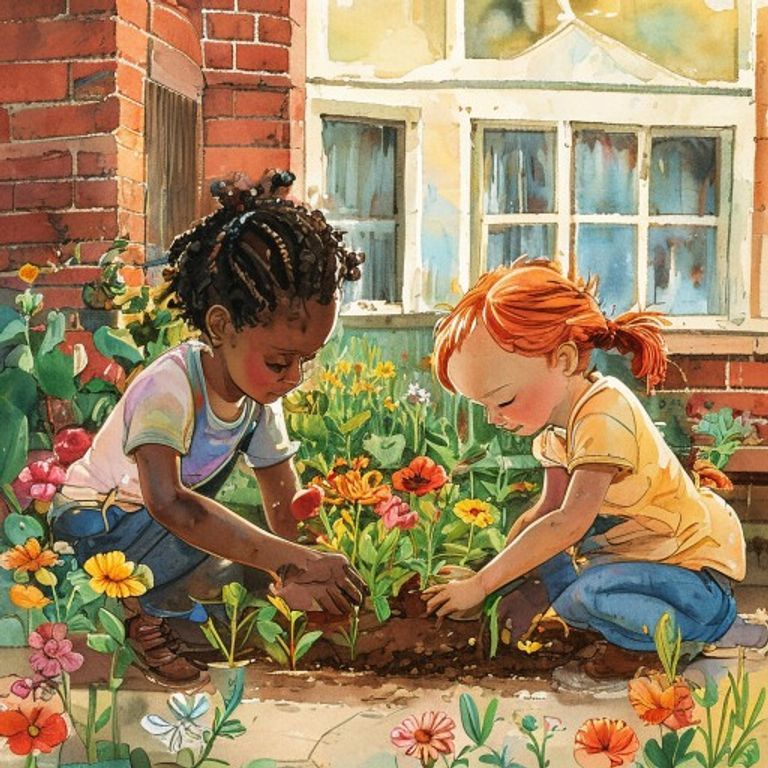
They met after school, twice a week, at their plot behind the gymnasium. It was a small rectangle of earth, bordered by wooden planks, filled with soil that was dry and gray and needed love.
Lila brought seeds from her grandmother: marigolds, zinnias, cosmos. Samir brought cuttings from his mother's balcony: basil, mint, a tiny thyme plant. They worked together, Lila turning the soil with a trowel, Samir watering with a can that had a rose-shaped spout.
At first, they were careful with each other. Polite. They talked about plants, about weather, about school. They did not talk about themselves. They did not share secrets. They did not laugh.
But friendship, like a garden, cannot grow in carefulness. It needs risk. It needs trust. It needs the courage to be vulnerable.
One afternoon, as they weeded their plot, Samir said something unexpected. "I miss my old home."
Lila looked up. She had never heard him mention his old home before. "Where did you live?"
"Across the ocean. In a city with tall buildings and narrow streets. The food was different. The language was different. The air smelled different." He paused, his fingers in the dirt. "Here, everything is new. And some of the children... they look at me strangely. They do not understand my food. They do not understand my hair. They do not understand me."
Lila was quiet for a long moment. Then she said, "I know what that feels like. Not exactly. I have never moved. But I am shy. And sometimes, even when people are nice, I feel like they do not see me. Like they see the quiet girl, the strange hair, the patched clothes. Not Lila."
Samir looked at her, really looked at her, for the first time. "I see you," he said. "I see that you know how to make soil come alive. I see that you care about worms. I see that you draw stars on your shoes because you love the night sky. I see you, Lila."

Lila felt her eyes sting. "I see you too," she said. "I see that you are brave to start over in a new place. I see that you love your mother's food. I see that you are kind to insects. I see you, Samir."
They smiled at each other, and something shifted. The carefulness fell away, like a seed coat splitting open, and something green and tender emerged.
From that day on, their friendship grew.
They shared lunches. Samir brought Lila spiced rice wrapped in warm bread, and Lila brought Samir her grandmother's honey cookies. They traded stories: Samir told Lila about the marketplace in his old city, where vendors sold colorful spices in pyramids; Lila told Samir about the meteor shower she had watched with her father, how the stars had fallen like silver rain.
They laughed together. Samir laughed at Lila's impression of their teacher's voice. Lila laughed at Samir's attempts to catch grasshoppers, which always ended with the grasshopper escaping and Samir falling backward into the lettuce.
They helped each other. When Samir struggled with English spelling, Lila quizzed him with flashcards. When Lila was afraid to speak in class, Samir sat beside her and squeezed her hand, a silent promise that she was not alone.
But friendship, like a garden, is not always easy. Sometimes there are storms.
One day, a group of older children teased Samir at recess. They made fun of his braids, his lunch, his accent. Samir stood very still, his hands in fists, his eyes on the ground. He did not fight back. He did not speak. He just... endured.
Lila saw. Her heart pounded. She was shy. She was small. She was afraid of the older children. But Samir was her friend. And friends do not let friends stand alone.
She walked over. She stood beside Samir. She did not say anything at first. She just stood there, her shoulder touching his, her presence a shield.
"What do you want, freckle-face?" one of the older children sneered.
Lila took a deep breath. "I want you to leave my friend alone," she said, her voice trembling but clear. "He is kind. He is brave. He is the best gardener in the school. And you are being mean because you do not understand him. That is not his fault. That is yours."
The older children blinked, surprised by the small girl's courage. They muttered and walked away, not because they were sorry, but because they were embarrassed.

Samir turned to Lila, his eyes wide. "You stood up for me."
"You are my friend," Lila said simply. "That is what friends do."
Samir hugged her, a fierce, grateful hug. And Lila, who had been so shy, who had been so afraid, hugged him back. Because friendship had made her brave.
The garden grew. The marigolds bloomed in bursts of orange and gold. The zinnias reached toward the sky in shades of pink and purple. The basil grew thick and fragrant, and Mrs. Meadow used it in the school cafeteria's pasta sauce. The cosmos swayed in the breeze like dancers, and bees came to visit, humming their busy songs.
But the best thing in the garden was not the flowers. It was the friendship that had grown alongside them.
At the end of the semester, each pair presented their garden to the class. Samir and Lila stood together, their hands touching, their smiles bright.
"This is our garden," Samir said. "But it is more than plants. It is a place where two people who were different became friends. Where two people who were alone became together. Where two hearts learned that friendship is not about being the same. It is about caring for each other, even when you are different. Especially when you are different."
"A garden needs sun and water and soil," Lila added. "But a friendship needs something else. It needs trust. It needs kindness. It needs the courage to stand up for each other. And it needs time. Like these flowers, friendship does not bloom in a day. It grows slowly, carefully, with patience and love."
The class applauded. Mrs. Meadow wiped her eyes. And Samir and Lila looked at their garden—not just the flowers and herbs, but the friendship that had grown in the dirt and the sun and the shared moments—and they knew that they had created something beautiful.
Years later, when they were grown, Samir became a botanist who traveled the world studying plants. Lila became an astronomer who searched the night sky for new stars. They lived in different cities, on different continents, but they never lost touch.
They wrote letters. They sent seeds and star maps. They visited each other, walking through gardens and gazing at the sky, talking about everything and nothing, their friendship as comfortable and warm as a well-worn blanket.
And on the wall of Samir's laboratory hung a photograph: two children, one with dark skin and braids, one with pale skin and freckles, standing in a small garden behind an old brick school, their hands dirty, their smiles wide, their hearts full.
The caption, written in Lila's handwriting, said: "The Garden of Two Hearts. Where friendship grew."
Moral of the Story: Friendship is one of the most precious gifts in the world. It is not about finding someone exactly like you. It is about finding someone who sees you, understands you, and stands by you, even when you are different. Samir and Lila came from different places, looked different, ate different food, and had different dreams. But they shared something more important: kindness, curiosity, and the courage to care. A true friend is someone who makes you feel less alone. Someone who helps you grow. Someone who stands beside you, not because they have to, but because they choose to. So be a good friend. Listen. Share. Stand up for each other. And remember that the best friendships, like the best gardens, are built with patience, trust, and love.
Age Range: 4-8 years | Reading Time: ~10 minutes | Core Value: Friendship