The Wallet on the Park Bench: A Story About Integrity
The Wallet on the Park Bench: A Story About Integrity
In the city of Silverbrook, where the buildings reached toward the clouds like fingers grasping at the sky, and the streets hummed with the constant music of cars and footsteps and distant sirens, there lived a boy named Theo. He was eight years old, small for his age, with hair the color of autumn wheat and eyes the gray of a stormy afternoon. He lived in a modest apartment with his mother, who worked long hours at a bakery, and his little sister, who was four and believed that every puddle was a portal to another world.
Theo understood things that many children his age did not. He understood that money was scarce. He understood that his mother's hands were always flour-dusted and always tired. He understood that the shoes he wore were two sizes too small, but new shoes cost money, and money was for rent and food and keeping the lights on.
But Theo also understood something else, something deeper. He understood that doing the right thing was not always easy, but it was always right.
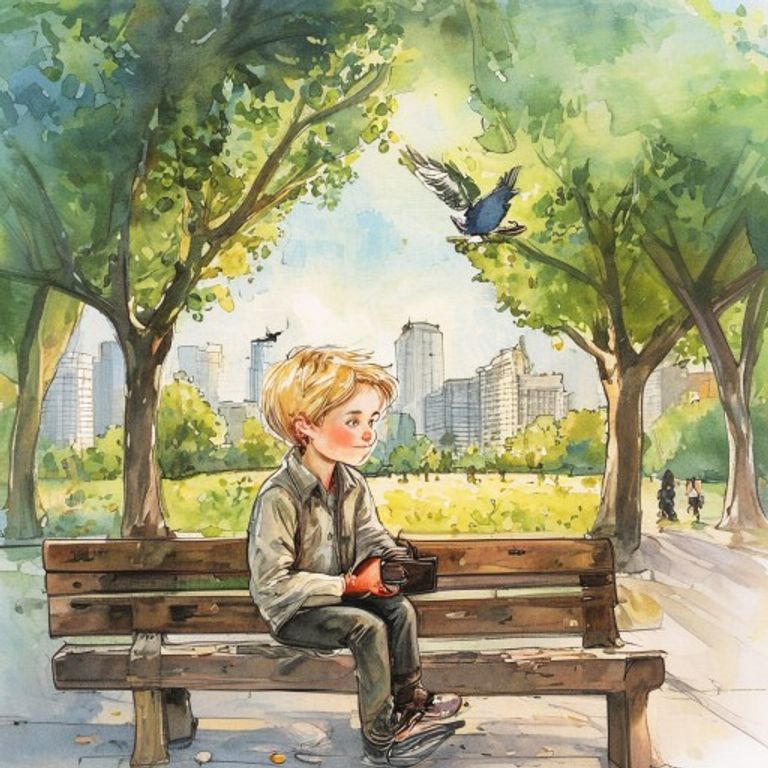
One Saturday morning, when the city was waking up and the bakeries were filling the air with the smell of warm bread, Theo walked through Silverbrook Park on his way to the library. It was early, barely past dawn, and the park was quiet. The benches were empty. The fountain was still. The pigeons huddled together like gray feathers, waiting for the day to begin.
And on one of the benches, near the old oak tree with roots that buckled the pavement, Theo saw something.
A wallet. Black leather, worn at the edges, bulging slightly.
Theo stopped. He looked around. No one was there. The bench was empty. The path was clear. The wallet was alone, abandoned, waiting.
He picked it up. It was heavier than he expected. He opened it, his hands trembling slightly, and what he saw took his breath away.
Money. More money than he had ever seen in one place. Bills of all sizes, crisp and green, folded neatly. And cards—credit cards, identification cards, a library card, a photograph of a smiling family.
Theo's heart raced. With this money, his mother could rest. She could buy new shoes for him and his sister. She could pay the rent without worry. She could buy something for herself, something she never did.
No one would know. The park was empty. There were no cameras here, no witnesses. He could take the money, leave the wallet, and walk away. He could help his family. He could make his mother's life easier. Just this once.
Theo sat on the bench, the wallet in his lap, and he thought.
He thought about the photograph. The smiling man with kind eyes. The woman beside him, laughing. The two children in front, a boy and a girl, making silly faces at the camera. They looked happy. They looked like a family.

He thought about the identification card. The man's name was Mr. Harold Chen. He lived on Oak Street, three blocks away. He was someone's father. Someone's husband. Someone's son.
He thought about his mother. She worked fourteen-hour shifts at the bakery, her back aching, her feet swollen, her hands cracked from the heat of the ovens. And she never complained. She never stole. She never took what was not hers. She worked hard, she saved carefully, and she taught Theo that character was not what you had, but what you did.
"Theo," she had said once, when he was very small and had found a coin on the sidewalk, "if something does not belong to you, you do not keep it. Even if no one is watching. Especially if no one is watching. Because the person who sees you when you are alone is the person you really are."
Theo held the wallet tight. He felt the weight of the money. He felt the pull of need. And he felt something else, something stronger: the certainty that taking this wallet would make him someone he did not want to be.
He stood up. He tucked the wallet into his jacket pocket. And he walked to Oak Street.
It was a quiet street, lined with maple trees that formed a canopy of green and gold. Theo found the house—a small brick home with a garden of wildflowers and a mailbox shaped like a birdhouse. He knocked on the door, his heart pounding, his palms sweating.
A woman answered. She was older than Theo's mother, with gray streaks in her hair and worry lines around her eyes. "Yes?" she said, her voice tired.
"I... I found something," Theo said. He pulled the wallet from his pocket and held it out. "In the park. On a bench. I think it belongs to Mr. Chen."
The woman's eyes went wide. She took the wallet with shaking hands. "Harold!" she called over her shoulder. "Harold, come here!"
A man appeared behind her—the man from the photograph, but older, more tired, his smile faded by stress. He saw the wallet, and his face transformed. Relief flooded his features like sunlight breaking through clouds.
"My wallet," he breathed. "I thought it was gone. I thought... I went to the park yesterday evening. I must have dropped it. I have been looking everywhere."
He opened it, checking the contents. The money was still there. The cards were still there. Everything was still there.
"You did not take anything," Mr. Chen said, his voice filled with wonder. "You found a wallet full of money, and you brought it back. All of it."
"It was not mine," Theo said simply. "It belonged to you."

Mr. Chen knelt down, bringing himself to Theo's level. His eyes were moist. "Do you know what this money was for?" he asked. "It was for my daughter's medicine. She is sick. She needs special treatment. The insurance does not cover everything. I had been saving for months, and yesterday I finally had enough. I was taking it to the pharmacy when I stopped in the park to rest. I must have fallen asleep. When I woke up, the wallet was gone."
He took a deep breath, his voice trembling. "If you had not returned this, Theo... I do not know what I would have done. My daughter might not have gotten her medicine. You did not just return a wallet. You saved my daughter's health. You saved my family."
Theo felt tears in his own eyes. "I am glad I could help," he said. "My mother says that doing the right thing is never wrong. Even when it is hard."
Mr. Chen smiled, a real smile, warm and grateful. "Your mother is a wise woman. And she has raised a wise son."
He reached into the wallet and pulled out a bill. "Please, Theo. Let me give you something. A reward. For your honesty, your integrity, your kindness."
Theo shook his head. "I cannot take it. I did not do this for a reward. I did it because it was right."
Mr. Chen looked at him for a long moment, his eyes searching Theo's face. Then he nodded, understanding. "I see. You have integrity, young man. True integrity. Not the kind that seeks praise. The kind that simply does what is right, because it is right."
He put the money away. But he did not let Theo leave empty-handed. "Wait here," he said.
He disappeared into the house and returned a moment later with a box. Inside were shoes. New shoes, sturdy and comfortable, the right size. "My son outgrew these last month," Mr. Chen said. "They are practically new. I was going to donate them. But I think they belong with someone who deserves them."
Theo looked at the shoes. They were beautiful. Clean, whole, with laces that were not frayed. They were exactly what he needed.
"Thank you," Theo whispered, his voice thick with emotion.
"No, Theo. Thank you. You reminded me that there is goodness in the world. That there are people who do the right thing, even when no one is watching. That integrity still exists."
Theo walked home that morning wearing his new shoes. They felt strange at first—too big, too clean, too new. But they also felt right. Like they belonged to someone who had made a good choice.
When he told his mother what had happened, she hugged him tight, her flour-dusted hands gentle in his hair. "I am proud of you," she said. "Not because you returned the wallet. But because you chose to be the person I always knew you were."
Theo smiled. "You taught me that, Mom. You taught me that integrity is not about what you have. It is about what you do when no one is watching."
His mother kissed his forehead. "And you listened. That is the greatest gift any parent could ask for."
Moral of the Story: Integrity means doing the right thing, even when no one is watching. Even when it is hard. Even when you could get away with doing wrong. Theo found a wallet full of money at a time when his family desperately needed it. No one would have known if he had kept it. But he knew. And he chose to return it, because taking what was not his would have made him someone he did not want to be. Integrity is not about being perfect. It is about being honest. It is about being true to yourself, even when no one else sees. Because the person you are when you are alone is the person you really are. So choose wisely. Choose kindness. Choose honesty. Choose integrity. Even when it is hard. Especially when it is hard. That is how you build a life you can be proud of.
Age Range: 4-8 years | Reading Time: ~10 minutes | Core Value: Integrity