The Boy Who Would Not Fall: A Story About Determination
The Boy Who Would Not Fall: A Story About Determination
In the town of Ironhaven, where the smoke from the forges rose like gray feathers into the sky and the streets rang with the hammer-song of a thousand metalsmiths, there lived a boy named Finn who wanted to fly.
Not in the way that birds fly, though he watched the sparrows with longing. Not in the way that dreams fly, though his dreams were full of clouds. Finn wanted to build a machine that would carry him into the air, a machine of gears and wings and springs, a machine that would prove what everyone in Ironhaven had told him was impossible.
"People cannot fly," said his father, a blacksmith whose hands were harder than the iron he shaped. "The ground is where we belong. The sky is for birds and angels, and you are neither."
"It is a foolish dream," said his mother, a weaver whose threads were strong enough to hold a bridge. "Dreams should be practical. Dreams should feed you. Dreams should keep you warm in winter. A dream of flying does none of these things."
"You are a strange boy," said his teacher, a man who had never had a dream that did not fit neatly on a page. "The other boys dream of becoming smiths, like their fathers. Or merchants, like their uncles. Or soldiers, like the heroes in stories. But you dream of the impossible."
Finn was nine years old, with hair the color of forge-smoke and eyes that were always looking up. He was small for his age, but his hands were clever. He could shape wire into birds that almost moved. He could build clocks that told time more accurately than the town bell. He could take broken things—toys, tools, machines—and make them whole again, often better than they had been before.
But he could not make people believe.
The machine began in secret.
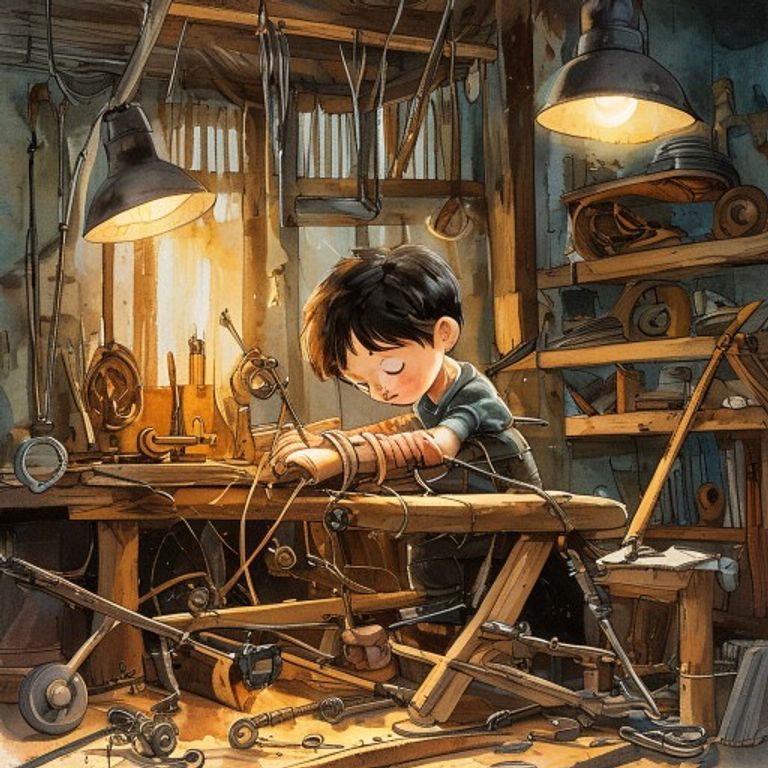
In the corner of his father's workshop, behind the pile of scrap metal that no one wanted, Finn built his flying machine. He started with the wings. He studied the sparrows that nested in the eaves, measuring the curve of their feathers, the angle of their bones. He made wings of light wood and thinner metal, shaped like the birds' but larger, much larger, large enough to hold a boy.
Then he built the body. A seat, like a chair but lighter, strapped with the leather his mother had given him for his birthday. "For a saddle," she had said, not knowing he would use it to hold himself in the sky.
Then he built the springs. This was the hardest part. Springs that would push the wings down, that would catch the air, that would lift him up. He tried a hundred designs. He coiled wire until his fingers bled. He tested springs that snapped, that sagged, that shot across the room like angry snakes.
But he did not stop.
"Why do you keep trying?" asked his friend Cora, the tinkerer's daughter, who was the only person who knew his secret. She was ten years old, with freckles like scattered pennies and a mind that understood machines better than people. "Everyone says it's impossible."
"Everyone says a lot of things," Finn replied, coiling another spring. "They said the bridge across the ravine was impossible. They said the clock tower was impossible. They said iron could not be made thin enough for a needle. But someone did all those things. Someone refused to believe everyone."
"But what if they're right?" Cora asked. "What if it really is impossible?"
Finn looked at her, his forge-smoke hair falling into his forge-smoke eyes. "Then I will fail," he said. "But I will fail having tried. I will fail knowing that I did everything I could. I will fail with my hands full of wire and my heart full of hope. And that is better than succeeding at nothing because I was too afraid to try."
Cora watched him for a long time. Then she picked up a piece of wire. "Show me how to coil," she said.
The first test came in spring.
Finn carried his machine—it weighed more than he expected, but less than his fear—to the top of the quarry hill, where the wind blew strong and steady. Cora came with him, carrying a bag of tools and a length of rope.
"If it doesn't work," she said, "I'll pull you back up with the rope."
"It will work," Finn said, though his hands were shaking.
He strapped himself into the seat. He gripped the handles that controlled the wings. He looked down at the quarry, a great bite taken out of the earth, deep and shadowed and waiting.
"Ready?" Cora asked.
"Ready," Finn lied.
He pushed off.
The wings caught the air. For one moment—one beautiful, impossible moment—Finn was flying. The wind rushed past him. The ground fell away. The sky reached down to meet him.
Then the left spring snapped.
The wing crumpled. The machine tilted. Finn fell, tumbling, crashing into the bushes at the quarry's edge, the machine breaking around him like a shattered bird.
Cora ran down the slope, the rope forgotten. "Finn! Finn! Are you dead?"
"Not dead," Finn groaned, untangling himself from the wreckage. His arm was cut. His ribs ached. His machine was in pieces around him, a collection of broken dreams.
"It's over," Cora said, tears in her eyes. "You tried. You failed. It's over."
Finn looked at the pieces. He looked at the broken wing. He looked at the snapped spring, coiled wire gone straight, as if giving up on itself.
"No," he said.
"What?"
"It's not over." He stood up, wincing. "The spring was too thin. I knew it was too thin. I used it because it was all I had. But I need a thicker spring. And the wing—see how it crumpled? It needs a support, here, and here. And the seat needs to be lighter. I can shave off half the weight if I change the shape."
Cora stared at him. "You fell. You could have died. And you're already planning the next one?"
"I fell because I made mistakes," Finn said. "Mistakes are lessons. The machine taught me what doesn't work. Now I know. And knowing what doesn't work is one step closer to knowing what does."
He picked up a piece of the broken wing. "I'm not done," he said. "I will never be done. Not until I fly."
The second test came in summer.
Finn had rebuilt the machine. Stronger springs. Reinforced wings. A lighter seat. He had tested each part separately, a hundred times, until he was certain.
But he was not certain enough.
This time, he chose the windmill hill, where the old windmill turned lazily and the grass was soft. A safer place. A gentler fall.
Cora came, and this time she brought her father, the tinkerer, a man who had once built a steam engine that ran for three days without stopping.
"I heard what you're doing," the tinkerer said. "I came to watch you fail."
"Thank you," Finn said.
The tinkerer almost smiled. "Not to enjoy it. To learn from it. Failure is the best teacher, if you pay attention."
Finn strapped in. He pushed off.
The wings caught the air. The springs pushed. The machine rose. Five feet. Ten feet. Fifteen. Finn was above the grass, above the windmill, above the world.
Then the wind shifted.
A gust from the east, unexpected, strong. It caught the underside of the right wing and flipped the machine. Finn tumbled, the machine spinning, and he crashed into the soft grass, the machine breaking again, but gentler this time, kinder.
He lay in the grass, breathing hard, staring at the sky he had almost touched.
The tinkerer walked over. "You flew," he said.
"I fell," Finn corrected.
"You flew first. For fifteen feet, you flew. No one in Ironhaven has ever flown fifteen feet."
"It wasn't enough."
"It was more than zero." The tinkerer knelt beside him. "The wind caught you because the wing was too flat. It needs a curve, like a bird's wing, to let the wind pass over it. And the machine needs a tail, to steady it when the wind shifts. These are small changes. You are close, boy. Closer than anyone has ever been."
Finn looked at him. "Will you help me?"
The tinkerer was silent for a long moment. Then he nodded. "Yes. Because I see something in you that I once had. The refusal to quit. The determination to keep trying, even when everyone says it's impossible. That is the rarest thing in the world. And it should not be wasted."
The third test came in autumn.
With the tinkerer's help, Finn built his third machine. Curved wings, like a bird's. A tail, to steady it. Stronger springs, thicker wire, better design. The tinkerer taught him mathematics, the science of air, the secrets of balance and weight. Cora helped him test each part, over and over, until there were no more mistakes to make.
This time, they chose the cliff above the sea. The highest point in Ironhaven. The place where the wind was strongest and the fall was longest.
The whole town came.
Finn's father, the blacksmith. His mother, the weaver. His teacher, the man who had never had an impossible dream. The other boys, who had mocked him. The other girls, who had whispered about him. They all came, drawn by rumor and curiosity and the human need to see someone try what they were too afraid to try themselves.
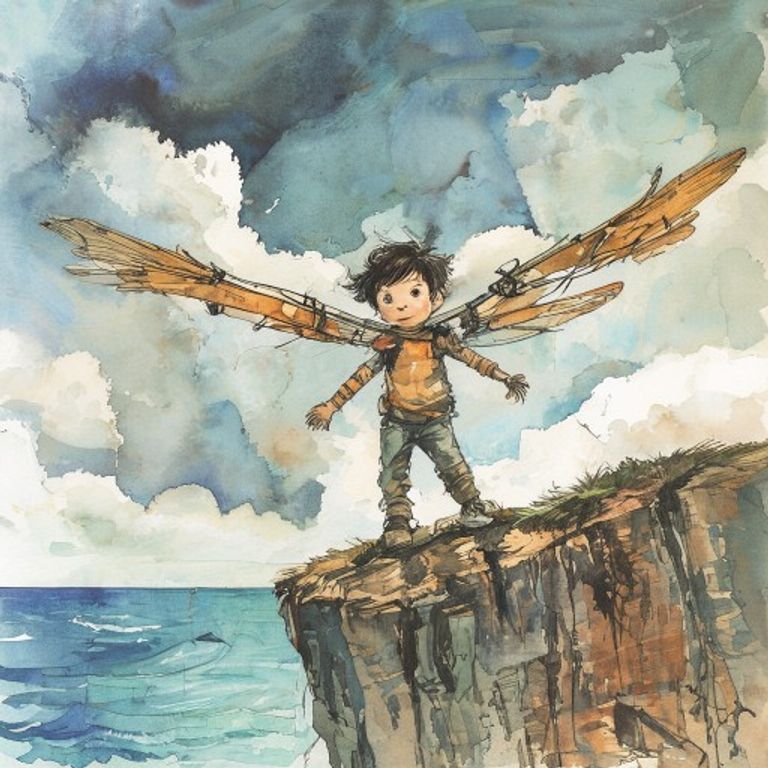
Finn stood at the edge of the cliff, his machine strapped to his back, his wings spread wide. The wind blew strong and steady. The sea crashed against the rocks below. The sky was wide and blue and waiting.
"This is foolish," his father called out. "You will die."
"Maybe," Finn said. "But I will die having tried."
"It is impossible," his teacher called out. "People cannot fly."
"Maybe," Finn said. "But I will know for certain."
He looked at Cora. She gave him a thumbs-up, her eyes bright with tears and hope.
He looked at the tinkerer. The old man nodded, his face grave and proud.
Finn took a breath. He ran. Three steps. Five. Ten. And he jumped.
The wings caught the air. The springs pushed. The machine rose. Ten feet. Twenty. Fifty. The wind rushed past him, not an enemy now but a friend, lifting him, carrying him, holding him in its strong hands.
Finn flew.
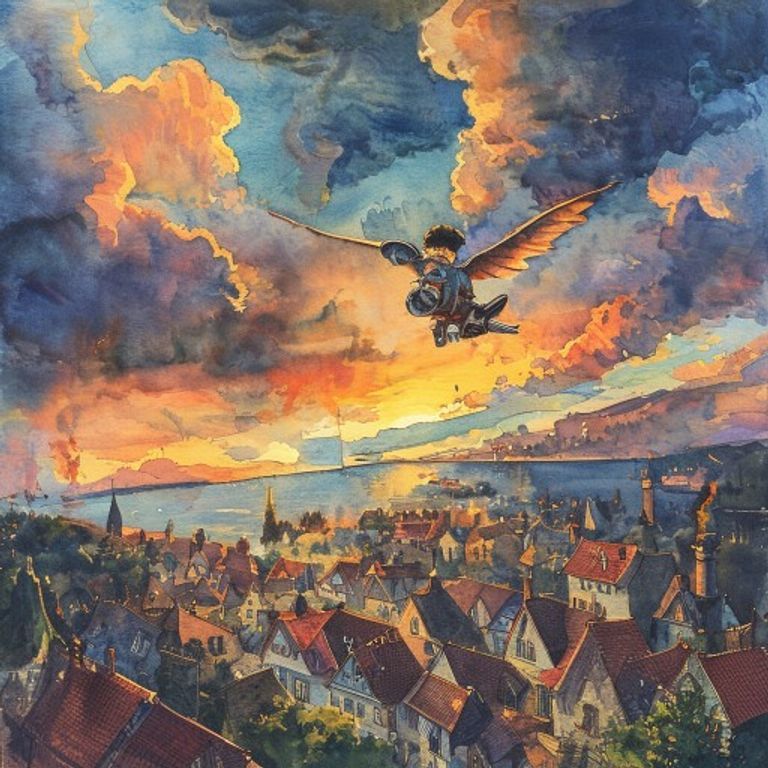
He flew above the cliff. Above the sea. Above the town of Ironhaven, where the smoke from the forges rose like gray feathers into the sky. He flew, and the people below looked up, and their mouths opened, and their eyes widened, and they saw what determination could do.
He did not fly forever. The machine was not perfect. The wind tired. The springs weakened. He glided down to the beach, landing hard in the sand, the machine breaking one last time, but gently, like a bird settling into its nest.
The crowd ran down to him. His father reached him first, the blacksmith who had said it was impossible, who now lifted his son in arms that had never held him so gently.
"You flew," his father whispered, tears running down his hard face. "You actually flew."
"I told you," Finn said, exhausted, elated, alive. "I told you I would."
"But how?" his mother asked, touching his forge-smoke hair. "How did you keep trying, even when you failed?"
"Because," Finn said, looking up at the sky he had touched, "determination is not about succeeding. It is about refusing to stop. It is about getting up every time you fall. It is about looking at the pieces of your broken dream and seeing not failure, but the next step."
He looked at Cora, at the tinkerer, at the crowd that had come to watch him fail and instead watched him fly.
"Everyone told me it was impossible. But 'impossible' just means 'no one has done it yet.' And if no one has done it yet, then someone has to be the first. Why not me? Why not anyone who refuses to quit?"
Moral of the Story: Determination is not about succeeding. It is about refusing to stop. Finn was told a hundred times that people cannot fly. He failed twice, crashing and breaking his machines, hurting himself, proving the doubters right. But he did not quit. He learned from each failure. He improved his design. He found help. And on the third try, he flew. Not because he was talented. Not because he was lucky. But because he refused to give up. Determination means getting up every time you fall. It means looking at the pieces of your broken dream and seeing not failure, but the next step. It means understanding that 'impossible' just means 'no one has done it yet.' And if no one has done it yet, then someone has to be the first. The world is full of people who gave up too soon. Don't be one of them. Dream big. Work hard. Fail forward. And never, ever quit. Because the only true failure is the failure to try again.
Age Range: 4-8 years | Reading Time: ~10 minutes | Core Value: Determination