The Penguin Who Learned to Sing: A Story About Perseverance
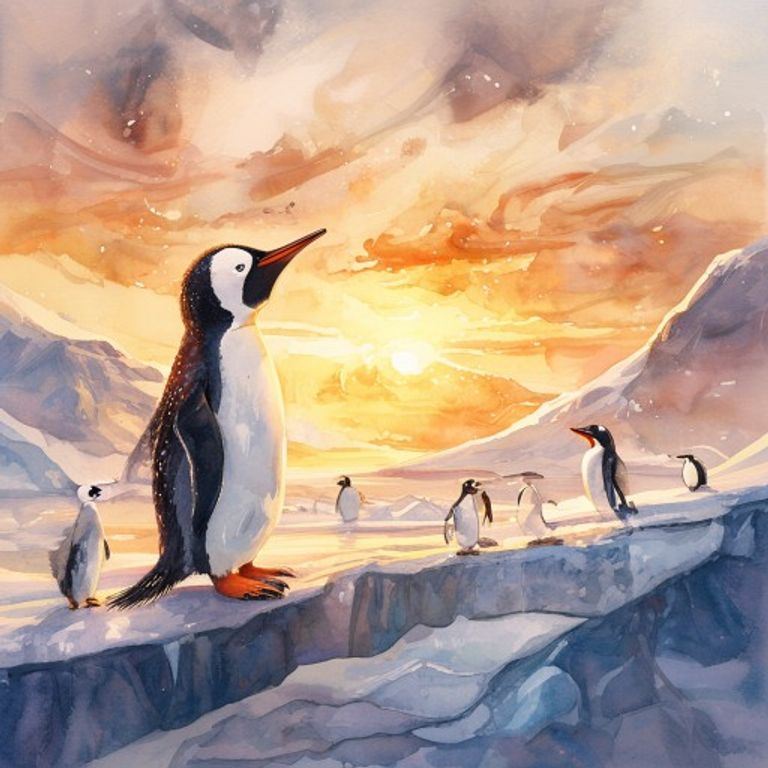
In the far south of the world, where the ice stretched white and endless under a sky so clear it seemed made of crystal, there lived a colony of emperor penguins. They were magnificent birds, black and white and proud, waddling across the ice in their fine feather coats, sliding on their bellies like toboggans, and diving into the freezing sea to catch silvery fish.
Among these penguins lived a young girl named Nova.
Nova was not like the other penguins. For one thing, she was smaller—barely half the size of her older brother, Tundra. For another, she was dreamier. While the other chicks practiced their waddles and learned to slide, Nova would sit at the edge of the ice shelf, staring at the horizon, her head tilted as if listening to a song no one else could hear.
And that was the third thing that made Nova different.
She loved to sing.
Not the hearty, trumpeting calls that penguins used to find their families in a crowd. Not the sharp barks of warning when a leopard seal approached. Nova loved to sing—long, flowing melodies that rose and fell like the wind, sweet and strange and utterly un-penguin-like.
"What kind of noise is that?" her brother Tundra would laugh, waddling past with his friends. "Penguins don't sing, Nova. We honk. We bark. We bray. Leave the singing to the whales."
The other chicks would join in the laughter, and Nova would tuck her head down, her small black beak pressed against her chest, and wait for them to pass.
But she never stopped singing.
Every morning, before the sun rose (which, in Antarctica, took a very long time indeed), Nova would climb to the top of Singing Ridge—a small hill of ice that overlooked the frozen sea. There, with the wind as her only audience, she would practice.
Her voice was not beautiful at first. It was squeaky and uncertain, like a rusty hinge on an old door. Sometimes it cracked. Sometimes it warbled. Sometimes it disappeared entirely, leaving only a soft puff of frozen breath.
But Nova did not give up.
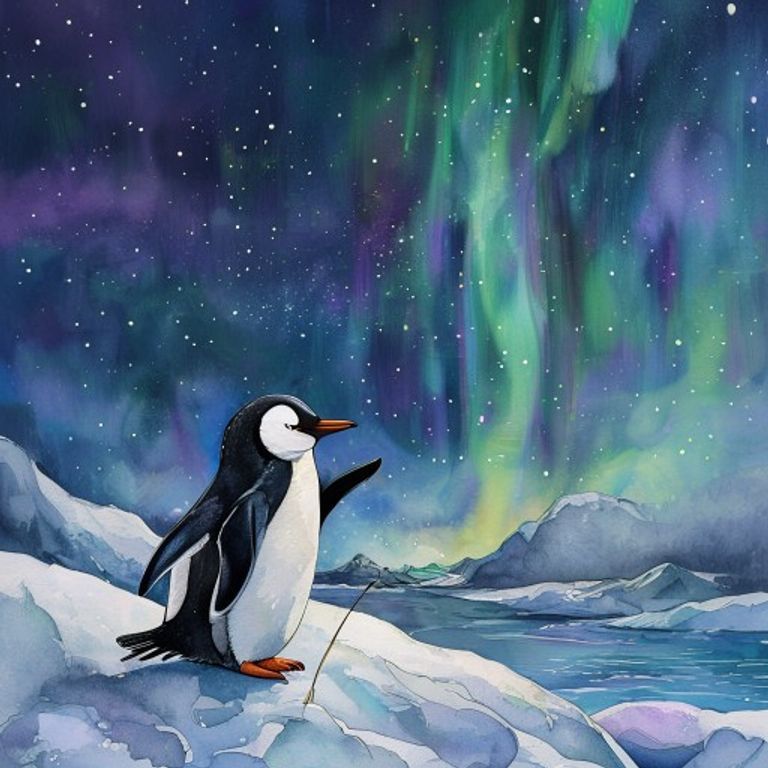
She sang when her throat was sore. She sang when the wind tried to steal her voice. She sang when the cold made her beak ache and her chest burn. She sang scales. She sang arpeggios. She sang songs she made up herself, about the stars and the ice and the deep blue mystery of the sea.
"You are wasting your time," her father, a stern penguin named Admiral, told her one evening. "Penguins are not singers. We are swimmers. We are fishers. We are survivors. Focus on what you are good at."
"But Father," Nova said, her dark eyes earnest, "what if I could be good at singing? What if I just need to keep trying?"
Admiral shook his head. "Some things are not meant to be, Nova. Perseverance is admirable, but wisdom is knowing when to stop."
Nova said nothing. But that night, she climbed Singing Ridge and sang louder than ever before.
Word of Nova's strange habit spread through the colony. Some penguins found it amusing. Others found it annoying. "Every morning," complained an old penguin named Frostbeard, "I am woken by that dreadful squeaking. It is bad enough the wind howls. Now we have a squeaking chick as well!"
But there was one penguin who did not laugh.
Her name was Echo, and she was the oldest penguin in the colony. No one knew exactly how old—her feathers had faded from black to soft gray, and her waddle was slow and careful—but her eyes were sharp and bright, the color of amber held to the light.
Echo had traveled. In her youth, she had ridden the great ice floes north to warmer waters. She had seen albatrosses gliding on twenty-foot wings. She had heard the songs of humpback whales filling the ocean like a cathedral choir. And she had seen things that other penguins had not.
One morning, as Nova practiced on Singing Ridge, Echo climbed up beside her.
"That is a C major scale," Echo said, her voice like dry leaves rustling. "But you are sharp on the third note."
Nova stopped, surprised. "You... you know about music?"
"I know about listening," Echo said. "And I have been listening to you for sixty-three mornings. You are getting better. Not good, mind you. But better."
Nova's heart leaped. "Do you really think so?"
"I think," Echo said, settling herself on the ice, "that perseverance without guidance is like a ship without a rudder. You are moving, but you may not be moving in the right direction. Would you like me to teach you?"
Nova could not speak. She could only nod, her eyes bright with tears that froze before they could fall.
And so, the lessons began.
Echo taught Nova about breath control—how to use her diaphragm to support her voice. She taught her about pitch, about tone, about the spaces between notes where the magic lived. She taught her songs from faraway places—melodies carried by the wind from tropical islands, rhythms learned from the drumming of walrus flippers, harmonies borrowed from the cries of gulls.
Nova practiced with a ferocity that amazed even Echo. While the other chicks played sliding games, Nova sang. While they napped in the warm pockets between ice mounds, Nova sang. While they ate, Nova hummed between bites, her mind always on the music.
Months passed. The Antarctic winter arrived, bringing darkness that lasted for weeks, and temperatures that could freeze a penguin solid if she stood still too long. But Nova still climbed Singing Ridge every morning, her breath pluming in the frozen air, her voice carving melodies into the darkness.
And slowly, miraculously, she improved.
The squeaks became clear notes. The warbles became smooth phrases. The rusty-hinge voice became something else entirely—something warm and rich and utterly unique. For Nova had not learned to sing like a whale, or a gull, or any other creature. She had learned to sing like herself.
Even Tundra noticed. "It is... not terrible anymore," he admitted grudgingly. "It is still strange. But not terrible."
High praise, from Tundra.
Then came the announcement.
Every year, on the first day the sun returned after the long winter dark, the colony held the Dawn Chorus. All the penguins gathered at the edge of the ice and sang together—a great, thundering call that welcomed the light back to the world. It was tradition. It was sacred. And it had sounded the same for as long as any penguin could remember.
But this year, the elder council had decided on something new.
"We will have a soloist," announced the head elder, a venerable penguin named Permafrost. "One voice, raised alone, to welcome the sun. It has never been done. But the world is changing, and perhaps it is time we changed with it."
A murmur rippled through the colony. A soloist? Who would dare?
Tundra stepped forward. "I will do it," he said, his chest puffed with confidence. "My call is the loudest in the colony. Everyone says so."
Other penguins volunteered too—penguins with deep voices, strong voices, traditional voices. But Permafrost's gaze swept across them all and settled on a small figure at the back.
"Nova," the elder said. "Will you sing for us?"
The colony fell silent. Then laughter erupted—sharp, barking penguin laughter.
"Her?" Tundra spluttered. "The squeaker? The dreamer? She is not even a proper penguin!"
"She is not a proper penguin," Echo agreed, her voice cutting through the noise like a knife. "She is something better. She is a penguin who never gave up. And that, my friends, is the only kind of penguin worth listening to."
Nova stepped forward, her heart hammering, her legs trembling. She looked at Echo, who nodded. She looked at her father, who would not meet her eyes. She looked at the vast, dark horizon, where the first hint of dawn was beginning to glow.
"I will sing," she said.
The morning of the Dawn Chorus arrived.
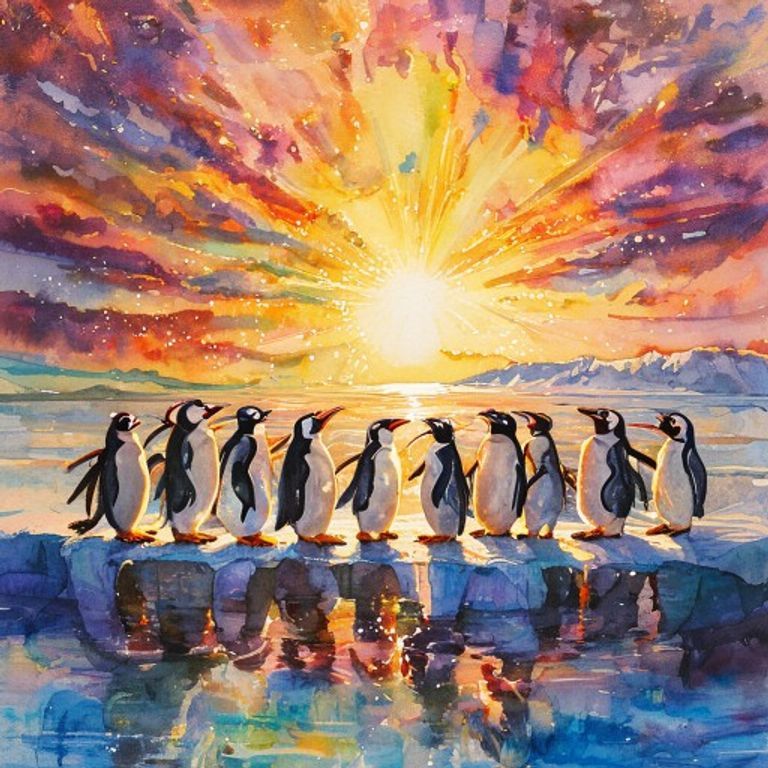
The colony gathered at the edge of the ice—a sea of black and white feathers stretching across the frozen plain. The sky was a deep, bruised purple, slowly lightening to indigo, then violet, then rose. The sun was coming. But it had not yet arrived.
Nova stood alone at the front, a tiny figure against the vastness. Her heart was a drum in her chest. Her breath came fast and shallow. She could see the faces of the colony—some curious, some skeptical, some openly mocking. Tundra stood with his friends, whispering and snickering.
She closed her eyes.
She thought of Singing Ridge, of all those mornings in the dark and cold. She thought of Echo's patience, of her guidance, of her belief. She thought of the sixty-three lessons, the sore throat, the frozen breath, the endless practice.
Perseverance, she realized, was not about becoming perfect. It was about becoming ready.
And she was ready.
She took a deep breath—slow, controlled, just as Echo had taught her. She opened her beak. And she began to sing.
It started as a single note, clear and pure as the ice itself. Then another. Then another. The melody unfolded like a flower blooming in fast-forward, each note building on the last, creating something that had never been heard in Antarctica before.
It was a song about the long dark. About patience. About hope. About the tiny voice that refused to be silent, even when the whole world said it should stop.
The mocking laughter died. The whispers ceased. The colony stood still, transfixed, as Nova's voice rose and soared and danced across the ice.
And then, something miraculous happened.
The sun rose.
Not gradually, as it usually did. But suddenly, blazingly, as if Nova's voice had called it forth. A great arc of gold and crimson exploded across the horizon, flooding the world with light. The ice caught fire with color. The sky blazed. The sea, still dark, reflected the glory like a mirror.
And Nova sang on.
Her voice mingled with the light, became part of it, a golden thread weaving through the dawn. The other penguins—stern Admiral, doubtful Tundra, even grumpy Frostbeard—joined in. Not with their traditional braying, but with something new. Something softer. Something that harmonized with Nova's impossible, perseverant song.
The Dawn Chorus had never sounded like this. It had never felt like this. It was no longer just a welcome for the sun. It was a celebration of every voice that had ever been told to be silent. Every dream that had ever been called foolish. Every small, stubborn heart that had refused to give up.
When the song ended, the silence was deeper than the ice itself.
Then, slowly, a sound began. Not barking. Not braying. Something else.
Applause.
The penguins were flapping their flippers together, creating a soft, thunderous rhythm that echoed across the ice. Tundra was flapping hardest of all, his eyes wet, his face split by a grin that stretched from ear to ear.
"I was wrong," he said, when Nova waddled over. "You are not a squeaker. You are a singer. And I am proud to be your brother."
Admiral approached next, his stern face softened by wonder. "I told you to stop," he said, his voice thick. "I told you to be practical. I was wrong. Perseverance is not just admirable, Nova. It is... it is magical."
Echo, watching from the side, said nothing. But her amber eyes glowed, and her gray feathers seemed, for a moment, to shimmer with all the colors of the dawn.
In the years that followed, Nova became the colony's first Songkeeper. She taught other penguins—chicks and adults alike—that their voices were capable of more than they knew. She composed new songs for every occasion: songs for the fish harvest, songs for the return of the sun, songs for the long journey across the ice.
And every year, on the morning of the Dawn Chorus, she stood at the edge of the ice and sang. Her voice was deeper now, richer, honed by decades of practice. But it was still unmistakably hers. Still strange. Still beautiful. Still the voice of a penguin who had refused to give up.
The other penguins would gather around her, young and old, and listen. And when she finished, they would turn to their own chicks and say:
"See that penguin? The small one with the gray feathers? She was told to stop singing a thousand times. She was told penguins cannot make music. She was told to be practical, to be normal, to give up. But she kept going. Every morning. Every day. For years. And now, she is the reason the sun returns with such joy."
And the chicks would look at Nova with wide, wondering eyes. And they would think: if a penguin can learn to sing, what can I do, if I just keep trying?
Perseverance, little one. Perseverance.
The End