The Forest Symphony: A Story About Teamwork
In the heart of the Whispering Woods, where oak trees hummed lullabies to their acorns and brooks sang secrets to the stones, there lived five young animals who had never met. They were neighbors, yes, living within a short flutter, hop, or scurry of one another. But they were also strangers, each convinced that the music they made was a gift meant only for themselves.
Pippin was a small sparrow with chestnut-brown feathers and a throat that could whistle melodies so sweet that butterflies would pause mid-flight just to listen. He practiced every morning on the old birch branch outside his nest, convinced that one day, the whole forest would gather to hear him alone.
Thistle was a young hedgehog who had discovered, quite by accident, that her quills made a wonderful sound when tapped against hollow logs. She could create rhythms—soft patters like rain, sharp raps like thunder, gentle rolls like wind through wheat. She practiced in a clearing deep in the ferns, certain that her drumming was a secret only she should keep.
Reed was a frog with emerald skin and a voice so deep and resonant that when he croaked, the water lilies on the pond shivered with delight. His croaks were not merely noise. They were notes—low, rumbling bass notes that seemed to come from the earth itself. He sang alone at twilight, sure that no one else could possibly understand his sound.
Bumble was a young bumblebee, round and fuzzy, who had learned that her wings did not merely buzz. They hummed. And when she hovered near certain flowers, the vibrations created harmonies—high, bright, shimmering tones like tiny bells. She buzzed from bloom to bloom, collecting nectar and music, never imagining that anyone else might add to her song.
And then there was Cedar, a young squirrel with a tail like a cinnamon flame, who had figured out that acorns, when dropped on flat stones at just the right angle, made crisp, percussive clicks. He could tap out rhythms with his tiny paws—fast, slow, syncopated, steady. He practiced in the hollow of an ancient elm, dreaming of the day the forest would applaud his solo performance.
They were all preparing for the same thing: the Moonlight Music Festival, the grandest celebration in the Whispering Woods. Once a year, when the moon was fullest and the stars seemed close enough to touch, every creature who could make a sound was invited to perform in the Great Glade. The festival was not a competition. It was a gift—the forest's way of reminding itself that beauty existed in every voice, every wingbeat, every heartbeat.
The Auditions
One warm afternoon, Maestro Moss, the ancient owl who had directed the Moonlight Music Festival for forty-seven years, announced that auditions would be held at the edge of the Great Glade. He sat on his favorite branch, his silver feathers catching the sunlight like spun moonbeams, and hooted the news in a voice that carried to every corner of the woods.
"This year," he said, his amber eyes twinkling, "I am looking for something special. Not the loudest voice. Not the fastest rhythm. Not the prettiest song. I am looking for creatures who understand that music, like the forest itself, is not meant to be alone."
The young animals did not quite understand what he meant. But they were excited. They practiced harder than ever.
Pippin arrived first. He fluttered down to the mossy stage in the center of the Glade, puffed out his tiny chest, and whistled a melody so lovely that even the grass seemed to lean closer. It was perfect—sweet, clear, and complete. When he finished, he bowed, expecting applause.
Maestro Moss nodded slowly. "Beautiful, little sparrow. Truly beautiful. But tell me—what do you hear when you listen to your own song?"
Pippin blinked. "I hear... me. My melody. It's complete."
"Is it?" Maestro Moss tilted his head. "Close your eyes and listen again. Not to what is there. To what is missing."
Pippin closed his eyes. He listened. And for the first time, he heard it—a space beneath his melody, a hollow place where something else should be. His song was lovely, yes. But it was thin. It floated, untethered, like a leaf on the wind. It had no roots.
He opened his eyes, confused. "I don't understand."
"You will," Maestro Moss said gently. "Next."
Thistle rolled onto the stage, her quills bristling with nervousness. She found a hollow log, positioned herself carefully, and began to drum. Her rhythm was extraordinary—complex, layered, alive. She played a storm, then a heartbeat, then a dance. When she finished, she curled into a ball, waiting.
"Magnificent, young hedgehog," Maestro Moss said. "But tell me—what do your rhythms need?"
Thistle thought. "I need... faster paws? A bigger log?"
Maestro Moss shook his head. "Listen. Not to yourself. To the silence between your beats. What lives there?"
Thistle listened. And she heard it too—a loneliness in her rhythm, a repetition that circled back on itself, never going anywhere new. Her drumming was powerful. But it was trapped, running in place, a wheel instead of a journey.
One by one, they all auditioned. Reed croaked his deep bass notes, powerful and mournful, but they echoed into emptiness, unsupported, like a heartbeat without a body. Bumble hummed her bright harmonies, shimmering and quick, but they flickered and faded, too fragile to hold. Cedar clicked his acorn rhythms, sharp and clever, but they were scattered, disconnected, like raindrops with no river to join.
Each was talented. Each was incomplete. Each heard, for the first time, the hollow place in their own music.
The Empty Spaces
Maestro Moss gathered them together as the sun began to set, painting the Glade in gold and rose. The five young animals sat in a circle, confused and disappointed. They had expected praise. They had received... questions.
"You are all remarkable musicians," Maestro Moss began. "But music is not a solo journey. It is a conversation. A melody needs a rhythm to walk beside it. A rhythm needs a harmony to lift it. A harmony needs a bass note to hold it. A bass note needs a percussion to punctuate it. And every sound needs silence to give it meaning."
He looked at each of them in turn. "Pippin, your melody is beautiful. But it floats. It needs something to hold it down, to give it weight."
He turned to Reed. "Your bass notes are powerful. But they echo into nothing. They need something bright to answer them."
To Bumble: "Your harmonies shimmer. But they are too quick, too light. They need something steady to rest upon."
To Cedar: "Your rhythms are clever. But they scatter. They need a melody to follow, a path to walk."
And finally, to Thistle: "Your drumming is alive. But it runs in circles. It needs a journey to take it somewhere new."
Pippin ruffled his feathers. "But Maestro, we are all different. A sparrow and a frog and a bee and a hedgehog and a squirrel—we don't make the same kind of music."
Maestro Moss smiled, and it was a smile like moonlight through leaves. "That, little sparrow, is exactly why you need each other. You are not meant to make the same music. You are meant to make music together. Teamwork is not about everyone doing the same thing. It is about everyone doing what only they can do, and trusting that the others will do what only they can do."
The five young animals looked at one another. They had never really looked before. They had been neighbors, but they had not been friends. They had shared the woods, but they had not shared themselves.
"Try it," Maestro Moss said softly. "Just once. Together."
The First Song
It was awkward at first. Pippin started his melody, but Reed didn't know when to join. Bumble tried to hum along, but her timing was off. Cedar dropped his acorns at the wrong moments, creating chaos instead of rhythm. Thistle, used to playing alone, drowned everyone out with her drumming.
They stopped. They tried again. They stopped again. They argued. Pippin said Reed was too slow. Reed said Pippin was too fast. Bumble said Cedar's clicks were confusing. Cedar said Thistle was too loud. Thistle said nobody was listening to her.
Maestro Moss watched them with patient eyes. He did not intervene. He knew that the hardest part of teamwork was not the music. It was the listening.
Finally, Pippin—who had been the first to audition and the first to hear the emptiness in his own song—did something brave. He stopped arguing. He turned to Reed and said, "Show me your rhythm. Just you. I want to hear it. Really hear it."
Reed, surprised, croaked his deepest note—a low, rumbling sound that seemed to rise from the earth itself. Pippin listened. He did not think about his own melody. He did not plan what he would play next. He simply listened.
And in Reed's croak, he heard something he had never heard before: a foundation. A place where a melody could rest. A bed of sound, steady and patient, waiting for something bright to bloom above it.
Pippin began to whistle. Not his usual melody. A new one. One that rose and fell with Reed's croak, that danced above it, that wrapped around it like ivy around oak.
Reed's eyes widened. He had never heard his own sound answered before. He croaked again, louder, prouder, and Pippin's melody soared higher.
Bumble, watching them, felt something stir in her fuzzy chest. She buzzed forward, hovered between them, and added her harmonies—not randomly, but carefully, listening to where Pippin's melody needed brightness, where Reed's bass needed lift. She became the bridge between them.
Cedar, seeing the pattern form, began tapping his acorns. Not his usual scattered rhythms, but something steady, something that held the beat, that gave the others a path to walk. He became the heartbeat.
And Thistle—brave, powerful Thistle—listened for the first time to the music that was forming around her. She did not need to be the loudest. She did not need to fill every silence. She found her place in the spaces between, her quills adding texture, thunder, rain, wind. She became the weather, the drama, the emotion that made the song feel alive.
They played for three minutes. It was not perfect. But it was whole.
When they finished, the Great Glade was silent. Even the wind had stopped to listen. And then, from somewhere in the oaks, a single cricket began to chirp. Then another. Then a brook, remembering its own song, began to murmur. Then the leaves, stirred by the music, rustled their applause.
The five young animals looked at one another. They were no longer strangers. They were a band.
The Moonlight Music Festival
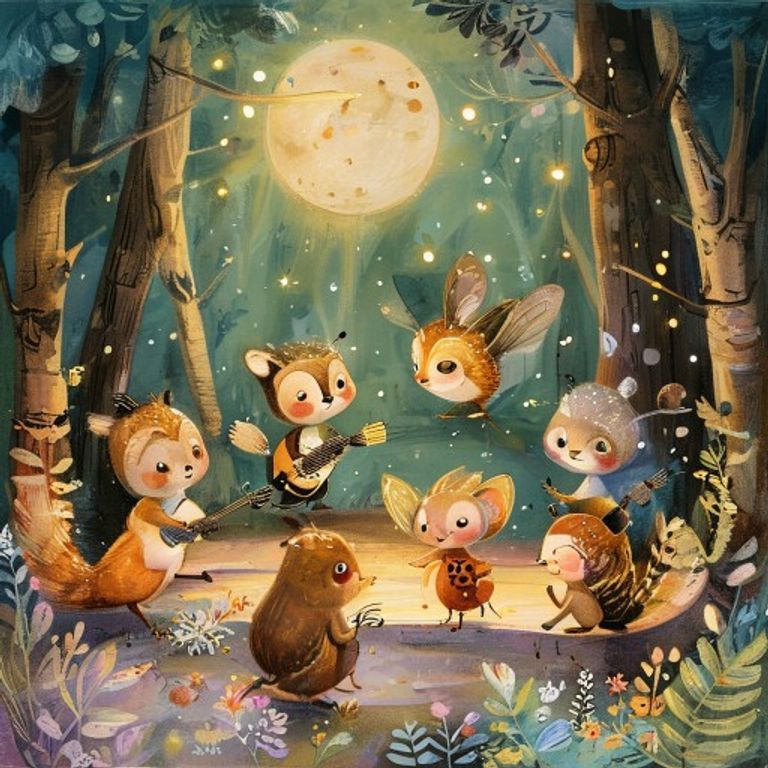
The night of the festival arrived like a gift wrapped in starlight. The Great Glade was transformed. Fireflies had woven themselves into living lanterns, hanging from branches in golden constellations. The moon, full and brilliant, poured silver light onto the mossy stage. Creatures had come from every corner of the Whispering Woods—rabbits and deer, foxes and owls, mice and moles, butterflies and beetles. They sat on toadstools and tree roots, on stones and in branches, waiting.
Maestro Moss stood on the stage, his silver feathers gleaming. "Tonight," he hooted, "we will hear many songs. But I want to begin with something new. Something that reminds us why we gather. These five young creatures have learned what many of us forget—that the most beautiful music is not made by one voice, but by many voices choosing to become one song."
Pippin, Thistle, Reed, Bumble, and Cedar took their places. They were nervous. Their paws trembled. Their wings buzzed with anxiety. Their quills stood straighter than usual. But they looked at one another, and they remembered the first song. They remembered what it felt like to be incomplete alone, and whole together.
Pippin began. A single, clear note, like the first star of evening.
Reed answered. A deep, resonant tone, like the earth breathing.
Bumble joined. A shimmer of harmony, like light on water.
Cedar clicked. A steady rhythm, like a heart finding its courage.
And Thistle—magnificent Thistle—unleashed her quills on the hollow log, and the forest itself seemed to pulse with her rhythm.
They played a song they had not rehearsed. They did not need to. They had learned to listen. They had learned to trust. They had learned that in teamwork, you do not follow a plan. You follow one another.
The melody soared and dived, wrapped in harmony, grounded by bass, driven by rhythm, lifted by the bright shimmer of bee-song. It was not any one of their songs. It was all of their songs, woven together like five threads into a single, unbreakable cord.
The forest listened. The moon leaned closer. The stars seemed to twinkle in time.
When the final note faded, there was no applause at first. Only silence. The deep, reverent silence of creatures who had heard something they would never forget.
Then the Great Glade erupted. Crickets chirped their approval. Owls hooted. Deer stamped their hooves. Squirrels chattered. Fish splashed in the nearby brook. Even the ancient trees creaked their applause, their branches swaying in a standing ovation.
Maestro Moss wiped a tear from his amber eye. "That," he said, his voice cracking with joy, "is what music is meant to be. That is what we are meant to be."
The Morning After
The next morning, the five friends met at the edge of the Great Glade. They were different now. They walked differently, talked differently, listened differently. They had become something they could not have become alone.
"I used to think," Pippin said, preening his feathers, "that being a great musician meant being the best. The loudest. The most beautiful. But now I think..." He paused, searching for the right words. "I think being a great musician means being part of something bigger than yourself."
"I used to hide my drumming," Thistle admitted, her quills softening. "I thought if I shared it, someone would steal it. But now I know—music isn't something you lose when you share it. It grows."
"I used to think my croaks were too sad," Reed said, his throat swelling with emotion. "Too slow. Too deep. But Pippin's melody showed me that my slowness gives his speed a place to rest. Without me, he would be breathless."
"And without Pippin," Bumble buzzed, landing on Reed's broad green back, "your depth would have no height to contrast with. You need his brightness as much as he needs your darkness."
Cedar clicked an acorn thoughtfully. "I used to think teamwork meant giving up what makes you special. But it's the opposite. Teamwork means your specialness finally has a place to belong."
They sat together as the sun rose, warming their fur and feathers and scales. They did not play music. They did not need to. The silence between them was its own song—a song of friendship, of trust, of five different creatures who had learned that being different was not a reason to be apart. It was a reason to come together.
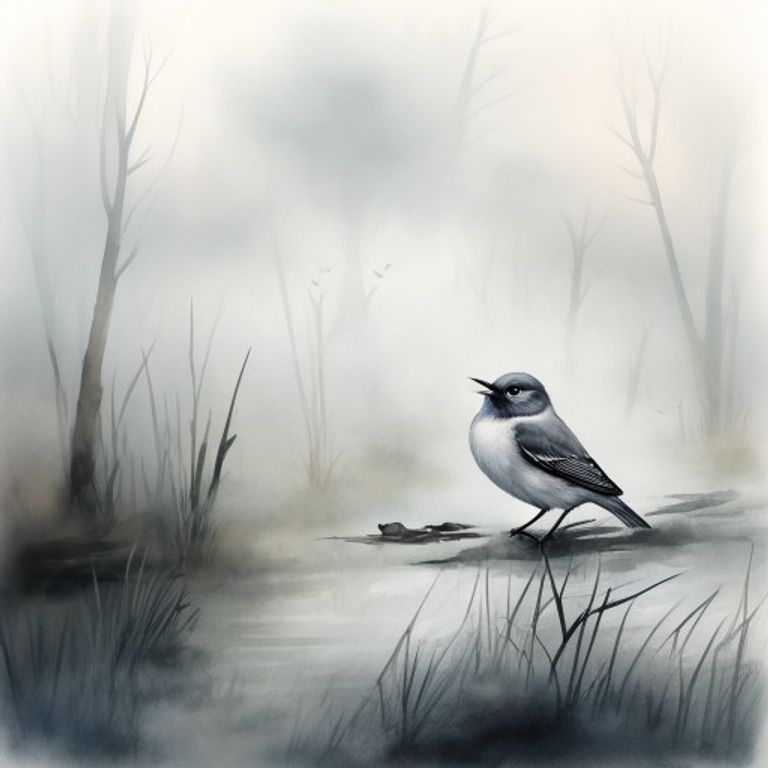
And somewhere in the Whispering Woods, Maestro Moss listened to the morning, heard the five friends laughing, and smiled. The festival had come and gone. But the music—real music, the kind that lives in hearts long after the last note fades—that music was just beginning.
For the forest, like all good things, was not meant to be solo. It was meant to be a symphony.
The Moral of the Story: Teamwork is not about everyone doing the same thing. It is about each person doing what only they can do, and trusting others to do what only they can do. A melody without rhythm floats away. A rhythm without melody runs in circles. A harmony without a foundation shimmers and fades. But together—melody, rhythm, harmony, bass, and percussion—they create something none of them could create alone. The most beautiful music in the world is not made by the best voice. It is made by voices that choose to sing together. And the most wonderful thing about teamwork? When you become part of something bigger than yourself, you don't disappear. You finally become who you were meant to be.