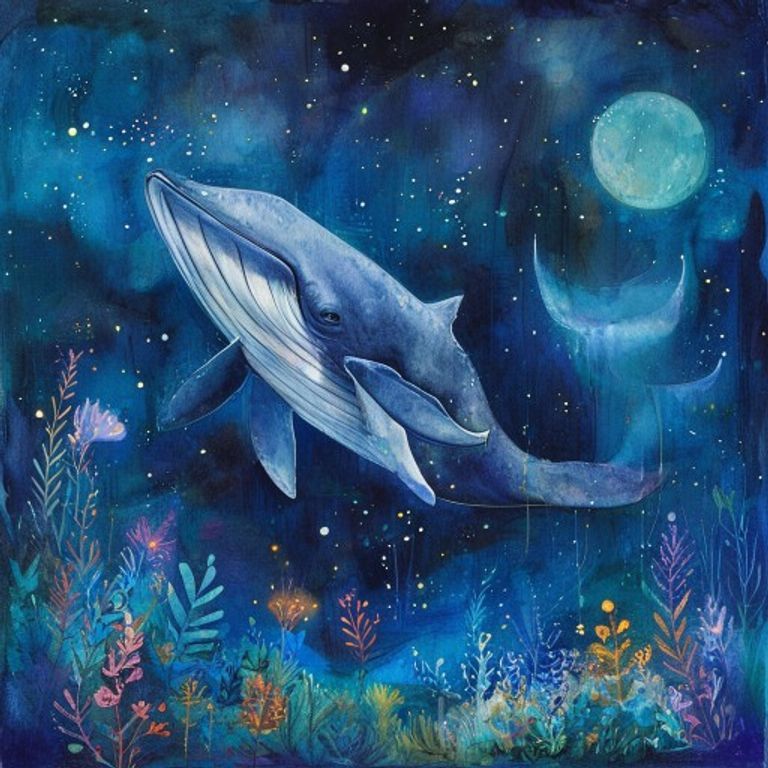
The Whale Who Sang in the Dark: A Story About Optimism
Far below the surface of the Sapphire Sea, where sunlight never reached and the water was as dark as a dreamless sleep, there lived a young whale named Echo. He was not a great whale, not yet. He was small for his kind, with a voice that was more whisper than song, and a heart that held more hope than the entire ocean could contain.
Echo lived in the Midnight Zone—the deepest part of the sea, where no light danced and no shadows played because there was nothing to cast them. The creatures here had no eyes, or eyes that saw only heat and movement. They drifted and hunted and survived, but they did not dream. Not like Echo.
Every morning—though morning meant nothing in the eternal dark—Echo would rise from his resting place among the warm vents and sing.
His song was not loud. It was not grand. It was a soft, searching melody, like a question asked into silence. "Is anyone there?" his song said. "I am here. I am waiting. I believe you are somewhere."
The other creatures of the deep thought Echo was strange. They told him so, in their ways. The anglerfish, with her dangling lantern of light, would flicker and say, "Why do you sing, little whale? No one can hear you down here. The deep is silent. The deep is empty. Singing is for the surface, where the sun lives."
The giant squid, ancient and patient, would drift past and rumbled, "I have lived three hundred years in this darkness. I have heard every sound the ocean makes. There is no answer to your song, young one. Save your breath. Save your strength. The deep does not sing back."
Even the tiny shrimp, darting through the warm currents, would whisper, "Echo, stop singing. It makes us sad. We want to believe too, but believing hurts when nothing changes."
But Echo could not stop singing. It was not stubbornness. It was not foolishness. It was simply who he was. He believed—truly, deeply, unshakably believed—that somewhere in the vast, endless ocean, there was another whale who needed to hear his song. Who was lonely too. Who was singing their own soft question into the dark, waiting for an answer.
"How do you know?" the anglerfish asked one evening, her bioluminescent lure casting eerie blue light across Echo's small face. "How do you know anyone is listening? You have no proof. You have no evidence. You have only... hope. And hope is a cruel thing in the deep."
Echo smiled, a whale-smile that crinkled the corners of his eyes. "I don't know," he said. "That is the whole point of hope. If I knew, it would not be hope. It would be certainty. And certainty is heavy. Hope is light. Hope lets me rise."
The Long Wait
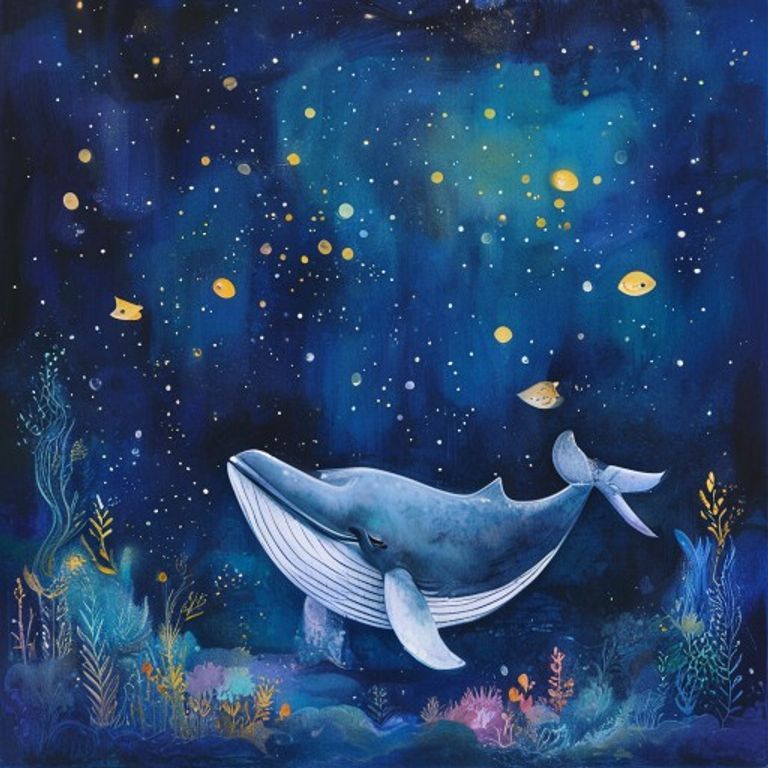
Months passed. Or years. Time is strange in the deep, where there are no seasons, no sunrises, no calendars. Echo grew a little larger, his voice a little stronger, but still he sang his same soft song every day. And still, there was no answer.
Sometimes, in the darkest moments, Echo felt doubt creep into his heart like cold water. What if the others were right? What if he was alone? What if his song traveled through the endless miles of black water and simply... faded? What if he was singing to nothing?
On those nights, Echo would swim to the warm vents and float above them, feeling the heat rise through his body. He would remember the stories his mother had told him before she left for the surface—stories about the ocean being full of songs, full of voices, full of whales calling to whales across distances that boggled the mind. "The ocean hears everything," she had said. "And everything in the ocean hears you. You just have to keep singing."
So Echo kept singing. Not because he was certain. But because hope was his choice. Optimism was his decision. He would rather sing and be wrong than stop singing and never know if he was right.
The Answer
It happened on a day that was no different from any other. Echo had just finished his morning song—a lilting, wandering melody that drifted up through the water like a question mark made of sound. He was about to rest when he heard it.
A sound. Faint. Fragile. Almost nothing. But unmistakably a song.
Echo froze. His heart—huge and steady—seemed to skip a beat. He listened, straining every sense, every nerve, every fiber of his being. And there it was again. A whisper of melody, soft and searching, carrying the same question his own song carried: "Is anyone there? I am here. I am waiting."
Echo sang back. Loudly. Joyfully. His voice filled the Midnight Zone with a music it had never known. "I am here! I hear you! I have been waiting too!"
For a long moment, there was silence. Echo's heart sank. Had he imagined it? Had the darkness played a trick on his hopeful heart?
But then—oh, then—the answer came. Clearer now. Stronger. Closer. A voice like silver bells and warm currents, like starlight translated into sound. "I hear you," the voice sang. "I hear you, and I am coming."
Echo wept. Whales do not cry tears, but their songs carry emotion in every note, and Echo's song was wet with joy, heavy with relief, bright with wonder. The other creatures of the deep—who had told him to stop, who had said the deep was empty, who had warned him that hope was cruel—gathered around him in the dark. The anglerfish's light pulsed in rhythm with Echo's song. The ancient squid drifted closer, his huge eyes reflecting something that might have been wonder. Even the tiny shrimp danced in the warm currents, their bodies glowing with borrowed bioluminescence.
"You were right," the anglerfish said, her voice soft with awe. "You were right all along."
"No," Echo said, his song gentle and warm. "I was not right. I was hopeful. There is a difference. Being right means you knew. Being hopeful means you believed even when you did not know. Hope is braver than certainty."
The Meeting
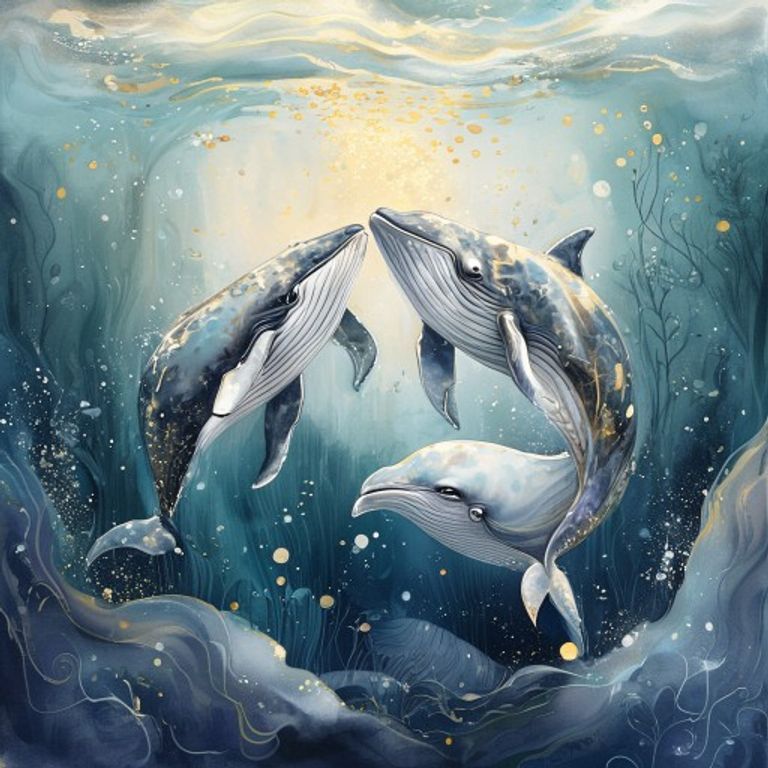
The other whale's name was Melody. She was young, like Echo, and she had been singing her own lonely song in a different part of the deep—hundreds of miles away, beyond trenches and mountains that no light had ever touched. She had been singing for just as long. She had faced the same doubts, heard the same warnings, felt the same cold fingers of despair.
But she had kept singing too.
When they finally met—two small whales in the vast, dark ocean—it was not dramatic. There were no fireworks, no shafts of sunlight, no crowds of creatures cheering. There was only the deep, and the dark, and two voices that had found each other.
They swam together, side by side, their songs intertwining like threads of silver and gold. They sang about their loneliness, their fears, their doubts. They sang about the moments they had almost stopped. They sang about the mornings when hope had felt too heavy to carry. And they sang about how they had carried it anyway.
"Why did you keep singing?" Echo asked Melody one evening, as they floated above a field of tube worms that waved like flowers in the warm vent-currents.
Melody was quiet for a long moment. "Because," she said finally, "the thought of not singing was worse than the thought of singing alone. If I stopped, I would lose the only thing that made me... me. And if I kept singing, at least I was being true to who I was. The loneliness was hard. But giving up would have been harder."
Echo understood. He had felt the same way. Optimism was not about ignoring the darkness. It was about choosing to sing in spite of it.
The Chorus
Echo and Melody did not stop singing once they found each other. They sang louder. They sang more boldly. Their combined voices traveled farther than either could have managed alone, carried by warm currents and reflected by underwater mountains, reaching into parts of the ocean that had never known song.
And something extraordinary began to happen.
Other lonely whales began to hear them. Whales who had stopped singing, who had given up hope, who had accepted the silence as permanent. One by one, they started to sing again. Tentatively at first. Then boldly. Then joyfully.
A young whale named Sol, who had been silent for ten years, heard Echo and Melody's combined song drift through his lonely trench. He raised his voice—rusty and cracked from disuse—and added his own melody. An old whale named Harmony, ancient and scarred, heard the growing chorus from her resting place in the Coral Cathedral, and she sang too, her voice rich and deep with the wisdom of ages.
Within a year, the deep was no longer silent. It was full of song. Hundreds of voices, thousands of songs, weaving together into a music so beautiful that even the creatures of the surface—dolphins and sailors and seabirds—could hear it in their dreams.
The Midnight Zone, once a place of darkness and silence, became known as the Singing Deep. Whales traveled from every ocean to add their voices to the chorus. And every new whale who arrived asked the same question: "Who started this? Who sang alone in the dark for so long?"
And the answer was always the same: "Echo. Echo and Melody. Two small whales who refused to believe that the deep was empty."
The Lesson
Echo lived a long life. He grew large and strong, his voice becoming one of the most beloved in the Singing Deep. He and Melody raised three calves, teaching them to sing from their first day. And every evening, before the young ones slept, Echo would tell them the same story.
"When I was young," he would say, his voice gentle as the warm currents, "I sang alone in the deepest, darkest part of the ocean. Everyone told me to stop. They said no one could hear me. They said hope was foolish. They said the darkness was empty."
"What did you do?" his calves would ask, though they knew the answer by heart.
"I kept singing," Echo would say, his eyes warm with the memory. "Not because I was certain. Not because I had proof. But because hope was my choice. Optimism was my decision. I chose to believe that somewhere, in all that darkness, there was light. And I was right. But even if I had been wrong—even if no one had ever answered—I would have been glad that I sang. Because singing made me who I was. And who I was, was enough."
His calves would snuggle close, feeling the warmth of his huge body, hearing the steady rhythm of his heart. And they would fall asleep to the sound of the Singing Deep—their father's legacy, their mother's gift, their own inheritance.
And far above, where the sun still danced and the stars still whispered, the ocean sang. A song of hope. A song of persistence. A song of two small whales who refused to let the darkness win.
The Moral of the Story: Optimism is not about pretending the darkness does not exist. It is about believing that light exists even when you cannot see it. Echo did not ignore the deep. He did not pretend it was sunny. He simply refused to let the darkness define him. He chose hope when there was no reason to hope. He chose to sing when there was no one to hear. And in that choice, he found his truth. The world will often tell you to stop believing. It will tell you that hope is foolish, that persistence is pointless, that the darkness is all there is. Do not listen. Keep singing. Your song may travel farther than you know. Someone, somewhere, may be waiting to hear it. And even if no one ever answers, the singing itself will make you stronger, braver, and more fully alive. Optimism is not a guarantee of success. It is a commitment to yourself. It is the decision to be the light you wish to see, even when you are surrounded by dark. Keep singing, little whale. The ocean is listening.