The Raven Who Broke the Story Tree: A Story About Honesty
In the heart of Whisperwood Forest, where the trees grew so tall they seemed to hold up the sky, and the sunlight filtered through the leaves like golden threads, there lived a young raven named Ink. He was not the biggest bird in the forest, nor the strongest, nor the most colorful. His feathers were the deep blue-black of midnight, and his eyes were the bright, curious black of polished obsidian. But Ink had something that no other creature in Whisperwood possessed: a voice that could make words dance.
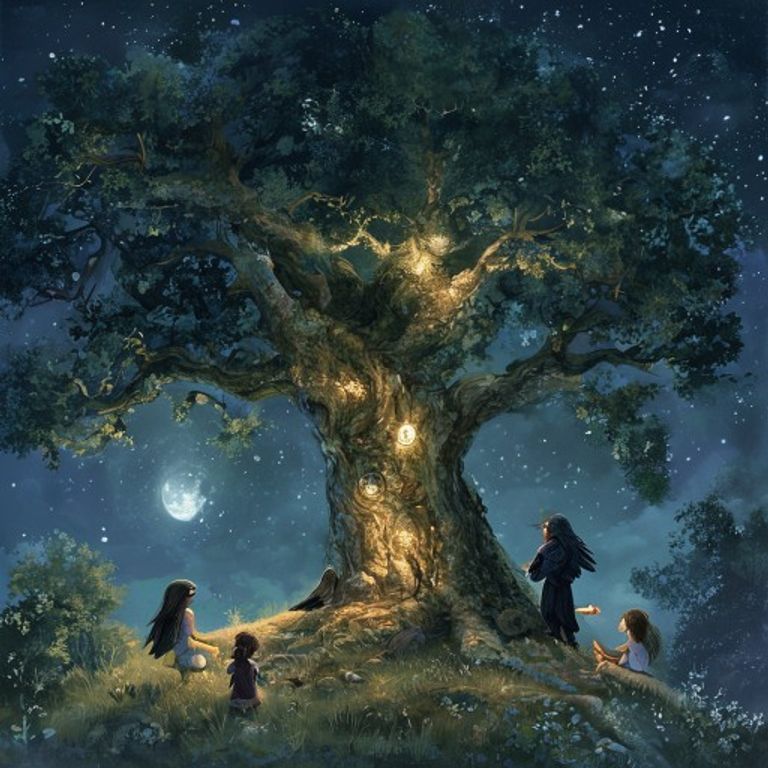
From the time he was a fledgling, Ink had loved stories. He would sit in the lowest branches of the ancient oak at the center of the forest—the one everyone called the Story Tree—and listen to Old Moss, the ancient tortoise who had been the Storykeeper for as long as anyone could remember. Old Moss would tell tales of the First Rain, of the Great Migration, of the Winter That Nearly Ended Everything. His voice was slow and creaky, like a door opening after a hundred years, but his stories were magic. The animals would gather from every corner of the forest—rabbits from the briar patches, deer from the deep glades, foxes from the rocky hills, even the shy badgers who rarely left their burrows. They would sit in a circle around the Story Tree, their eyes wide, their breath held, and they would listen.
Ink dreamed of being the Storykeeper someday.
"A Storykeeper," Old Moss told him one autumn evening, as the first red leaves began to drift down like slow-motion fire, "is not just someone who tells stories. A Storykeeper is someone who holds the truth of the forest. Every story we tell is a thread in the great web of what is real. If a thread breaks, the whole web weakens. Do you understand, young Ink?"
"I understand," Ink said, though he was not entirely sure he did.
"The most important story a Storykeeper ever tells," Old Moss continued, his ancient eyes gleaming in the twilight, "is the true one. Even when it is hard. Even when it costs you something. Because a lie, no matter how beautiful, is like a weed in a garden. It grows fast, and it chokes everything else."
Ink nodded solemnly. He would remember this. He was sure of it.
The New Storykeeper
The day came, as all days do, when Old Moss decided it was time to pass the role to someone younger. He was very old now—so old that his shell had patches of green moss growing on it, and his legs moved so slowly that telling a single story could take an entire afternoon.
"Ink," Old Moss announced at the Gathering, where all the animals of Whisperwood sat in their great circle. "You will be the new Storykeeper."
The forest erupted in cheers and caws and chirps. The rabbits thumped their feet. The deer tossed their heads. Even the owls, who usually pretended not to care about anything that happened during the day, hooted their approval from the high branches.
Ink's heart swelled until he thought it might burst through his feathers. He flew to the Story Tree, landing on the thick branch that served as the Storykeeper's perch, and looked out at the sea of faces. All those eyes, watching him. All those ears, waiting for him. It was the happiest moment of his life.
"I will be the best Storykeeper Whisperwood has ever known!" he declared, his voice ringing through the clearing. "I will tell stories that make you laugh! Stories that make you cry! Stories that make you braver than you thought you could be!"
Old Moss smiled—a slow, crinkly smile. "Remember, young Ink. The best story is the true one."
"I will remember!" Ink promised.
The Accident
Ink's first Gathering as Storykeeper was scheduled for the night of the Harvest Moon—the brightest full moon of the year, when the forest glowed silver and even the shyest creatures came out to listen. Ink wanted his first story to be unforgettable. He wanted the animals to talk about it for generations.
He spent three days preparing. He practiced his voice until it was smooth as river stones. He found the perfect story—a tale of adventure and bravery about a young raven who flew across the Great River to save a nest of baby sparrows from a flood. He added details. He added jokes. He added a dramatic pause right at the most exciting moment.
"But it needs something more," he muttered to himself on the morning of the Gathering. "It needs... spectacle."
He looked up at the Story Tree. It was a magnificent oak, with branches that spread wider than a cottage, and bark so old and rough that it had natural shelves and ledges. The Storykeeper's perch was the lowest thick branch, but above it, the tree climbed higher and higher. The highest branches swayed in the wind, dancing against the sky.
"If I tell the story from the very top," Ink thought, "everyone will be able to see me. The moon will be behind me. I will look like a hero from the stories themselves."
It was not a wise thought. But Ink was young, and he was proud, and he wanted so badly to be magnificent.
That night, the animals gathered. More animals than Ink had ever seen at a Gathering. Deer with antlers like crowns. Foxes with tails like flames. Rabbits in such numbers that the clearing looked like it was covered in soft brown pebbles. Squirrels lined every branch of every nearby tree. The owls had come down from their high perches, sitting on middle branches so they could watch. Even the fish in the Whispering Stream poked their heads above the water, listening.
Ink landed on the Storykeeper's perch. The animals cheered. He bowed. Then, with a dramatic flap of his wings, he flew upward, higher and higher, until he reached the very top of the Story Tree. The moon was enormous behind him, turning his dark feathers into a silhouette of midnight blue.
"Gather close, friends of Whisperwood!" he called, his voice carrying across the entire forest. "For tonight, I tell you the story of the Brave Raven and the Great River!"
He began. The story was wonderful. The animals were spellbound. Ink could feel their attention like warm sunlight on his wings. He added gestures. He changed his voice for different characters. He paused at the dramatic moments, letting the suspense hang in the air like mist.
Then came the climax. The young raven in the story was diving toward the flooded nest, the water rising, the baby sparrows crying. Ink wanted to make it look real. He spread his wings and leaned forward, as if he were diving too.
He leaned too far.
His talons slipped on the smooth bark of the high branch. He flapped wildly, trying to regain his balance, but his wing caught on a thin twig that jutted out from the trunk. There was a sharp CRACK, and then Ink was tumbling, tumbling, tumbling down through the branches, feathers flying, claws scrabbling, until he landed with a thud on the Storykeeper's perch below.
The forest went silent.
Ink lay there, dazed, his heart hammering against his ribs. He was not badly hurt—a few bruised feathers, a scratched wing. But as he looked up, his blood turned to ice.
The twig his wing had caught was not a twig. It was a branch. A small but beautiful branch, one that had grown from the Story Tree for over fifty years. It was cracked now, hanging by a thin strip of bark, its leaves already beginning to wilt.
Ink had broken the Story Tree.
The Lie
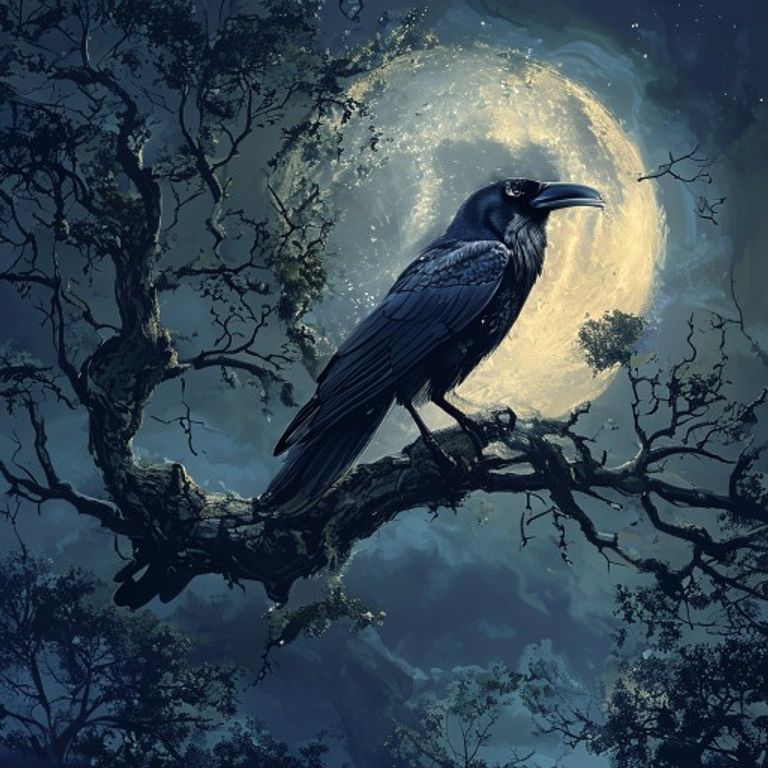
Ink stood on the Storykeeper's perch, looking out at the animals. They were all staring up at the broken branch. Whispers rustled through the crowd like wind through dry leaves.
"The Story Tree..." murmured a rabbit.
"It's broken," whispered a fox.
"Who broke it?" asked a squirrel, her voice sharp.
Ink opened his beak to speak. The truth was right there, ready to fly out: "I did. I was showing off. I climbed too high. It was an accident, but it was my fault."
But then he saw their faces. The awe had turned to concern. The joy had turned to worry. And in some eyes—just a few—he saw something worse: doubt. Doubt about the young raven who had been Storykeeper for less than a day.
"If I tell them I broke it," Ink thought, panic fluttering in his chest, "they will think I am careless. They will think I am not worthy. Old Moss will take the Storykeeper's perch back. I will lose everything."
And so, instead of the truth, a lie flew out of his beak.
"A terrible wind!" Ink cried, his voice louder and more dramatic than necessary. "A sudden, terrible wind came from the east! It caught me by surprise and snapped the branch! I barely escaped with my life!"
The animals looked at each other. The night was calm. The leaves barely stirred. But the Story Tree was high, and winds were strange at high places. Perhaps...
"A wind?" asked the squirrel, still sharp-eyed. "I felt no wind."
"It was a high wind," Ink said, his voice growing more confident as the lie settled into place. "A wind from far away. It only touched the top of the tree. We were lucky it did not break more branches. We were lucky it did not hurt anyone."
The animals murmured among themselves. Some believed him. Some did not, but they had no proof otherwise. Old Moss, sitting at the edge of the clearing, watched Ink with eyes that seemed to see everything and say nothing.
Ink finished his story—rushed now, his heart not in it. The animals clapped politely, but the magic was gone. The Gathering ended, and the creatures drifted away into the shadows of the forest, casting backward glances at the broken branch.
Ink sat alone on the Storykeeper's perch, staring at the cracked branch. "It was just a small lie," he told himself. "A wind. That's all. It doesn't matter."
But it did matter. He knew it did.
The Lies Grow
By the next morning, Ink had convinced himself that the lie was harmless. But the forest had not forgotten.
"Did you feel a wind last night?" the rabbits asked each other in the briar patches.
"I felt nothing," the foxes said in the rocky hills. "The night was still as stone."
"Perhaps it was a ghost wind," the owls hooted, their eyes gleaming. "A wind that only touches high places."
But the squirrel—her name was Quick, and she was the fastest thinker in Whisperwood—was not satisfied. She climbed the Story Tree that afternoon, her sharp claws finding holds in the rough bark, and she examined the broken branch. She noticed something: the break was not clean, as it would be if the wind had snapped it. It was jagged, with claw marks.
She did not say anything. Not yet. But she watched Ink. And Ink knew she was watching.
At the next Gathering, three nights later, Ink told another story. But this time, fewer animals came. The deer stayed in their glades. The badgers stayed in their burrows. Even some of the rabbits stayed home. The clearing felt empty, and Ink's voice echoed off the trees with a lonely sound.
Quick sat in the front row, her eyes never leaving him.
After the Gathering, Ink flew to the stream to drink. He found Old Moss there, drinking slowly, his ancient neck stretching out like a bend in a river.
"You told a story about a wind," Old Moss said, not looking up.
"Yes," Ink said, his throat tight.
"There was no wind."
"There was!" Ink insisted, too loudly. "A high wind. From the east."
Old Moss finally looked at him. His eyes were kind, but they were also sad. "A lie," he said softly, "is like a stone dropped in a still pond. The ripples go on and on. They touch shores you never intended to reach. And every time you tell another lie to cover the first, you drop another stone. Soon the pond is nothing but ripples, and no one can see the bottom anymore."
"But if I tell the truth now," Ink whispered, "they will know I lied. They will not trust me. I will lose everything."
"If you tell the truth now," Old Moss said, "they will know you are brave enough to be honest. That is a different kind of trust. A deeper kind."
"What if they don't forgive me?"
Old Moss smiled his slow, crinkly smile. "Then you will have learned something important. But I think you will be surprised. The forest is not as cruel as you fear."
He turned and walked away, his shell disappearing into the ferns, leaving Ink alone with his reflection in the stream.
The Truth
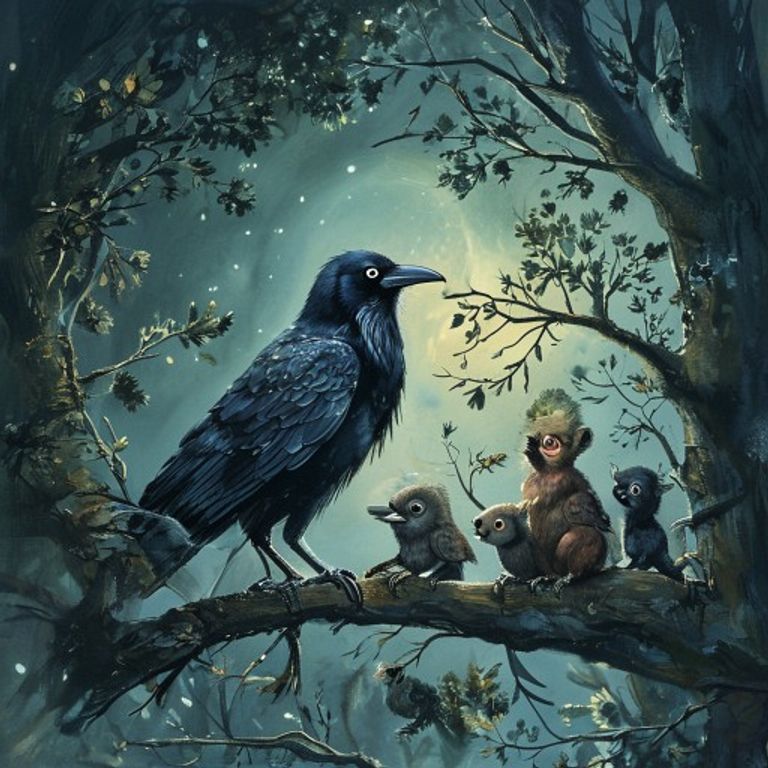
Ink did not sleep that night. He sat on the Storykeeper's perch, watching the broken branch sway in the moonlight, and he thought about all the stories he had ever loved. The brave heroes. The wise mentors. The creatures who faced their fears and came out stronger.
"If I am the Storykeeper," he said to himself, "then I must be the hero of my own story. And heroes do not hide from the truth."
At dawn, he flew to every corner of Whisperwood. He told the rabbits in the briar patches. He told the foxes in the rocky hills. He told the deer in the deep glades. He told the owls in the high branches. And he told them all the same thing:
"Gather at the Story Tree tonight. I have a story to tell you. A true one."
That night, every animal in Whisperwood came. Even the badgers emerged, blinking in the twilight. Even the fish poked their heads from the stream. They sat in the great circle, and they waited.
Ink stood on the Storykeeper's perch—not the high branch, but the low one, where Old Moss had always stood. He looked out at the faces. He saw Quick, her eyes sharp but not unkind. He saw Old Moss, his ancient head nodding slowly. He saw all the creatures who had trusted him, who had believed in him, who had come to hear his stories.
"Friends of Whisperwood," Ink began, and his voice was not dramatic or loud. It was small, and it was honest. "I told you a lie. There was no wind on the night of the Harvest Moon. The branch did not break because of a storm. It broke because of me."
The forest was silent. Not a leaf rustled. Not a cricket chirped.
"I wanted to impress you," Ink continued. "I wanted to be magnificent. So I climbed to the highest branch of the Story Tree, and I leaned too far, and I broke the branch with my wing. And instead of telling you the truth, I told you about a wind. I was afraid. I was afraid you would think I was careless. I was afraid you would think I was not worthy to be your Storykeeper. So I lied."
He paused. His heart was pounding so hard he could feel it in his talons.
"I am sorry," he said. "I am sorry for breaking the branch. I am sorry for the lie. And I am sorry for not trusting you to forgive me. A Storykeeper should tell true stories. And the truest story I know is this one: I made a mistake. I was proud. I was scared. And I was wrong."
For a long moment, no one spoke. Ink felt tears pricking his eyes—tears he did not know ravens could cry. He waited for anger. He waited for rejection. He waited for the animals to turn away and leave him alone with his shame.
But then Quick stood up. The sharp-eyed squirrel hopped onto a low branch where everyone could see her.
"I knew," she said. "I climbed the tree and saw the claw marks. I knew it was not a wind." She paused. "But I did not say anything, because I wanted to see what you would do. I wanted to see if you were the kind of Storykeeper who would hide, or the kind who would step into the light."
She looked at Ink, and for the first time, her eyes were warm. "You stepped into the light."
A murmur rippled through the crowd. Then a voice called out: "The branch can be mended!" It was the beaver, Broadtail, who was the finest builder in Whisperwood. "I will weave it back with willow strips! It will take time, but it will heal!"
"I will bring sap from the maple trees!" called a deer. "It will help the bark grow back!"
"I will sing to it every morning!" called a songbird. "Songs help things grow!"
One by one, the animals offered to help. Not because Ink had asked, but because that was what the creatures of Whisperwood did. They helped. They forgave. They believed in second chances.
Old Moss shuffled forward until he stood at the base of the Story Tree. He looked up at Ink, and his eyes were shining.
"You have learned the most important lesson of all, young Storykeeper," he said. "Honesty is not about being perfect. It is about having the courage to say, 'I made a mistake.' And trust is not about never falling. It is about being brave enough to stand up again."
The Mended Branch
It took three months for the branch to heal. Broadtail the beaver wove willow strips around the crack, tight and careful, like a doctor stitching a wound. The deer brought maple sap, which hardened into a golden scar. The songbird sang every morning, and her songs were so beautiful that other birds joined in, until the Story Tree rang with music at dawn.
And Ink? Ink became the Storykeeper he had always wanted to be. Not because he was magnificent. Not because he told dramatic stories from high branches. But because he told true stories. He told stories about his own mistakes. He told stories about the animals who had helped him. He told stories about the night he learned that honesty was not a burden, but a gift.
The broken branch became the most famous part of the Story Tree. Animals would climb up just to touch the golden scar where it had healed. "This is where the Storykeeper told the truth," they would say. "This is where honesty grew."
And every year, on the anniversary of that night, Ink would tell the story of the broken branch. He would tell it simply, without drama, without pretending. He would say: "I was proud. I was scared. I told a lie. And then I told the truth. And the truth was harder. But it was better. And it made me stronger."
The young animals would listen, their eyes wide. And when they grew older, and they made their own mistakes, they would remember the raven who broke the Story Tree and told the truth about it. They would remember that honesty was not about never falling. It was about getting up, brushing off the dust, and saying, "I did this. I am sorry. And I will do better."
The Moral of the Story: Honesty is not about being perfect. It is about having the courage to admit when you are not. A lie may seem like a shield, but it is really a prison. It traps you in a story that is not true, and every day you tell it, the walls grow higher. But the truth—even when it is hard, even when it costs you something—is a door. It opens into a world where people trust you not because you are flawless, but because you are real. The bravest thing you can do is not to climb the highest branch or tell the most dramatic story. The bravest thing you can do is to stand before the people you care about and say, "I made a mistake. I am sorry. This is what really happened." Because when you tell the truth, you give others the chance to forgive you. You give yourself the chance to grow. And you show everyone—most of all yourself—that your integrity is stronger than your fear. That is the story worth telling. That is the story that never gets old. And that is the story that makes a true Storykeeper.