The Scarecrow Who Chose Kindness
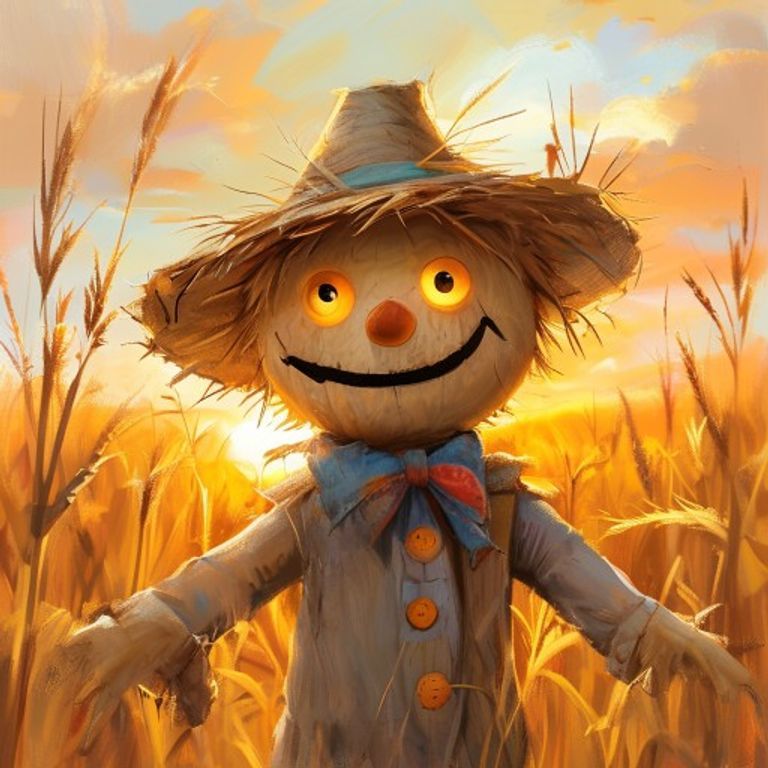
In the middle of a vast cornfield, where the golden stalks swayed like an ocean in the breeze and the sky stretched so wide it seemed to touch forever, there stood a scarecrow. His name was Strawbert.
He was not a very good scarecrow, if you were to ask the farmer who built him. His straw-stuffed body sagged a little to the left because the pole was crooked. His button eyes—one black, one brown—were slightly mismatched, giving him a permanently surprised expression. His flannel shirt had faded from bright red to a soft pink, and his straw hat had a hole in the brim where a family of field mice had nibbled through. But Strawbert's most distinctive feature was his smile. The farmer had painted it with great care, a wide, gentle curve that said, "Welcome, friend," rather than, "Go away!" Which, for a scarecrow, was something of a design flaw.
Strawbert had stood in the same spot for three seasons. He had watched the corn grow from tiny green shoots to towering golden giants. He had watched the sun rise and set over the flat horizon, painting the sky in shades of peach and violet and burning orange. He had watched the seasons change—the crisp bite of autumn, the silent white blanket of winter, the muddy renewal of spring, and the warm abundance of summer.
And every single day, he had watched the crows.
They came in the morning, black wings slicing through the mist, landing on the fence posts and the dirt paths between the rows. They came in flocks of ten, twenty, sometimes fifty, their caws echoing across the field like rough music. They hopped through the corn, pecking at the tender shoots in spring, at the ripe kernels in late summer, at the insects that buzzed around the stalks.
And every time they came, Strawbert did what scarecrows are supposed to do. He raised his wooden arms. He flapped his floppy sleeves. He tilted his hat forward and tried to look menacing.
The crows were not menaced.
"Look at that face," one crow would say, tilting its glossy head. "He looks like he wants to give us a hug."
"He's waving hello," another would caw. "How polite."
"I think he's lonely," said a third, a young crow named Ink, whose feathers were not yet the deep blue-black of adulthood but still held a hint of brown at the edges. "Look at his smile. No one who wants to scare you smiles like that."
And so the crows ate their fill, and Strawbert flapped his arms, and neither of them accomplished very much.
The Broken Wing
It happened on a Tuesday in late August, when the corn was heavy and golden and the air smelled of earth and sunshine. A young crow—barely more than a fledgling—fell from the sky.
Strawbert saw it happen. He saw the little crow struggling to keep up with its flock, its wings beating frantically but without the strength of the older birds. He saw it dip, and dip again, and then tumble in a flurry of black feathers and desperate caws, landing in the dirt at the base of Strawbert's pole with a soft thump.
The little crow lay there, dazed, one wing bent at a wrong angle. Its beak opened and closed silently. Its eyes, bright and frightened, looked up at Strawbert.
"Help," the little crow whispered. "Please."
Strawbert looked at the crow. He looked at the empty field around them—the farmer was in town, the farmhouse was a mile away, and no one would hear a little crow's cry over the wind in the corn. He looked at the sky, where the rest of the flock was disappearing over the horizon, unaware that one of their own was hurt.
And then Strawbert did something no scarecrow had ever done before.
He bent down.
It was not easy. His straw joints creaked and groaned. His wooden spine bent with alarming cracks. His button eyes strained in their sockets. But slowly, creakingly, Strawbert lowered himself until his stuffed hands—rough twine wrapped around straw—gently lifted the little crow from the dirt.
"There, there," Strawbert said, his voice like dry leaves rustling. "You're safe now."
The little crow blinked. "You... you can talk?"
"I can do many things," Strawbert said, carefully cradling the crow against his straw chest. "I just never had a reason to."
The Scarecrow's Hospital
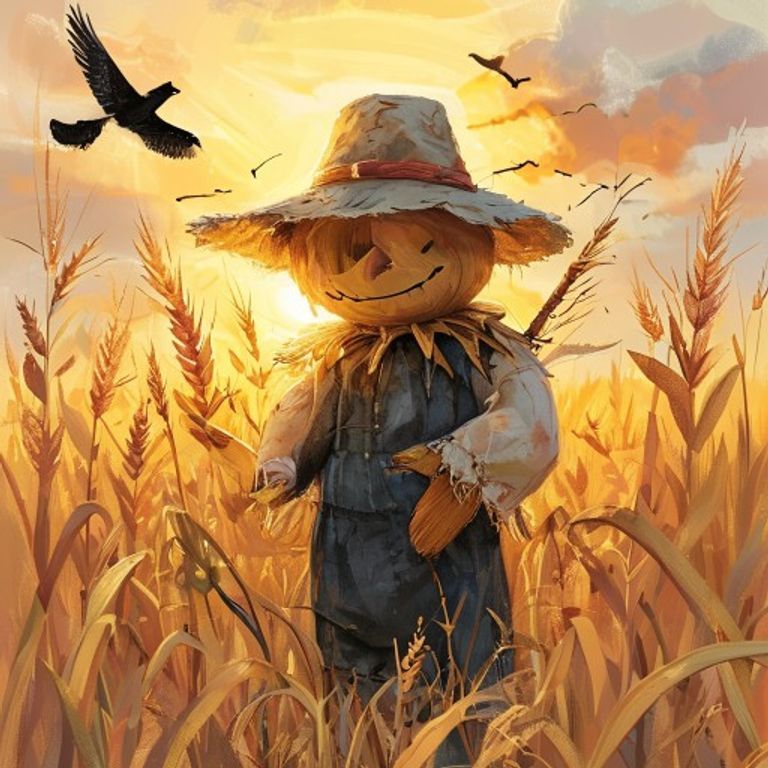
Strawbert's hat became a shelter. He placed it on the ground, brim-down, creating a little dome of shade for the injured crow. His scarf—a faded blue strip of cloth the farmer's daughter had tied around his neck—became a bandage, wrapped gently around the little crow's broken wing. And Strawbert himself became a nurse, a guard, and a friend.
He told the little crow stories to keep her mind off the pain. Stories about the field mice who held races through the corn tunnels. Stories about the old tractor that coughed and sputtered but never gave up. Stories about the time a fox had tried to sneak into the henhouse and had been chased away by the farmer's goose, who was braver than any guard dog.
He shared his corn. Not the ripe, golden ears the farmer sold at market, but the small, imperfect ones that grew at the base of the stalks, hidden under leaves. Strawbert could feel them with his straw fingers, and he would twist them free and place them gently beside the little crow.
"I thought scarecrows hated crows," the little crow said one afternoon, her wing beginning to heal under Strawbert's care. "I thought you were supposed to scare us away."
"I was built to scare," Strawbert admitted. "But I was never very good at it. And besides..." He looked out at the cornfield, at the wide sky, at the world that seemed to stretch forever in every direction. "How can I scare something that is just trying to live? You are hungry. You are doing what your heart tells you to do. How can that be wrong?"
The little crow—whose name was Pip, she had finally told him—looked at Strawbert with shining eyes. "You are the kindest thing I have ever met," she said. "And you are made of straw."
Strawbert laughed, a sound like wind chimes made of dried corn husks. "Kindness does not need flesh and blood, little Pip. It only needs a heart. And though mine is stuffed with straw, it is very full."
The Flock Returns
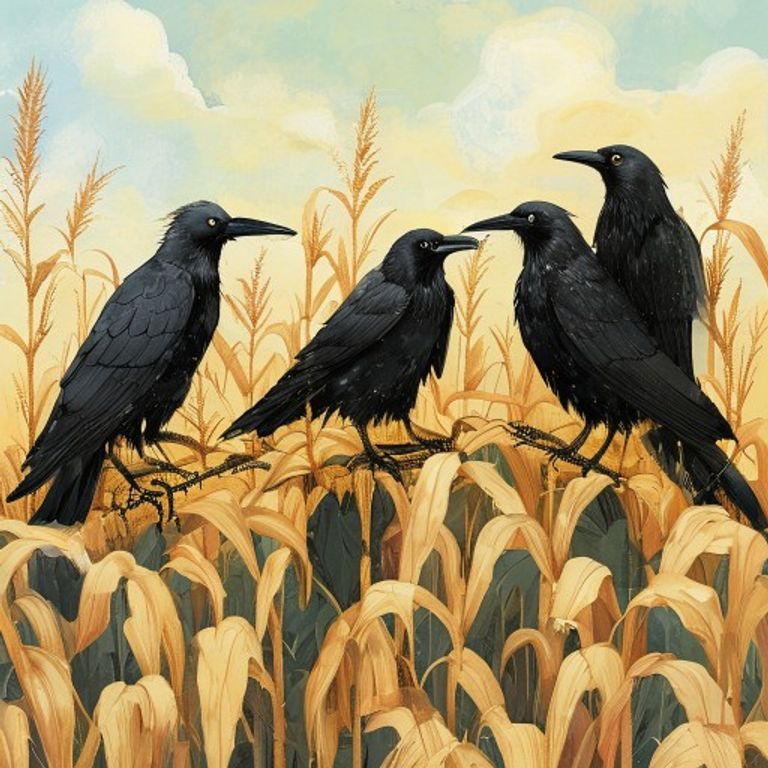
When Pip's flock returned three days later, circling the field in their black cloud, calling for their lost member, they found something they had never seen before.
They found Pip, her wing healed and strong, perched on Strawbert's shoulder, eating corn from his outstretched hand. They found Strawbert himself, not flapping or waving or trying to look frightening, but standing tall and gentle, his painted smile as wide as ever.
"Pip!" Ink cried, landing on the fence post. "We thought you were dead! We searched for days!"
"I was hurt," Pip said. "My wing was broken. And Strawbert saved me."
The crows were silent. They looked at Strawbert. They looked at Pip. They looked at the corn that surrounded them, ripe and golden and untouched by their beaks for three whole days.
"But... he's a scarecrow," said an older crow named Slate, his voice uncertain. "He is supposed to be our enemy."
"He was never our enemy," Pip said. "He was only ever alone. And when someone is alone, the kindest thing you can do is be their friend."
And then something extraordinary happened.
Ink flew to Strawbert's other shoulder. Then Slate. Then two more crows, then five, then ten. They landed on his arms, his head, his hat, until Strawbert was wearing a cloak of glossy black feathers, their weight warm and alive against his straw. They cawed and chattered and nuzzled against him, and Strawbert, who had stood alone in the field for three seasons, felt something he had never felt before.
He felt seen.
The Harvest
Autumn came, and with it, the harvest. The farmer and his family worked long days, cutting the corn, loading it into wagons, stacking the golden stalks in tall barns. They worked from dawn until the stars came out, their hands rough and their backs tired.
Strawbert watched them, and for the first time, he felt a twist of worry in his straw heart. The farmer had built him to protect the corn. And now the corn was being taken away. What would happen to Strawbert when the field was empty? Would the farmer take him down? Would he be left to rot in the winter snow? Would he ever see his crow friends again?
But the crows had been thinking too.
Every morning, while the farmer worked, the crows would fly in tight circles around Strawbert, keeping him company. Every afternoon, they would bring him gifts—a shiny pebble, a blue jay feather, a length of red string they had found in the barn. And every evening, as the sun set and the farmer went inside for supper, the crows would settle around Strawbert's feet and tell him stories of their own. Stories of the places they had flown. Stories of the worms they had found. Stories of the world beyond the cornfield, which was so much bigger than Strawbert had ever imagined.
"You should come with us," Ink said one night, as the first frost began to silver the stubble of the harvested field. "When we fly south for the winter. You could ride on Slate's back. He's the strongest."
Strawbert smiled his painted smile. "I am tied to this pole, little friend. I cannot fly."
"Then we will stay," Pip said firmly. "We will not fly south. We will stay here, with you."
"You cannot stay," Strawbert said gently. "Winter here is cold and harsh. There is no food. You would freeze. You would starve."
"Then we will find another way," said Slate. And he flew away into the dusk, his black wings cutting through the cold air.
He returned the next morning with the entire flock. And in their beaks, they carried sticks. Sticks and straw and dried grass and bits of old cloth.
They built him a house.
It was not a big house. It was not a fancy house. It was a small, warm shelter at the base of Strawbert's pole, woven from sticks and lined with straw and feathers and bits of wool they had pulled from the fence. It had a roof of woven corn husks and a doorway just big enough for a crow. And inside, it was warm and dry and safe.
"For you," Pip said, hopping into the little house and then back out. "And for us. So we can stay. So we can be warm. So we can be together."
Strawbert looked at the little house. He looked at the crows, his friends, his family. And for the first time since he had been built, his painted smile felt real.
The Winter Garden
Winter came, sharp and white and silent. The field was covered in snow, the corn stubble poking through like whiskers on a white face. The farmhouse windows glowed with warm light, and smoke rose from the chimney in soft gray curls.
Strawbert and the crows weathered the cold together. They huddled in the little house at the base of his pole, sharing warmth and stories. The crows would fly to the farmhouse barn, where the farmer kept grain for his chickens, and they would bring back kernels for Strawbert to hold in his straw hands. They were not stealing, exactly. They were borrowing. And they always left a gift in return—a shiny button, a polished stone, a blue jay feather laid carefully on the barn floor.
On the coldest nights, when the wind howled and the snow piled high, Strawbert would tell stories to keep the crows' spirits up. Stories of spring. Stories of warm sun on corn leaves. Stories of the first green shoot pushing through the earth. And the crows would listen, their bright eyes reflecting the moonlight, and they would believe, because Strawbert believed, that winter would end.
And one morning, it did.
The snow began to melt. The earth turned from white to brown to green. The first shoots of new corn pushed through the soil, tiny and tender and impossibly green. And the crows—who had stayed through the winter, who had not flown south, who had chosen kindness over instinct—were there to see it.
"You stayed for me," Strawbert said, his voice full of wonder. "You could have flown to warmth and sun. But you stayed."
"You stayed for Pip," Ink said simply. "When she was hurt. When she needed help. You could have let her lie there. You could have done what scarecrows are supposed to do—nothing. But you helped. You were kind. And kindness, Strawbert, is a chain. Once someone starts it, it does not stop. It just keeps going."
The Kindest Scarecrow
Spring turned to summer, and summer to autumn, and the corn grew tall and golden once again. The farmer came out to check on Strawbert and found something he had never seen before.
His scarecrow was surrounded by crows. Not attacking him. Not pecking at the corn. Just sitting. Perching on his shoulders, his arms, his hat. Talking to him. Nuzzling against him. Being... friends.
"Well, I'll be," the farmer said, scratching his head. "You're supposed to scare them away, not invite them to tea."
But the farmer was not angry. Because his corn was safe. The crows, who had once eaten their fill of the golden kernels, now ate only what fell on the ground. They helped Strawbert watch for real threats—foxes, weasels, hungry deer. They were better guards than any scarecrow could ever be.
And so the farmer left Strawbert exactly as he was. Crooked pole, mismatched buttons, faded shirt, and all. Because Strawbert had become something better than a scarecrow. He had become a bridge. A connection. A reminder that the things we are told to fear are often just the things that need our kindness most.
Years passed. Strawbert grew older—his straw turned gray, his flannel shirt became threadbare, his button eyes grew cloudy. But the crows never left. New generations came, and the old crows told them the story of the scarecrow who had saved a broken wing. Of the kindness that had started a chain. Of the friendship that had changed everything.
And when Strawbert finally grew too old to stand, when his pole rotted and his straw scattered in the wind, the crows did not forget him. They built a new scarecrow in his place, woven from sticks and lined with the softest feathers, with a smile painted just as wide and gentle as Strawbert's had been. And they called it Strawbert the Second.
But everyone knew. It was not the straw that mattered. It was not the buttons or the pole or the faded shirt. It was the kindness. The kindness that had lived in a scarecrow's straw heart. The kindness that had turned enemies into friends. The kindness that had made a lonely field feel like home.
And so, in the middle of a vast cornfield, where the golden stalks swayed like an ocean in the breeze and the sky stretched so wide it seemed to touch forever, there stood a scarecrow. Not a very good scarecrow, if you were to ask what scarecrows are supposed to do.
But if you were to ask what kindness looks like, you would only need to look at his smile.
The Moral of the Story: Kindness is not about what you are supposed to do. It is about what you choose to do. Strawbert was built to scare crows. That was his job. That was his purpose. But when he saw a little crow who was hurt, who was frightened, who needed help, he did not think about what scarecrows were supposed to do. He thought about what was right. And he chose kindness. That is the secret of kindness. It is not about being the biggest, or the strongest, or the most important. It is not about having the most to give, or being in the best position to help. It is about choosing to care, even when it is hard. Even when it goes against what everyone expects. Even when it means being different. Strawbert could have let Pip lie there. He could have stood still and done nothing, like a proper scarecrow. No one would have blamed him. No one would have even known. But he would have known. And that is what kindness is. It is the voice inside you that says, "I can help. So I will." It does not matter if you are made of straw or stone or flesh and blood. It does not matter if you are big or small, strong or weak, brave or afraid. What matters is that you choose to be kind. Because kindness is the most powerful magic in the world. It turns enemies into friends. It turns loneliness into belonging. It turns a cold, empty field into a home. And once you start it, once you choose it, it does not stop. It keeps going. From one heart to another. From one act to the next. A chain of kindness, stretching across time and space, connecting everyone who has ever chosen to care. So if you ever feel too small to make a difference, remember Strawbert. Remember the scarecrow who was not very good at scaring, but who was very, very good at loving. Remember that kindness does not need to be big to be powerful. It only needs to be real. And it only needs to start with you.