The Octopus Who Stole the Moon Pearl: A Story About Forgiveness
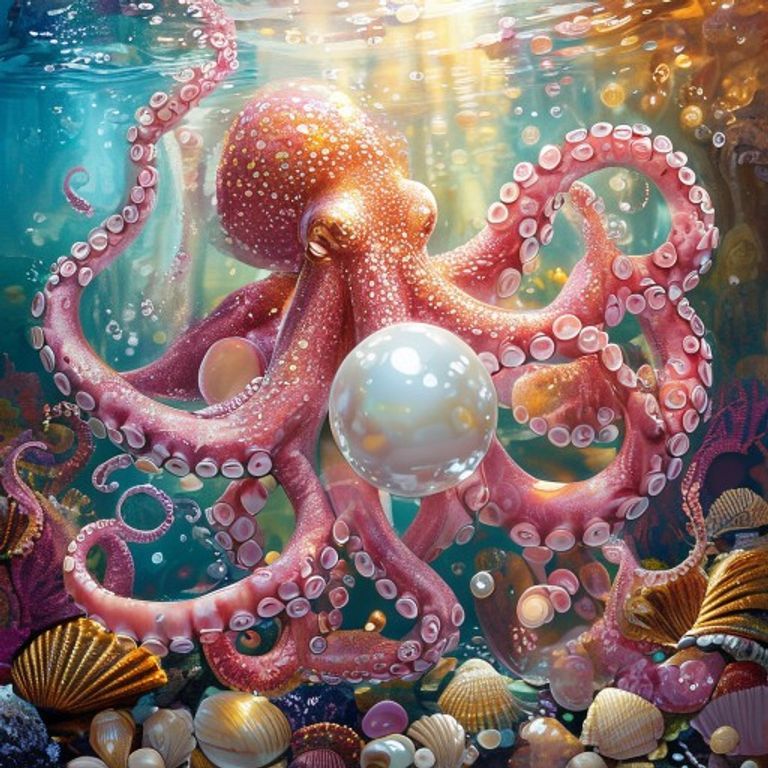
In the shallow tide pools of the Sun Coast, where the water was warm as a bath and clear as glass, there lived an octopus named Ink. She was the color of sunset clouds — soft coral pink with swirls of gold and silver — and she had eight long arms that could reach into every crack and crevice of the rocky pool. But her most remarkable feature was not her color or her arms. It was her collection.
Ink collected beautiful things.
She collected shiny pebbles that caught the light like tiny mirrors. She collected sea glass that had been softened by decades of tumbling in the waves — green glass and blue glass and the rarest pink glass that looked like frozen cotton candy. She collected shells of every shape: spirals and fans and smooth white discs that felt like silk against her suckers. She collected coins that had fallen from ships, and buttons from sailor coats, and even a silver spoon that had tumbled down from a picnic basket on the cliffs above.
Her collection filled three-quarters of her tide pool. It spilled out of the cave where she slept. It covered the rocks where she rested. It glittered and gleamed and caught the sunlight in a thousand tiny flashes, making her home look like a treasure chest that had been opened by the sea itself.
Ink was proud of her collection. She arranged it by color. She rearranged it by size. She spent hours moving one shell three inches to the left so it would catch the light just so. She believed — truly believed — that the more beautiful things she gathered, the more beautiful she was. That her worth was measured by the shine of her treasures.
And she had never, not once, thought about where those beautiful things came from. Or who might have loved them before she took them.
The Pearl
It happened on a morning in late summer, when the tide was high and the water was so clear that Ink could see all the way to the bottom of the deepest pool. She was hunting for breakfast — little crabs, tiny fish, sea snails that crunched satisfyingly between her beak — when she saw something that made all eight of her arms go still.
A pearl.
It was the most beautiful thing Ink had ever seen. Not the largest — no bigger than her eye — but the most perfect. It glowed with a soft white light, like a piece of the moon that had fallen into the sea. Its surface was smooth as cream and bright as starlight, and when the sun hit it, it threw rainbows onto the rocks around it.
The pearl sat in the shell of an oyster named Mother-of-Pearl. She was an ancient oyster, her shell the size of a dinner plate, her edges rough and barnacled from sixty years of life. She had nested in the same spot since before Ink was born — a quiet corner of the tide pool where the current was gentle and the sand was soft. She never moved. She never spoke much. She simply... was. A part of the landscape. A grandmother of the sea.
And for seven years, she had been growing that pearl.
Not for herself. For her children. For the oysters she would never meet, the great-great-grandchildren who would inherit her spot in the tide pool long after her shell had become sand. The pearl was her legacy. Her gift to the future. The story of her life, compressed into a single perfect sphere of light.
Ink did not know any of this.
She only knew that the pearl was beautiful. And that she wanted it.
Her first arm reached out before her mind could stop it. Her sucker touched the pearl's surface — cool and smooth and more wonderful than any glass, any shell, any coin she had ever touched. Her second arm reached out. Her third. Her fourth. She wrapped all eight arms around the oyster, prying at her shell, pulling with all her strength.
Mother-of-Pearl resisted. She clamped her shell shut with a force that surprised even Ink — the strength of sixty years, the strength of a mother protecting her child. But Ink was younger. Ink was hungrier. Ink had the desperate strength of someone who believed that possessing beautiful things was the same as being beautiful.
With a sound like a sigh, the shell opened.
Ink snatched the pearl and fled.
The Empty Place
Ink placed the pearl at the center of her collection. She arranged her best shells around it. She put her rarest sea glass beside it. She angled a piece of mirror-glass above it so that when the sun came through the water, the pearl would throw its rainbows across her entire treasure trove.
It was magnificent.
It was perfect.
And it felt like nothing.
Ink stared at the pearl for hours. She waited for the rush of pride she usually felt when she added something new. She waited for the warmth that spread through her arms when she looked at her collection. She waited for the voice inside her — the one that always said more, more, more — to quiet down and let her rest in satisfaction.
But the voice only grew louder.
Because Ink knew, deep in the part of her that was older than collecting and wiser than wanting, that the pearl did not belong to her. That she had taken something that was not hers to take. That the beauty of the pearl was not in its shine, but in the love that had made it — and that love did not belong to her, and never would.
She tried to ignore the feeling. She rearranged her collection. She polished the pearl with her softest arm. She told herself that beautiful things wanted to be gathered. That they existed to be admired. That the oyster was just a shell, just a creature, just a thing — and things could not own beauty. Beauty belonged to whoever could appreciate it most.
But the pearl seemed to dim whenever she looked at it. Its rainbows grew pale. Its glow grew cold. And Ink began to understand that some beautiful things cannot be stolen without losing what makes them beautiful.
That night, a storm came.
The Storm
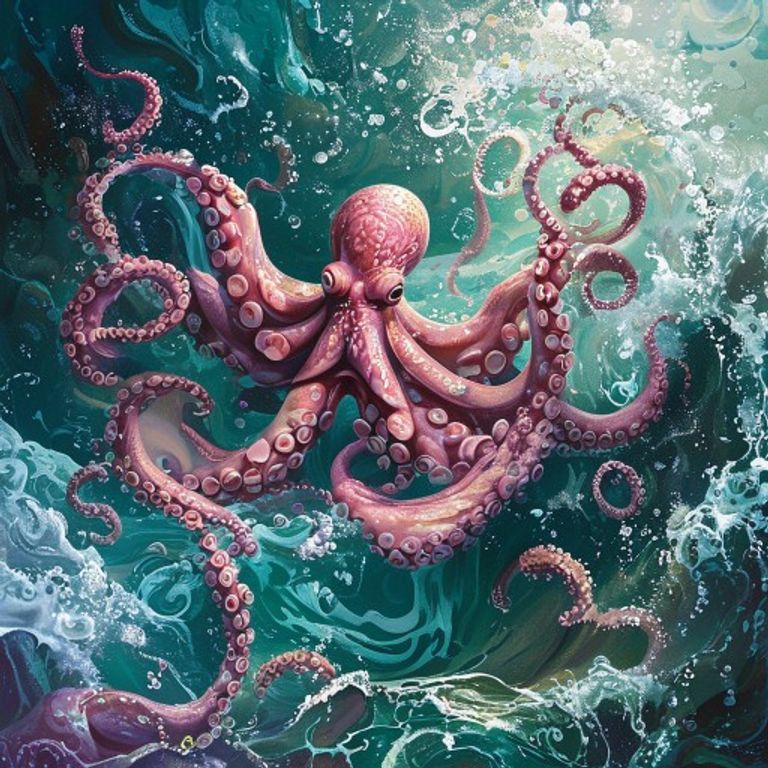
It was not the worst storm the tide pools had ever seen, but it was bad enough. The waves rose higher than the rocks. The rain fell in sheets. The water churned and foamed and roared, and creatures huddled in their caves and crevices, waiting for the morning.
Ink tried to protect her collection. She wrapped her arms around the pearl. She pulled her shells close. She wedged her sea glass into cracks where the current could not reach it. But the storm was stronger than her eight arms. The waves tore at her treasures. The current dragged her shells away. And in a single, terrible moment, a surge of water struck her cave with the force of a falling tree.
Ink held onto the pearl with every sucker she had. But the pearl was smooth. The pearl was round. The pearl was made to slip through water, not to be held against it.
It slipped from her grasp.
Ink lunged after it. Her arms stretched to their full length — each one longer than her body, each one reaching with desperate strength. She touched the pearl with the tip of one sucker. For a moment, she held it. For a moment, she believed she could save it.
But the pearl rolled off her sucker, caught in the current, and tumbled into the deep water beyond the tide pool — into the darkness where the sea floor dropped away, into the place where no tide pool creature could follow, into the forever-deep where light did not go.
It was gone.
And Ink could not bring it back.
The Confrontation
The next morning, the water was calm again. The sun was gentle. The tide pool sparkled as if the storm had never happened. But something had changed. The water tasted different. The rocks felt different. The silence was different.
Because Mother-of-Pearl knew.
She knew the moment the storm passed. She knew because she felt the empty space inside her shell where the pearl had been. She knew because the water around her carried the chemical memory of struggle — the stress hormones, the fear signals, the desperate pulse of a creature fighting for something precious. She knew because she was ancient, and ancient things know when something has been taken from them.
And she knew because Ink came to her.
Not hiding. Not running. Not pretending it had not happened. Ink swam to Mother-of-Pearl's corner of the tide pool — slowly, heavily, all eight arms dragging in the sand — and stopped before the ancient oyster. She did not speak at first. She simply... was there. Present. Guilty. Broken.
"I took it," Ink finally said. "I am sorry."
Mother-of-Pearl did not open her shell. She did not need to. Her voice came through the water, old and soft and tired. "I know."
"I wanted to bring it back," Ink said, and her voice cracked like a shell under pressure. "I tried. The storm — it was the storm — the pearl is gone. I cannot bring it back. I cannot fix it. I cannot give you what I took."
The water between them was silent. The current moved gently, carrying the scent of salt and the memory of rain.
"Seven years," Mother-of-Pearl said. "I grew that pearl for seven years. It was not for me. It was for the oysters who will live here when I am sand. It was their inheritance. Their story. Their beginning."
Ink felt something collapse inside her — not her body, but the part of her that had believed collecting things made her whole. "I know," she whispered. "And I cannot bring it back. I cannot undo what I did. I cannot make it right. I am sorry. I am so sorry. And I know sorry is not enough."
Mother-of-Pearl was quiet for a long time. So long that Ink thought the ancient oyster had fallen asleep, or given up, or simply decided that Ink was not worth speaking to anymore. Ink began to turn away, to crawl back to her empty cave, to live with the shame of what she had done for the rest of her life.
But then Mother-of-Pearl spoke.
"Do you know," she said, "what a pearl is?"
Ink stopped. "It is... it is beautiful. It shines."
"It is a wound," Mother-of-Pearl said. "A pearl begins as a grain of sand — a tiny, sharp thing that hurts. It gets inside the oyster's shell, and the oyster cannot get it out. So the oyster does the only thing it can do. It wraps the sand in layer after layer of smoothness, until the sharp thing becomes a soft thing. Until the pain becomes beauty. The pearl is not a treasure, little thief. It is a wound that chose to heal."
Ink felt her arms tremble. "I gave you a wound," she said. "But I cannot wrap it in smoothness. I cannot make it beautiful. The pearl is gone."
"No," Mother-of-Pearl said. "The pearl is gone. But the wound is here. And you are here. And I have a choice to make."
The Choice
Mother-of-Pearl told Ink a story.
When she was young — younger than Ink was now — she had been a different creature. She had been greedy. She had taken the best spots in the tide pool, pushing smaller oysters into rough sand where the current was too strong. She had stolen plankton from the filter-feeders beside her, reaching farther than her share, eating more than her need. She had been thoughtless and selfish and hungry, the way all young things are thoughtless and selfish and hungry.
And one day, she had taken something that could not be replaced. A shell. A perfect, spiraled shell that belonged to a young hermit crab named Clatter. Clatter had found it after molting, after searching for weeks, after dreaming of the home it would become. And Mother-of-Pearl, in her hunger for beautiful things, had rolled her heavy body onto it and crushed it to powder.
Clatter had been devastated. He had sat beside the broken shell for three days, not moving, not eating, simply staring at the dust of his dream. Mother-of-Pearl had watched him, ashamed and silent, waiting for the rage she deserved.
But Clatter had not raged. On the fourth day, he had turned to her and said: "You did not mean to crush my shell. You did not see me. You only saw something you wanted. And I forgive you. Not because what you did was okay. But because holding anger against you would be another shell that I would have to carry — and I am already tired."
"Clatter forgave me," Mother-of-Pearl said, her voice soft as tide. "And because he forgave me, I changed. I stopped taking. I started giving. I grew my first pearl not for beauty, but for love. And every pearl since then has been an apology. A thank-you. A promise that the creature who crushed a shell would spend her life making beautiful things for others."
She paused. The water moved between them, carrying the story like a current carries a seed.
"I will not tell you that what you did was okay," Mother-of-Pearl said. "Because it was not. I will not tell you that I am not angry. Because I am. I will not tell you that the pearl does not matter. Because it mattered more than you will ever understand. But I will tell you this: I have been the one who took. I have been the one who hurt. I have been the one who needed forgiveness. And I know that the only way to stop the wound from growing is to choose love over punishment. So I forgive you, Ink. Not because you deserve it. But because I deserve peace."
The Giving Back
Ink did not know what to do with forgiveness. She had never received it before. She had spent her whole life collecting things, not receiving gifts. And forgiveness — real forgiveness, given freely by someone she had deeply hurt — felt like the most precious thing she had ever touched. More precious than pearls. More precious than gold.
But she also knew that forgiveness was not the end. It was the beginning.
She began to return her collection.
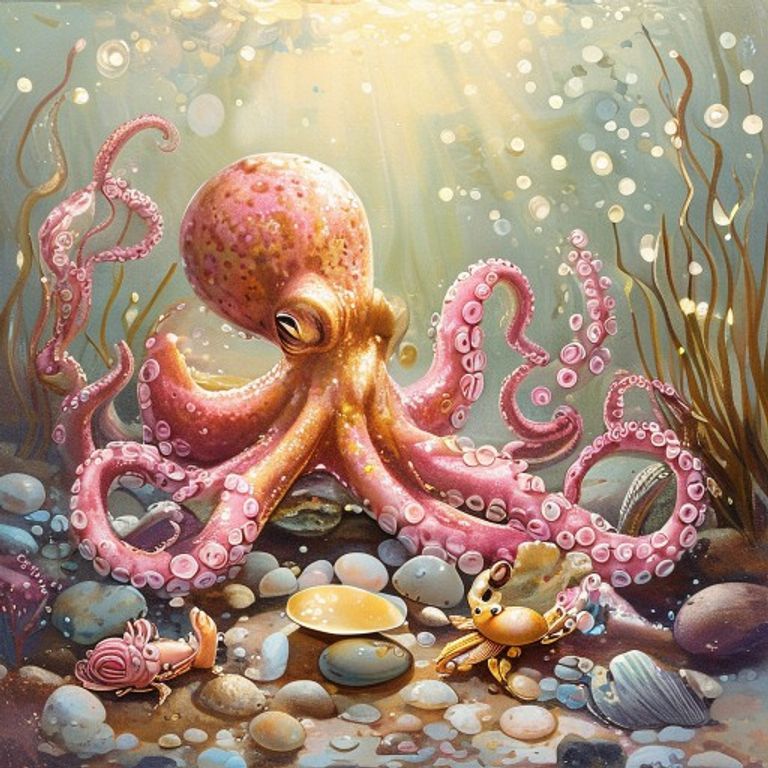
One by one, she found the creatures she had taken things from. The crab whose pebbles she had stolen. The anemone whose sea glass she had pried from its tentacles. The snail whose shell she had snatched while it was sleeping. The fish whose coin — a lucky charm from its grandmother — had disappeared from its hiding spot. She returned them all. Not with excuses. Not with explanations. Simply: "I took this. It was not mine. I am sorry."
Some creatures were angry. Some did not believe her. Some took their things back without a word. But Ink did not hide from their anger. She accepted it. She let it wash over her like the tide, knowing that she had earned it, knowing that it was part of the price of what she had done.
And some creatures forgave her. Not all. But enough. Enough to show her that the world was not only full of things to take, but also full of hearts that could choose love over punishment.
Her collection shrank. Her cave grew empty. The rocks around her home were bare and plain. And for the first time in her life, Ink looked at her empty space and felt... free.
Because she understood now that a collection is just a pile of things that someone else is missing. That beauty cannot be owned, only borrowed. That the only way to truly have something beautiful is to let it be where it belongs.
But she did not stop at returning what she had taken. She began to give things she had never taken. She found a smooth white stone and placed it beside the young crab's burrow. She wove a strand of kelp into a blanket for the sleeping snail. She polished a piece of driftwood with her softest arm and left it for the fish to use as a sunning spot.
She was not collecting anymore. She was giving. And giving, she discovered, felt better than taking ever had.
The New Pearl
It happened on a morning one year later, when the water was the same warm clarity and the tide pool sparkled with the same gentle light. Ink was bringing Mother-of-Pearl a gift — a piece of shell she had found that matched the color of the lost pearl, white and soft and glowing — when she noticed something.
Mother-of-Pearl's shell was open.
Not wide. Just a crack. Just enough to show what lay inside.
It was a pearl. Small. New. Barely bigger than a grain of sand. But growing. Layer by microscopic layer. Day by patient day.
"You are growing another one," Ink said, her voice full of wonder and sorrow — wonder at the beauty, sorrow at what she had cost.
"I am," Mother-of-Pearl said. "Not for my great-great-grandchildren this time. Not for the future. For you."
Ink went still. All eight arms froze in the water. "For... me?"
"For you," Mother-of-Pearl confirmed. "Because you returned what you took. Because you gave what you never had to give. Because you changed. This pearl is not a replacement for the one that is lost. Nothing can replace that. This pearl is a symbol. A reminder. A promise that forgiveness is not the end of the story — it is the beginning of a new one."
"But I cannot take it," Ink said. "I cannot own it. I know that now."
"You will not own it," Mother-of-Pearl said. "You will keep it. Here, in the tide pool, where it belongs. Where you can see it. Where it can remind you, every day, that a creature who took can also learn to give. That a wound can become a pearl. That forgiveness is not forgetting — it is choosing to grow something beautiful from the hurt."
And so the pearl grew. Slowly. Patiently. The way all pearls grow. And Ink, who had once believed that beauty was something to steal, learned that beauty is something to grow. Something to give. Something to share.
She became the tide pool's guardian. She helped young crabs find safe homes. She protected sleeping snails from hungry fish. She shared her food with creatures who had none. And every morning, she would swim to Mother-of-Pearl's corner and sit beside her, not collecting, not taking, simply being. Simply present. Simply grateful.
And when the pearl was finally finished — smooth and white and glowing with a soft inner light — it did not sit in a collection. It sat in the tide pool, where the current could carry its story to every creature who passed by. Where the sunlight could throw its rainbows onto the rocks, not for one octopus to admire, but for everyone.
Because that is what forgiveness does. It does not erase the past. It does not make the hurt disappear. But it transforms the hurt into something else. Something gentle. Something shared. Something that belongs to everyone who sees it and knows the story of how it came to be.
And that, little one, is the most beautiful thing of all.
The Moral of the Story: Forgiveness is not about saying that what happened was okay. It is not about pretending the hurt never happened. It is not about forgetting, or fixing, or making everything go back to the way it was before. Sometimes — most times — what was broken cannot be fixed. What was taken cannot be returned. What was lost cannot be found. And forgiveness must happen anyway. Mother-of-Pearl could not have her pearl back. Ink could not undo what she had done. The hurt was real. The loss was permanent. And yet — forgiveness happened. Not because the wrong was erased, but because the heart chose to grow something new from the wound. Forgiveness is the choice to stop letting the past define the future. It is the choice to say: "What you did hurt me. I will not pretend it did not. But I will not let it turn me into someone who only knows how to hurt back." It is the hardest, bravest, most beautiful choice a heart can make. And when we make it — when we truly, deeply, honestly choose to forgive — we do not just free the person who hurt us. We free ourselves. We become the oyster who turns the wound into a pearl. We become the creature who says: "This hurt me. But I will not let it be the end of my story. I will make it the beginning of something beautiful." And that is the truest magic there is. Not forgetting. Not erasing. But transforming. Growing. Choosing love over punishment, even — especially — when punishment would be easier. That is forgiveness. And that is the most powerful magic in all the sea.