The Hummingbird Who Learned to Be Still: A Story About Mindfulness
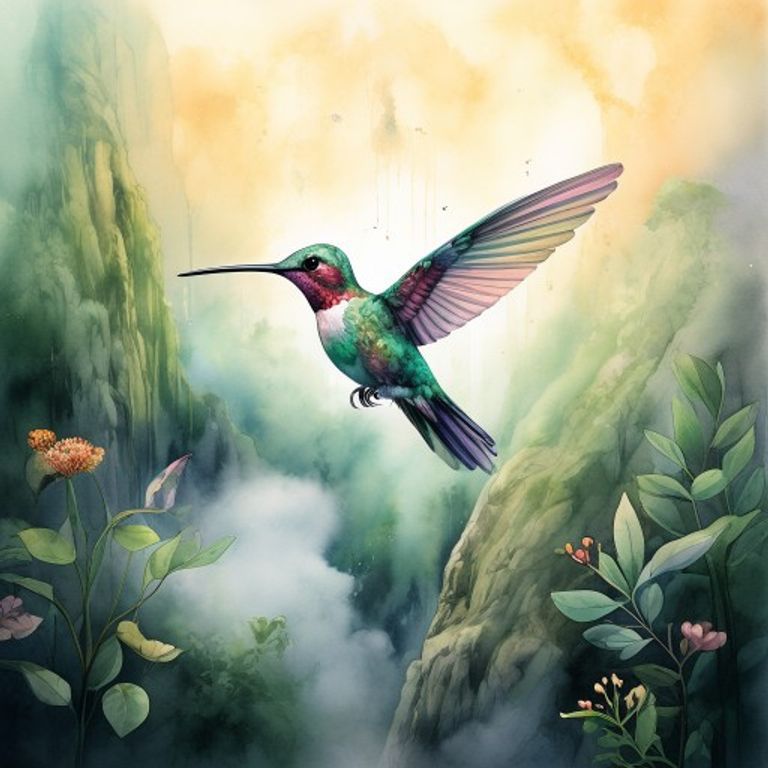
In the Cloudmist Mountains, where the air was so thin it tasted like starlight and the clouds drifted through the trees like herds of silent ghosts, there lived a young hummingbird named Zip. She was smaller than your thumb, her feathers a blur of emerald and ruby and gold, her heart beating twelve hundred times every minute. She was the fastest creature in the forest. She could hover in place, fly backwards, dive at sixty miles per hour, and sip nectar from a flower so quickly that the flower itself barely noticed she had been there.
Zip never stopped moving.
She could not stop moving. A hummingbird's heart was a tiny engine that burned fuel so quickly she had to eat every ten minutes or she would die. She visited a thousand flowers a day. She chased away bees twice her size. She performed courtship dives that made the air scream. She was a living streak of color, a heartbeat with wings, a creature for whom stillness was not just unfamiliar — it was impossible.
"You are exhausting to watch," said the old mountain swallow, a bird named Glide who had been sailing the wind currents for thirty years. "Have you ever tried sitting on a branch?"
"I sit on branches," Zip said indignantly, hovering in midair because even when she talked, she could not stop flying.
"You land on branches," Glide corrected. "You perch for three seconds, then launch. That is not sitting. That is landing. There is a difference."
"Sitting is for creatures who don't need to eat ten times an hour," Zip said. "Sitting is for creatures with slow hearts. I have a fast heart. Fast hearts need fast lives."
Glide ruffled his gray feathers and said nothing more. But his silence stayed with Zip, a small thorn in her mind, pricking at moments when she was darting between flowers, drinking the world in sips too quick to taste.
Then Zip heard about the Moonbloom.
It was a flower that grew only on the highest peak of the Cloudmist Mountains, a blossom so rare that it opened just once a year, at midnight, under the full moon. Its nectar was said to be the sweetest in the world — sweeter than agave, sweeter than honeysuckle, sweeter than the first drop of rain after a drought. But more than that, the old swallows said the Moonbloom granted something else to any creature who tasted it.
"The vision of the slow world," Glide had called it, his eyes distant and strange. "You see what the rest of us miss. You see what exists between the moments."
Zip did not know what "between the moments" meant. She lived in the moments themselves, darting from one to the next so quickly they blurred together. But she wanted that nectar. She wanted to be the first hummingbird in generations to taste the Moonbloom.
So she set out.
The Cliff
The flight to the peak was farther than Zip had imagined. The Cloudmist Mountains rose in layers — lowland orchids, middle-forest bromeliads, high-altitude moss gardens, and finally the alpine tundra where nothing grew but lichen and stubborn grass. Zip had never been above the middle forest. She had never seen the world from so high. The air grew thinner with every wingbeat. The flowers grew scarcer. The wind grew sharper, cutting through her feathers like tiny knives.
By late afternoon, she was exhausted. Her wings ached. Her heart hammered not with excitement but with strain. She had eaten every flower she could find, but the high-altitude blossoms were small and pale, barely a sip each. She was burning more energy than she was taking in.
And the peak was still miles away.
Zip found a cliff ledge — a narrow shelf of rock jutting from the mountainside, covered in soft moss and sheltered from the wind by an overhang. She landed on it. Her legs trembled. Her wings drooped. For the first time in her life, she did not want to fly. She wanted to rest.
But she could not rest.
Her heart would not slow down. It beat and beat and beat, a tiny drum insisting that she move, that she eat, that she keep going. She hopped along the ledge, looking for flowers, but there were none this high. She tried to preen her feathers, but her beak shook. She tried to tuck her head under her wing, the way other birds slept, but her body vibrated with unused energy, a engine revving in neutral.
"You are new here," said a voice.
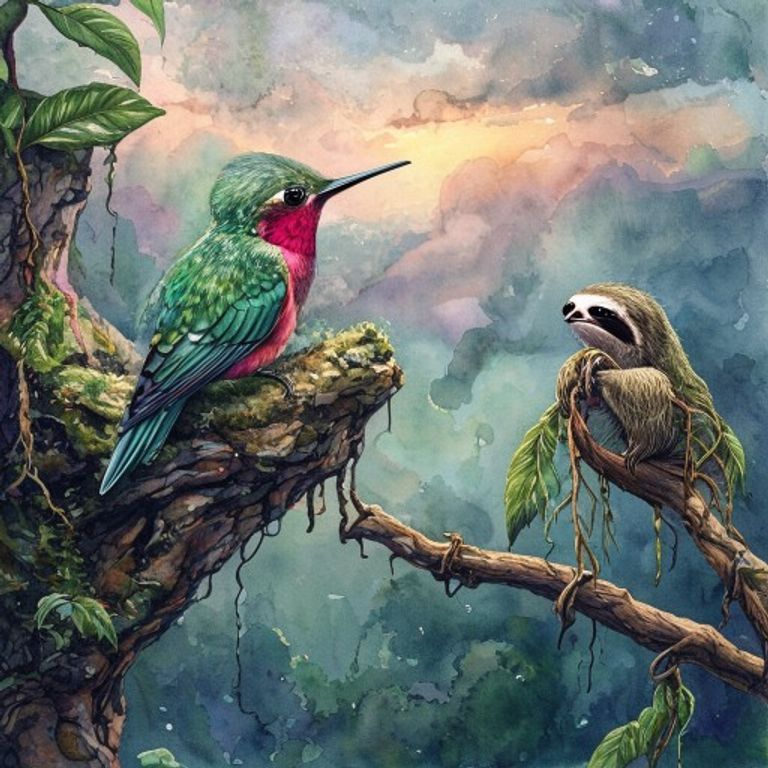
Zip spun around — a movement that used up precious calories — and found herself face-to-face with a sloth.
He was hanging upside down from a twisted root that clung to the cliff face, his body a soft mound of greenish fur. Algae grew on his coat in tiny gardens. His face was gentle and slow, his eyes half-closed, his breathing so subtle that Zip could not see his chest move. He looked like a creature made of moss that had learned to smile.
"I'm Zip," she said, hovering because she could not stand still. "I'm going to the Moonbloom. But I'm... I'm tired. And I can't... I can't seem to..."
"Be still," the sloth finished. His voice was so slow that each word seemed to arrive from a great distance, carried on a wind that had been traveling for years. "Yes. I know. I have watched your kind before. You come to the mountains. You fly until you cannot fly anymore. Then you panic. Then you leave."
"I don't panic," Zip said, though her shaking wings suggested otherwise.
"You are panicking now," the sloth observed, without judgment. "Your heart is a hammer. Your wings are a blur. Your mind is a thousand miles away, counting flowers that are not here, planning flights that are not possible, worrying about a moon that has not yet risen." He blinked — a movement that took three full seconds. "I am Moss. I have lived on this ledge for twelve years. I have never left it. And I have never been bored."
Zip stared at him. "Twelve years? On this ledge? Doing what?"
"Watching," Moss said. "Breathing. Being."
"That sounds like nothing," Zip said.
Moss smiled — a gesture so gradual that Zip watched it happen, like sunrise in slow motion. "It is not nothing. It is the opposite of nothing. It is everything. But you must be still enough to notice."
"I can't be still," Zip whispered. "I tried. My heart won't slow down. My body won't stop shaking. I am built for speed. I am not built for... for..."
"For being?" Moss suggested. "Then let me show you what you are built for. Not by telling you. Not by teaching you. Just by being here. With you. All night. Until the Moonbloom opens."
The Night
Zip perched on the ledge beside Moss. She tucked her wings close to her body. She closed her eyes. She tried to breathe slowly.
Her heart galloped.
She opened her eyes. She closed them again. She shifted her weight. She opened one eye. She scratched an itch. She looked at the sky. She looked at Moss. She looked at her own feet. She counted her heartbeats. She lost count. She started again.
Moss watched her without watching — his eyes half-closed, his body a soft green mound, his breath so slow that Zip counted fifteen of her own breaths for every one of his.
"What do you see?" Moss asked, after what felt like an hour but was probably ten minutes.
"I see the ledge," Zip said. "I see the sky getting darker. I see you. I see my own wings. I see that I am failing at being still."
"Look deeper," Moss said.
Zip looked. She looked at the moss beneath her feet. She had never really looked at moss before. It was not just green. It was a thousand greens — emerald and jade and lime and forest and sage. It was a tiny forest in itself, each strand a tree, each droplet a lake. She saw a beetle walking through it, no larger than a grain of sand, navigating between moss-trees like an explorer in a jungle.
She looked at the cliff face. She had never really looked at rock before. It was not just gray. It was silver and quartz and mica, sparkling in the last light of sunset. She saw layers — sedimentary stripes, each one a page in a book written in stone, each one millions of years old. She saw a single white flower growing from a crack, its roots gripping the rock with impossible determination.
She looked at Moss. She had never really looked at a sloth before. His fur was not just green — it was an ecosystem. She saw tiny moths living in it. She saw beetles crawling through it. She saw a whole world, a whole civilization, thriving in the slow warmth of his coat. His algae-gardens glowed faintly in the dusk, bioluminescent, creating a soft green aura around him like a living lantern.
"You are a world," Zip whispered.
"And so are you," Moss said. "But you have never stopped moving long enough to see it."
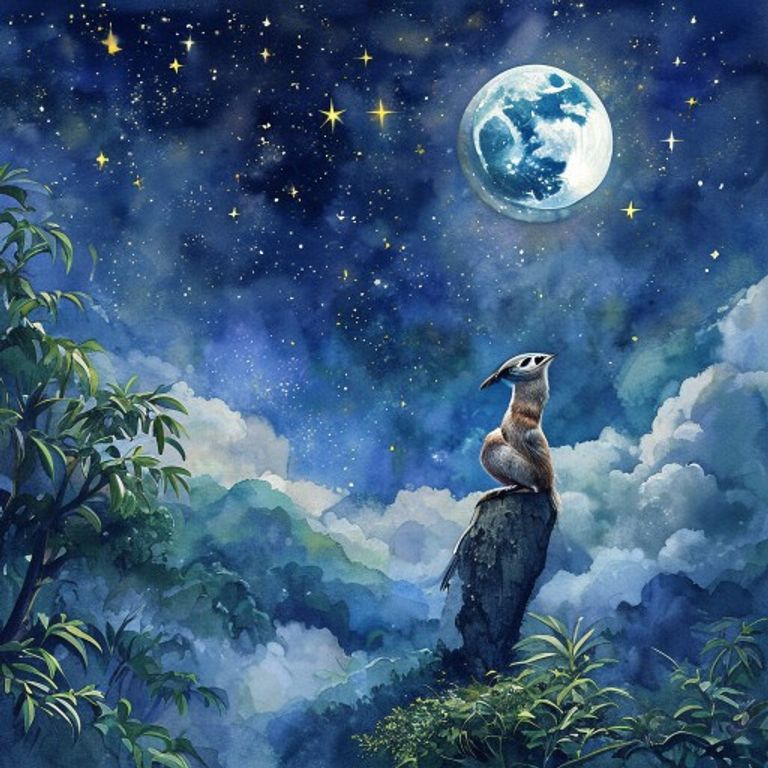
The sun set. The stars emerged — not all at once, as Zip had always assumed, but one by one, each one testing the darkness before committing to shine. The moon rose, fat and silver, casting shadows that moved so slowly they seemed alive. The wind changed, carrying smells from the lowland forest — orchid pollen, rotting wood, distant rain, the breath of a million sleeping flowers.
Zip's heart was still fast. But something had shifted. She was no longer fighting it. She was no longer trying to slow down. She was simply... noticing it. Feeling it. Watching it beat in her chest like a tiny drum, steady and strong and alive. She noticed her own breathing — shallow and quick, yes, but also rhythmic, musical, a song her body had been singing since before she was born.
She noticed the cold. The high-altitude chill that crept through her feathers, making her shiver. She had never noticed cold before — she was always moving too fast for it to catch her. But now she felt it, and instead of fighting it, she let it be. It was not her enemy. It was just... the air. Being honest about what it was.
She noticed the silence. Not the absence of sound — there were sounds everywhere, if you listened for them — but the silence between sounds. The pause between cricket chirps. The space between wind gusts. The moment after a star appeared and before the next one gathered its courage. The silence was not empty. It was full. It was waiting. It was rich with possibility.
And slowly, very slowly, Zip's heart began to slow.
Not to a huma pace. Not to a sloth's pace. But to a hummingbird's version of slow. To eight hundred beats per minute, then seven hundred, then six hundred. Still fast by any other creature's standard. But for Zip, it was a revolution. It was a rebellion against her own nature. It was the first time she had ever felt... calm.
"You are not failing," Moss said, his voice floating across the darkness like a leaf on a still pond. "You are learning. There is a difference."
The Moonbloom
At midnight, the Moonbloom opened.
Zip had expected a trumpet, a fanfare, a blaze of light. But the Moonbloom did not announce itself. It simply... unfolded. Petal by petal, each one the color of moonlight made solid, each one translucent and veined like a stained-glass window. The flower was larger than Zip's whole body, a cathedral of silver and pearl and the palest blue. It smelled of vanilla and starlight and something else — something Zip could not name, because she had never experienced it before.
It smelled of time.
Not hurry. Not rush. Not the frantic tick of a clock. But time as a river — wide, deep, patient, carrying everything along without demanding anything in return.
Zip approached it. She hovered before it — but this time, her hovering was different. She was not frantic. She was not racing. She was simply... present. She extended her beak toward the nectar, and she sipped.
The nectar was sweet. Of course it was sweet. But Zip tasted something else in it, something the old swallows had tried to describe and failed. She tasted the mountain. She tasted the twelve years Moss had spent on the ledge. She tasted the patience of the flower itself, waiting all year for this single night. She tasted the cold air and the warm rock and the beetle in the moss and the star that had died ten million years ago whose light had finally reached her eyes.
She tasted the slow world.
And she understood, finally, what Glide had meant. "Between the moments" was not a place. It was a way of being. It was the space where life actually happened — not in the darting, not in the racing, not in the thousand flowers, but in the single flower, fully tasted. Not in the blur of motion, but in the clarity of stillness. Not in the doing, but in the being.
Zip did not drink quickly. She drank slowly. She drank for ten minutes, twenty minutes, an hour. The Moonbloom did not close. It stayed open for her, as if it too understood that some things could not be rushed.
When she was finished, she did not launch herself into the air. She landed on the edge of the Moonbloom's petal — a landing so gentle that the flower barely trembled — and she sat there, watching the moon cross the sky, feeling her heart beat at six hundred times per minute, feeling the cold air and the warm nectar in her belly and the moss ledge miles below and the whole world, vast and ancient and infinitely patient, holding her in its quiet embrace.
She was still.
And for the first time in her life, stillness did not feel like death.
It felt like home.
The Return
In the morning, Zip flew back to the lowland forest. Her wings were strong again — the Moonbloom's nectar had given her energy beyond anything she had ever known. But she did not fly the way she used to.
She hovered. She lingered. She visited a flower and stayed, tasting every drop, noticing the texture of the petals, the pattern of the pollen, the angle of the stem. She did not dart away the moment she was finished. She sat on the edge of the blossom and watched a bee approach, and instead of chasing the bee away, she simply... let it be. Two creatures, sharing a flower, both present, both alive.
The other hummingbirds noticed.
"Zip has gone strange," they whispered, darting past her in their usual blur of color. "She sits on flowers. She watches bees. She doesn't race anymore. Something happened to her on the mountain."
"I did go strange," Zip agreed, when they confronted her. "I learned that a flower is not just fuel. It is a world. I learned that a moment is not just something to fly through. It is something to live in. I learned that my heart does not always have to beat at twelve hundred times per minute. Sometimes six hundred is enough. Sometimes three hundred is enough. Sometimes one — one single heartbeat, fully felt — is more than a thousand half-felt ones."
The other hummingbirds did not understand. They darted away, shaking their tiny heads, convinced that Zip had lost her mind.
But Zip did not mind. She flew to the Cloudmist Mountains every week. She sat on Moss's ledge. She watched the moss and the beetles and the stars. She helped the moths in Moss's fur find new homes. She brought him news from the lowland flowers — which were blooming, which were fading, what the bees were saying. And Moss, in return, taught her more about stillness, about patience, about the courage it took to simply be.
Years passed. Zip grew old — which for a hummingbird meant four years, five at most. Her ruby throat faded to rose. Her emerald back softened to jade. She could no longer dive at sixty miles per hour. She could no longer visit a thousand flowers a day.
But she could sit on a flower for an hour, feeling the sun warm her feathers, watching a spider build its web, listening to the forest breathe. And in that hour, she experienced more than she had in all her thousand-flower days combined.
On her last morning, she flew to the cliff ledge one final time. Moss was still there — older, slower, his fur now a deep forest of algae and moss and tiny flowers that had taken root in his patience. He had not moved in three days. He might not move for three more.
"I am going soon," Zip said.
"I know," Moss said. "I have been watching you. All your life. I saw you the first day you flew. I saw you the night you arrived on this ledge. I see you now. And I will see the young hummingbird who comes after you, and the one after that, and the one after that. Because that is what I do. I watch. I breathe. I am."
Zip landed on his shoulder — a place she had never landed before, a place so soft and warm and alive with tiny ecosystems that it felt like landing on a living world. She tucked her wings close. She closed her eyes. She felt her heart beat — three hundred times per minute, then two hundred, then one hundred, then slower and slower until it was just a whisper, just a memory, just a single, perfect note in the great symphony of the mountain.
And then she was still.
Truly, completely, beautifully still.
Moss did not move. He did not mourn. He simply sat on his ledge, feeling the tiny weight of his friend, watching the clouds drift through the trees, breathing his slow, ancient breath, and knowing — without needing to say it — that Zip had not died.
She had simply learned, at last, how to be.
And in the forest below, a young hummingbird — no more than a month old, her heart beating twelve hundred times per minute, her wings a blur of emerald and ruby and gold — hovered before a flower and paused. Just for a moment. Just for a single, shining heartbeat. She did not know why. She did not know that a hummingbird named Zip had once sat on this same flower and learned that stillness was not death. She only knew that something in the flower, something in the air, something in the great breathing world around her, whispered: Wait. Notice. Be here.
And she did.
For one perfect moment, she was still.
And the world, vast and ancient and infinitely patient, held her in its quiet embrace.
The Moral of the Story: Mindfulness is not about stopping. It is not about being slow. It is not about doing nothing. Mindfulness is about being fully present in whatever you are doing — whether you are darting between flowers or sitting on a ledge, whether your heart beats twelve hundred times per minute or twelve. Zip spent her whole life believing that speed was her only gift, that stillness was her enemy, that she had to keep moving or she would die. But she discovered something that changed everything: the world is not something to fly through. It is something to be with. When she stopped fighting her own nature and simply began noticing — the moss, the beetle, the starlight, her own heartbeat — she found that she was not losing time. She was gaining it. She was gaining the moments that had always been there, waiting for her to slow down enough to see them. Mindfulness does not require you to be a sloth. It does not require you to stop moving. It only requires you to be where you are, fully, completely, with all your attention and all your heart. Because the flower you drink from is not just fuel. The ledge you land on is not just a rest stop. The breath you take is not just survival. They are the world, offering itself to you, moment by moment, in infinite beauty and infinite patience. All you have to do is notice. All you have to do is be here. And in that being, you will find what Zip found: that stillness is not death. It is home.