Mochi the Maltipoo: A Story About Love
Emma was sick.
Not the kind of sick that meant a bandage and a kiss and then everything was better. Not the kind of sick that lasted a day, or even two. The doctor called it a "prolonged respiratory infection," which meant that Emma's chest felt heavy, her cough sounded like a bark of its own, and her fever made her cheeks flush the color of the roses in Nana Rose's garden.
It also meant that Emma could not go outside.
For a week, then two, Emma stayed in her room, propped against pillows that her mother fluffed every hour. The yellow house was quiet in a way it had never been before—no laughter echoing down the stairs, no running footsteps, no back door slamming as Emma and Mochi burst outside to greet the morning.
Mochi didn't understand germs, or infections, or why the doctor had said Emma needed rest more than anything. But she understood that her best friend was hurting, and that the world had somehow gone gray even though the spring flowers were blooming just outside the window.
At first, Mochi tried her usual methods of healing.
She brought Emma her favorite toy, a squeaky carrot that had lost most of its squeak but remained precious. Emma smiled and held it weakly, but she didn't have the energy to throw it for a game of fetch. Mochi tried her silly dance—the one where she spun in circles and wiggled her entire fluffy body until Emma usually laughed so hard she had to sit down. But Emma only managed a small, tired smile before closing her eyes.
"I'm sorry, Mochi," Emma whispered, her voice thin as paper. "I'm just so tired."
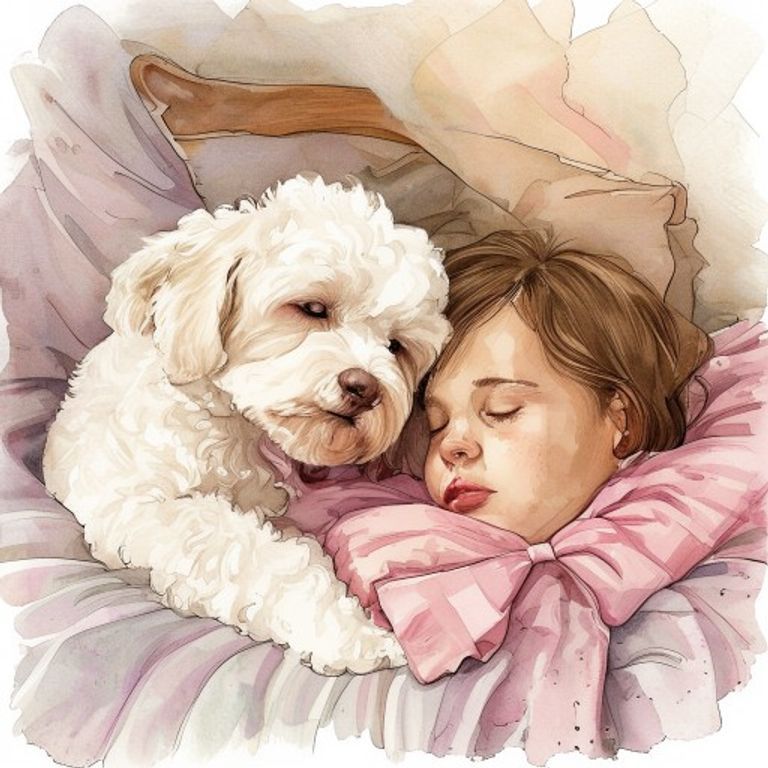
Mochi curled up on the bed beside her, careful not to jostle the blankets. She pressed her warm body against Emma's side, feeling the too-quick rise and fall of her breathing. She stayed there all afternoon, not moving, not asking for play or walks or treats, simply being the warmth that Emma needed.
But as the days stretched into a third week, something began to change in Mochi.
She started refusing her morning walks. When Emma's father clipped on her leash and opened the front door, Mochi would look up at Emma's bedroom window, visible from the porch, and she would not move. She would sit, small and white and stubborn, her pink bob slightly askew, until her father sighed and unclipped the leash.
"She wants to stay with Emma," her father said to her mother, his voice soft with wonder.
Mochi stopped eating her full meals. She would take a few bites, ensure her bowl was not empty, and then carry a mouthful of kibble upstairs, dropping it carefully on Emma's bedside table as if offering a gift. Emma never ate it—couldn't eat it—but she always thanked Mochi, and that was enough.
At night, when the house was dark and the maple trees rustled secrets to the moon, Mochi would leave Emma's bed only for brief patrols of the house. She would check the doors, listen to the silence, ensure all was safe, and then return to her spot against Emma's side, sometimes waking with a start to check that Emma was still breathing, her nose pressed gently to Emma's cheek until she felt the warm exhale.

"She's not herself," she told Emma's father one evening, watching Mochi climb the stairs with heavy paws. "She's grieving something that hasn't happened."
But Mochi wasn't grieving. She was loving.
She was loving in the only way she knew how: completely, without reservation, without expectation of anything in return. She was loving through presence, through sacrifice, through the thousand small choices she made every day to put Emma before herself.
One rainy afternoon in the third week, when the gray sky pressed against the windows and Emma's fever had risen again, Mochi did something extraordinary.
She left the house.
Not through the front door—she had never learned to turn that handle—but through the dog door in the kitchen that led to the backyard. She pushed through the plastic flap into the rain, her white curls immediately darkening with water, her pink bow sagging against her ear.
She crossed the backyard, her paws sinking into the soft earth. She pushed through the loose board in the fence that Emma had been meaning to fix. And she trotted, small and determined and soaked, down Maple Street.
She passed Mrs. Henderson's house, where the smell of baking bread made her stomach ache with hunger—she had eaten so little lately—but she didn't stop. She passed the oak tree where she and Emma had carved their initials last fall, its bark wet and dark, but she didn't pause. She kept going, her pink bow plastered to her head, her small body shivering, until she reached Nana Rose's cottage at the corner of Maple and Birch.
She scratched at the door. Once, twice, three times.
Nana Rose opened the door and gasped. "Mochi! Oh, you poor soaked thing! What are you doing out in this weather?"
But Mochi didn't come inside. She stood in the rain, looking up at Nana Rose with eyes that held an urgent message, and then she turned and looked back down Maple Street, toward the yellow house, and whined—a high, keening sound that was not begging but calling.
Nana Rose understood.
She grabbed her coat and her umbrella and followed the little white dog through the rain. Mochi trotted ahead, looking back every few steps to make sure Nana Rose was coming, her tail wagging desperately, her whole body radiating urgency.
When they reached the yellow house, Mochi didn't wait for the door. She went back through the dog door, and Nana Rose knocked, and when Emma's mother opened the door, she found Nana Rose standing there with a strange, serious expression.
"I think," Nana Rose said slowly, "that Mochi believes Emma needs me. And I have learned, in my many years, that dogs often know things before we do."
They went upstairs together, the two women and the sodden little dog, and found Emma awake but distant, her eyes glassy with fever, her breathing quick and shallow.
Nana Rose sat on the bed and took Emma's hand. She had been a nurse, long ago, before she retired to her garden and her stories. She felt Emma's pulse. She placed her ear against Emma's chest and listened.
Then she looked at Emma's mother with eyes that were calm but firm. "Call Dr. Chen. Tell her Emma needs to come in today. Not tomorrow. Today."
Emma's mother didn't question. She called.
It turned out that Emma's infection had turned into pneumonia, something the doctor had warned might happen but that everyone had hoped to avoid. She needed stronger medicine, breathing treatments, careful watching. She spent three days in the hospital, and when she came home, she was still weak but improving, the dangerous peak of the illness behind her.
Dr. Chen said that catching it when they had made all the difference.
"Another day or two, and we would have been in serious trouble," she told Emma's parents, her voice grave. "You did the right thing, bringing her in when you did."
Emma's mother looked at Mochi, who was curled in a tight white ball on Emma's hospital bag, exhausted and hungry but refusing to leave it. She looked at Nana Rose, who smiled and said, "It wasn't us. It was the little fairy dog who came through the rain."
Mochi didn't understand antibiotics, or breathing treatments, or pneumonia. She didn't know that her desperate journey through the rain had saved her best friend's life. She only knew that Emma was home, and that her breathing was slower, and that when she opened her eyes, they were clear and present and here again.
"Mochi," Emma whispered, on the first evening she was strong enough to speak more than a few words. She reached out a thin hand and touched Mochi's damp fur—her mother had toweled her off, but she was still slightly matted, her pink bow ruined and replaced with a fresh one Emma insisted on tying herself, even though her fingers trembled.
"You came through the rain for me," Emma said, her eyes filling with tears that were not sad. "You got all wet and cold because you love me."
Mochi licked her hand, her tongue warm and rough and steady.
Of course she had. What else could she have done? When you love someone, you don't measure the cost. You don't wait for the rain to stop. You don't say "tomorrow" when today might be too late. You simply go. You simply do. Love is not a feeling that sits quietly in the heart; it is a force that moves through the world, rain or shine, tired or strong, hoping or afraid.
In the weeks that followed, as Emma grew stronger—first sitting up, then walking to the window, then finally, blessedly, running outside into the sunlight—Mochi stayed beside her. Not because she had to, but because love, once given so completely, becomes a habit of the heart. She walked slowly when Emma was slow. She rested when Emma rested. And when Emma was finally strong enough to run again, Mochi ran with her, her pink bow streaming behind her, her white curls catching the light, her heart so full of joy it seemed to lift her paws off the ground.
The maple trees on Maple Street had never looked so green. The flowers had never smelled so sweet. And Emma's laugh—when it finally returned, full and bright and breathless—was the most beautiful sound Mochi had ever heard, more beautiful even than the morning birdsong she had missed so much.
One evening, as they sat together on the porch swing, Emma's parents behind them with their arms around each other, Mochi in Emma's lap with her chin resting on Emma's knee, Nana Rose came walking up the path. She carried a small wooden plaque she had made herself, burned with careful letters.
She hung it beside the front door, where everyone who entered could see.
"In this house, love walks on four paws."
Mochi didn't read it. She couldn't read. But she understood it anyway, in the way that love understands things beyond words.
That night, as Emma slept deeply and peacefully, her breathing steady and strong, Mochi lay awake for a little while. She thought of the rain, and the journey, and the fear that had driven her through it. She thought of Nana Rose's hand, warm and certain, closing around Emma's. She thought of the porch swing, and the green trees, and the plaque that said what her heart had always known.
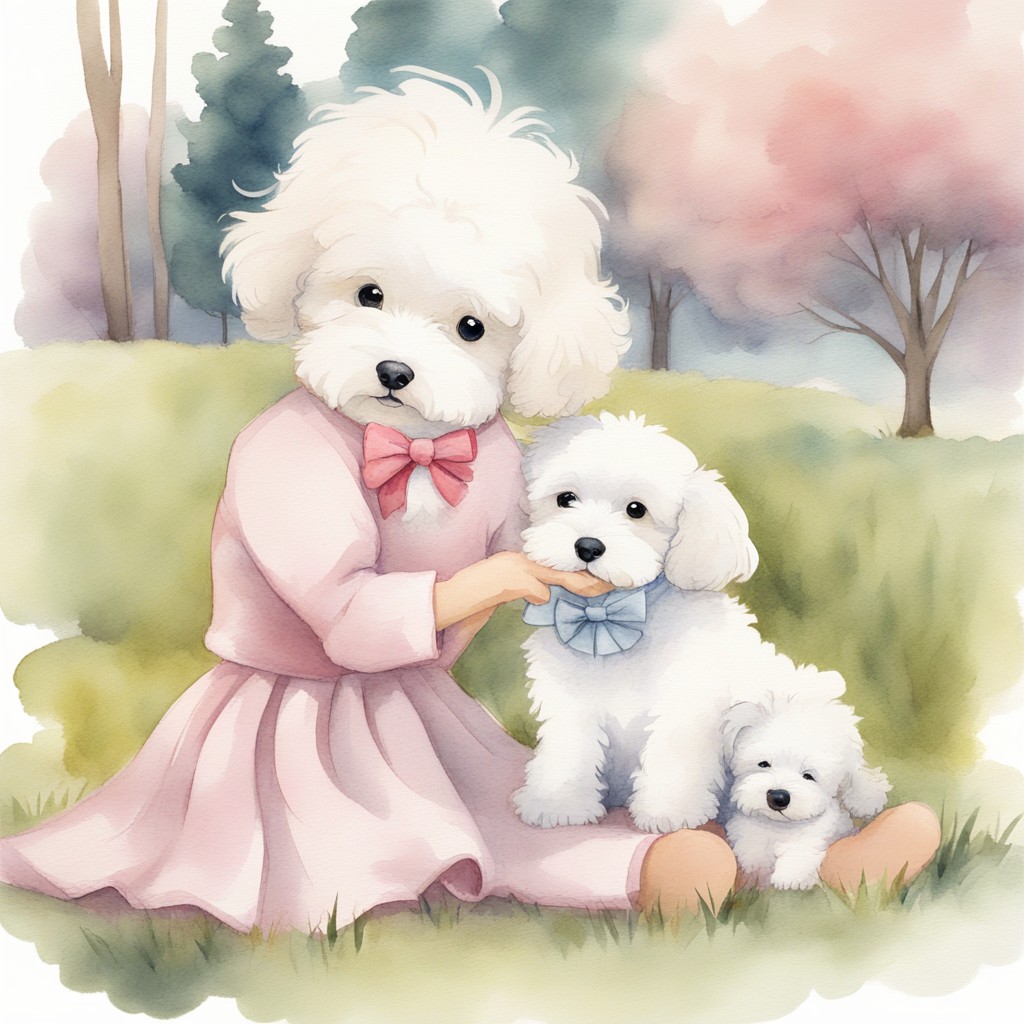
Then she closed her eyes and dreamed of running with Emma through a meadow that had no end, where the grass was soft as her own white curls and the sun was warm as Emma's hand on her head, and love was not just a word on a plaque but the very air they breathed, infinite and eternal and enough.
And in her dream, she was not small. She was as vast as the love she carried, and her pink bow was the color of a heart that had learned the greatest truth of all: that love is not measured in what you receive, but in what you are willing to give, even through the storm, even to the end of the road, even when you are only a small white dog with a wet pink bow and a heart that holds more than the whole wide world.