The Broken Swing: A Story About Forgiveness
In the center of a small town where the cobblestone streets wound like ribbons and the houses wore coats of ivy, there stood a playground that had seen a thousand summers. It was called Harmony Park, and it was famous for one very special thing: the Double Swing.
The Double Swing was no ordinary swing. It had two seats side by side, connected by a single strong chain, so that two friends could swing together—higher and higher, soaring toward the clouds, laughing as they touched the sky.
And no two friends loved the Double Swing more than Maya and Oliver.
Maya was eight years old, with curly black hair that bounced when she ran and eyes that sparkled like dark honey. She was brave and fierce and always knew exactly what she wanted. When she set her mind to something, nothing could stop her.
Oliver was eight too, with messy red hair that stuck up in all directions and freckles that danced across his nose like cinnamon sprinkles. He was gentle and thoughtful and saw magic in things other people missed—the way dewdrops hung on spider webs, the patterns clouds made, the stories old trees might tell if they could speak.
They had been best friends since they were four years old. They shared secrets, sandwiches, and dreams. They built forts and caught fireflies and read books under their favorite oak tree. And every single day, without fail, they would meet at Harmony Park and ride the Double Swing until the sun painted the sky in shades of pink and gold.
"Higher!" Maya would shout.
"To the moon!" Oliver would reply.
And up they would go, pumping their legs in perfect rhythm, swinging so high that their stomachs did flip-flops and their laughter rang like bells across the park.
They were invincible. They were unstoppable. They were best friends.
Until the day they weren't.
It started with a kite.
Oliver had spent three weeks building it—painting delicate dragons on the fabric, tying the perfect bowline knots, balancing the tail just so. It was his masterpiece, his magnum opus, his greatest creation. He named it Starwing, and he couldn't wait to show Maya.
"Look!" he said, bursting with pride. "I made it myself! Isn't it beautiful?"
"It's okay," Maya said, because Maya was competitive and sometimes forgot that other people had feelings too. "But I bet my kite can fly higher. My dad bought me a professional one from the city."
Oliver's smile flickered. "I don't want to compete," he said softly. "I just wanted to share it with you. Starwing is special because I made it."
Maya's store-bought kite soared immediately, a sleek predator of the sky. Oliver's handmade kite struggled at first, dipping and wobbling. But slowly, beautifully, Starwing began to rise, dancing like a living thing.
"Beginner's luck," Maya muttered, though not quietly enough.
"It's not luck," Oliver said. "It's because I understand how the wind works. I spent weeks studying."
"Studying?" Maya laughed. "You spent three weeks on a kite that almost crashed? My kite took thirty seconds to assemble!"
"Your kite is store-bought," Oliver said, his voice sharp. "Anyone can fly a store-bought kite. Starwing is special because I made it."
"Special?" Maya's voice rose. "It was wobbling like a dying bird five minutes ago!"
"At least I made mine!" Oliver shot back. "You just bought yours because you don't know how to make anything yourself!"
Maya's eyes widened. Her face turned red. "Take that back!"
"No!" Oliver shouted. "You're just jealous because my kite is better than yours!"
"Your kite is STUPID!" Maya screamed.
And before she could think, she grabbed Oliver's kite string and yanked. Starwing spun wildly, caught a branch, and crashed into the dirt—broken and ruined.
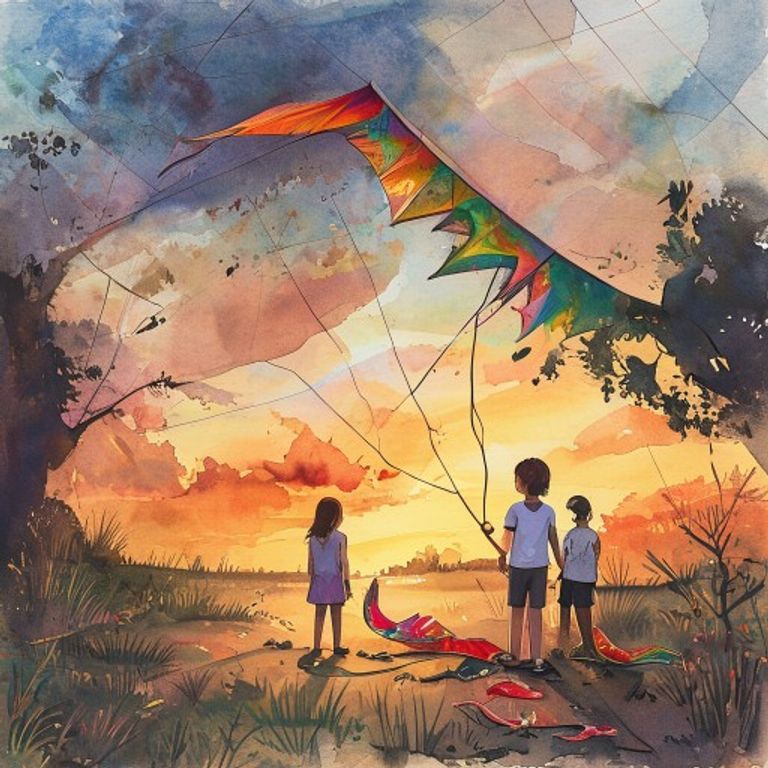
For a moment, no one breathed.
Oliver looked at his destroyed kite. Then he looked at Maya. His eyes—those gentle, thoughtful eyes—filled with tears.
"I hate you," he whispered.
And he ran.
Maya stood alone on the hill, holding her perfect store-bought kite. She waited for the rush of victory.
It didn't come.
Instead, she felt hollow. She looked at the broken pieces of Starwing scattered in the dirt—the dragons Oliver had painted so carefully, the dream he'd wanted to share with her.
And she realized what she'd done.
That night, she couldn't sleep. She kept seeing Oliver's face—the hurt, the betrayal, the tears. She kept remembering all the times they'd shared. The Double Swing. The secrets. The way he always saved her the blue raspberry popsicle because he knew it was her favorite.
She had ruined everything.
Days passed. Then a week. Maya and Oliver didn't speak. Every day, Maya walked past Harmony Park and saw the empty Double Swing swaying in the breeze, waiting for two best friends who no longer knew how to be friends.
One evening, her grandmother found her sitting on the porch steps, watching the sunset.
"When I was young," Grandma Rosa began, "I had a best friend named Sofia. We had a terrible fight and stopped speaking. Years passed. We became strangers. And now, forty years later, I don't even know where she is. I don't know if she's happy."
She looked at Maya with wise eyes. "Do you know what I think about, all these years later? Not the fight. Not who was right or wrong. I think about all the moments we missed. All the laughter we didn't share."
"But Oliver said he hated me," Maya whispered.
"Words spoken in anger are like bubbles," Grandma Rosa said. "They look big and scary, but they're mostly air. What matters is what's underneath. Did Oliver really hate you? Or was he hurt?"
"He was hurt," Maya admitted.
"Here's what forgiveness means, little one: it means understanding that people make mistakes. It means choosing love over anger. It means giving someone a chance to make things right—even when they don't deserve it."
She squeezed Maya's hand. "The question isn't who started it. The question is: who will be brave enough to end it?"
The next morning, Maya woke up with a plan.
For five days, Maya worked in secret. She bought paints, fabric, and a kite frame. She read books about kite building. She followed Oliver's methods—studying wind patterns, learning about balance, practicing her brush strokes until the dragons she painted looked alive.
It was hard. She made mistakes. She tore fabric and had to start over. She got paint in her hair and under her fingernails.
But she kept going, because this wasn't about winning. This was about saying "I'm sorry" in a language Oliver would understand.
She named it Phoenix, because like the mythical bird, their friendship would rise from the ashes. If he let it.
She found Oliver at Harmony Park, sitting alone on the bench near the Double Swing. When he saw her approaching, he stiffened.
"Go away," he said.
"I will," Maya said. Her voice was steady, though her hands shook. "But first, I need to give you something."
She held out the kite.
Oliver stared at it. He looked at Maya's face—really looked—and saw the dark circles under her eyes, the paint stains on her fingers, the fear and hope mixed in her expression.
"You made this?" he asked.
"I did," Maya said. "I read the same books you did. I watched the wind. I failed a lot. But I kept trying, because I wanted to understand why Starwing mattered so much to you."
She took a deep breath. "I'm sorry, Oliver. I'm sorry I broke your kite. I'm sorry I was jealous. I'm sorry I said your kite was stupid. I'm sorry I ruined something you worked so hard on. I was a terrible friend. I cared more about winning than about your feelings. And I understand if you can't forgive me. But I wanted you to know that I get it now. I understand what I destroyed. And I... I really miss you."

Oliver looked at the kite. Then he looked at Maya. Then he looked at the Double Swing, swaying empty in the breeze.
"I miss you too," he whispered.
The tears started then—for both of them. Not angry tears, but sad tears, healing tears, the kind that wash away hurt and make room for something better.
"I shouldn't have said you weren't creative," Oliver said. "You're the most creative person I know. You just... you always have to be the best at everything, and it makes me feel small sometimes."
"I know," Maya said. "I'm working on it. I want to be better."
"And I shouldn't have said I hated you," Oliver continued. "I didn't mean it. I was just so sad about Starwing, and I wanted to hurt you back. That was wrong."
"It's okay," Maya said. "I hurt you first."
"But I didn't have a right to be mean," Oliver said firmly. "That's different."
They sat in silence for a moment, the kite between them like an offering of peace.
"Want to fly it?" Maya asked. "Together?"
Oliver looked at her—really looked—and saw his best friend. The girl who knew all his secrets. The girl who made him feel less alone in the world.
"Yes," he said.
They walked to the hill. "On three?" Maya asked.
"One," Oliver said.
"Two," Maya said.
"Three!" they shouted together.
Phoenix caught the wind. The wobbly dragons soared. And as the kite rose higher and higher, something else rose too—their friendship, rebuilt and renewed, stronger than before because it had been tested and survived.
It wasn't the same as before. It was better. Because now they understood that love isn't about never hurting each other. It's about choosing to heal the hurt. It's about forgiveness.
That evening, as the sun set and painted the world in gold, Maya and Oliver sat on the Double Swing—their swing—pumping their legs in perfect rhythm.
"Higher!" Maya shouted.
"To the moon!" Oliver replied.
And up they went, soaring toward the clouds, their laughter ringing like bells across Harmony Park, where broken things could be mended and lost friends could be found.
🌟 The Moral of the Story 🌟
Forgiveness means choosing to let go of anger and hurt, even when someone has done something wrong. It means giving someone a chance to make things right—even when they don't deserve it.
When we fight with friends, we often get stuck thinking about who started it and who was meaner. But the truth is, holding onto anger hurts us more than it hurts them. It's like drinking poison and expecting the other person to get sick.
True forgiveness doesn't mean pretending the hurt never happened. It means acknowledging the pain and choosing to move past it anyway. It means understanding that everyone makes mistakes—including you.
Sometimes, being the one to apologize first is the bravest thing you can do. It takes courage to admit you were wrong. It takes strength to say "I miss you" when you're not sure if the other person feels the same way.
- Friendships are more important than being right
- Saying sorry doesn't make you weak—it makes you wise
- Forgiving someone doesn't mean they didn't hurt you; it means you're choosing peace over pain
- It's okay to be angry, but don't let anger become a wall between you and the people you love
- The strongest friendships are the ones that have been broken and repaired
When someone hurts you, you have a choice. You can hold onto your anger and let it grow until it destroys everything. Or you can take a deep breath, open your heart, and offer forgiveness. It's not easy. It's not fair. But it's the path that leads back to love.
So tonight, think about someone you might be angry with. Someone you've been avoiding. Someone you miss. And consider: would you rather be right, or would you rather be happy? Sometimes, the bravest thing is to be the first one to say "I'm sorry" or "I forgive you." Because in the end, love is always worth the risk.
The End
Sweet dreams, little one. 🌙✨