The Giving Tree of Golden Orchard: A Story About Generosity
In a valley where the hills rolled like green waves and the sky seemed to stretch forever in every direction, there stood an orchard that had existed for as long as anyone could remember. The locals called it Golden Orchard, not because everything there was made of gold, but because in autumn, when the fruit ripened and the leaves turned, the whole valley glowed with a light that looked like treasure.
The orchard was home to many trees. There were apple trees with fruit as red as sunsets, pear trees with golden fruit shaped like bells, cherry trees that burst into pink clouds every spring, and plum trees with dark purple fruit that stained fingers and smiles alike. Each tree had its own personality, its own rhythm, its own way of being in the world.
But there was one tree that stood apart from all the others.
In the very center of the orchard, where the morning sun first touched the land and the evening sun lingered longest, there grew an ancient oak tree. She was enormous—her trunk was wider than three children holding hands could reach around, her branches spread like a giant's welcoming arms, and her roots went deep into the earth, drinking from underground rivers that other trees could only dream of.
Her name was Grandmother Oak.
And she was the most generous soul in all of Golden Orchard.
No one knew exactly how old Grandmother Oak was. The oldest farmers in the valley said she had been there when their great-great-grandparents were children. The oldest farmers' grandparents had said the same thing. She had witnessed a hundred autumns, a thousand storms, and more dawns than the stars had twinkled.
But age had not made her bitter, nor had time made her stingy. If anything, the longer she lived, the more she gave.
Her branches were thick and strong, providing shade for travelers on hot summer days. Her leaves rustled in patterns that sounded like stories, and children would sit beneath her canopy for hours, listening to tales that only their imaginations could translate. Her acorns fed the squirrels and the chipmunks, the jays and the woodpeckers, and every creature in the valley knew that Grandmother Oak's pantry was always open.
But it wasn't just what she had that she gave. It was what she was.
She gave patience to the young apple trees who worried they would never bear fruit. "You will," she would tell them in her creaky, gentle voice. "When you're ready. Not a moment before, not a moment after."
She gave courage to the saplings who trembled in storms. "Your roots will hold," she would whisper through the wind. "They go deeper than you know."
She gave wisdom to the old pear tree who mourned his falling leaves every autumn. "Letting go is not the same as losing," she would say. "It makes room for what comes next."
And she gave love—quiet, steady, unconditional love—to every creature who came within reach of her branches.

In the orchard, there lived a young fox named Finn.
Finn was quick and clever, with a russet coat that blazed like autumn fire and a tail that swept behind him like a banner. He was fast, he was smart, and he was—though he would never admit it—a little bit selfish.
Finn believed, as many young creatures do, that the world was a place of scarcity. There was only so much food, only so much shelter, only so much warmth. If you wanted to survive, you had to take what you could, when you could, and hold onto it with both paws.
He hunted diligently, burying his extra food in secret places. He found the warmest dens and guarded them jealously. He collected treasures—shiny stones, pretty feathers, interesting bones—and hid them in a hollow log that he defended fiercely.
"This is mine," he would say to anyone who came near. "I found it. I worked for it. You can't have it."
The other animals understood. They had all been young once. They knew the fear of not having enough, the panic of empty bellies, the desperation of cold nights. So they let Finn be, and they went about their business, and they didn't hold his selfishness against him.
But Grandmother Oak watched, and she worried.
The drought came slowly, as droughts do.
First, the creek that ran through the valley grew shallow. Then the mud at its edges turned to dust. Then the dust began to spread, creeping across the meadow like a gray shadow, turning green grass brown and sweet flowers crisp.
The farmers watered their crops, but their wells were running low. The animals searched for food, but the berries shriveled on their bushes and the nuts fell empty from their shells. The orchard, which had always been a place of plenty, became a place of worry.
The apple trees produced small, bitter fruit. The pear trees dropped their leaves early, conserving water. The cherry trees, usually so cheerful, stood bare and silent, their pink blossoms a distant memory.
But Grandmother Oak was different.
Her roots went so deep that they still found water, even when the surface was dry. Her trunk was so thick that it stored reserves from years of plenty. She had survived droughts before—many of them—and she knew that hard times were part of living, not the end of it.
So she did what she always did.
She gave.
"Finn," she called one morning, when the young fox was passing beneath her branches, looking thinner than he had in weeks.
Finn stopped. He looked up at the massive oak, her leaves still green despite the heat, her acorns still plump despite the drought. "Yes, Grandmother?"
"You look hungry."
"I'm fine," Finn said quickly, too proud to admit need.
"Your tail is less fluffy than it was," Grandmother Oak observed. "Your ribs are showing. Your eyes are tired."
"I can manage," Finn insisted. "I have stores. Hidden food. I'll be fine."
"Will your stores last through the winter?" Grandmother Oak asked gently. "Will they last until the rains return?"
Finn didn't answer. He didn't know. The drought was lasting longer than anyone expected, and his hidden food was running low.
"Come here," Grandmother Oak said.
And from her branches, she dropped acorns. Dozens of them. Hundreds of them. Plump, nutritious, life-giving acorns that she had been saving, that she had been growing, that she could have used to sustain herself through the hard times ahead.
"Eat," she said.
"But... but these are yours," Finn stammered. "You need them. The winter—"
"The winter is months away," Grandmother Oak said. "And there will be more acorns. There are always more acorns. But you are hungry now. So eat."
"Why?" he asked. "Why would you give me so much? What do you want in return?"
Grandmother Oak laughed—a deep, rustling sound like wind through autumn leaves. "Want in return? Oh, my dear Finn. I don't want anything. I give because I have. I give because giving is how I live. I give because the joy of seeing you fed is worth more than any acorn I could save."
"But... but that's not how the world works," Finn said. "You have to get something back. You have to protect what's yours. Otherwise... otherwise you'll have nothing left."
"Will I?" Grandmother Oak asked. "I've been giving for a hundred years, and I still have more than enough. The more I give, the more I seem to have. The more I share, the more grows back. That's the magic of generosity, Finn. It doesn't empty you. It fills you."
And so Finn ate. He ate until his belly was full, until his tail was fluffy again, until his eyes were bright. And as he ate, something in his selfish heart began to crack, like ice melting in spring.
Word spread about Grandmother Oak's generosity.
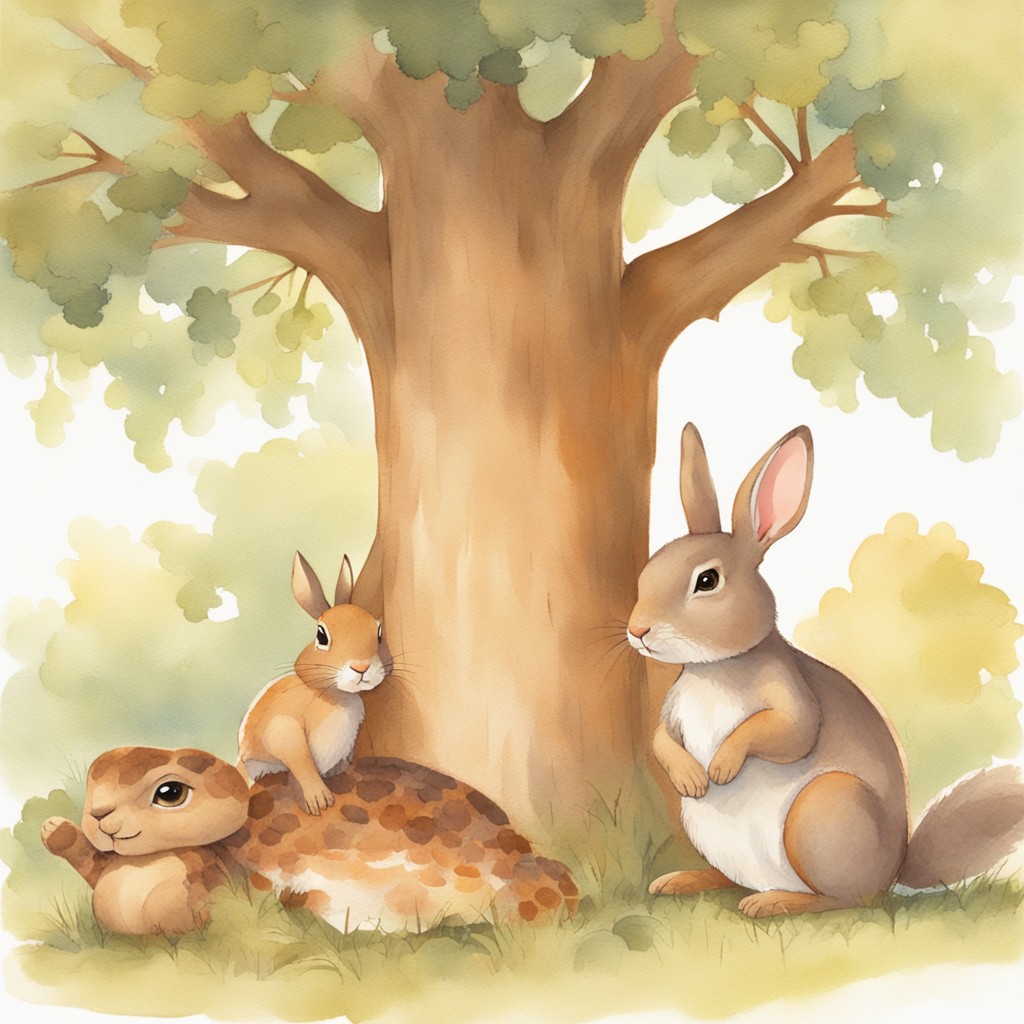
The squirrels came, and she fed them. The chipmunks came, and she fed them too. The jays and the woodpeckers and the little brown mice all came, and she welcomed them all, dropping acorns and sharing shade and offering the comfort of her presence.
The other trees watched, confused.
"You're giving away your winter stores," the oldest apple tree said, his voice creaky with worry. "What will you eat when the snows come?"
"I will eat what I need," Grandmother Oak replied. "And I will need less than you think."
"But the drought continues," the pear tree said. "The well is dry. The creek is dust. What if the rains don't come?"
"Then I will dig deeper," Grandmother Oak said. "I have roots that go down to places these young eyes have never seen. Water flows in darkness where the sun never reaches. I will find it."
"You're taking a risk," the cherry tree whispered.
"Living is a risk," Grandmother Oak answered gently. "But living alone, living without giving, living hoarded and hidden and afraid—that's the greatest risk of all. Because that's not really living. That's just... surviving."
The other trees fell silent. They didn't understand, not really. But they respected her. She had lived longer than all of them combined. Perhaps she knew something they didn't.
Finn came back the next day.
He didn't come for food, though his belly was full and his strength was returning. He came because something had changed in him, and he didn't know what to do with the feeling.
"Grandmother Oak," he said, sitting beneath her branches. "I don't understand you."
"What don't you understand, dear?"
"You gave me everything. No conditions. No expectations. Just... gave. And yesterday, after I ate, I felt something I never felt before. I felt... light. Like a weight I didn't know I was carrying had disappeared."
"That weight was fear," Grandmother Oak said. "The fear of not having enough. When you accept generosity, you learn that the world is not as scarce as you thought. And when you practice generosity, you learn that you are not as limited as you believed."
"But I'm just one fox," Finn said. "I can't give like you do. I don't have acorns. I don't have shade. I don't have a hundred years of wisdom."
"What do you have?" Grandmother Oak asked.
Finn thought. "I can run fast. I can find things. I can... I can dig."
"Then run fast for someone who needs help. Find things for someone who is searching. Dig for someone who cannot."
"But that's so small," Finn protested. "Compared to what you give—"
"There is no small generosity," Grandmother Oak interrupted, her voice firm but kind. "A single acorn feeds a squirrel. A single word comforts a lonely heart. A single act of kindness changes a life. Don't measure your giving by what others give. Measure it by what you have to offer. And offer it. Freely. Joyfully. Without expecting anything in return."
Finn changed that day.
He didn't become perfect. He still had moments of selfishness, still felt the old fear, still wanted to hoard and hide and guard. But now, when those feelings came, he remembered the lightness he had felt under Grandmother Oak's branches. He remembered the joy of being fed without condition. He remembered the crack in his heart, and how it had let in light.
So he tried.
He found a lost kitten, frightened and hungry, and instead of chasing her away, he led her to Grandmother Oak's shade and shared his next meal with her. He discovered a burrow of rabbits whose mother was sick, and he brought them food every day until she recovered. He found a baby bird who had fallen from its nest, and he sat beneath the tree, guarding it, until its mother could find it.
None of these things were big. None of them were grand. But each one felt like a stone dropped into a still pond, sending ripples outward in ways he couldn't see.
And each time he gave, he felt that lightness again. That warmth. That sense of being part of something larger than himself.
He began to understand what Grandmother Oak meant. Generosity wasn't about having a lot. It was about being willing to share what you had, no matter how small. It wasn't about expecting gratitude. It was about the joy of giving itself.
And slowly, the other animals noticed.
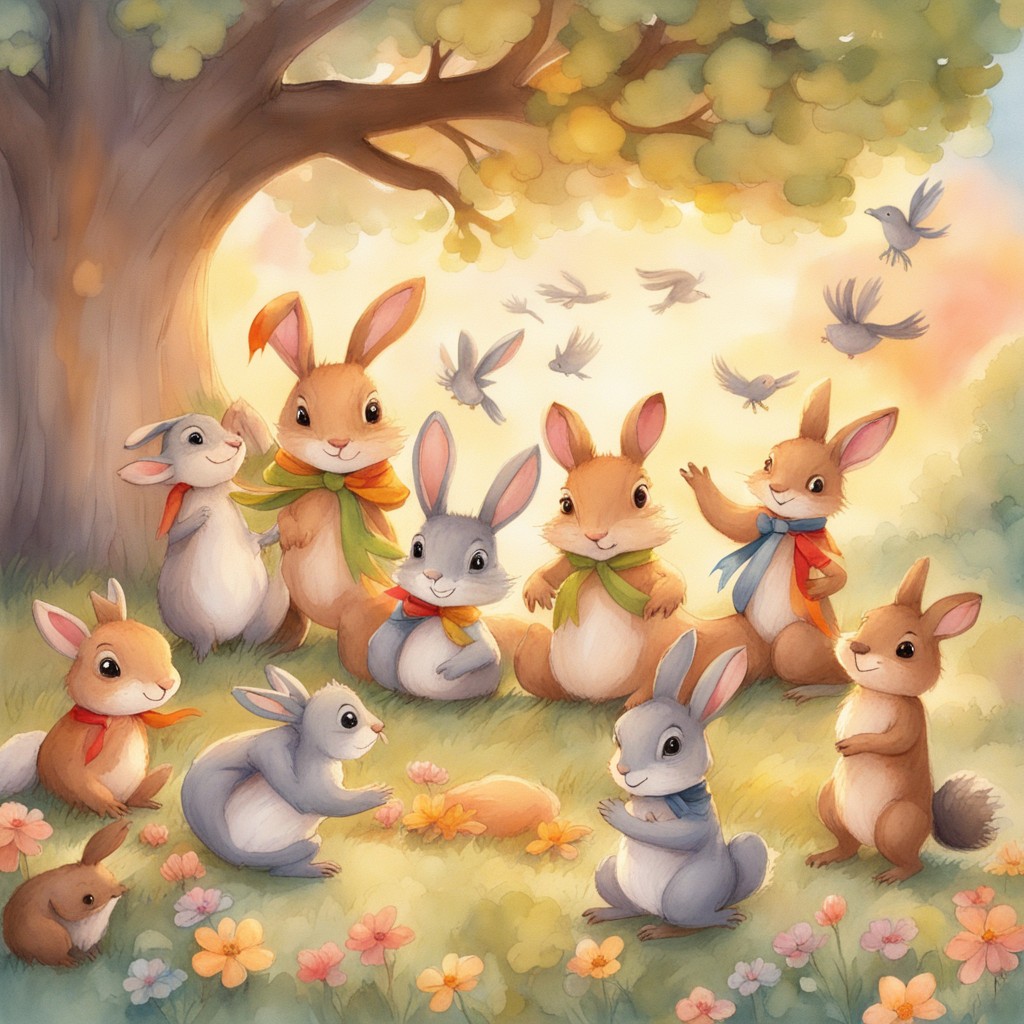
The squirrel who had received acorns from Grandmother Oak now shared his findings with the chipmunks. The chipmunk who had been fed now left berries for the birds. The bird who had eaten the berries now sang songs that lifted everyone's spirits.
A chain of kindness formed, link by link, stretching across Golden Orchard, changing the way the animals thought about each other and themselves.
And at the center of it all, giving and giving and never stopping, stood Grandmother Oak.
The drought ended, as droughts do.
The rains returned, first as gentle showers, then as steady downpours that soaked the earth and filled the wells and turned the creek into a rushing, singing stream again. The orchard burst back to life—green leaves, sweet blossoms, fruit heavy on the branches.
The farmers rejoiced. The animals celebrated. The trees sighed with relief.
And Grandmother Oak?
She was fine.
Her deep roots had found water in the darkness, just as she said they would. Her trunk was thinner than it had been, but her heart was full. She had given through the hardest times, and she had survived.
Not just survived. Thrived.
New saplings sprouted near her roots—acorns she had dropped in her giving, taking root in the enriched soil. Her branches were fuller than before, because the stress of the drought had actually strengthened her. The animals who had been fed now protected her, chasing away pests, warning of danger, keeping her safe in ways she had never needed before but appreciated nonetheless.
And Finn?
He sat beneath her branches, grown now into a strong, wise fox, and he told the young kits who gathered around him stories of the drought and the generosity that had saved them all.
"Grandmother Oak taught me," he would say, "that the world is not a place of scarcity. It's a place of abundance, if we choose to see it that way. She taught me that giving doesn't empty you—it fills you. That sharing doesn't weaken you—it strengthens everyone."
"But what if you don't have much?" a young kit would ask.
"Then you give what you have," Finn would answer. "A kind word. A helping paw. A moment of your time. There is no small generosity. Every act of giving sends ripples through the world, touching lives you will never know, changing hearts you will never see."
He would look up at Grandmother Oak, her leaves rustling in approval, her branches spreading wide and welcoming.
"And the most magical thing," Finn would add, his voice soft with wonder, "is that the more you give, the more you find you have. Generosity is not just a gift to others. It's a gift to yourself. It turns fear into love, scarcity into abundance, and loneliness into connection."
Years passed, as years do.
Grandmother Oak grew older, her trunk wider, her branches more gnarled and beautiful. She witnessed more autumns, more storms, more dawns than ever before. She gave more acorns, more shade, more wisdom, more love than seemed possible for one tree to contain.
And when the time came—when her wood grew too old to support her massive weight, when her roots could no longer hold her steady—she didn't mourn. She didn't cling to life out of fear.
She gave one last time.
Her falling nourished the soil. Her wood became homes for creatures. Her stories became legends. Her lessons became the foundation of the community she had nurtured.
And in the exact center of where she had stood, a new oak sprouted—a sapling with deep roots and spreading branches, already dropping acorns, already offering shade, already whispering wisdom to anyone who would listen.
The animals called her Daughter Oak.
And she was, in every way that mattered, her mother made new.
On quiet evenings, when the sun set over Golden Orchard and the valley glowed with golden light, the animals would gather beneath Daughter Oak's branches. They would share food, tell stories, and remember the ancient oak who had taught them all how to live.
And Finn, old now, his russet coat turned silver, would raise his voice above the rest and say:
"Generosity is not about what you have. It's about what you're willing to give. It's not about the size of your gift. It's about the size of your heart. And the heart that gives freely, loves deeply, and shares joyfully—that heart will never be empty. That heart will never be alone. That heart will live forever, in the lives it has touched and the love it has shared."
And above them, Daughter Oak would rustle her leaves in agreement, dropping an acorn here, a patch of shade there, a whisper of wisdom everywhere.
Giving.
Always giving.
Because that is how love lives on.
THE END
Moral of the Story: Generosity is the willingness to give freely without expecting anything in return. It is not about having a lot—it is about being willing to share what you have, no matter how small. True generosity transforms both the giver and the receiver. The giver discovers that giving does not empty them but fills them with joy, purpose, and connection. The receiver learns that the world is not a place of scarcity but of abundance, and that kindness exists even in hard times. Generosity creates ripples that spread far beyond the original act, inspiring others to give in turn and building communities bound by care and compassion. The most powerful generosity comes not from obligation or guilt, but from a heart that genuinely delights in sharing. When we give freely—whether of our time, our resources, our skills, or our love—we discover that we have more than enough, and that the act of giving is itself the greatest gift we receive.