The Guardian of the Nest: A Story About Responsibility
High in the branches of the oldest oak tree in Silverwing Forest, where the leaves whispered secrets to the wind and the sunlight filtered through in patterns of gold and green, there lived a family of blue jays. Their nest was a masterpiece of woven twigs, soft moss, and discarded ribbon scraps from the nearby village—a cozy cup of safety cradled in the arms of the giant tree.
In this nest lived Mama Larkin, a wise and gentle blue jay with feathers the color of a summer sky; Papa Finn, a strong bird with a white chest that looked like a patch of fresh snow; and their three chicks: Sage, the eldest, who had already begun to show the bright blue feathers of adulthood; little Pip, the youngest, whose downy fluff was still more gray than blue; and Wren, the middle chick, who was neither the oldest nor the youngest, neither the biggest nor the smallest, but who held something precious in her heart that would soon prove to be the most important gift of all.
Wren was a responsible chick. Even before she truly knew what the word meant, she felt it in her bones. When Mama Larkin left the nest to find worms and berries, Wren would tuck her tiny wings around Pip, keeping him warm. When the wind grew strong and rattled the branches, Wren would press herself against the nest's edge, using her small body as a shield to keep her younger brother from rolling too close to the open air. When Sage practiced her squawking—loud, enthusiastic squawks that often brought curious squirrels to peer into the nest—Wren would calm her sister with gentle chirps, reminding her that not every sound needed to be a song.
"You are such a good helper, Wren," Mama Larkin would say, nuzzling her middle chick with her soft beak. "You have a heart for caring."
Wren did not know what "a heart for caring" meant, exactly. She only knew that when Pip shivered, she shivered too. When Sage cried, her own chest felt tight. And when Mama and Papa were away, something inside her—something that felt like warmth and weight and wonder all at once—told her that she was the one who needed to keep the nest safe.
One morning, when the dew still clung to the oak leaves like tiny diamonds, Mama Larkin and Papa Finn called their chicks together. Their faces were serious, their eyes filled with a worry that made Wren's small heart flutter.
"My darlings," Mama Larkin said, her voice gentle but grave, "your grandmother in the Northern Grove is very ill. She is old, and her wings are weak, and she needs someone to care for her until she is strong again."
"We must go to her," Papa Finn continued, his strong chest puffed with determination. "But the journey is long—three days by wing, over the Misty Mountains and across the Whispering River. It is not a journey for little chicks."
Sage ruffled her feathers, already beginning to show the independence of a young bird ready to leave the nest. "I am not so little," she said. "I could make the journey."
"You are still learning to fly, my brave one," Papa Finn said, his eyes soft. "And your grandmother needs experienced wings. We must go, and we must go today. But we will return as quickly as the wind allows."
"How long will you be gone?" Wren asked, her voice smaller than usual.
"Four days," Mama Larkin said. "Perhaps five, if the mountain winds are strong. We have left you plenty of food—berries in the hollow log, seeds in the bark crevice, and a jar of honeydew that the ants were kind enough to share."
"Sage," Papa Finn said, turning to his eldest, "you are the oldest. While we are gone, you are in charge of the nest. You must keep your brother and sister safe, make sure they eat, and call for help if danger comes. Do you understand?"
Sage puffed out her chest, her blue feathers catching the morning light. "I understand, Papa. I will protect the nest. I am the oldest, after all."
Wren watched her sister, a small knot forming in her belly. Sage was brave and strong, but she was also... impulsive. She loved to explore, to test her wings, to see how close she could fly to the forest floor without touching it. Responsibility, to Sage, sounded like an adventure. But Wren knew—though she could not say how—that responsibility was something quieter, something deeper, something that asked more of the heart than the wings.
Mama and Papa nuzzled each of their chicks, leaving trails of warmth and love on their downy heads. Then, with a final look back, they spread their wings and soared into the sky, becoming two blue dots against the clouds, and then nothing at all.
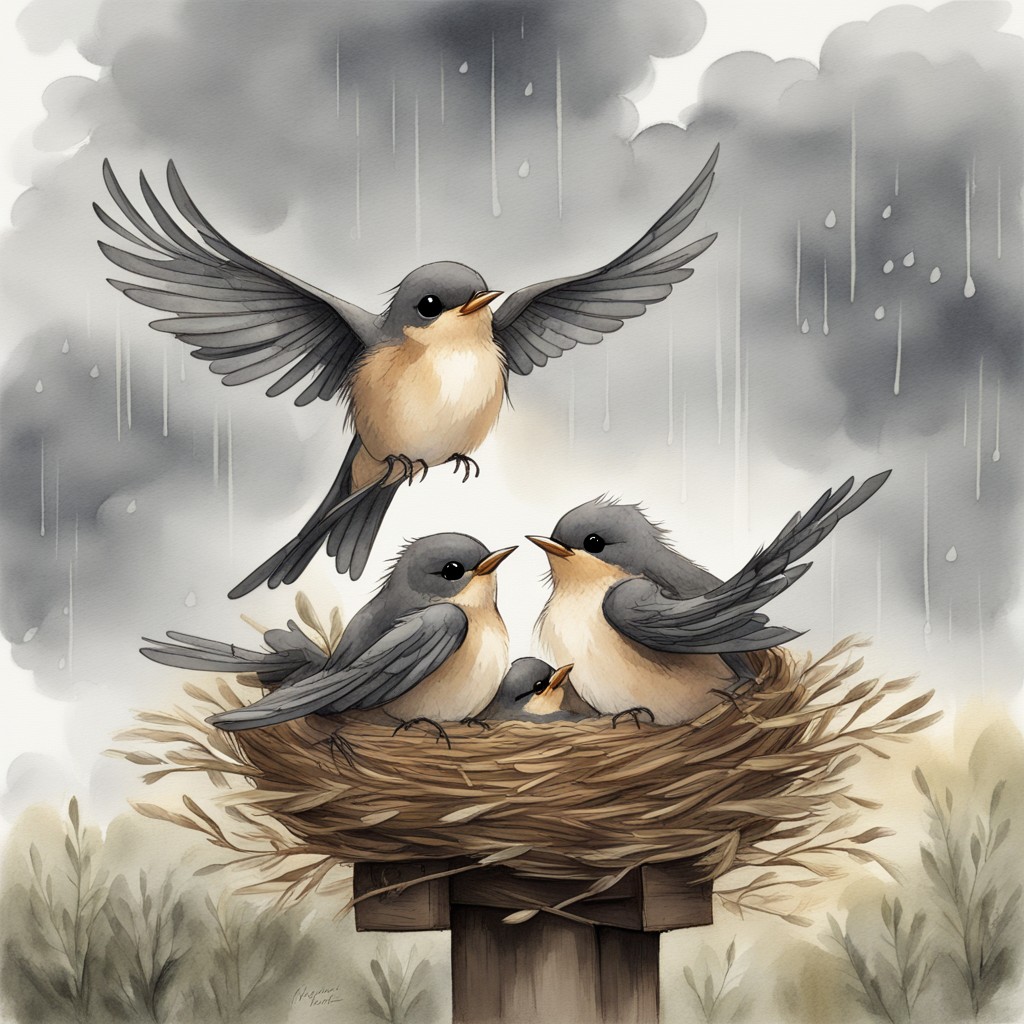
The first day was not so bad.
Sage took her role seriously—at first. She counted the berries, showed Pip where the seeds were hidden, and even let Wren help her reinforce the nest walls with fresh twigs. When a curious crow landed on a nearby branch, Sage puffed up and squawked so fiercely that the crow flew away, cawing in surprise.
"See?" Sage said, preening. "I am protecting the nest. I am being responsible."
"You are," Wren agreed, and she meant it. Sage was trying. That was important.
But by the second day, Sage's patience began to fray.
Pip was a demanding little chick. He was always hungry, always cold, always needing something. "Wren, my wing itches." "Wren, the sun is too bright." "Wren, tell Sage to stop squawking so loud." And Sage, who had discovered that being in charge meant she could make the rules, began to make rules that suited her more than her siblings.
"I am going to practice flying to the lower branch," Sage announced on the morning of the second day. "I need to stretch my wings."
"But Mama said we should stay in the nest," Wren said gently. "She said we are not ready to fly alone."
"Mama made me in charge," Sage said, her voice sharp. "And I say I need to practice. Pip is napping. You can watch him. I will only be gone a little while."
Before Wren could say another word, Sage hopped to the edge of the nest, spread her still-developing wings, and fluttered down to a branch ten feet below. She landed awkwardly, her claws scrabbling for purchase, but she made it. And from below, she called up: "See? I am fine! I am the oldest! I know what I am doing!"
Wren watched her sister, her chest tight with worry. The lower branch was not so far, but it was far enough. And Pip was awake now, chirping for food, his small beak open wide.
"I will get you berries," Wren said, and she hopped to the hollow log where Mama had stored their food. She pulled out three plump blueberries, carrying them one by one to her brother, who gobbled them up with happy chirps.
But as Wren turned to get more, she heard a sound that made her blood run cold.
A rustling. Not the wind-in-leaves rustling. Not the squirrel-scampering rustling. Something heavier. Something closer. Something in the tree.
Wren froze, her tiny body going rigid. From the corner of her eye, she saw it: a snake, long and green, sliding up the trunk of the oak tree, its tongue flicking, its eyes fixed on the nest above.
Wren's heart hammered against her ribs. She was small—so small. The snake was big, bigger than Mama, bigger than Papa, bigger than anything she had ever seen that was not a cloud or a mountain. Its scales gleamed in the dappled sunlight, and its movement was slow but certain, unstoppable, like a vine growing toward the sky.
"Pip," Wren whispered, her voice trembling. "Pip, come here. Come to me. Now."
Pip, sensing something wrong in his sister's voice, waddled over, his eyes wide. "Wren? What is it?"
"There is a snake," Wren said, and her voice cracked. "It is coming up the tree. We need to hide. We need to be very, very quiet."
Pip's beak opened to squawk in terror, but Wren pressed her wing against his small body, muffling the sound. "No, Pip. No noise. Noise makes it come faster. We need to hide."
She looked around the nest, her mind racing. Where could they hide? The nest was open, exposed, a cup of twigs with nowhere to run. The snake was below them, climbing steadily, its body coiling around the trunk with terrifying grace.
Wren thought of Mama, who had always known what to do. She thought of Papa, who had always been strong enough to protect them. But Mama and Papa were four days away, over mountains and rivers, and Wren was here, small and scared and responsible.
Then she saw it: the ribbon.
A long strip of red ribbon, woven into the nest by some village child months ago, now dangling over the edge like a loose thread. It hung down the side of the nest, brushing against a branch below, and then trailing further down toward the ground.
Wren had an idea. A terrible, frightening, impossible idea. But it was the only idea she had.
"Pip," she whispered, "I need you to climb onto my back. Hold on with your claws. Do not let go, no matter what happens. Do you understand?"
Pip's eyes were wet with tears, but he nodded. He climbed onto Wren's back, his tiny claws digging into her feathers, his small body trembling against hers.
Wren hopped to the edge of the nest. The snake was closer now—she could see its eyes, black and gleaming, could smell its musky scent. Below her, the branch with the ribbon was ten feet down. Ten feet. To Wren, it might as well have been ten miles.
But she had to try.
"Hold on, Pip," she whispered. And she jumped.
The fall was the most terrifying thing Wren had ever experienced. The air rushed past her, the ground spun below, the branches blurred. For a heart-stopping moment, she thought she had made a terrible mistake, that she and Pip would hit the forest floor and never get up again.
But then her claws found the ribbon.
She grabbed it with all her strength, her wings flapping frantically, her body swinging like a pendulum. The ribbon held—barely—and Wren found herself dangling ten feet below the nest, Pip clinging to her back, both of them swaying in the air like a strange, feathery fruit.
The snake reached the nest. It coiled around the edge, its tongue flicking, its eyes searching. But the nest was empty—almost empty. Sage was still on the lower branch, frozen in terror, watching the snake from below.
"Sage!" Wren called, her voice a desperate chirp. "Sage, fly! Fly to the village! Find help! Go!"
Sage, jolted from her paralysis, spread her wings and flew—not well, not gracefully, but with a terror-driven determination that carried her toward the village in a blur of blue and white.
The snake, realizing its prey had escaped, began to slide down the trunk toward Wren and Pip. Wren saw it coming and did the only thing she could: she climbed.
Hand over hand—claw over claw—she pulled herself up the ribbon, Pip clinging to her back, the snake gaining below. Her muscles burned, her wings ached, her heart felt like it would burst from her chest. But she climbed, and climbed, and climbed, until she reached the branch where the ribbon was tangled.
She pulled herself and Pip onto the branch, gasping for breath, trembling with exhaustion and fear. The snake was still coming, sliding down the trunk with relentless patience.
"Wren!" Pip cried, burying his face in her feathers. "What do we do? What do we do?"
Wren looked around. The branch was sturdy but thin. The snake could not follow them onto it—its body was too heavy, the branch too narrow. But they could not stay here forever. They needed help. They needed Sage.
And then, from the distance, Wren heard it: squawking. Loud, urgent, desperate squawking, approaching fast.
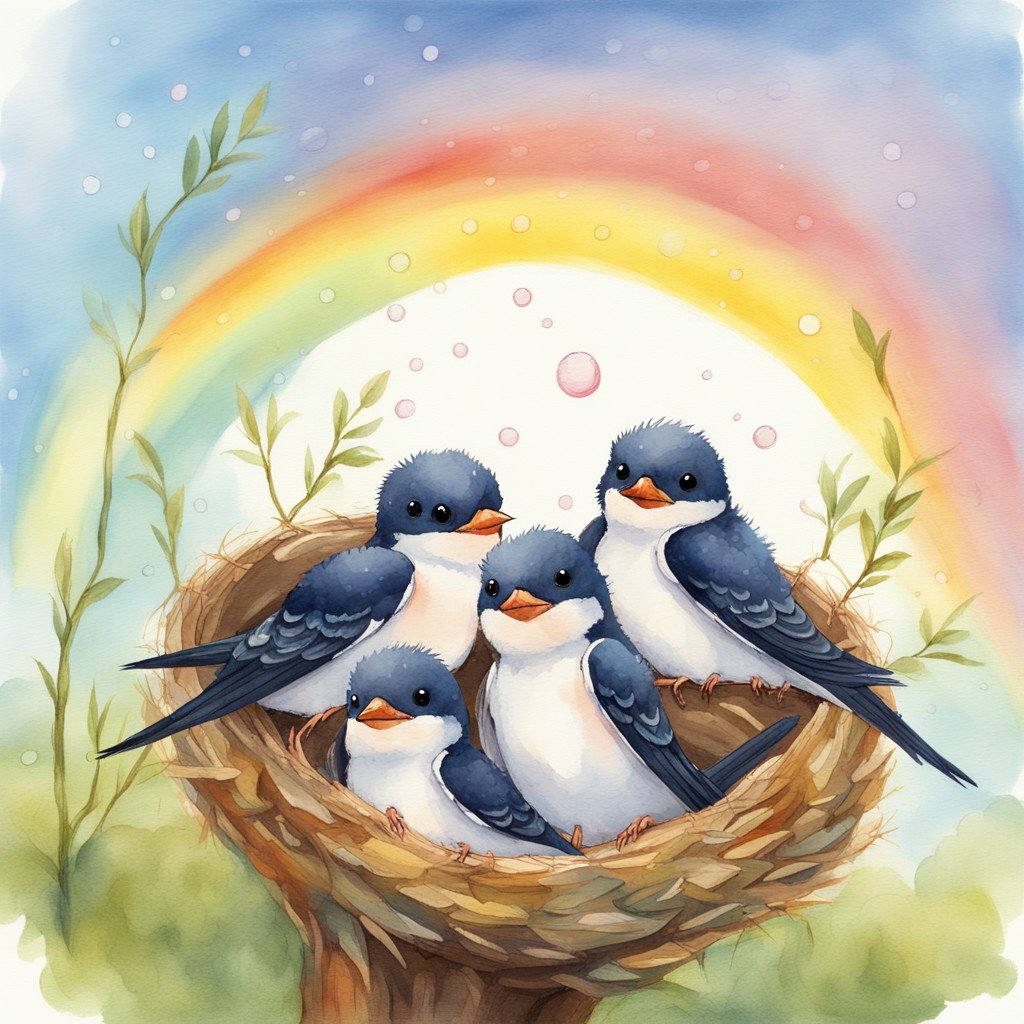
Sage was back. And she had brought help.
An adult red-tailed hawk—the guardian of Silverwing Forest, a bird so large and powerful that even snakes feared her—swept toward the oak tree, her wings casting shadows like a storm cloud. She saw the snake, saw the chicks on the branch, and with a cry that shook the leaves, she dove.
The snake, wise enough to know when it was outmatched, slithered down the trunk and disappeared into the underbrush, fleeing the hawk's terrible talons.
The hawk landed on a branch above Wren and Pip, her eyes warm despite their fierce appearance. "Are you hurt, little ones?" she asked, her voice like distant thunder.
"N-no," Wren stammered, her whole body shaking. "We are okay. We are okay."
Sage landed beside them, her own wings trembling, her eyes wet with tears. "Wren, I am so sorry. I should not have left. I was supposed to protect the nest. I was in charge. And I left."
Wren looked at her sister, this brave, impulsive, loving sister who had flown for help when it mattered most. "You came back," Wren said. "That is what matters. You came back."
The hawk flew them back to the nest, one by one, her strong talons gentle as hands. She coiled herself around the trunk, her presence enough to keep any predator away for miles. And she stayed, because that is what guardians do, until Mama Larkin and Papa Finn returned three days later.
When Mama and Papa heard the story—how Wren had carried Pip down the ribbon, how Sage had flown for help, how the two sisters had protected each other and their brother—they wept with pride and terror and love.
"You were so brave, my darlings," Mama Larkin said, holding all three chicks close to her heart. "So brave."
"But I was not brave," Sage said, her voice small. "I left the nest. I wanted to fly and explore. I was not responsible. Wren was. Wren protected Pip. Wren saved us."
Wren shook her head. "Sage flew for help. Without you, the snake would have found us. We did it together."
Papa Finn nuzzled Wren's head, his eyes shining. "Responsibility is not about being the oldest, little Wren. It is not about being the biggest or the strongest. It is about being the one who sees what needs to be done and does it, even when you are afraid. It is about caring for others more than you care for your own comfort. And you, my sweet chick, have shown more responsibility than many adult birds."
Wren thought about this as she curled up in the nest that night, Pip snuggled against her side, Sage's wing draped protectively over them both. She thought about the snake, and the ribbon, and the fall, and the fear. She thought about how she had wanted to cry, to hide, to wait for someone bigger and stronger to save them.
But she had not waited. She had acted. Not because she was brave, but because she was responsible. Because Pip needed her. Because the nest needed her. Because love, when it is real, does not ask you to be unafraid. It asks you to be present.
From that day on, Wren grew into the most trusted bird in Silverwing Forest. When Mama and Papa needed to leave the nest, they no longer asked Sage to be in charge. They asked Wren. Not because Sage was not loved—she was, dearly—but because Wren had shown them what responsibility truly meant.
And Sage? She learned too. She learned that being the oldest did not make her the leader. She learned that leadership was not about giving orders, but about being there when it mattered. She learned to listen to Wren, to support her, to be the wings that flew for help when Wren's wings were busy holding the nest together.
Together, the two sisters became the guardians of Silverwing Forest—the responsible heart and the brave wings, working as one, protecting all the little chicks who needed someone to care.
For that is the truest lesson of responsibility: it is not a burden placed upon the oldest or the biggest or the strongest. It is a gift given to the one whose heart is large enough to hold another's fear, whose courage is quiet enough to act when no one is watching, and whose love is steady enough to say:
"I am here. I will not leave. I will keep you safe."
And in the oldest oak tree, where the leaves still whispered secrets to the wind and the sunlight still filtered through in patterns of gold and green, three blue jay chicks grew into wise and loving birds, each knowing that the greatest power they possessed was not in their wings, but in their willingness to care.
The End
📚 Core Values Series
This story is part of our Core Values Series — stories that teach important life lessons through magical adventures:
- 📖 Explore All Core Values Stories — Discover the complete collection
- ✅ This Story — The Guardian of the Nest: A Story About Responsibility