The Kitten Who Found a Friend: A Story About Curiosity
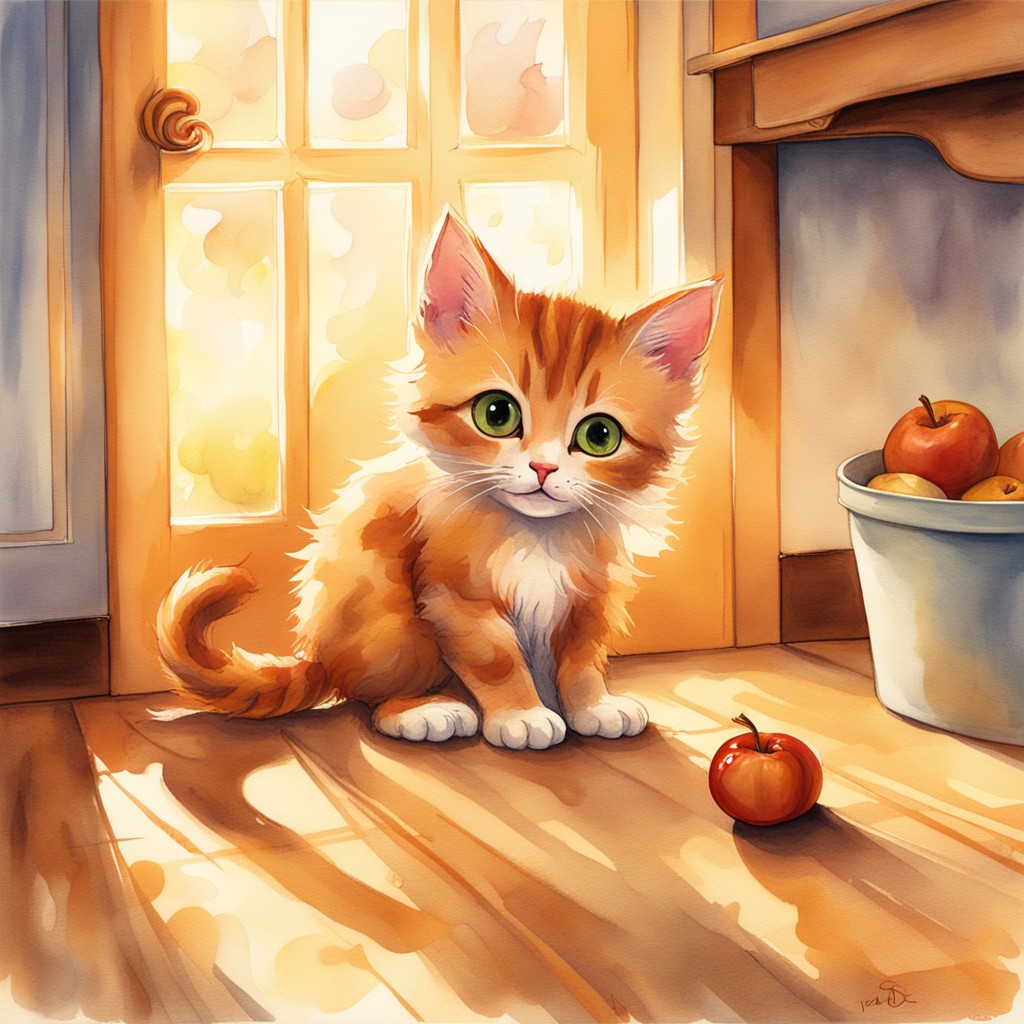
In a cozy house at the end of Maple Lane, where morning light poured through lace curtains like liquid honey and radiators hummed gentle lullabies, there lived a small kitten named Whisk. Her fur was the color of warm caramel with darker swirls, like someone had drizzled chocolate on top of toffee. But it was her eyes that truly set her apart—round and bright and endlessly wondering, the color of polished amber that seemed to see everything and question it all.
Whisk had been born in a cardboard box in the linen closet, along with her three siblings. While her brothers and sisters were content to tumble and pounce on dust motes, Whisk was different. From her very first wobbly steps, she was drawn to the unknown. The way a door hinge squeaked. Why water formed circles when it dripped. What made the refrigerator hum. Every corner of the house held a mystery, and Whisk was determined to solve them all.
"Whisk! Get down from there!" her mother, a dignified calico named Muffin, would call as Whisk perched atop the bookshelf, peering at the ceiling fan with scientific fascination.
"But Mama, how does it spin without falling?" Whisk would ask, her tiny head tilted at an angle that made her look like a living question mark.
"It just does," Muffin would sigh. "Now come down before you pull the encyclopedia set on your head."
Whisk's siblings thought she was strange. "Why do you waste time wondering about things?" her brother Patch would say, batting at a toy mouse. "Just play! That's what kittens do!"
But Whisk couldn't help herself. The world was a puzzle, and she wanted to understand how every piece fit together. She would sit for hours watching raindrops race down the windowpane, trying to figure out why some moved faster than others. She would paw at the kitchen tiles, testing which ones felt cooler and which ones held warmth from the afternoon sun. She even attempted to measure the height of the kitchen table by stretching her full length against one of the legs, leaving a tiny claw mark that the humans never noticed but that Whisk considered valuable scientific data.
"You're going to get into trouble one day," warned her sister Purl, who preferred napping to investigating. "Curiosity killed the cat, you know."
"That's just something grown-ups say," Whisk replied confidently. "And anyway, I'm being careful. I just want to understand things."
The turning point came on a Tuesday morning in late autumn, when the house was filled with the scent of cinnamon and baking apples. Whisk had discovered something extraordinary—a loose floorboard under the kitchen cabinet that, when scratched just right, lifted to reveal a dark, mysterious space beneath.
She peered into the gap, her amber eyes wide with excitement. The space below was dim and cool, full of dust and shadows. But there was something else too—a faint, rhythmic sound. Tap... tap... tap. Like a tiny heartbeat. And a soft glow, barely visible, flickering in the darkness.
Whisk's heart raced with the thrill of discovery. This was it! A real mystery! Something no one else knew about!
Without a moment's hesitation, she squeezed through the gap and dropped into the hidden space. Her paws landed on something soft—old insulation that felt like a bed of clouds. The air was thick with the smell of wood and dust and something else she couldn't identify. She blinked, letting her eyes adjust to the dim light, and began to explore.
The space beneath the floor was a maze of beams and pipes and wires. Whisk navigated it like an adventurer in a lost temple, her whiskers brushing against wooden supports as she squeezed through narrow gaps. The tapping sound grew louder as she moved deeper, and the faint glow became stronger—a soft blue light that pulsed like a gentle heartbeat.
"Hello?" Whisk called out, her voice small but brave. "Is someone there?"
The tapping stopped. For a long moment, there was only silence. Then a voice, barely a whisper, replied: "Who... who's there?"
Whisk followed the sound, squeezing past a heating duct and under a tangle of electrical cables. And there, in a small hollow between two support beams, she found the source of the mystery.
It was a mouse. But not just any mouse—a very young one, barely more than a baby, with fur the color of storm clouds and eyes like dark beads. The little creature was huddled against the beam, trembling, with one of its tiny legs caught in a loop of loose wire that had fallen from somewhere above.
The blue glow came from an old nightlight that had somehow tumbled down from a bedroom and lodged itself between the beams. It was the only light in the little mouse's dark prison.
"You're stuck," Whisk said, her heart filling with empathy. "How long have you been here?"
"I don't know," the mouse whispered, its voice shaking. "I was exploring, like I always do, and I fell. The wire caught my leg, and I can't reach the knot. I've been tapping for help, but no one ever comes down here."
Whisk's mind raced. She was small, but was she small enough to reach the knot? And even if she could, did she know how to untie it? Her claws were good for many things—climbing, catching, batting at yarn—but precision knot-untying was not one of them.
"My name is Whisk," she said, trying to sound braver than she felt. "And I'm going to help you. But first, I need to understand how this wire works. How did it catch you? Where does it lead?"
The mouse blinked at her, surprised. "You want to know how it happened? Most creatures would just try to pull me free."
"If I just pull, I might hurt you more," Whisk explained, her curious nature becoming her greatest strength. "I need to understand the problem before I can solve it. That's what my curiosity teaches me."
She examined the wire carefully, her bright eyes tracking its path. It was old telephone wire, thin and flexible, looped around the mouse's leg in a way that tightened when pulled. But Whisk noticed something—the loop was held in place by a nail that had worked loose from the beam. If she could somehow nudge the nail, the loop might loosen.
"I have an idea," she said. "But it requires something precise. Wait here."
"I'm not going anywhere," the mouse said weakly, managing a tiny smile.
Whisk hurried back through the maze of beams, her mind working faster than her paws. She needed something thin and strong—a tool. And then she remembered: in the sewing room upstairs, there was a box of quilting pins that the human used for her crafts. One of those pins might work!
But the sewing room was on the second floor. To get there from under the house, Whisk would need to find another way up. She remembered seeing a gap where a pipe passed through the wall between floors—a gap just wide enough for a determined kitten.
She found it within minutes: a plastic pipe that carried water from the upstairs bathroom. The seal around it had loosened over the years, creating a kitten-sized gap. Whisk squeezed through, emerging into the wall cavity of the second floor. From there, it was a matter of following the electrical lines (which ran like highways for a climbing kitten) until she reached the sewing room.
The quilting pin was exactly what she needed—thin, strong, and pointed. She carried it carefully in her mouth, the flat head sticking out like a tiny flag, and made her way back down to the trapped mouse.
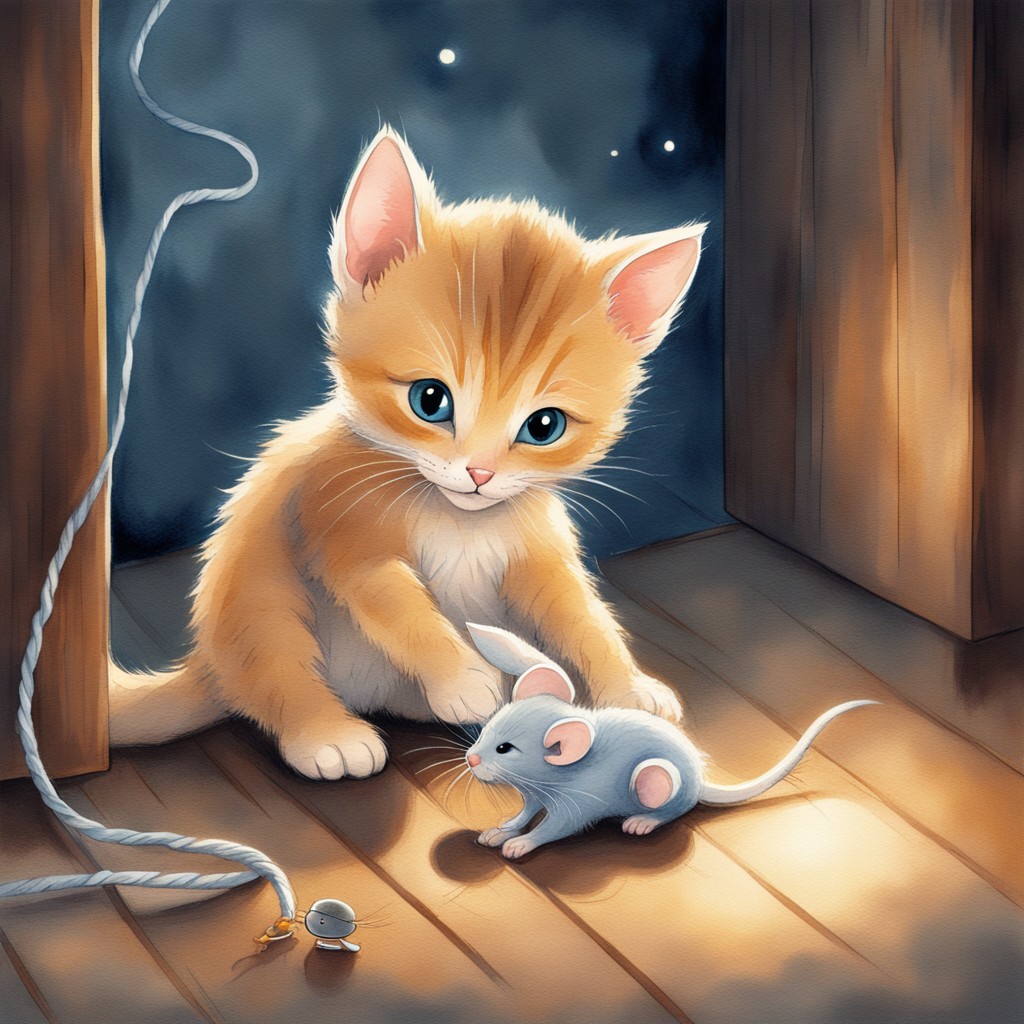
The mouse's eyes grew wide when he saw her return. "You came back," he whispered, as if he couldn't believe it.
"I told you I would," Whisk said, setting down the pin. "Now, hold very still."
With the delicacy of a surgeon, Whisk used the pin to work at the nail holding the wire loop. It was awkward work—she had to position her body at a strange angle, and her paws weren't designed for such fine manipulation. But her curiosity had taught her patience, and patience was exactly what she needed now.
Tap. Tap. Tap. The nail moved a fraction with each gentle push. The wire loosened a hair's breadth. And finally, after what felt like an eternity but was really only a few minutes, the nail came free, the loop opened, and the mouse's leg was released.
"You're free!" Whisk exclaimed, helping the little creature to his feet. "Can you walk?"
The mouse tested his leg gingerly. "It hurts, but I can move. Thank you, Whisk. Thank you for not giving up on me."
"Giving up isn't in my nature," Whisk said proudly. "I like to see things through. Now, let's get you home. Where do you live?"
"In the garden shed. My family has a nest behind the old watering can."
Whisk guided the mouse through the maze of beams, back toward the loose floorboard. But when they reached it, Whisk realized the gap was too high for the injured mouse to jump through.
"I can't lift you," she said, thinking hard. "But maybe I can build you a ramp."
She looked around the dark space, her curious eyes finding solutions where others would see only obstacles. A piece of cardboard from an old box, wedged against a beam at an angle. A strip of insulation to make it soft. A few pushes with her paws, and a gentle slope was born.
"Climb up," she instructed. "Take it slowly."
The mouse used his good legs to pull himself up the ramp, his tiny claws finding purchase on the cardboard. Whisk followed close behind, ready to help if he slipped. Together, they emerged into the warm kitchen, where the scent of cinnamon still lingered and afternoon light painted golden squares on the tile.
Whisk's mother Muffin was there, along with her siblings, who had gathered when they heard the floorboard move. They stared in astonishment at the sight of Whisk emerging from beneath the house with a mouse at her side.
"Whisk!" Muffin gasped. "What have you been doing? And why is there a mouse with you?"
Whisk sat up proudly, her caramel fur dusty but her eyes shining. "I found a mystery, Mama. Under the floor, there was a mouse who was trapped. His leg was caught in wire, and he couldn't get free. No one knew he was there. No one could hear his tapping. But I found him because I followed my curiosity. And I saved him because being curious taught me how to solve problems."
Purl stepped forward, her eyes wide. "You went under the house? All by yourself?"
"I wasn't alone," Whisk said. "I had my curiosity with me. It helped me find the right tool, figure out the right angle, and build the right ramp. Curiosity isn't just about asking questions—it's about finding answers when someone needs help."
Muffin looked at her daughter with new eyes. All this time, she had thought Whisk's endless questions were just kittenish foolishness. But now she saw the truth—Whisk's curiosity was not a flaw. It was a gift. A powerful, wonderful gift that had saved a life.
She stepped forward and gently licked Whisk's dusty head. "I'm proud of you, my little questioner. You turned your wondering into wisdom."
The little mouse, leaning against Whisk's leg for support, looked up at the family of cats with nervous eyes. "Thank you all for letting me into your home. I promise I won't cause trouble. I just want to get back to my family."
Patch, who had always been the most playful of the siblings, surprised everyone by stepping forward. "I know a shortcut to the garden shed," he said. "Through the cat door in the laundry room. It's faster than going around the house."
And so, the unlikely group—two cats and a mouse—made their way to the garden shed, where the mouse's family waited with frantic worry. When they saw their little one return, guided by a cat no less, their joy knew no bounds.
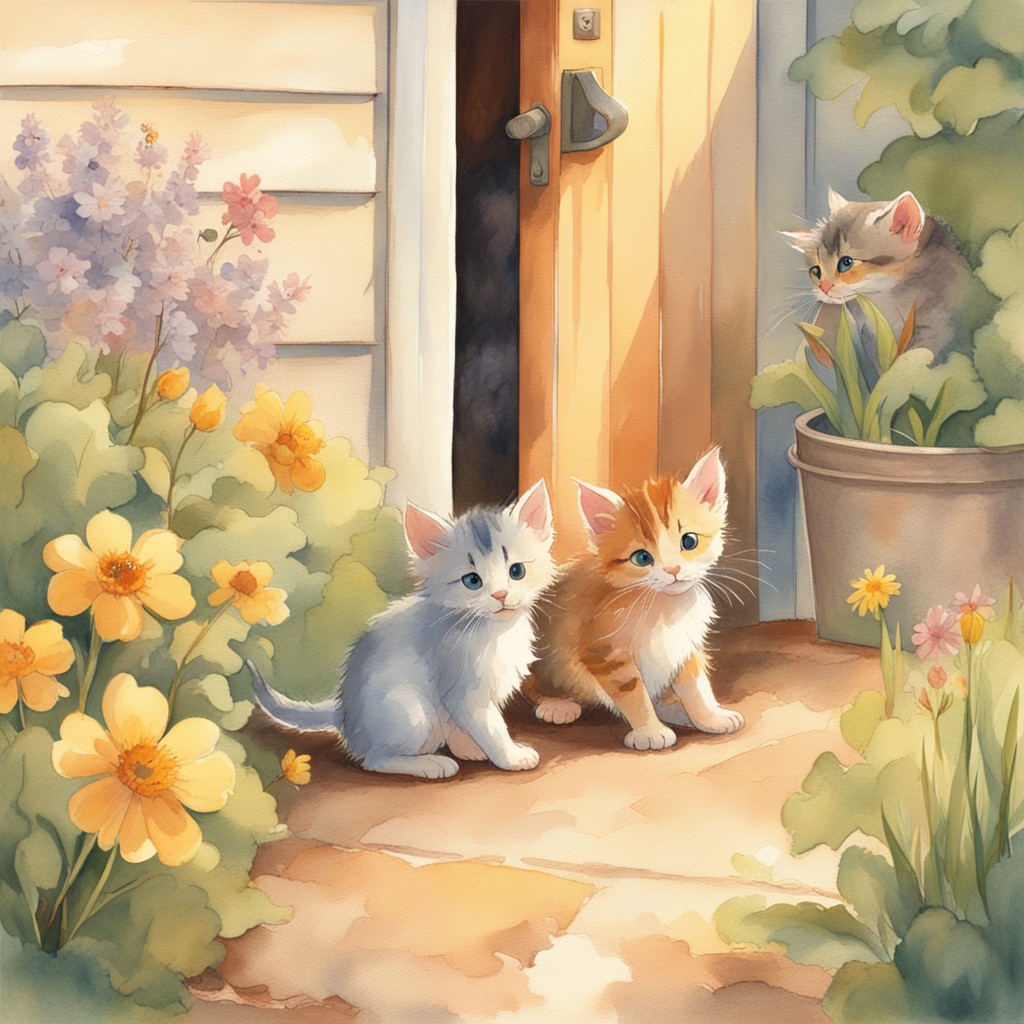
From that day forward, Whisk became known throughout the house—and eventually, throughout the neighborhood—as Whisk the Wonderer. When a toy went missing, Whisk would find it by thinking about where it might roll. When a strange sound came from the attic, Whisk would investigate and discover a family of raccoons who needed help finding a new home. When the humans' car wouldn't start, Whisk's observation of a loose wire under the hood (noticed during one of her many explorations) led to a quick repair.
But more than her problem-solving skills, it was Whisk's spirit that inspired others. Young animals from all around would come to her, asking how to be more curious, how to ask better questions, how to see the world as a place full of wonders rather than fears.
And Whisk would always tell them the same thing:
"The world is full of mysteries, and every mystery is an invitation. Don't be afraid to ask 'why?' Don't be embarrassed to wonder 'what if?' The ones who change the world aren't the ones who already know all the answers—they're the ones brave enough to ask the questions no one else has thought to ask. Curiosity is the key that opens every door. It's the light that shines in dark places. It's the map that guides you to treasures you never knew existed."
"And sometimes," she would add with a twinkle in her amber eyes, "it leads you to a new friend who needs your help. And that, my fellow wonderers, is the greatest treasure of all."
And in the cozy house at the end of Maple Lane, where the morning light still poured through lace curtains and radiators still hummed gentle lullabies, a small caramel kitten with endlessly curious eyes continued to explore, to question, and to discover—proving every single day that the world belongs to those who dare to wonder.
The end.