The Nest Keeper: A Story About Responsibility
High in the branches of an ancient oak tree, where the sun filtered through leaves like golden lace and the wind sang soft lullabies through the branches, there lived a family of robins.
The nest was a masterpiece of woven grass and twigs, lined with soft moss and feather down, cradled in the fork of two strong branches. It had been built by the mother robin, Robinia, with help from her mate, Rowan, when the first hint of spring had touched the winter-bare trees. They had worked for days, flying back and forth with beakfuls of building materials, until the nest was perfect—cozy, safe, and just the right size.
Inside this nest, four small eggs rested like tiny blue jewels. Robinia sat on them day and night, keeping them warm, keeping them safe. She knew that beneath those delicate shells, life was stirring, growing, preparing to enter the world.
And she knew something else: that once those eggs hatched, everything would change.

The first crack appeared on a morning when the dew still clung to the grass and the air smelled of new beginnings.
Robinia felt the movement beneath her—a tiny tap, tap, tap against the inside of the shell. She shifted carefully, giving the chick inside room to work. The tapping grew stronger, more insistent.
Rowan stood guard on a nearby branch, his bright eyes watching for danger. "Is it time?" he called softly.
"It's time," Robinia whispered.
They waited together as the first chick broke through, wet and wrinkled and utterly helpless. Its eyes were sealed shut, its body trembling, its voice a thin, desperate peep.
Robinia tucked it beneath her warm feathers, and the chick immediately went quiet, comforted by the heat and the steady heartbeat of its mother.
By evening, three more chicks had joined the first. Four tiny lives, each no bigger than Robinia's claw, each completely dependent on their parents for everything—warmth, food, protection, love.
Robinia and Rowan named them in the secret language of birds, sounds that meant Sky, Leaf, Brook, and the eldest, who had been first to break free of his shell, Wren.
Wren was different from the start.
While his siblings huddled together in a warm pile, sleeping most of the day, Wren was awake. While they waited passively for food to arrive, Wren watched. He watched his mother fly away and return with worms and insects. He watched his father stand guard, scanning the sky for hawks and the ground for cats. He watched the way the nest was constructed, the way the twigs interlocked, the way the moss formed a soft cushion.
He was curious. He was alert. And most of all, he was aware.
Even before he could see—his eyes still sealed for those first few days—Wren understood that the world was full of dangers. He felt the nest sway in strong winds and knew they could fall. He heard the cries of predators in the distance and knew they could be attacked. He felt the cold when his parents were away hunting and knew that warmth was life.
And he felt something else, something he couldn't quite name. A sense that he needed to do something. To help. To protect. To be ready.
The first test came when Wren was five days old.
Robinia had gone to find breakfast, and Rowan was patrolling the outer branches, watching for danger. The four chicks were alone in the nest—a rare and vulnerable moment.
Wren felt it first. A strange stillness in the air. A shadow passing over the sun. A sound he had never heard before but somehow knew to fear—the high, sharp cry of a hawk.
His siblings slept on, unaware. But Wren's whole body went rigid with alarm.
"Father!" he peeped, as loud as his tiny voice would allow. "Father, come!"
Rowan heard the cry—the special, urgent cry that chicks used only for danger. He darted back to the nest, feathers puffed, ready to fight.
The hawk circled overhead, a great shadow against the blue sky. It had seen the nest. It was calculating, planning its dive.
But Rowan was ready. He positioned himself at the nest's edge, between his chicks and the sky, and let out a warning call—a series of sharp, angry notes that told the hawk this nest was defended. This nest was not easy prey.
The hawk circled once more, then flew away, searching for an easier meal.
Rowan turned to his chicks, counting them with his eyes. Four. All safe. All alive.
He looked at Wren, who had raised the alarm. "You did well, little one," Rowan said softly. "You kept watch when others slept. That is a special gift."
Wren didn't fully understand his father's words, but he felt a warm glow inside. He had done something. He had helped. And it had mattered.
As the days passed, Wren's sense of responsibility grew along with his feathers.
He was the first to open his eyes, and what he saw amazed him. The world was enormous—an endless expanse of green and blue and gold. Trees stretched in every direction. The sky went on forever. Other birds flew past, calling to each other in songs that Wren longed to understand.
But he also saw the dangers. The neighbor's cat, stalking through the grass below. The squirrels, quick and clever, who would steal eggs if they could. The jays, loud and aggressive, who might attack a nest to steal its contents. The weather, which could turn from gentle sunshine to driving rain in minutes.
The nest was safe, but only because his parents made it so. And Wren began to understand that safety wasn't something that just happened. It was something that had to be worked for. Protected. Maintained.
When his siblings huddled together during a thunderstorm, crying with fear, Wren positioned himself on the outside of the huddle, taking the brunt of the wind and rain. He was wet and cold and miserable, but his siblings were warmer, and that mattered more.
When food was scarce and Robinia returned with only a few small insects, Wren let his siblings eat first. He went hungry, his stomach aching, but he knew they needed the food more. They were smaller, weaker, less able to endure.
"You don't have to do this," Robinia told him one evening, when she noticed he had gone without food for the third time that day. "You are still a chick. You need to eat."
"They need it more," Wren said simply. "I'll be okay."
Robinia looked at her eldest chick with a mixture of pride and worry. "Responsibility is a heavy burden for one so young."
"What's responsibility?" Wren asked.
"It means caring for others even when it's hard," Robinia said. "It means putting their needs before your own. It means being ready to act, even when you're afraid."
Wren thought about this. "I think I like responsibility," he said.
Robinia laughed—a soft, musical sound. "Most young ones run from it. You seem to run toward it."
"Someone has to," Wren said. And in that moment, he understood something that would shape his entire life: that responsibility wasn't a burden to be avoided. It was a gift to be embraced. It was the way a creature showed love—not just in words, but in actions. In sacrifices. In showing up, again and again, even when it was hard.
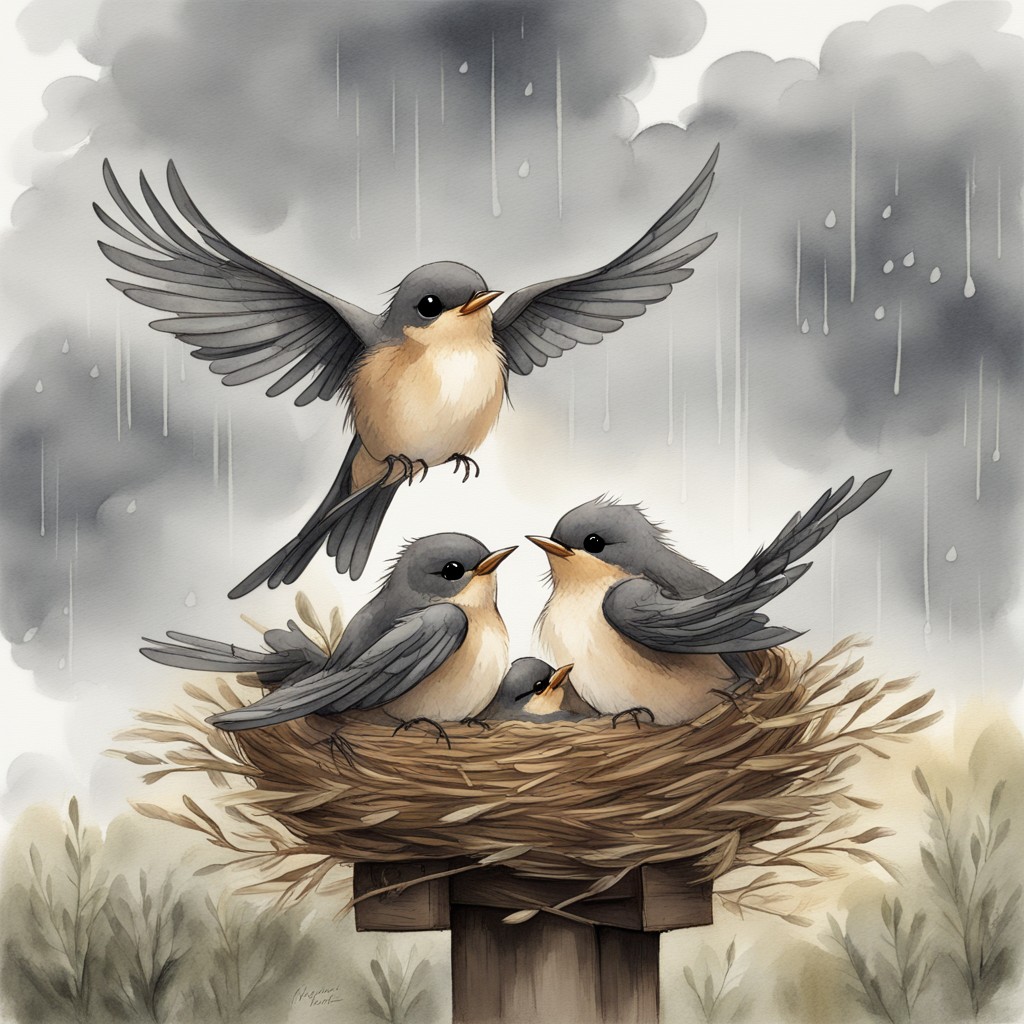
The greatest test came on a day when the sky was the color of steel and the wind carried the scent of rain.
Robinia had left early that morning to find food. The chicks were growing fast, their appetites enormous, and she needed to hunt longer and travel farther to keep them fed. Rowan was following her, helping carry the load, leaving Wren in charge of the nest.
"Keep them safe," Rowan had said, his eyes serious. "We'll be back as soon as we can."
"I will," Wren promised.
He was two weeks old now—almost fully feathered, his eyes sharp, his body strong. He could hop to the edge of the nest and look down at the ground far below. He could spread his wings and feel the air catch them, though he couldn't yet fly. He was almost ready to leave the nest, almost ready to become an adult.
But not yet. And his siblings needed him.
The first danger came from above.
A crow, black and clever, landed on a branch near the nest. Crows were nest robbers. They would eat eggs and small chicks if they got the chance. This one was eyeing the nest, calculating, planning.
Wren positioned himself at the nest's edge, making himself as big as possible. He fluffed his feathers. He opened his beak. He let out a series of sharp, aggressive cries—the most intimidating sounds he could make.
The crow hesitated. This chick was bigger than expected. More confident. More ready to fight. Was it worth the risk?
The crow decided it wasn't. With a harsh caw, it flew away.
Wren relaxed slightly, but he didn't let his guard down. Danger could come from any direction.
And it did.
The second danger came from below.
The neighbor's cat—a sleek, gray predator with yellow eyes—had been watching the nest for days. It knew there were chicks inside. It knew they would be worth the climb. And today, with the parents away, it saw its chance.
The cat began to climb.
Wren heard the scratching of claws on bark. He looked down and saw the cat, inching up the trunk, its eyes fixed on the nest with terrible intensity.
His siblings were sleeping, unaware. Leaf and Brook and Sky, huddled together, dreaming of flying and sunshine and their next meal.
Wren knew he couldn't fight a cat. He was a chick, small and flightless. One swipe of those claws would end him.
But he also knew he couldn't let the cat reach the nest. Not while his siblings were inside. Not while he had promised to keep them safe.
"Wake up!" he chirped, nudging his siblings with his beak. "Danger! Hide!"
His siblings stirred, confused and sleepy. "What?" Leaf mumbled.
"The cat!" Wren said urgently. "Get to the back of the nest. Stay low. Don't move."
The chicks scrambled to the back of the nest, pressing themselves against the trunk, making themselves small and invisible.
Wren stayed at the front. He would be the one the cat saw first. He would be the target. And maybe, just maybe, that would give his siblings time.
The cat climbed higher, its muscles bunching and releasing, its tail twitching with excitement. It was almost at the nest. Wren could smell it now—a sharp, musky scent that made his feathers stand on end.
He did the only thing he could do. He attacked.
Not the cat—that would be suicide. But the cat's face. Its eyes. The most sensitive, vulnerable part of a predator.
Wren launched himself from the nest, his wings spread wide, his claws extended. He aimed for the cat's eyes, shrieking at the top of his voice—a high, piercing cry that echoed through the trees.
The cat was startled. It hadn't expected a chick to fight back. It flinched, throwing up a paw to protect its face, losing its grip on the trunk.
Wren dodged the paw, landed on a branch, and attacked again. Shriek! Peck! Flap! He was a fury of feathers and noise, utterly fearless, completely focused.
The cat, now half-blind and off-balance, began to slide down the trunk. It scrambled for purchase, its claws raking the bark, but Wren kept attacking, kept shrieking, kept fighting.
With a yowl of frustration, the cat dropped to the ground and ran away, tail between its legs.
Wren watched it go, his chest heaving, his heart pounding. He had done it. He had driven away a predator many times his size. He had protected his siblings.
He hopped back to the nest, his legs trembling with exhaustion and relief. His siblings were safe. They were all safe.
"Wren!" Sky chirped, her eyes wide with wonder. "You saved us!"
"You were so brave!" Brook added.
"I just..." Wren started, but he didn't know how to finish. He didn't feel brave. He had been terrified. But he had done what needed to be done. Because he had promised. Because his siblings were his responsibility.
Robinia and Rowan returned to find their chicks alive and unharmed.
When they heard the story—how Wren had kept watch, how he had raised the alarm, how he had fought off the cat—they were amazed.
"You are special, Wren," Robinia said, nuzzling her eldest chick with her beak. "Not because you fought the cat. But because you chose to. Because you put others before yourself. Because you understood that responsibility is love in action."
"I just did what needed to be done," Wren said.
"Exactly," Rowan said. "And that is the heart of responsibility. Seeing what needs to be done, and doing it. Even when it's hard. Even when it's scary. Even when no one is watching."
The days grew longer. The chicks grew stronger. Their downy fluff gave way to sleek feathers. Their chirps grew louder, more confident. They practiced flapping their wings, jumping from branch to branch, preparing for the day they would leave the nest.
And then, one bright morning, it was time.
Robinia stood on the edge of the nest, looking at her four chicks. "Today is the day," she said. "Today you learn to fly."
The chicks looked at each other, equal parts excited and terrified.
"Don't worry," Robinia said. "I'll be right here. I'll catch you if you fall."
One by one, the chicks leaped from the nest. Sky went first, her wings catching the air, carrying her in a wobbly arc to a nearby branch. Leaf followed, his flight steadier, more controlled. Brook went next, landing a bit hard but safe and sound.
And then it was Wren's turn.
He stood at the nest's edge, looking down at the ground far below. He had dreamed of this moment. He had practiced and prepared. He was ready.
But he hesitated.
He looked back at the nest—the home that had sheltered him, the place where he had learned to be responsible, to care for others, to understand that love was shown in actions.
He would miss this nest. But he knew that what he had learned here would go with him, wherever he flew.
"Are you ready?" Robinia asked.
"I'm ready," Wren said.
And he jumped.
The air caught his wings, lifting him up, carrying him forward. He flew—not perfectly, not gracefully, but truly flew. The world spread out beneath him, vast and green and full of possibility.
He landed on a branch beside his siblings, all of them chattering with excitement, with joy, with the thrill of newfound freedom.
"We did it!" Sky sang.
"We're flying!" Leaf chirped.
"This is amazing!" Brook trilled.
Wren looked at them—all of them safe, all of them happy, all of them ready for the next chapter of their lives. He felt a warmth in his chest that had nothing to do with the sun.
He had kept them safe. He had done his duty. And now, watching them soar, he knew that every sacrifice, every hunger, every moment of fear had been worth it.
Responsibility wasn't a chain that held you down. It was a pair of wings that helped you rise.
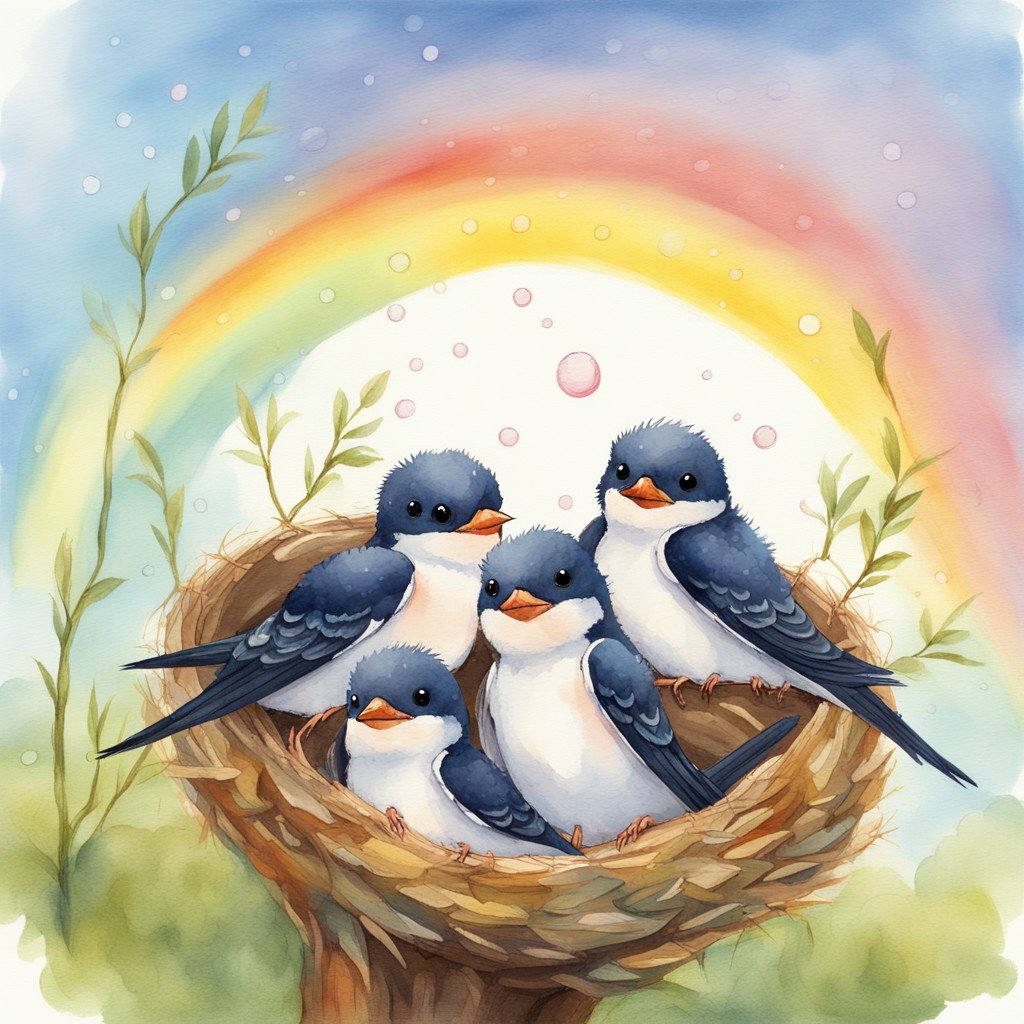
Years later, Wren had a nest of his own.
He had chosen a mate—a gentle robin named Willow—and together they had built a home in the branches of an elm tree near a bubbling brook. They had four eggs, then four chicks, then four young robins learning to fly.
And Wren taught them what he had learned.
He taught them to watch for danger. To care for each other. To put the needs of the family before their own. To understand that responsibility was not a punishment, but a privilege—the greatest privilege any creature could have.
"Responsibility," he would tell them, perched on the edge of the nest as the sun set, painting the sky in colors of amber and rose, "means showing up. Even when you're tired. Even when you're scared. Even when you'd rather do something else. It means keeping your promises, protecting those you love, and doing what needs to be done—because it's right, not because someone is watching."
"But it's hard," one of his chicks would say.
"It is," Wren agreed. "But it's also how we show love. Not with words, but with actions. With sacrifices. With showing up, again and again, no matter what."
He looked at his chicks, all of them listening with wide, attentive eyes. "And when you do that—when you take responsibility for others, when you make their safety and happiness your own—you become something bigger than yourself. You become a guardian. A protector. A nest keeper."
"And that," he said, his voice soft but strong, "is the greatest thing any of us can be."
THE END
Moral of the Story: Responsibility is the act of caring for others and fulfilling our duties, even when it is difficult or frightening. It means putting the needs of those who depend on us before our own comfort. It means keeping our promises, being reliable, and doing what needs to be done—not because we must, but because we choose to. True responsibility is not a burden; it is a gift that allows us to show love through action. When we embrace responsibility, we become guardians, protectors, and nest keepers for those we love. And in doing so, we discover that the act of caring for others is what gives our own lives meaning and purpose.