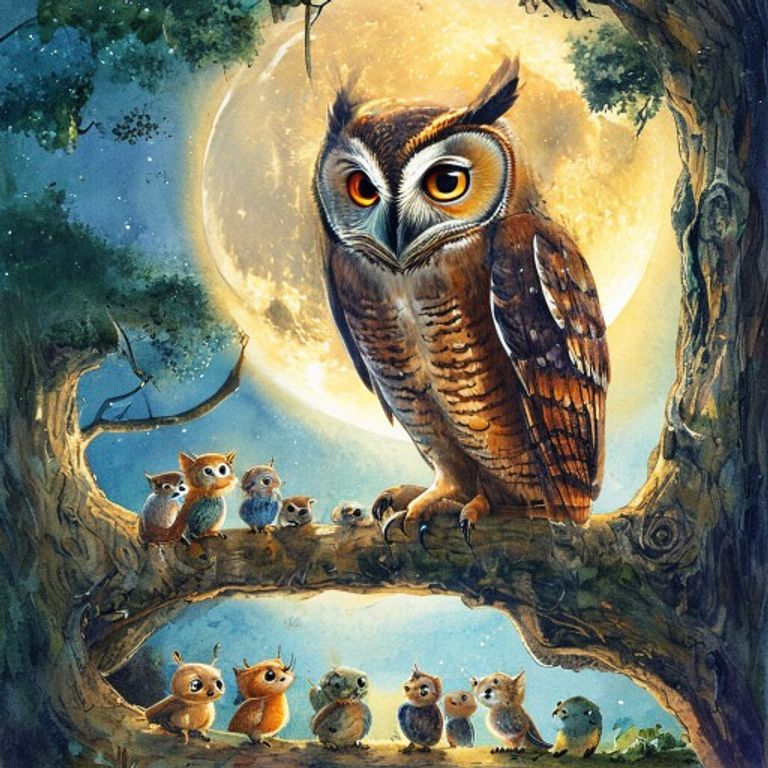
The Owl Who Weighed the Heart: A Story About Justice
The Owl Who Weighed the Heart: A Story About Justice
High in the branches of the Great Oak of Eldervale, where the oldest leaves whispered secrets to the wind and moonlight pooled like silver coins between the boughs, there lived a great horned owl named Solstice. He was not the largest owl in the forest, nor the fiercest, but he was the wisest. His eyes were the color of amber honey, and when he looked at you, it felt as though he could see not just your actions, but the intentions behind them—the hopes, fears, and fleeting thoughts that even you had not yet named.
Solstice served as the Judge of the Canopy Court, a sacred gathering place where the animals of Eldervale brought their disputes. The court was not made of stone or wood, but of trust. It existed wherever Solstice perched, and all who came before him knew that his judgments were not about winning or losing. They were about making things right.
For many years, the forest had been peaceful. Squirrels shared acorn trees. Rabbits respected one another's burrows. The stream belonged to everyone, and everyone belonged to the stream. But as autumn painted the leaves in shades of flame and gold, a tension began to grow—slowly at first, like frost creeping across a window, then faster, like a storm gathering over the mountains.
It began with the Berry Patch.
The Berry Patch was a sun-drenched clearing where blackberry bushes grew so thick and sweet that the air itself tasted like summer. For generations, every animal had taken only what they needed. The rabbits gathered berries for their young. The deer nibbled the leaves. The birds plucked the fruit that hung highest, where no one else could reach. It was a quiet harmony, unwritten but understood.
Then came Bramble.
Bramble was a young fox with fur the color of burnt copper and eyes that sparkled with cleverness. He was quick, charming, and utterly convinced that the world belonged to those who claimed it first. One morning, before the dew had dried, Bramble strung vines across the Berry Patch and declared it his.
"I found it first," he announced to the gathered animals, his tail swishing with triumph. "I marked it. I defended it. The berries are mine, and anyone who takes them must pay me with their best acorns, their shiniest pebbles, or their finest feathers."
The animals were stunned. The rabbits trembled. The birds squawked in outrage. An elderly badger named Thorn, whose family had eaten from the Berry Patch for forty years, stepped forward.
"This is not how things are done," Thorn rumbled, his voice like gravel rolling down a hillside. "The Berry Patch belongs to all of us. No one animal can claim it."
Bramble smiled, showing teeth as white as moonstones. "Then take me to court," he said. "Let Solstice decide."
The animals murmured. The Canopy Court had not been called in many seasons. But this was a matter that could not be ignored. So Thorn, with the rabbits and birds at his side, climbed the Great Oak to where Solstice waited, his feathers unruffled by the wind.

Solstice listened as Thorn spoke of tradition, of sharing, of the unspoken rules that had kept the forest peaceful. He listened as Bramble argued that possession was justice, that effort deserved reward, and that the cleverest animal had the right to claim what others were too slow to take.
When both had finished, Solstice was silent for a long time. The wind moved through the oak leaves like a held breath.
"Bramble," the owl said at last, his voice deep and measured. "You say the Berry Patch is yours because you claimed it first. But tell me—did you plant the bushes? Did you water them through the droughts of summer? Did you tend the soil, protect the roots, or sing to the bees that pollinate the flowers?"
Bramble shifted. "No," he admitted. "But I—"
"And you, Thorn," Solstice continued, turning his amber eyes to the badger. "You say the Berry Patch belongs to everyone. But tell me—when the drought came three summers ago, who carried water from the stream to save the bushes? When the frost threatened, who wove coverings to protect the vines?"
Thorn looked at his paws. "I did not," he said quietly. "I assumed... I assumed they would survive, as they always had."
Solstice spread his wings—not in anger, but in a gesture that seemed to gather the whole forest into his embrace. "Justice," he said, "is not a word. It is a balance. It is the understanding that what we take, we must also give. That what we claim, we must also care for. Bramble, you wish to own the Berry Patch. But ownership without stewardship is not justice. It is greed wearing a mask."
Bramble's ears flattened. "Then what would you have me do?"
"Share the work, share the reward," Solstice said. "Tend the bushes with the others. Protect them. Water them. And when the berries ripen, take your fair portion—not more, not less. Justice is not about getting everything. It is about getting what is right."
Bramble was silent. Then, slowly, he nodded. "I understand," he whispered.
But Solstice was not finished. "And Thorn," he said, "you cannot expect peace to maintain itself. Tradition without effort becomes entitlement. The Berry Patch thrived because animals before you cared for it. Will you be the generation that lets it wither?"
Thorn bowed his head. "I will help," he promised. "We all will."
The animals cheered. But Solstice raised a talon, and they fell silent.
"This is not the end," the owl warned. "Justice is not one judgment. It is a practice, like flying or hunting. You must choose it every day."
The weeks that followed were hard. Bramble learned that tending berries was more difficult than claiming them. His paws were scratched by thorns. His back ached from carrying water. But slowly, he began to understand something he had never felt before—the satisfaction of creating something, not just taking it.
Thorn, for his part, discovered that the young fox had clever ideas. Bramble suggested building a small irrigation channel from the stream, using stones and clay. He figured out which birds were best at chasing away berry-stealing insects. He even taught the rabbits how to identify the ripest fruit by its scent.
The Berry Patch flourished as it never had before. The harvest was bountiful. And when the animals gathered to share the berries, there was enough for everyone—even a little extra.
But justice, as Solstice had warned, was not one judgment. And soon, another dispute arose.
This time, it was about the Acorn Bridge.
The Acorn Bridge was a fallen log that spanned the Whispering Stream, connecting the east side of the forest to the west. It was narrow, and only one animal could cross at a time. For years, the animals had taken turns. But now, as winter approached and food grew scarce, the bridge became a battleground.
A family of squirrels argued that they should have priority, since they needed to gather the most food for winter. A pair of otters insisted that they needed to cross quickly to catch fish before the stream froze. A young deer with a twisted leg struggled to wait her turn, while the stronger animals pushed past her.
The arguments grew heated. Accusations flew like autumn leaves. Someone had to decide.
Once again, the animals climbed the Great Oak. Solstice listened to each story. He heard the squirrels' fear of winter hunger. He heard the otters' worry about the freezing stream. He heard the young deer's quiet plea for fairness.
"Justice," Solstice said, "must consider need, not just strength. It must see the whole picture, not just one corner."
He ruled that the bridge would have crossing times. In the morning, when the fish were most active, the otters would have priority. In the afternoon, when the acorns were easiest to find, the squirrels would cross first. And at all times, any animal with an injury, a young family, or a special need would be allowed to cross immediately, no matter the hour.
"But that is not equal!" cried a young squirrel. "They get more time than we do!"
"It is not equal," Solstice agreed. "But it is fair. Equal means everyone gets the same. Fair means everyone gets what they need. Justice lives in fairness, not equality."
The young squirrel thought about this. She thought about the deer with the twisted leg, struggling to stand. She thought about the otter pups, too young to swim in icy water. And slowly, she understood.
"I will wait my turn," she said. "And I will help others who need to cross more than I do."
Solstice smiled—a rare and beautiful thing, like the first star of evening. "Then you have learned the heart of justice," he said. "It is not about rules carved in stone. It is about compassion carved in the heart."

Seasons passed. The animals of Eldervale changed. Young ones grew old. Old ones passed into memory. But the Canopy Court remained, and Solstice remained, and the practice of justice spread through the forest like roots through soil.
Bramble the fox became one of the most respected berry-tenders in Eldervale. The young squirrel who had questioned the bridge rules grew into an elder who taught her grandchildren that fairness was worth more than winning. And the deer with the twisted leg discovered that when the strong helped the weak, the whole forest grew stronger.
On the night of his hundredth winter, Solstice called the animals together one final time. His feathers were silver with age, and his voice was softer than it had been, but his eyes still held the same amber warmth.
"I will not be here forever," he told them. "No judge is eternal. But justice must be. So I ask you to remember three things."
He raised one talon. "First: listen to all sides. The truth is rarely found in one voice. It lives in the space between stories."
He raised a second talon. "Second: consider the vulnerable. Justice that only protects the strong is not justice. It is power wearing a costume."
He raised a third talon. "Third: be willing to change. What was fair yesterday may not be fair today. The world moves, and justice must move with it."
The animals wept. They begged him to stay. But Solstice only smiled.
"Justice does not need me," he said. "It needs you. Every time you choose fairness over favor. Every time you help the weak instead of joining the strong. Every time you pause to ask, 'What is right?' instead of 'What do I want?'—you keep the court alive."
And with that, he spread his wings and flew into the moonlight, vanishing among the stars.
But the Canopy Court did not vanish with him. It moved into the hearts of the animals. When disputes arose, they gathered beneath the Great Oak and asked one another: What would Solstice have seen? What would he have weighed? What would he have said?
And always, if they listened honestly, they heard his voice in the whisper of the leaves: Justice is not a destination. It is a journey. And the journey belongs to all who choose to walk it.
Moral of the Story: Justice is not about having the most power or getting the biggest share. It is about making things fair for everyone—especially those who need help the most. True justice means listening to all sides, caring for the vulnerable, and choosing what is right over what is easy. It requires us to work together, share what we have, and remember that a community is only as strong as its kindness to the smallest and weakest among it. Fairness is not a rule written in a book. It is a promise we make to one another, every single day.
Age Range: 4-8 years | Reading Time: ~10 minutes | Core Value: Justice