The Boy Who Built a Rainbow: A Story About Creativity
The Boy Who Built a Rainbow: A Story About Creativity
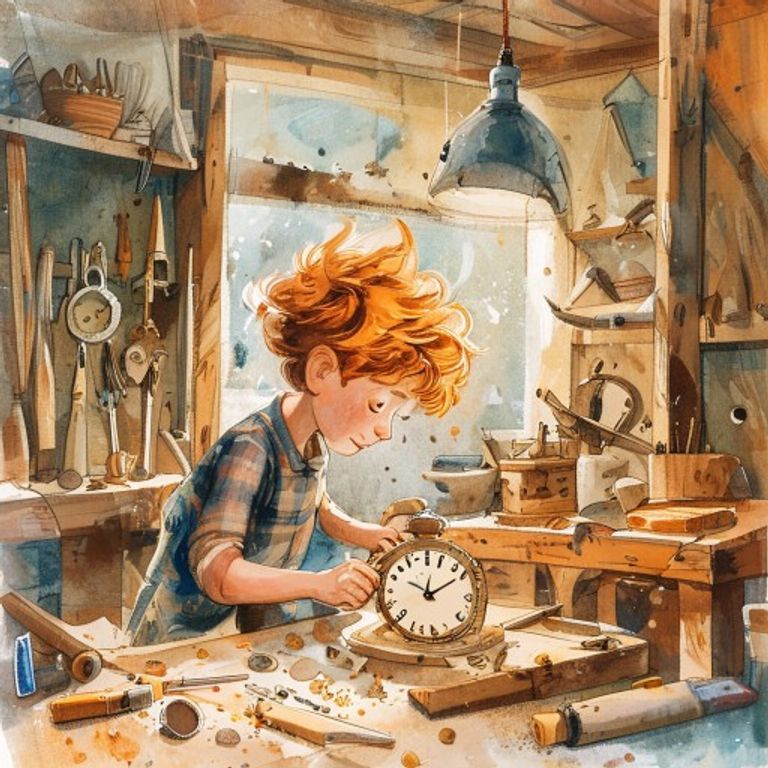
In the town of Millbrook, where the river turned the old waterwheel and the blacksmith's hammer rang like a bell, there lived a boy named Felix. He was ten years old, with hair the color of copper wire and eyes the blue of a summer sky. He lived with his father above a woodworking shop, where sawdust gathered in corners like golden snow and the smell of pine filled every room.
Felix was not like other children. While his classmates played football and chased each other through the streets, Felix sat in the workshop, surrounded by scraps of wood, bits of metal, and spools of wire. He was not building anything in particular. He was just... creating.
He built a birdhouse shaped like a teacup, with a tiny door where the handle should be. He built a clock where the numbers were replaced with small painted animals, so that when it was three o'clock, a frog would pop out and croak. He built a kite with wings that flapped in the wind, made from old silk scarves and bamboo sticks.
The other children thought Felix was strange. "Why do you waste your time on silly toys?" they would ask. "Why don't you play normal games?"
Felix would shrug. "I like making things. It makes me happy."
But inside, their words hurt. He wanted to be accepted. He wanted to fit in. He wanted the other children to see that his creations were not silly—they were special.
One day, the mayor of Millbrook announced a contest. "The town needs a new clock for the square," he declared. "Something unique. Something that represents our town's spirit. The child who designs the best clock will have their creation built and displayed for all to see."
The children of Millbrook buzzed with excitement. They drew plans in their notebooks, sketched elaborate designs, and dreamed of glory. Felix listened, his heart beating faster. This was his chance. This was his moment to show everyone what creativity could do.
He ran to the workshop and pulled out every scrap, every tool, every material he had saved. He worked for days, barely sleeping, barely eating, his mind racing with ideas.
He built a model. Not just a clock—a story. A clock that told time not with numbers, but with scenes from Millbrook's history. At dawn, tiny wooden fishermen would cast their lines into a painted sea. At noon, the blacksmith would strike his anvil, and a small flame would flicker. At dusk, a family of paper deer would emerge from a forest of wire and dance. And at midnight, the stars would light up, one by one, on a velvet sky.
It was beautiful. It was strange. It was unlike anything anyone had ever seen.
When Felix brought his model to the town square on the day of the contest, the other children laughed. "What is that?" they asked. "It does not even have numbers! How will anyone know what time it is?"
"You will know," Felix said quietly. "Because it tells time through stories. Through art. Through imagination."
The judges—a panel of elders and artisans—walked from table to table. They saw clocks with golden numbers and marble bases. They saw clocks with bells and chimes. They saw clocks that were elegant and traditional and perfectly normal.

And then they saw Felix's clock.
They stared. They leaned closer. They watched as Felix wound the mechanism and the tiny fishermen cast their lines, the blacksmith struck his anvil, the deer danced, and the stars lit up.
"This," one judge whispered, "is not just a clock. This is a story. This is a dream made real."
"But how do you tell the time?" another judge asked.
Felix smiled. "You do not just tell time. You feel it. You experience it. Every hour is a story, every minute a memory. That is what creativity does. It does not just show you what is. It shows you what could be."
The judges conferred. The crowd murmured. The other children fidgeted, suddenly less confident in their golden numbers and marble bases.
And then the mayor stepped forward, holding a ribbon. "The winner of the Millbrook Clock Contest," he announced, "is Felix, the boy who built a rainbow out of wood and wire and dreams."

The crowd erupted in applause. The other children, who had laughed at Felix's strange creation, now stared in awe. They saw not a silly toy, but a masterpiece. They saw not weirdness, but wonder.
"How did you think of this?" one of the children asked, approaching Felix after the ceremony.
"I did not think of it," Felix said. "I imagined it. Creativity is not about thinking. It is about dreaming. It is about taking what is in your head and making it real, even if everyone says it is impossible."
The child nodded, understanding dawning in his eyes. "Can you teach me?"
"I can try," Felix said, smiling. "But first, you have to stop worrying about what is normal and start wondering what is possible."
Moral of the Story: Creativity is not about being normal. It is about being brave enough to imagine something new and work hard to make it real. Felix was different. He built strange things that other children did not understand. But when he had the chance, he showed everyone that creativity is not silly—it is powerful. It turns dreams into reality. It turns imagination into art. So do not be afraid to be different. Do not be afraid to build, to paint, to write, to dream. The world needs your creativity. The world needs your rainbow.
Age Range: 4-8 years | Reading Time: ~10 minutes | Core Value: Creativity