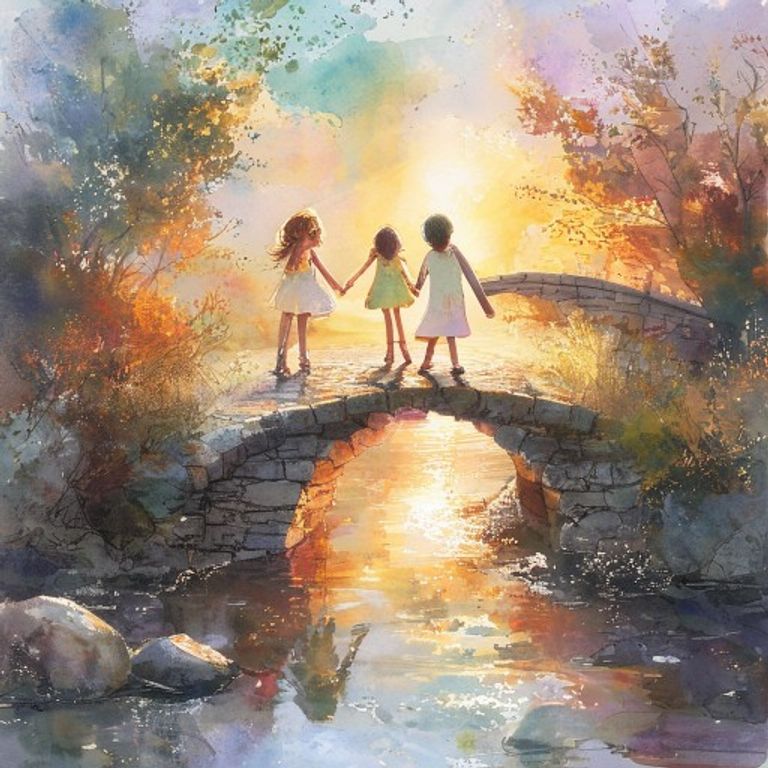
The Bridge of Forgiveness: A Story About Letting Go
The Bridge of Forgiveness: A Story About Letting Go
In the town of Willow Creek, where the river wound through meadows like a silver ribbon and the old stone bridge had stood for a hundred years, there lived two friends named Mia and Jade. They were nine years old, inseparable since kindergarten, and everyone in town knew that where one went, the other was sure to follow.
Mia had hair the color of autumn leaves and a laugh that sounded like wind chimes. Jade had skin the color of warm honey and eyes that sparkled like sunlight on water. They were different in many ways—Mia loved books and quiet corners, while Jade loved sports and loud games—but they fit together like puzzle pieces, each one making the other complete.
Every afternoon, they met at the playground near the river. They played on the swings, climbed the old oak tree, and walked across the stone bridge, dropping pebbles into the water and making wishes. They shared secrets, dreams, and half-eaten sandwiches. They were best friends, and they believed nothing could ever change that.
But one Tuesday, something did.
It started with a small thing. A very small thing. Jade had borrowed Mia's favorite colored pencils for an art project and had forgotten to return them. Mia needed them for her own homework, and when she could not find them, she felt a hot spark of anger in her chest.
"Jade!" she called across the playground. "Where are my pencils?"
"Oh," Jade said, looking up from her game of tag. "I think I left them in my backpack. I will get them tomorrow."
"Tomorrow?" Mia's voice rose. "I need them today! You always borrow my things and never return them. You are so careless!"
Jade's face hardened. "I am not careless. I just forgot. You do not have to yell."
"Yes, I do! Because you never listen!"
"Well, you never share! You act like your things are so special, like no one else is allowed to touch them!"
The words hung in the air, sharp and heavy. Other children stopped playing and stared. Mia and Jade stood facing each other, their hands in fists, their faces flushed with anger.
"I do not want to be your friend anymore!" Mia shouted.
"Fine!" Jade shouted back. "I do not want to be yours either!"
And just like that, the friendship that had seemed unbreakable was broken.
The next day, Mia sat alone on the swings, pushing herself back and forth, watching Jade play soccer with a group of other children on the other side of the playground. She told herself she did not care. She told herself Jade was mean and careless and not worth her time. But her chest ached, and her eyes stung, and the swing felt colder without Jade beside her.
Jade, meanwhile, was not having fun. She kicked the ball half-heartedly, laughed at jokes she did not find funny, and kept glancing at Mia on the swings. She missed her friend. She missed their walks on the bridge, their shared sandwiches, their whispered secrets. But she was angry, and anger felt like armor, protecting her from the hurt.
Days passed. The anger did not fade. It changed shape, becoming smaller but sharper, like a pebble in a shoe. Mia found herself wanting to tell Jade about the book she had read, but she stopped herself. Jade found herself wanting to show Mia a funny drawing, but she stuffed it in her pocket instead.
One Friday afternoon, Mia walked to the stone bridge alone. It was their place, hers and Jade's, and standing there without her friend felt like standing in a room with all the lights turned off. She dropped a pebble into the water and watched the ripples spread.
"I wish things were different," she whispered.
"Me too."
Mia turned. Jade was standing behind her, her hands in her pockets, her eyes on the ground.
"I did not know you were here," Mia said.
"I followed you," Jade admitted. "I wanted to talk. But I did not know what to say."
Mia looked at her friend—really looked at her—and saw the same ache she felt in her own heart. "I miss you," she said, her voice trembling.
"I miss you too," Jade said. "But I am still angry. You said mean things."
"You did too," Mia said. "You said I never share. That hurt."
"I know. I am sorry." Jade took a deep breath. "I should have returned your pencils. I was careless. I did not mean to upset you."
"And I should not have yelled," Mia said. "I was worried about my homework, but that does not mean I had to be mean. I am sorry too."
They stood in silence, the river flowing beneath them, the old bridge holding them up.
"Do you think we can be friends again?" Jade asked.
Mia thought about the anger. It was still there, a small, sharp thing. But beside it was something bigger: the memory of Jade's laugh, the warmth of her presence, the thousand small moments that had made their friendship precious.
"I think," Mia said slowly, "that forgiveness is like this bridge. It does not erase what happened. It does not make the river disappear. But it lets us cross over. It lets us get to the other side."
Jade smiled, a small, tentative smile. "I like that. The bridge of forgiveness."
"Do you want to walk across it?" Mia asked, holding out her hand. "Together?"
Jade took her hand. "Yes. Together."
They walked across the bridge, their fingers intertwined, their steps slow and careful. When they reached the other side, they did not let go. They sat on the bank, their feet dangling over the water, and talked. They talked about the fight, about their feelings, about what they had learned. They talked about the pencils, about the careless words, about the fear of losing each other.
And as they talked, the anger melted away, like ice in spring sunlight. It did not disappear completely—there was still a small scar, a memory of the hurt—but it no longer controlled them. They had chosen forgiveness, and forgiveness had set them free.
From that day on, Mia and Jade were careful with each other. Mia learned to speak gently when she was upset. Jade learned to return borrowed things promptly. They learned that friendship was not about never fighting. It was about forgiving.
They still played on the swings, still climbed the oak tree, still dropped pebbles from the bridge and made wishes. But now, when they stood on the old stone bridge, they did not just see a river. They saw a reminder: that anger could divide, but forgiveness could unite. That bridges were not just made of stone. They were made of love, and trust, and the courage to say "I am sorry."
Moral of the Story: Forgiveness is not about forgetting what happened. It is about choosing to let go of anger so that love can grow again. Mia and Jade were best friends, but a small disagreement turned into a big fight. They said hurtful things. They stopped talking. But in the end, they realized that their friendship was more important than their anger. They apologized. They forgave. And they crossed the bridge of forgiveness together. So remember: everyone makes mistakes. Everyone says things they regret. But if you hold onto anger, it will hurt you more than anyone else. Forgiveness is not weak. It is strong. It takes courage to say "I am sorry" and even more courage to say "I forgive you." So be brave. Build bridges, not walls. And let love lead the way.
Age Range: 4-8 years | Reading Time: ~10 minutes | Core Value: Forgiveness