The Empty Chair: A Story About Justice
The Empty Chair: A Story About Justice
In the town of Fairview, where the streets were lined with oak trees and the school cafeteria smelled of pizza and laughter, there lived a boy named Marcus. He was ten years old, with skin the color of polished walnut and hair cropped close to his head. He was quiet, observant, and possessed a strong sense of what was right—a moral compass that pointed unwaveringly toward fairness.
Marcus believed in justice. Not the kind with judges and courts, but the simple kind. The kind that meant everyone got a turn. The kind that meant no one was left out. The kind that meant standing up when something was wrong, even if your voice shook.
But believing in justice and practicing it were two different things.
It happened on a Tuesday, during lunch. The cafeteria was its usual chaos of trays and chatter, children trading snacks and comparing homework. Marcus sat at a table near the window, eating his sandwich, watching the world outside.
And then he heard it. Laughter. Cruel, sharp laughter, cutting through the noise like a knife.
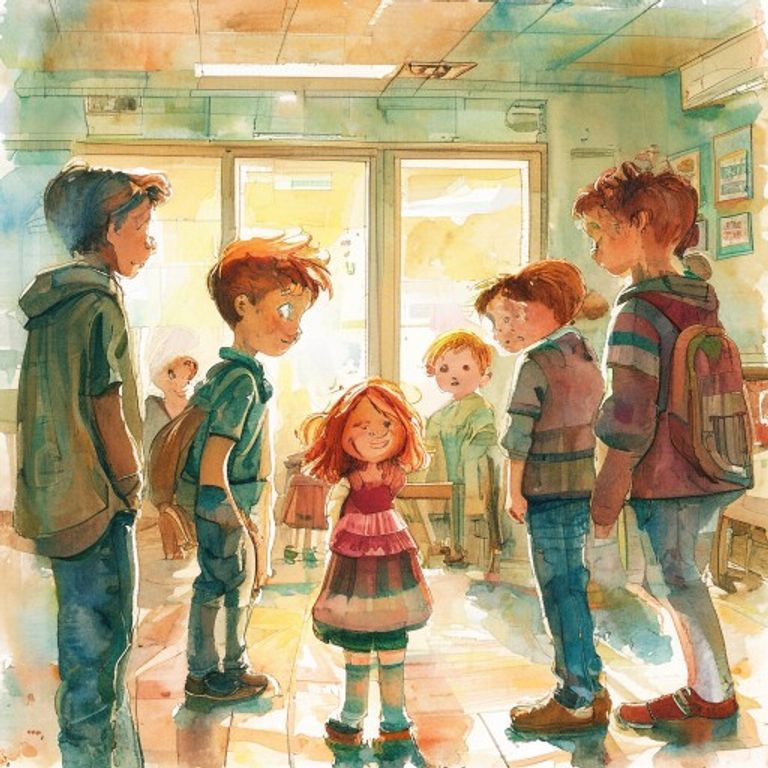
He turned. At a table near the back, a group of older boys surrounded a small girl with red hair and freckles. Her name was Sophie, and she was new. She had moved to Fairview two weeks ago, and she had not made many friends yet. She was shy, awkward, and—Marcus realized with a sinking heart—different. She had a lisp. She walked with a slight limp, the result of a childhood illness. And the older boys had noticed.
"Look at her walk!" one of them shouted, mimicking her limp. "Hop, hop, hop! Like a broken bunny!"
Sophie's face turned red. She stared at her tray, her hands shaking.
"And listen to her talk!" another boy added. "Thith ith my lunch! Thith ith my milk!"
The group erupted in laughter. Other children watched, some uncomfortable, some giggling nervously, most looking away. No one said anything. No one did anything.
Marcus felt anger rise in his chest, hot and sudden. He stood up. His legs felt weak, his heart pounding. He was not brave. He was not strong. But he was just.
"Stop it," he said, his voice trembling but clear.
The boys turned. The leader, a tall boy named Brad, sneered. "What did you say?"
"I said stop it." Marcus walked closer, his fists clenched. "Leave her alone."
"Or what?" Brad stepped forward, towering over Marcus. "You going to make us?"
Marcus swallowed. Fear clawed at his throat. But he thought of Sophie, small and alone, her eyes bright with tears. He thought of justice. Of fairness. Of the empty chair at the table where no one dared sit because it was "uncool."
"No," Marcus said. "I am not going to make you. I am going to ask you. Asking is stronger than forcing. And I am asking you to stop. Because it is not fair. Because she has done nothing to you. Because everyone deserves to eat lunch without being laughed at."
Brad stared at him. The cafeteria had gone quiet. Everyone was watching now.
"You are weird," Brad said, but his voice lacked conviction.
"Maybe," Marcus said. "But I am right."
Brad looked at his friends, then at Sophie, then at Marcus. Something shifted in his eyes. Shame, perhaps. Or surprise. He had expected Marcus to back down, to look away, to join the silent crowd.
"Whatever," Brad muttered. "Come on, guys. Let's go."
The group left, their laughter gone, their shoulders hunched. Marcus watched them go, his heart still racing. Then he turned to Sophie.
"Are you okay?" he asked.
Sophie looked up at him, her eyes wide and wet. "Why did you do that?" she whispered. "No one ever does that."
"Because it was not fair," Marcus said simply. "And when something is not fair, someone has to say so."

Sophie smiled, a small, watery smile. "Thank you."
Marcus sat down across from her. "Do you mind if I eat here?"
"I would like that," Sophie said.
They ate together, talking about books and movies and the strange habits of cats. Marcus learned that Sophie was funny, smart, and passionate about astronomy. She learned that Marcus wanted to be a lawyer someday, to help people who could not help themselves.
The next day, Marcus sat with Sophie again. And the day after that. And the day after that. Other children joined them, drawn by the warmth of their table, the absence of cruelty, the presence of kindness.
Brad and his friends stopped bothering Sophie. They never apologized, not in words. But Marcus saw Brad hold the door open for a younger student one morning. He saw Brad share his chips with a boy who had forgotten his lunch. Small changes. Small growths. The seeds of justice, planted in unexpected soil.
One Friday, Mrs. Henderson, the principal, called Marcus to her office. He went with a nervous stomach, wondering what he had done wrong.
"Marcus," she said, her eyes kind. "I heard about what you did in the cafeteria. I want you to know that what you did was brave. But more than that, it was just. You saw something unfair, and you stood up. Not with fists. Not with shouting. But with words. With conviction. That is the mark of a true leader."
Marcus did not know what to say. "I was scared," he admitted.
"Of course you were," Mrs. Henderson said. "Courage is not the absence of fear. It is doing what is right despite it."

She gave him a certificate. It said "Champion of Justice" in gold letters. Marcus took it home and pinned it to his wall, not because he was proud, but because it reminded him of a promise he had made to himself.
To never be silent when someone needed a voice.
To never look away when someone needed a witness.
To always, always stand for what was fair.
Years later, Marcus became a lawyer, just as he had dreamed. He worked for people who had no one to speak for them. He fought for fairness in courtrooms and classrooms, in offices and orphanages. And everywhere he went, he carried the memory of a Tuesday lunch, a crying girl, and the knowledge that justice began with a single word.
Stop.
Moral of the Story: Justice means being fair to everyone, especially those who cannot defend themselves. Marcus saw Sophie being bullied in the cafeteria. Everyone else looked away. But Marcus stood up. He was scared. He was smaller than the bullies. But he knew what was right, and he said so. Justice is not about being the strongest or the loudest. It is about being the one who cares enough to act. It is about seeing unfairness and refusing to accept it. So if you see someone being treated badly, do not be silent. Do not look away. Stand up. Speak out. Because justice begins with a single voice, and that voice can be yours.
Age Range: 4-8 years | Reading Time: ~10 minutes | Core Value: Justice