The Thank-You Tree: A Story About Gratitude
The Thank-You Tree: A Story About Gratitude
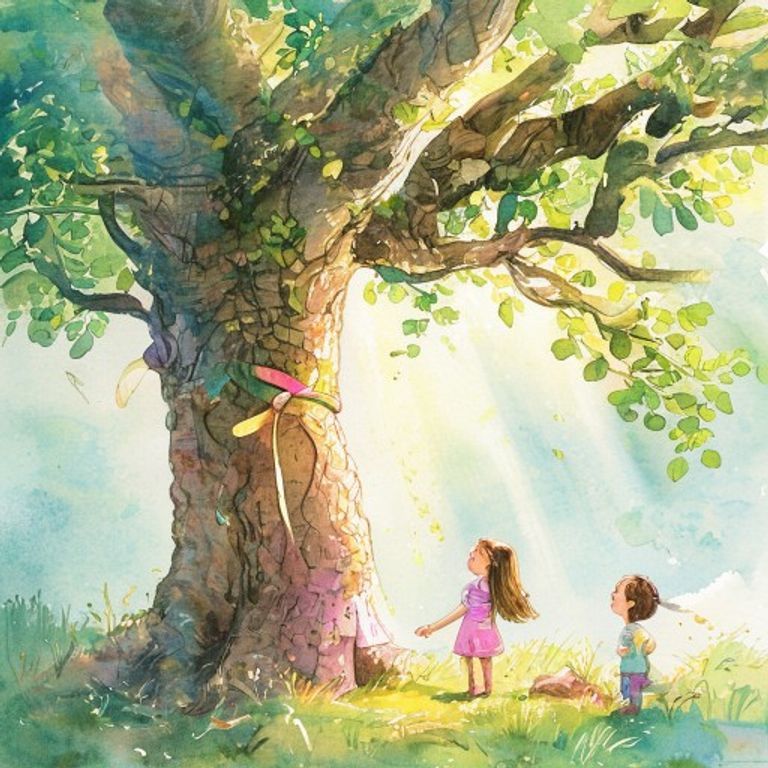
In the village of Sunshire, where the hills rolled like green waves and the wildflowers painted the meadows in colors that made the sky jealous, there lived a girl named Aria. She was seven years old, with hair the color of autumn wheat and eyes like two perfect blueberries. She lived with her grandmother in a cozy cottage at the edge of the village, where an old oak tree stood taller than the church steeple.
The oak tree was ancient. Its trunk was as wide as a cottage, its bark gnarled and wise, its branches reaching up to touch the clouds. The villagers called it the Thank-You Tree. Legend said that if you tied a ribbon to its branches while saying something you were grateful for, the tree would hold onto your gratitude forever.
Aria loved the Thank-You Tree. Every morning, she would run to it before breakfast, press her small hands against its rough bark, and whisper her thanks. "Thank you for the sunshine," she would say. "Thank you for the birdsong. Thank you for Grandmother's warm bread."
But Aria had a neighbor named Felix. He was eight years old, with dark curly hair and a permanent scowl. Felix complained about everything. The sun was too bright. The rain was too wet. The bread was too crusty. The bed was too lumpy. Nothing was ever good enough for Felix.
"Why do you always say thank you?" Felix asked Aria one day, watching her tie a yellow ribbon to the tree. "The tree does not hear you. It is just a tree."
"The tree hears," Aria said, patting the bark. "And even if it did not, gratitude makes my heart feel warm. Try it, Felix. Say one thing you are thankful for."
Felix rolled his eyes. "I am not thankful for anything. My shoes have holes. My porridge is cold. My kite broke last week."
"But you have shoes," Aria said. "And porridge. And you had a kite. Some children have none of those things."
Felix stuck out his tongue and ran away.
That night, a terrible storm came to Sunshire. The wind howled like a wounded wolf. The rain fell in sheets so thick you could not see your own hand. Lightning split the sky, and thunder shook the windows.

In the morning, the village was changed. The river had flooded its banks. Gardens were ruined. Fences were flattened. And worst of all, the Thank-You Tree had been struck by lightning. Half of its branches lay broken on the ground. Its leaves were scattered like tears across the meadow.
Aria ran to the tree, her heart breaking. "Oh, Thank-You Tree," she cried, wrapping her arms around the trunk. "I am so sorry."
The villagers gathered, their faces grave. The Thank-You Tree was the heart of Sunshire. Without it, the village felt empty.
"We must cut it down," said the mayor, a round man with a sad mustache. "It is too damaged. It will not survive."
"No!" Aria cried. "We cannot give up on it. We must help it."
But the villagers shook their heads. Trees do not heal from lightning, they said. It is nature's way.
Aria would not accept it. She went to Felix's house and found him sitting on his step, staring at the ruined tree.
"Felix," she said. "I need your help."
"Why?" Felix asked. "It is just a tree."
"It is not just a tree," Aria said, her voice fierce. "It holds all our gratitude. Every thank you we ever whispered. Every ribbon we tied. If we lose the tree, we lose all of that."
Felix looked at the tree. He thought about all the times he had watched Aria tie her ribbons, all the times he had rolled his eyes. He thought about his shoes with holes, and how at least he had shoes. He thought about his cold porridge, and how at least he had food.
And for the first time, he felt something warm in his chest. Something that felt like... gratitude.
"Okay," Felix said. "I will help."
Together, Aria and Felix worked day and night. They propped up the broken branches with wooden poles. They covered the wounded bark with healing clay. They watered the roots with rainwater collected in buckets. They sang songs to the tree, songs of hope and love.
And something miraculous began to happen.
Other children joined them. Then their parents. Then the whole village. People who had not visited the tree in years came with ribbons and words of thanks. "Thank you for this tree," they said. "Thank you for teaching us gratitude. Thank you for bringing us together."

The Thank-You Tree seemed to listen. New buds appeared on the broken branches. Green leaves unfurled like tiny flags of hope. And within a month, the tree was more beautiful than ever, its branches heavy with ribbons of every color, fluttering in the breeze like butterflies.
But the real miracle was Felix.
He changed. Slowly, day by day, he began to see the good in things. He stopped complaining about his shoes and started running races. He stopped frowning at his porridge and started sharing it with stray cats. He even made his own kite, and when it flew high above the meadow, he looked at Aria and smiled.
"Thank you," he said.
"For what?" Aria asked.
"For teaching me gratitude," Felix said. "I used to think gratitude was silly. But now I know. Gratitude is what makes the broken things whole again."
Aria smiled and tied a new ribbon to the tree. It was blue, the color of Felix's eyes when he was happy.
And the Thank-You Tree rustled its leaves in reply, as if to say, "You are welcome."
Moral of the Story: Gratitude means appreciating what you have and saying thank you for the good things in your life. Aria loved the Thank-You Tree and always expressed her gratitude. But her neighbor Felix complained about everything and could not see the good in his life. When a storm broke the tree, Aria refused to give up. She asked Felix for help, and together they healed the tree. In the process, Felix learned that gratitude is what makes broken things whole. It turns what we have into enough. So always say thank you. For your home, your food, your family, your friends. Because gratitude is the sunshine that helps everything grow.
Age Range: 4-8 years | Reading Time: ~10 minutes | Core Value: Gratitude