The Basket That Was Always Full: A Story About Generosity
The Basket That Was Always Full: A Story About Generosity
In the town of Meadowgrove, where every house had a garden and every garden had a fence and every fence had a gate that was never locked, there lived a girl named Amara who had a basket that was always full.
Not full of things she had bought. Amara's basket was full of things she had grown. Her mother was the town's best gardener, and her father was a baker whose bread could make a stone weep with joy. From them, Amara had learned that the best things in life were not the things you kept, but the things you gave away.
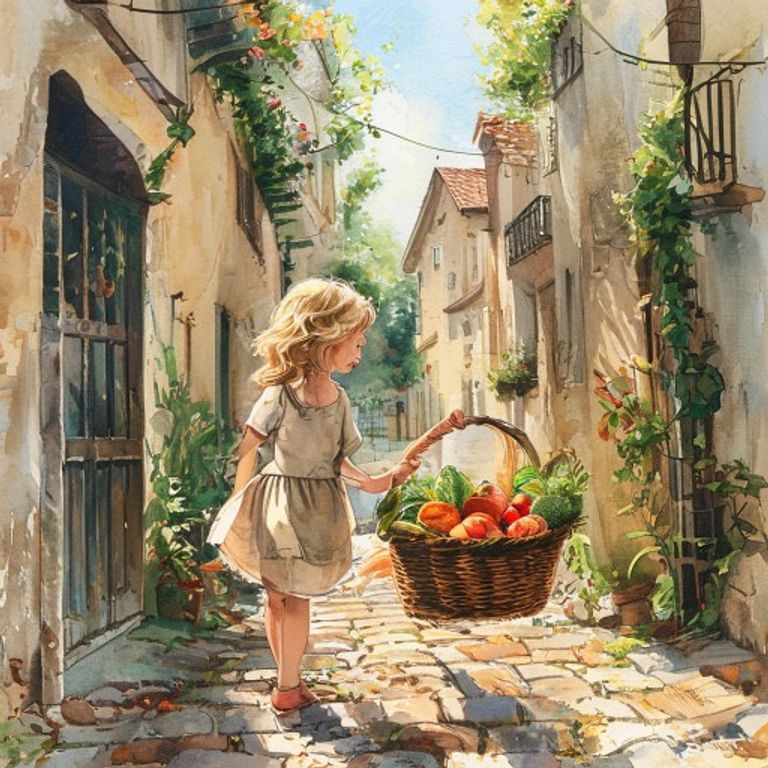
She was seven years old, with hair the color of wheat in August and hands that smelled of rosemary and soil. Every morning, she filled her basket. Tomatoes like red jewels. Cucumbers cool and crisp. Bunches of basil that made the whole street smell like summer. And her father's bread, still warm from the oven, wrapped in cloth that kept the heat close.
Then she walked.
She walked to the Widow Mordecai's house, where the old woman sat in her chair by the window, watching the world go by with eyes that had seen too much leaving and not enough staying.
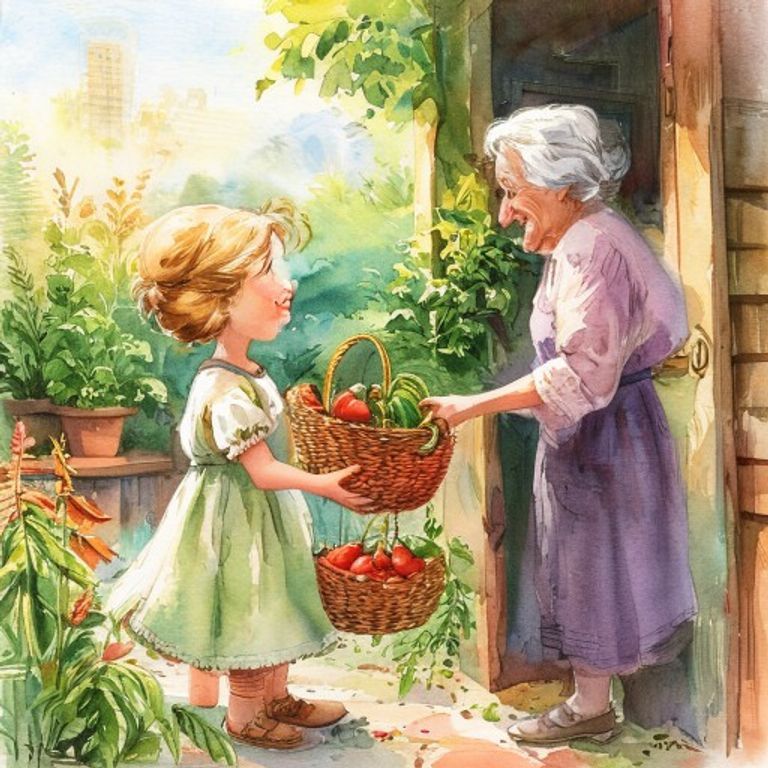
"Good morning, Mrs. Mordecai," Amara would say, pushing open the never-locked gate.
"Good morning, child," the widow would answer, her voice like dry leaves.
"I brought you some tomatoes. They're the first of the season. And some bread. It's still warm. And some basil, because it reminds me of your garden, before..."
Before the arthritis. Before the cane. Before the garden had become a jungle of weeds that the widow could no longer tame.
"You are too generous," Mrs. Mordecai would say, but her eyes would soften, and she would take the tomatoes with trembling hands, and she would smell the basil, and for a moment, just a moment, she would be young again, kneeling in her own garden, her fingers deep in the earth.
From Mrs. Mordecai's, Amara walked to the apartment above the shoemaker's shop, where old Mr. Peabody lived with his cat, Mittens. Mr. Peabody had been the town's teacher for fifty years, but now his eyes were cloudy and his hands shook too much to hold a pen.
"I brought you cucumbers," Amara would say. "And bread. And I picked some blackberries from the bush by the river. They're sweet this year."
Mr. Peabody would smile, his cloudy eyes finding her somehow. "You are a miracle, Amara. Do you know that?"
"I'm not a miracle," Amara would say, her cheeks flushing. "I'm just... I have things, and you need things, and that's how it works."
"No," Mr. Peabody would say, reaching out to touch her wheat-colored hair. "That's not how it works for most people. Most people hold on. You let go. And that is the miracle."
From Mr. Peabody's, Amara walked to the edge of town, where the trailer park sat in the shadow of the old factory. There, she found the children. The children whose parents worked double shifts. The children whose cupboards were sometimes empty. The children who had stopped hoping for surprises.
She gave them tomatoes. Cucumbers. Bread. Blackberries. And she sat with them, under the one tree that grew in the trailer park, and she told them stories about her mother's garden, about the tomato plants that grew so tall they touched the sky, about the cucumber vines that stretched from one end of the garden to the other like green highways.
"Why do you do it?" asked a boy named Diego, whose mother worked nights at the hospital and whose father had gone away to find work and never came back. "Why do you give us your food?"
"Because I have it," Amara said, as if this explained everything.
"But you could sell it," Diego said. "You could sell it at the market and buy things. Toys. Candy. A bicycle."
Amara thought about this. She thought about the bicycle she had wanted, red with a bell that sounded like a robin. She thought about the toys in the shop window, the ones with bright colors and buttons that made noise. She thought about candy, sweet and sticky and wonderful.
"I could," she said. "But then Mrs. Mordecai would have no tomatoes. And Mr. Peabody would have no cucumbers. And you would have no blackberries. And I would have a bicycle, but I would ride it alone. And toys, but I would play with them alone. And candy, but I would eat it alone. And alone is the worst way to have things."
Diego looked at her, his dark eyes serious. "You're weird," he said.
"I know," Amara said, smiling.
"But I like weird," Diego said, and he took a blackberry, and he smiled too.
The trouble began—or perhaps the lesson began—in the winter.
Winter in Meadowgrove was not cruel, but it was thorough. The gardens slept under blankets of snow. The river wore a skin of ice. The streets were quiet, the gates still unlocked but rarely opened, the people huddled in their warm houses, waiting for spring.
Amara's basket was empty.
There were no tomatoes, no cucumbers, no basil. The blackberry bush by the river was bare, its branches black and brittle. Her father's oven still produced bread, but flour was expensive in winter, and the loaves were smaller now, precious, not something to be given away lightly.
Amara walked to Mrs. Mordecai's house. She pushed open the never-locked gate. She knocked on the door.
Mrs. Mordecai opened it, wrapped in three shawls, her breath visible in the cold air. "Amara," she said, surprised. "What are you doing out in this weather?"
"I came to see if you needed anything," Amara said, though her basket was empty and her hands were cold and her heart was colder.
Mrs. Mordecai looked at the empty basket. She looked at Amara's red nose and chapped lips. She looked at the snow falling softly on the garden that had become a jungle.
"Come in," she said.
Amara stepped into the house. It was warm, surprisingly warm, and it smelled of something wonderful. Soup. Chicken soup, rich and golden, with dumplings floating like clouds.
"I made soup," Mrs. Mordecai said, shuffling toward the kitchen. "Sit down. Eat."
"But I came to bring you things," Amara said. "Not to take things."
"And in summer, you bring me things," Mrs. Mordecai said, ladling soup into a bowl. "In winter, I bring you things. That is how generosity works. It is not a one-way street. It is a circle. You give in summer. I give in winter. And the giving goes round and round, and no one is ever empty for long."
Amara sat. She ate the soup. It was the best thing she had ever tasted, better than tomatoes, better than blackberries, better than anything her mother's garden had produced.
"I didn't know," she said, when the bowl was empty. "I didn't know that generosity could go both ways."
"Most people don't," Mrs. Mordecai said, patting her hand. "Most people think generosity is about having and giving. But it is also about needing and receiving. It is about letting someone else be generous to you. It is about completing the circle."
From Mrs. Mordecai's, Amara walked to Mr. Peabody's apartment. She climbed the stairs, her heart lighter, her basket still empty but no longer heavy.
Mr. Peabody opened the door. "Amara! I was just thinking of you. Come in, come in."
The apartment smelled of books and peppermint. And something else. Cookies. Oatmeal cookies, crisp at the edges, soft in the middle, with raisins that sang of sweetness.
"I can't read anymore," Mr. Peabody said, as Amara ate a cookie. "My eyes won't let me. But I can still bake. And I bake for you, because you brought me cucumbers when I could not go to the market. Now I bring you cookies when you cannot bring me vegetables. We are even, child. More than even. We are connected."
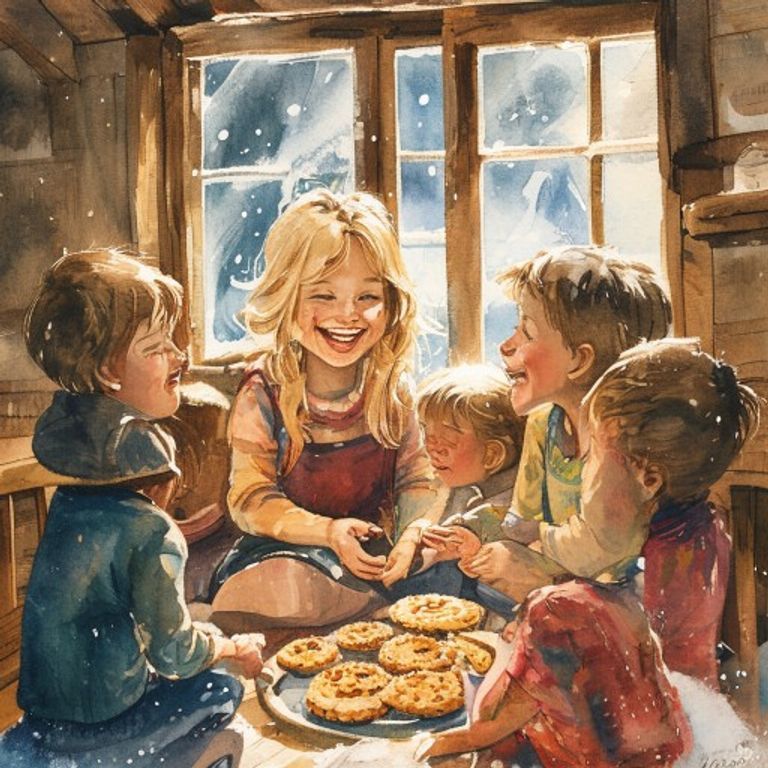
From Mr. Peabody's, Amara walked to the trailer park. The children were huddled in the community room, where the heater worked if you kicked it and the windows leaked if the wind blew hard.
Diego saw her first. "Amara! Your basket is empty!"
"I know," Amara said, smiling. "And I'm glad. Because now it's your turn to fill it."
The children looked at her, confused.
"In summer, I gave you food," Amara said. "Now it's winter, and I have no food to give. But you have things to give. You have stories. You have songs. You have games and laughter and the warmth of being together. And I need those things more than I need tomatoes. So will you give them to me? Will you let me be the one who receives?"
Diego looked at her for a long time. Then he nodded. "We can do that," he said. "We can give you stories. And songs. And we can teach you the game we made up, the one with the bottle caps. And we can... we can be warm together."
And they were. They told stories—terrible, wonderful, impossible stories about dragons and spaceships and talking dogs. They sang songs—off-key, loud, joyful songs about nothing in particular. They played the bottle cap game, which made no sense and had no rules and was therefore the best game ever invented.
And Amara, sitting among the children in the cold community room, eating oatmeal cookies and thinking of chicken soup, understood something that would stay with her forever.
Generosity was not a basket that you filled and emptied. It was a circle that you joined. It was not about being the one who always gave. It was about being the one who gave when they could, and received when they needed to, and trusted that the circle would keep turning.
Years later, when Amara was grown and had children of her own, she told them this story. She told them about the basket that was always full, and the winter when it was empty, and the lessons she had learned from a widow, a teacher, and a boy who thought she was weird.
"Generosity," she told her children, her wheat-colored hair now streaked with silver, her hands still smelling of rosemary and soil, "is not about having more than others. It is about caring more than others. It is about noticing who needs what you have, and giving it without expecting anything back. But it is also about noticing when you need what others have, and letting them give it to you."
"Why?" asked her youngest, a girl with dark curls and serious eyes.
"Because," Amara said, touching her daughter's cheek, "a circle has no beginning and no end. If you only give and never receive, you break the circle. If you only receive and never give, you break the circle. But if you do both—if you give when you can and receive when you must—then the circle keeps turning. And in that turning, everyone is fed. Everyone is warm. Everyone is seen."
She looked out the window, at the garden where her own mother still grew tomatoes like red jewels, at the gate that was still never locked, at the world that was still waiting to be generous.
"The world will tell you that you need to hold on," she said. "That you need to keep what you have, to protect it, to hoard it. But the world is wrong. The only things worth having are the things you give away. Because giving is not losing. Giving is planting. And what you plant in others, in the circle of generosity, grows forever."
Moral of the Story: Generosity is not about having more than others. It is about caring more than others. Amara thought that generosity meant filling her basket and giving everything away. She learned, through a hard winter, that generosity is a circle, not a one-way street. Giving is only half of it. Receiving is the other half. When we let others be generous to us, we complete the circle. We allow them the joy of giving. We acknowledge that we are all connected, that we all have something to offer, and that we all need something sometimes. The world tells us to hold on, to hoard, to protect what is ours. But the world is wrong. The only things worth having are the things we give away. Because giving is not losing. Giving is planting. And what we plant in others—in the circle of generosity—grows forever. A circle has no beginning and no end. Give when you can. Receive when you must. And trust that the circle will keep turning.
Age Range: 4-8 years | Reading Time: ~10 minutes | Core Value: Generosity