The Festival of Many Voices: A Story About Respect
In a small town nestled between rolling green hills and a river that sparkled like a ribbon of silver, there lived a girl named Amara. She was ten years old, with skin the color of warm cinnamon, hair that curled like springs of midnight silk, and eyes so bright and brown they seemed to hold all the warmth of the earth itself. Amara lived with her mother, who was a baker, and her father, who was a musician. Their home was filled with the smell of cardamom bread and the sound of drums, and Amara loved every corner of it.
But Amara's town had a problem.
For as long as anyone could remember, the town had been divided into neighborhoods—neat little clusters of houses where people who looked alike, spoke alike, and believed alike lived together. The North Hill was where the tall, fair-skinned families lived, in houses with steep roofs and gardens full of roses. The East Bank was where the families with golden-brown skin and dark, straight hair lived, in homes with red lanterns hanging by the doors. The South Meadow was where the families with deep brown skin and coiled hair lived, in cottages painted in colors as bold as the sunset. And the West Grove was where the families with olive skin and curling auburn hair lived, in stone houses covered with ivy.
Each neighborhood had its own market, its own school, its own festivals. The children played only with children who looked like them. The grown-ups spoke only with grown-ups who shared their ways. And though no one was mean, exactly, no one was kind, either—not in the way that bridges gaps and builds understanding.
Amara felt the divide every day. When she walked to the town square, she saw the North Hill children playing tag on one side, the East Bank children flying kites on another, and never the two mixing. When she went to the library, she saw books about her own culture in one corner, books about other cultures in another, and never anyone reading across the divide.
It made her heart ache, though she could not say why.
One autumn morning, as the leaves turned to fire and the air smelled of apples and woodsmoke, something extraordinary happened.
A great ship sailed up the silver river. It was unlike any ship the town had ever seen. Its sails were made of patchwork cloth in every color imaginable—crimson and cobalt and gold and emerald—sewn together like a quilt made by a hundred different hands. Its hull was carved with symbols from every corner of the world: stars and moons and trees and animals and patterns that seemed to dance when the sunlight hit them.
And standing at the prow was a woman.
She was ancient, with skin like weathered parchment and hair like spun silver that fell to her waist. But her eyes were young—bright and green and full of mischief. She wore a cloak made of feathers and beads and tiny bells that chimed with every movement, and in her hand she held a staff carved with the words: "All voices matter. All stories matter."
"I am Vespera," she called out, her voice carrying across the water like a song. "And I bring the Festival of Many Voices to your town. For three days and three nights, the Great Tent will stand in your square. And inside, every child will learn the most important lesson there is: how to respect the song of another."
The townspeople gathered at the riverbank, curious and cautious. The mayor, a round man with a walrus mustache, stepped forward. "What is this festival? We have our own traditions. We don't need outsiders telling us what to do."
Vespera's smile did not waver. "I do not come to replace your traditions, good mayor. I come to help you hear them more clearly. For a song sung alone is beautiful. But a song sung with others? That is magic."
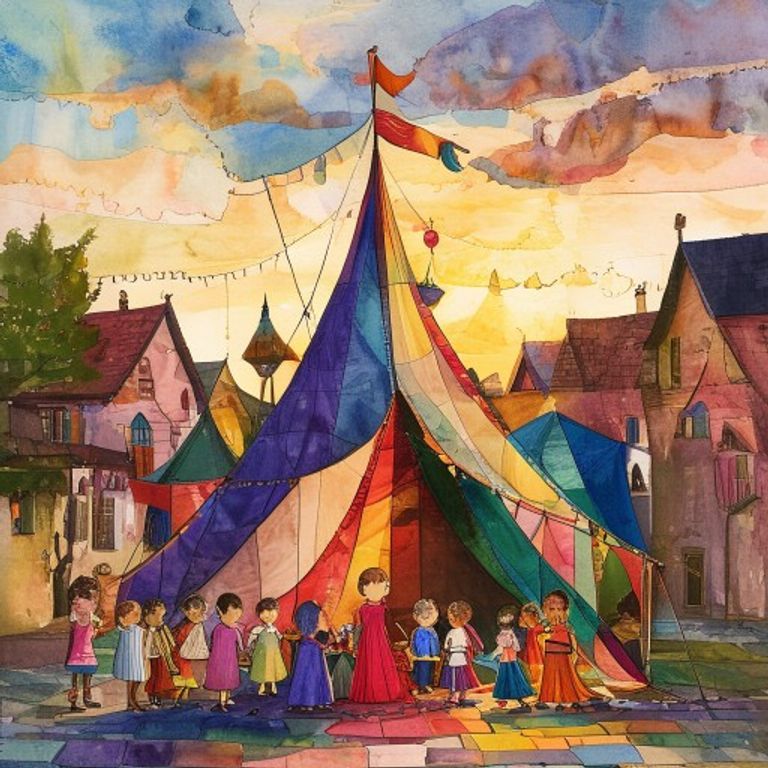
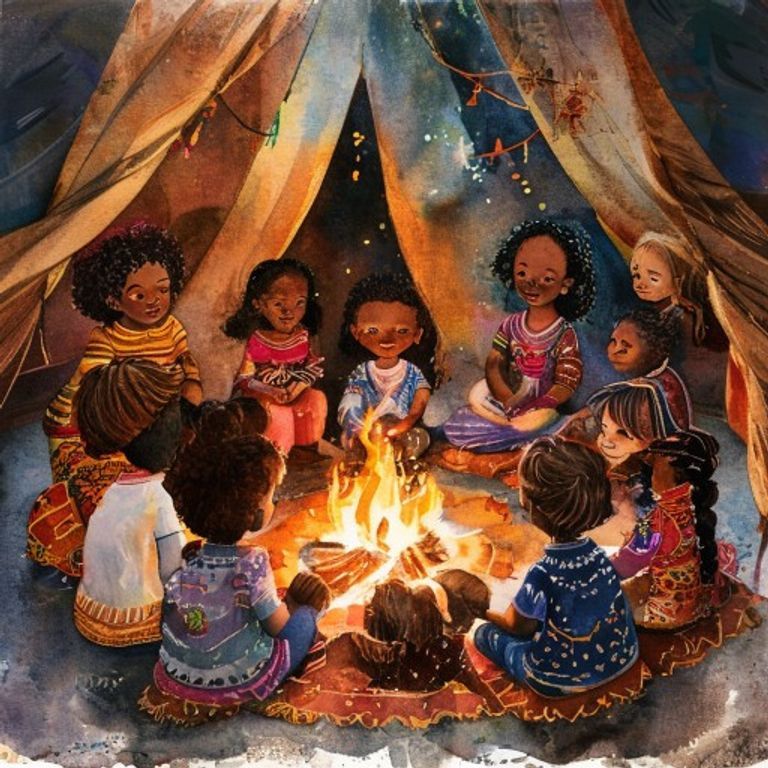
The Great Tent rose that very afternoon. It was enormous, big enough to hold the entire town. Its fabric was woven from threads of every color, and when the wind blew, it rippled like a living thing. Inside, there were no walls, no corners, no divisions. Just a vast circular space with a fire pit in the center and cushions scattered like flower petals across the floor.
Vespera gathered all the children first. Amara stood with the others—North Hill children in their woolen sweaters, East Bank children in their silk tunics, South Meadow children in their bright prints, West Grove children in their embroidered vests. They stood in clusters, each group eyeing the others with the careful politeness of strangers.
"Children," Vespera said, her bells chiming softly. "Tonight, you will share your stories. Not the stories you read in books. The stories of your families. The songs your grandmothers sing. The food your fathers cook. The games your cousins play. And as you share, you will listen. Truly listen. For respect begins with hearing."
The first to speak was a boy from the North Hill named Erik. He was tall and pale, with freckles like spilled cinnamon across his nose and hair the color of wheat. He stood nervously, twisting his sweater sleeve.
"In my family," Erik said, his voice quiet, "we celebrate the Long Night. When the winter is darkest, we light a hundred candles and tell stories about our ancestors. My grandmother says the candles guide the spirits home. And we eat fish soup, because the sea is where our people came from, long ago."
As Erik spoke, Amara felt something shift inside her. She had never thought about the Long Night. She had never wondered what it meant to Erik, what memories it held, what love it carried. She had only seen his pale skin and his woolen clothes and thought: he is different.
But he wasn't different. He was a boy who loved his grandmother. A boy who cherished the dark winter and the candlelight. A boy who carried the sea in his heart, just as she carried the drums in hers.
Next was a girl from the East Bank named Mei-Lin. She was small and delicate, with hair like a waterfall of ink and eyes that tilted at the corners like crescent moons. She wore a tunic the color of jade, and when she moved, she moved like water.
"In my family," Mei-Lin said, "we celebrate the Moon Festival. We make mooncakes with lotus seed paste and salted egg yolks. My grandfather says the round mooncake is like the full moon, and when you share it, you share completeness. We write poems and hang lanterns and watch the moon together."
Amara imagined the lanterns floating into the night, golden and red, carrying poems up to the moon. She imagined the sweetness of mooncakes and the laughter of family gathered beneath the stars. And she felt her heart grow a little bigger, making room for Mei-Lin's moon, just as it had made room for Erik's candles.
Then it was Amara's turn. She stood, her curls bouncing, her heart pounding.
"In my family," she said, her voice growing stronger with every word, "we celebrate the Drum Dance. When the harvest comes, we play drums made from goat skin and wood, and we dance until our feet are dusty and our souls are free. My mother says the drumbeat is the heartbeat of the earth, and when we dance, we are speaking the language of the soil. We eat bread with cardamom and honey, and we tell stories about the first rain and the first seed."
As she spoke, she saw the other children listening. Truly listening. Their eyes were wide, their faces open. They were not thinking: that is strange. They were thinking: that is beautiful.
The last to speak was a boy from the West Grove named Luca. He had olive skin and auburn curls and eyes the color of moss on old stone. He wore a vest embroidered with vines and leaves, and his hands were stained with paint.
"In my family," Luca said, "we celebrate the Vine Song. When the grapes are ripe, we crush them with our feet and sing old songs in a language only our grandmothers remember. We paint pictures on the walls of our stone houses, and each picture tells a story of the season—planting, growing, harvesting, resting. My father says the earth speaks in colors, and we are its translators."
Amara looked around the tent. She saw Erik nodding at Luca, imagining the Vine Song. She saw Mei-Lin smiling at her, picturing the Drum Dance. She saw all the children, all the different faces, all the different stories, and she realized something extraordinary.
They were not so different after all. They were all children who loved their families. They were all children who carried tradition like a treasure. They were all children who wanted to be seen, to be heard, to be respected.
On the second day, Vespera taught them a game.
"This is the Exchange," she said, handing each child a small, empty basket. "Today, you will visit a neighborhood that is not your own. You will meet a family. You will learn one of their customs. And in return, you will teach them one of yours. By sunset, your basket will be full of new knowledge. And so will your heart."
Amara was paired with Erik. Together, they walked to the North Hill, where the houses were tall and narrow and the gardens smelled of roses and rain. Erik's grandmother was a white-haired woman named Ingrid, with eyes as blue as the winter sea. She welcomed Amara with a bowl of fish soup, thick and creamy, flavored with dill and potatoes.
"In our tradition," Ingrid said, stirring the soup with a wooden spoon worn smooth by generations, "we share soup when a guest arrives. The bowl is round, like the world, and the soup is warm, like a welcome."
Amara tasted the soup. It was unlike anything she had ever eaten—salty and rich and comforting, like a hug from the ocean. "It is beautiful," she said.
Amara reached into her bag and pulled out a small drum, no bigger than her hand, that her mother had given her. "We share music," she said. "The drumbeat is our heartbeat. And when we play together, our hearts beat as one."
She taught Ingrid the basic rhythm—boom-tap-tap, boom-tap-tap—and the old woman's eyes lit up with delight. Soon, Erik was drumming too, and then Ingrid, and then neighbors who had heard the sound and come to investigate. The North Hill rang with drumbeats that afternoon, and Amara felt something she had never felt before: the joy of being welcomed, truly welcomed, in a place she had always thought was not for her.
Meanwhile, Mei-Lin visited the South Meadow with a girl named Zara. Zara's family taught her the Harvest Dance, a stomping, clapping, joyful celebration of the earth's bounty. In return, Mei-Lin taught them to fold paper into lotus flowers, each petal a wish for peace.
Luca went to the East Bank and learned to make mooncakes from Mei-Lin's grandmother, his paint-stained hands struggling with the delicate dough. In return, he painted a mural on the family's wall—a vine winding around a moon, symbols of two worlds becoming one.
By sunset, the Great Tent was full again. The children sat in a circle, their baskets overflowing with new treasures: recipes, songs, dances, crafts, stories. But more than that, they carried something invisible. Something weightless but powerful.
Understanding.
On the third and final day, Vespera asked them a question.
"What is respect?" she said, her silver hair gleaming in the firelight.
The children were silent for a moment. Then Erik spoke.
"Respect is listening," he said. "Really listening. Not just waiting for your turn to speak."
"Respect is learning," Mei-Lin added. "Learning that different doesn't mean wrong."
"Respect is sharing," Luca said. "Sharing your story and making room for someone else's."
Amara stood up. "Respect is seeing," she said. "Seeing that behind every face is a family, behind every tradition is a love, behind every difference is a person who wants what we all want: to belong."
Vespera's eyes glistened. "You have learned the lesson," she said. "Not from me, but from each other. Respect is not a rule. It is a choice. A choice to honor the voice of another, even when it sings a different song. A choice to see the beauty in difference, not the threat. A choice to build bridges where there were walls."
She reached into her cloak and pulled out a small seed, glowing with a soft golden light. "This is the Seed of Unity. Plant it in the center of your town, and let it remind you: from many voices, one song. From many threads, one tapestry. From many hearts, one home."
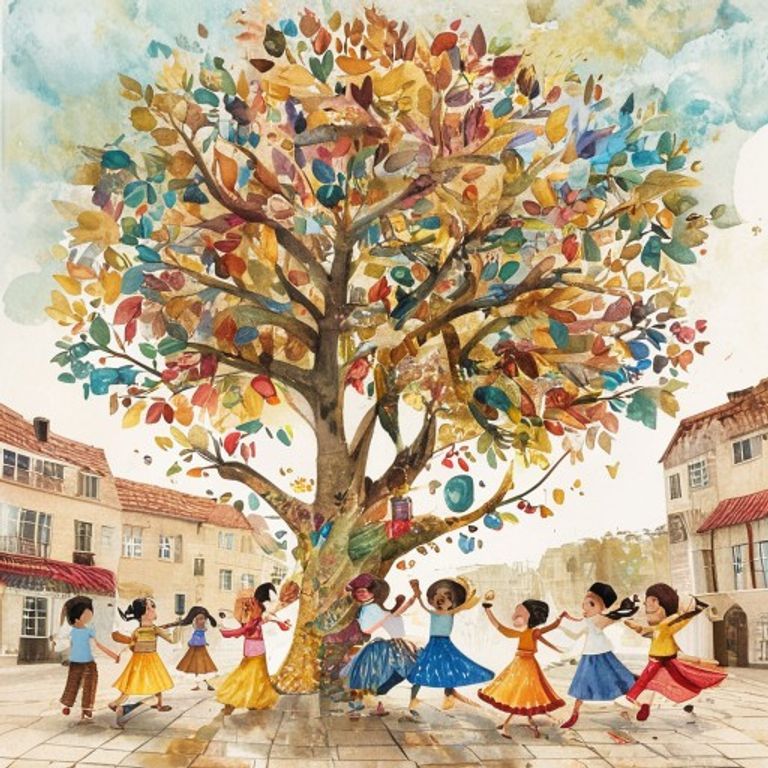
The festival ended, and Vespera's ship sailed away, its patchwork sails catching the morning wind. But the Great Tent remained, transformed into a community hall where all the neighborhoods gathered. The Seed of Unity was planted in the town square, and within a year, it had grown into a tree with leaves of every color—gold and crimson and jade and amber—shading all who sat beneath it.
The children became teenagers, then adults. They married across neighborhoods. They built schools where all the traditions were taught. They held a new festival, the Festival of Many Voices, every year, inviting towns from miles around to share their songs.
And Amara? She became a teacher. Every morning, she stood before a classroom full of children with every kind of face, every kind of hair, every kind of story. And she taught them what Vespera had taught her, what Erik and Mei-Lin and Luca and all the others had taught her.
"Respect," she would say, her cinnamon skin glowing in the sunlight, "is the golden thread that weaves us together. It is the choice to see the beauty in another's song. It is the courage to say: your way is not my way, but your way matters."
And the children would listen. Truly listen. Because they knew, as Amara knew, that when we respect one another, the world becomes a little smaller, a little warmer, a little more like home.
Respect, little one. Respect.
The End