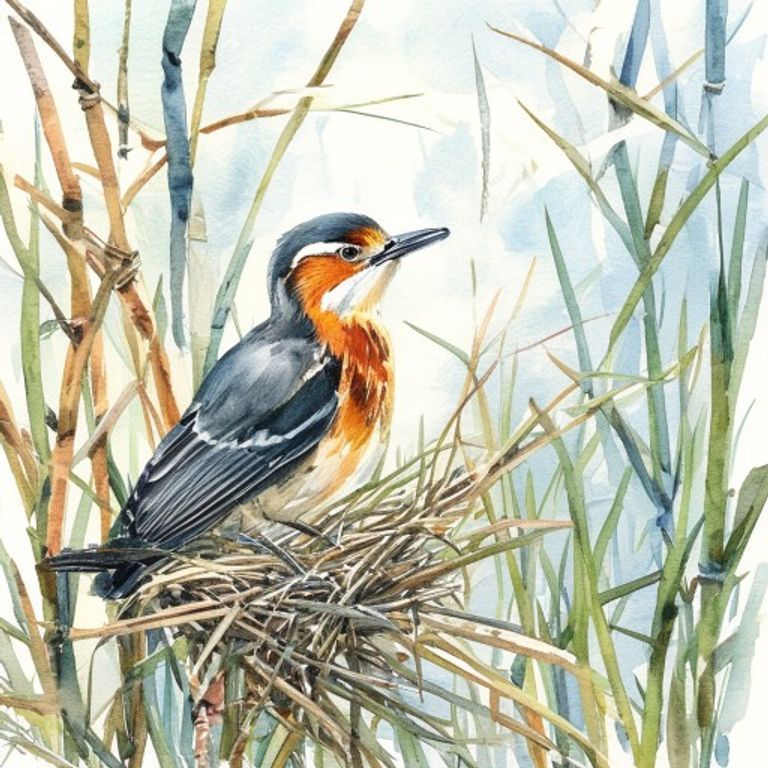
The Nest That Could Not Be Rushed: A Story About Patience
In the Reed Marsh, where the tall grasses swayed like green dancers and the water lilies floated like porcelain plates, there lived a young weaver bird named Pip. He was small and bright, with feathers the color of sunshine and eyes that sparkled with dreams. Pip lived with his mother, Willow, in a cozy nest woven into the reeds, but Pip was not content.
He wanted his own nest. Not just any nest—a magnificent nest. The kind of nest that would make the whole marsh gasp with wonder. A nest with walls so tight that rain could not seep through. A nest with a doorway so perfect that it looked like a circle cut from the sky. A nest with a swinging porch where he could sit and sing to the rising sun.
"Mother," Pip chirped one morning, hopping from reed to reed. "I am going to build my nest today!"
Willow smiled, her beak full of grass stems. "That is wonderful, my dear. But remember, nest-building takes time."
"Not for me!" Pip declared. "I am going to build the fastest nest in the history of Reed Marsh!"
And so he began.
Pip flew to the grassy bank and gathered a bundle of stems. He carried them to a sturdy reed, began to weave, and... the stems fell apart. He tried again, tying them in knots, but the knots slipped. He tried a third time, twisting and looping, and the entire structure collapsed into the water with a sad splash.
"This is impossible!" Pip cried, his feathers ruffled with frustration. "Why won't it work?"
A voice, deep and calm, drifted from the reeds. "Because you are trying to finish before you have begun."
Pip turned. Floating on a lily pad was an old weaver bird named Elder Reed. His feathers had faded from gold to a gentle bronze, and his beak was worn smooth with age. But his nest—oh, his nest! It hung from three reeds like a golden lantern, woven so finely that the morning light shone through it like stained glass.
"Your nest is beautiful," Pip breathed. "How long did it take?"
"Three weeks," Elder Reed said.
"Three WEEKS?" Pip squawked. "I want mine done by sunset!"
Elder Reed laughed—a sound like water bubbling over stones. "Sunset? My first nest took three weeks, and it was lopsided. My tenth took two weeks, and it leaked. My fiftieth took one week, and the door was crooked. This one, my hundredth, took three weeks. And it is perfect not because I am fast, but because I am patient."
Pip frowned. "But I don't want to wait. I want it NOW."
"Come," Elder Reed said, hopping onto a nearby reed. "I will teach you. But you must promise to do exactly as I say. No rushing. No shortcuts."
"I promise," Pip said, though his wings twitched with impatience.
"Lesson one," Elder Reed said. "Watch the river."
Pip blinked. "The river? I thought we were building nests."
"We are. But first, you must learn what patience looks like."
They sat on the reed for an hour. The river flowed below them, slow and steady, wearing away the stones not with force, but with persistence. A dragonfly hovered over the water, still as a statue, waiting for the perfect moment to strike. A heron stood in the shallows, motionless, until a fish swam close.
"Do you see?" Elder Reed asked. "The river does not rush to the sea. It flows. The dragonfly does not flail. It waits. The heron does not chase. It is still. Patience is not doing nothing. It is doing the right thing at the right time."

Pip thought about this. He watched the river. He watched the dragonfly. And slowly, his twitching wings grew still.
"Lesson two," Elder Reed said. "Gather one stem at a time."
Pip flew to the bank and picked a single grass stem. He brought it back. Then he flew again, and brought another. And another. After twenty trips, he had a small pile.
"This is too slow!" he complained. "I could carry ten at once!"
"You could," Elder Reed agreed. "But ten stems tangle. Ten stems snag. One stem, chosen carefully, placed precisely, makes the foundation strong. Ten stems, thrown together, make a mess."
He showed Pip how to split the stem with his beak, how to weave it under and over the reed, how to pull it tight but not too tight. One stem. One knot. One careful loop.
By sunset, Pip had woven three strands. Three! His nest was barely visible—a tiny platform no bigger than his own feet.
"This is nothing!" Pip wailed. "At this rate, it will take forever!"
"It will take as long as it takes," Elder Reed said. "And that is the lesson. The nest does not care about your hurry. The reed does not bend faster because you are frustrated. Building is a conversation between you and the world, and the world speaks slowly."
That night, Pip slept in his mother's nest, his head full of visions of perfect nests and his heart heavy with impatience.
The next morning, he returned to his tiny platform. He wove one stem. Then another. By noon, he had six strands. By evening, nine. He went to bed aching and exhausted.
On the third day, Pip woke up and flew to his nest. And stopped.
Overnight, something had happened. The nine strands had settled into each other, creating a shape—a flat, sturdy circle. It looked like... the beginning of something real.
"It grew!" Pip chirped, astonished.
Elder Reed appeared, chewing a lily seed. "It did not grow. It settled. The reeds relaxed. The knots tightened. The stems found their place. This is what happens when you stop fighting and start listening."
Pip worked harder that day. Not faster—harder. He chose each stem with care. He wove each knot with attention. When his beak grew tired, he rested. When his wings grew sore, he stretched. And at sunset, his platform had become a bowl, shallow but strong.
Days passed. Pip woke each morning and wove. He learned which stems were flexible and which were brittle. He learned which knots held and which slipped. He learned that some reeds bent easily and some resisted, and that both had their place.
By the end of the first week, his bowl had walls. By the end of the second, it had a roof. By the end of the third, it had a doorway—a perfect circle, just like Elder Reed's.
But Pip was not done. He wanted his swinging porch. He wanted his stained-glass walls. He wanted his singing perch.
"Those come later," Elder Reed said. "First, live in what you have built. Test it. Let the rain fall on it. Let the wind shake it. See what needs fixing. A nest is not finished when it looks pretty. It is finished when it keeps you safe."
Pip moved into his nest that night. It was small, simple, and strong. The rain came at midnight, drumming against the roof, but not a single drop seeped through. The wind blew at dawn, rattling the reeds, but his nest swayed gently, anchored firm.

In the morning, Pip flew to Elder Reed's golden lantern of a nest. "It works!" he sang. "It really works!"
Elder Reed smiled. "Of course it does. Because you built it with patience."
"But it's not as beautiful as yours," Pip said, looking down at his simple home.
"Not yet," Elder Reed agreed. "But this is only your first nest. Wait until your tenth. Your fiftieth. Your hundredth. Each one will be better, not because you are faster, but because you are wiser. And wisdom, young Pip, is patience with experience."
Pip looked at his nest. Then at Elder Reed's. Then back at his own. And he realized something: his nest was not less than Elder Reed's. It was earlier. It was younger. It was the first chapter of a long story.
"Will you teach me the swinging porch?" Pip asked.
"When your walls have settled," Elder Reed said. "In three more days."
Pip did not groan. He did not flap in frustration. He simply nodded. "Three days," he said. "I can wait."
And he could.
Over the following months, Pip built many nests. Some were small, some were large. Some leaked, some held. Some were lopsided, some were straight. Each one taught him something. Each one made him better.
And one spring morning, five years later, a young weaver bird named Sky hopped onto Pip's reed. Sky was small and bright, with feathers the color of sunshine and eyes that sparkled with dreams.
"I want to build my nest today!" Sky chirped. "And I want it done by sunset!"
Pip smiled. His feathers had faded from gold to a gentle bronze. His beak was worn smooth with age. And his nest—a magnificent thing of woven reeds and grass, with walls so tight that rain could not seep through, a doorway so perfect it looked like a circle cut from the sky, and a swinging porch where he sang to the rising sun—hung from three reeds like a golden lantern.
"Come," Pip said. "I will teach you. But first... watch the river."
The End