The Peacock Who Learned to Bow: A Story About Humility
In the emerald valley between Whispering Mountain and the Silver River, there lived a peacock named Pavo.
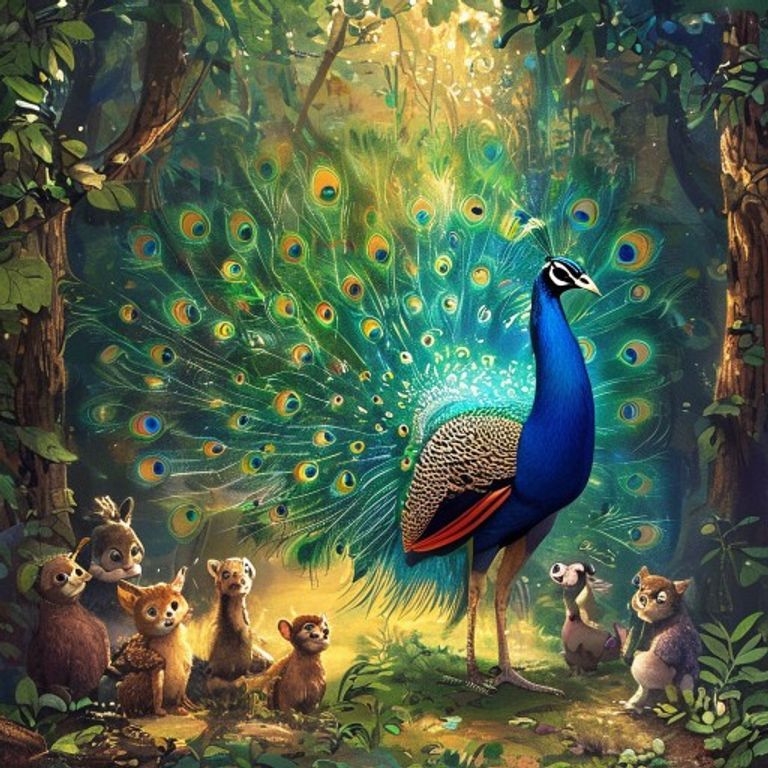
Pavo was, without question, the most beautiful creature for miles around. His tail feathers were a cascade of color—sapphire and emerald, gold and violet, each one tipped with an eye that seemed to watch the world with ancient wisdom. When he fanned his tail, the sunlight caught it and scattered into rainbows. Butterflies would pause in their flight to watch. Flowers would turn their faces toward him. Even the wind seemed to still, as if holding its breath in awe.
And Pavo knew it.
"Did you see my display this morning?" he would ask the sparrows who nested in the nearby hedges. "I counted seven colors. Seven! No peacock in history has ever shown seven colors at once."
"It was lovely, Pavo," the sparrows would chirp, exchanging glances.
"Lovely?" Pavo would toss his head, his crest feathers rippling. "It was magnificent. It was divine. It was, if I may say so, the most beautiful thing these valleys have ever witnessed."
The sparrows said nothing. They had learned that agreeing only encouraged him, and disagreeing... well, disagreeing meant sitting through a three-hour lecture on the physics of iridescence.
Pavo was not just beautiful. He was talented, too. He could imitate any bird's song—the thrush's liquid melody, the owl's haunting call, even the kingfisher's sharp whistle. He could dance, his feet tapping patterns on the forest floor that made the rabbits stop and stare. He could tell stories, weaving tales of ancient peacocks and distant lands that held every creature spellbound.
And he never, ever let anyone forget it.
One warm spring morning, a notice arrived in the valley.
A great Talent Show would be held at the crossroads where three valleys met. Every creature was invited to share their gift. The winner would receive the Golden Acorn, a prize of great prestige, and would be named the Valley's Greatest Talent.
Pavo read the notice with growing excitement. "At last!" he declared to the valley at large. "A chance for everyone to see what true greatness looks like. I shall win, of course. But it will be good for the others to try. Trying builds character. Losing builds humility. And I," he added, spreading his tail in a modest half-fan, "shall provide both lessons."
The other animals of the valley exchanged worried looks.
"Perhaps," said a wise old tortoise named Tethys, who had lived through forty Talent Shows, "you might consider letting someone else win this year, Pavo. There are many talented creatures here. The nightingale's song, the fox's storytelling, the beaver's architecture—"
"All very... adequate," Pavo interrupted. "But none can compare to my display. I have seven colors, Tethys. Seven!"
Tethys sighed, a sound like dry leaves scraping stone. "Colors are not everything, young peacock."
"They are when you have seven of them," Pavo replied, and strutted away to practice.
The day of the Talent Show arrived.
The crossroads had been transformed. Flower garlands hung from every branch. A stage of flat stones had been arranged beneath the oldest oak. Rows of mushrooms and toadstools formed seats for the audience. And every creature for valleys around had gathered—rabbits and foxes, deer and badgers, birds of every feather, even a family of hedgehogs who had rolled in from the eastern meadows.
Pavo arrived fashionably late, his tail folded neatly, his crest perfectly groomed. He took a seat at the front, where everyone could see him, and waited with an expression of patient suffering for the lesser talents to perform.
The nightingale went first. Her voice was like silver water pouring over smooth stones, rising and falling in a song so pure it made the flowers weep dew. The audience sat spellbound, and when she finished, the applause was thunderous.
"Adequate," Pavo muttered, just loudly enough to be heard. "Pretty, even. But she only has one voice. I have seven colors."
Next came a fox named Riven, who told a story about the moon and the sea that was so vivid, listeners could smell the salt and feel the tide. The badgers wept openly. The rabbits hugged their children.
"Moving," Pavo acknowledged, with a small yawn. "But words are just words. I have seven colors."
A beaver showed the dam she had built—a structure of interlocking sticks and stones, perfectly engineered, strong enough to withstand floods. The audience murmured in admiration.
"Impressive engineering," Pavo said, examining his claws. "For a beaver. But can it display seven colors? No. It cannot."
On and on the performances went. A squirrel who could juggle acorns. A badger who painted landscapes with mud and berry juice. A pair of swans who danced a duet so graceful it seemed they were one creature with four wings. Each was wonderful. Each was unique. Each was met with Pavo's increasingly bored commentary on the superiority of his seven colors.
And then, the final performer was announced.
"A wren," called the owl who was serving as master of ceremonies. "From the northern marshes."
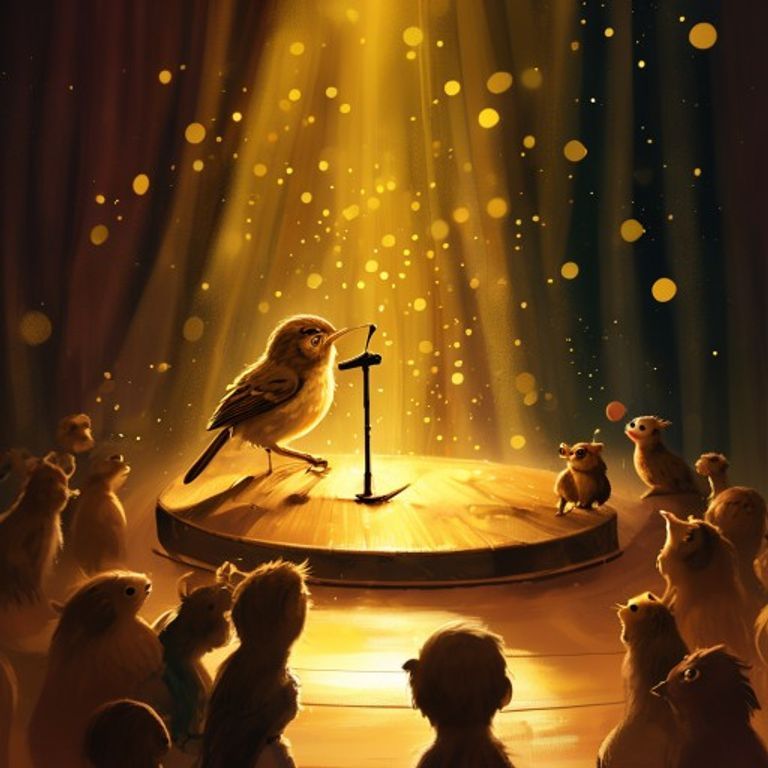
A tiny bird hopped onto the stage. She was so small she could have fit in a teacup. Her feathers were a plain, unremarkable brown. Her beak was short, her eyes ordinary, her voice—when she spoke—soft and hesitant.
"Hello," she whispered. "I am Wren."
The audience leaned forward, some out of curiosity, some out of politeness, some because they could barely see her.
"I do not have beautiful feathers," Wren said. "I cannot tell stories or paint pictures. I cannot even sing very well. But... I can listen."
Pavo snorted. "Listen? That is not a talent. Everyone can listen."
But Wren was not finished. She closed her eyes and tilted her head. And then she began to sing.
Or rather, she began to... become.
For Wren's gift was mimicry of a different kind. As she listened to the wind, she became the wind—her voice rushing and sighing, carrying the scent of rain and the promise of change. As she listened to the river, she became the river—her song flowing and tumbling, full of stones and secrets and ancient songs. As she listened to the oak tree above her, she became the tree—her voice deep and patient, rustling with a hundred years of leaves.
But then she did something extraordinary.
She listened to the nightingale's song—and sang it back, not as the nightingale had sung it, but as the nightingale's song sounded to a seed waiting to bloom, or a heart waiting to heal. She listened to the fox's story—and told it back, not as the fox had told it, but as the moon might whisper it to a lonely traveler. She listened to the beaver's dam—and described it back, not as the beaver had built it, but as the river might dream of it.
And finally, she listened to Pavo.
She listened to his display, his pride, his seven colors. And she sang them back—not as they were, but as they might be. The sapphire became the color of a child's first view of the ocean. The emerald became the shade of new leaves in spring. The gold became the warmth of a grandmother's smile. The violet became the mystery of twilight.
And the eyes on his feathers—those watchful, ancient eyes—became the eyes of every creature who had ever looked at Pavo and wished, just for a moment, that he would see them too.
When Wren finished, the silence was absolute.
Then, slowly, the owl began to clap. Then the badgers. Then the rabbits, the deer, the foxes, the sparrows, every creature in the clearing, all clapping and cheering and weeping, because they had heard something they had never heard before.
They had heard themselves.
Pavo sat frozen.
His seven colors had never felt so small. His crest, usually so proud, drooped against his neck. For the first time in his life, he felt... small. Invisible. Unremarkable.
And something else, too. Something he had never felt before.
He felt ashamed.
Not because Wren was better than him. But because Wren had made everyone else feel seen, while he had spent his whole life making everyone else feel small.
The Golden Acorn was awarded to Wren, of course. She accepted it with wide, wondering eyes, then immediately tried to give it to the nightingale, who had inspired her first verse. The nightingale refused and suggested the fox, who had given her the story's shape. The fox suggested the beaver, whose dam had taught her about strength. And so it went, the acorn passing from creature to creature, each one crediting another, until it came back to Wren, who finally held it close and wept.
"I do not deserve this alone," she said. "I am just a listener. The talents belong to all of you."
"That," said Tethys the tortoise, his old voice creaking like a door, "is why you deserve it."
Pavo slipped away before the celebration ended.
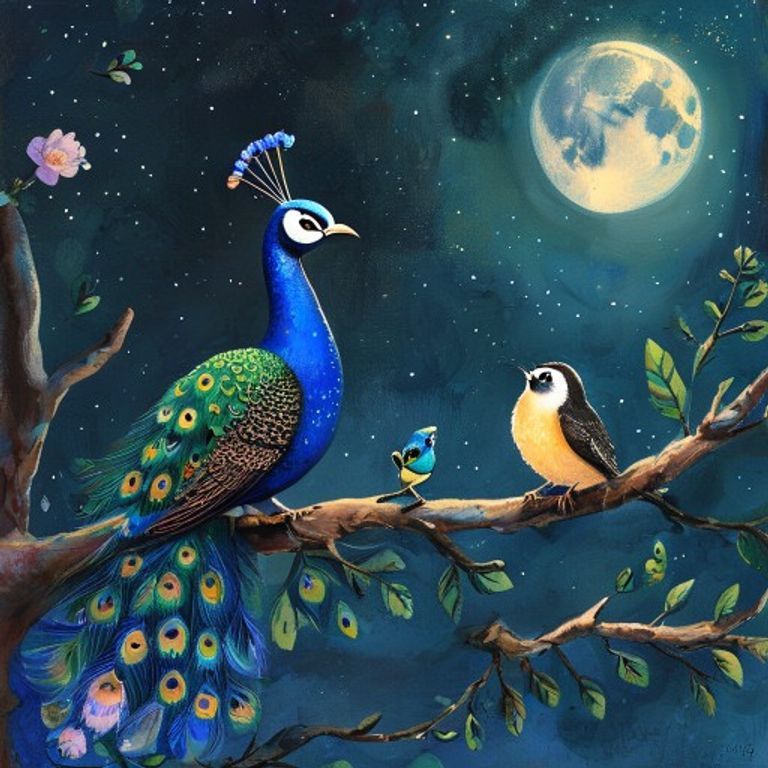
He walked through the moonlit forest, his tail dragging in the dirt, his colors dimmed by shadow. He reached his favorite clearing and stood in the darkness, wondering if he had ever been beautiful at all, or if the colors had just been a way to hide an empty heart.
"May I join you?"
Pavo turned. Wren sat on a branch above him, the Golden Acorn glinting beside her.
"I suppose you want to gloat," Pavo said, his voice bitter. "The great peacock, humbled by a plain little wren. It is a good story. Everyone will love it."
Wren cocked her head. "I do not want to gloat. I want to thank you."
Pavo stared. "Thank me? For what? For being arrogant? For dismissing everyone? For making the Talent Show about myself instead of about the valley's gifts?"
"For your colors," Wren said simply. "They were the most beautiful thing I had ever heard. Each one was a different note—a chord of light. I could not have made my final song without them."
Pavo felt something crack inside him. Not his pride. Something deeper. "But... but I was cruel. I was vain. I made everyone feel small."
"You did," Wren agreed. "But that does not change the fact that your colors are beautiful. Beauty and cruelty can live in the same heart, Pavo. The question is which one you feed."
Pavo looked at his reflection in a puddle. Seven colors, yes. But what Wren had shown him was that colors alone were not enough. True beauty—true greatness—was not about being seen. It was about seeing others. It was not about making the world admire you. It was about helping the world admire itself.
"How do I learn to be..." Pavo hesitated. "How do I learn to be like you?"
Wren laughed, a sound like bells. "You do not need to be like me. You need to be like you. But a you who listens. A you who shares credit. A you who knows that seven colors are more beautiful when they are used to illuminate others, not to overshadow them."
She hopped down from the branch and stood before him, tiny and plain and radiant with something Pavo had never understood before.
"Humility is not about hiding your gifts, Pavo. It is about knowing that your gifts are not just for you. They are for everyone. And when you share them—when you let others shine alongside you—that is when you are truly beautiful."
The next morning, Pavo did something unprecedented.
He found the nightingale and asked her to teach him her song. Not to copy it, but to understand it. He spent an afternoon with the fox, listening to stories instead of interrupting them. He helped the beaver gather sticks, learning the patience of good design. He sat with Wren for hours, learning to listen—not to reply, not to judge, but simply to hear.
It was hard. Harder than fanning his tail. Harder than displaying his colors. Harder than anything he had ever done, because it required him to be small, to be quiet, to be... ordinary.
But slowly, he changed.
He still displayed his colors, but now he did it for the sick fawn who needed cheering, or the lonely child who had wandered into the valley, or the old tortoise whose eyes were failing and who needed to remember what beauty looked like. He sang his songs, but now he harmonized with the thrush instead of drowning her out. He told his stories, but now he asked others for theirs first.
And one day, a young peacock—barely more than a chick—approached him.
"You are Pavo," the chick said, wide-eyed. "The most beautiful peacock in the valley."
Pavo looked at his reflection in the stream. Seven colors, still. But now they seemed different. They seemed to glow not from pride, but from purpose.
"I am Pavo," he said. "And yes, I have seven colors. But the most beautiful thing about me is not my feathers. It is that I finally learned to bow."
He lowered his head in a gesture of respect to the young chick, who blinked in confusion and then—slowly, uncertainly—bowed back.
And in that moment, Pavo understood what Wren had tried to teach him. Humility was not a reduction. It was an expansion. It was not about being less. It was about making room for more.
More voices. More colors. More stories. More love.
Seven colors were beautiful, yes. But a valley full of creatures, each one shining in their own way, each one heard and valued and celebrated—that was a beauty no single tail could ever match.
Humility, little one. Humility.
The End