The Beetle Who Loved the Compost Heap: A Story About Gratitude
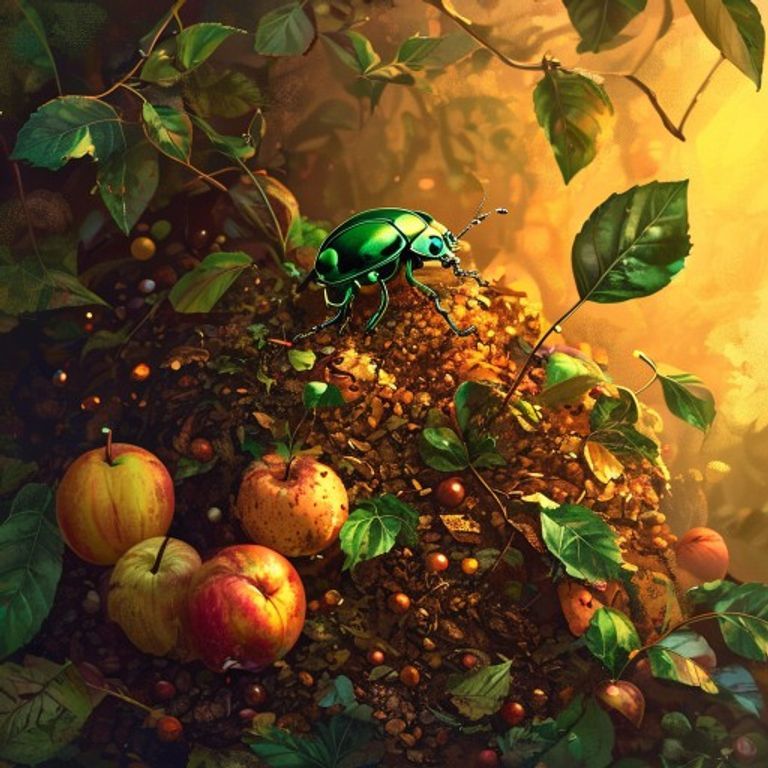
In the corner of a quiet garden, behind a cottage with blue shutters and a roof of mossy tiles, there was a heap. It was not a small heap, nor a neat one. It was the Grand Compost Heap, a mountain of fallen leaves, vegetable peelings, apple cores, coffee grounds, eggshells, and earth. To a human, it might have looked like garbage. To the creatures who lived inside it, it was a castle.
But Brio did not think it was a castle.
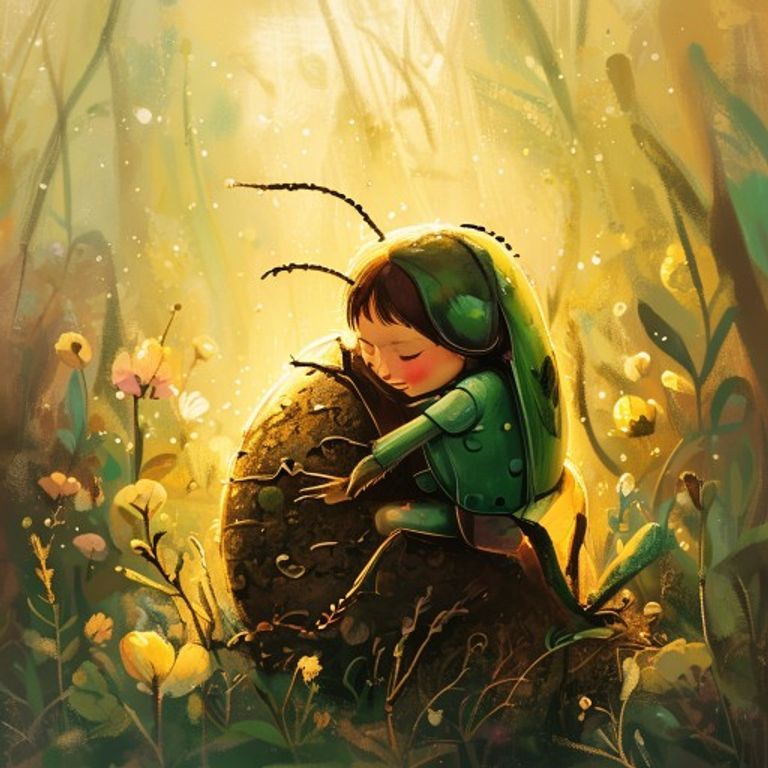
Brio was a young beetle, no bigger than a sunflower seed, with a shiny black body and wing cases the color of emeralds after rain. He had six legs that could scurry faster than a heartbeat, and two antennae that waved like tiny flags when he was thinking. He was strong for his size, clever for his age, and brave when he needed to be. But Brio had one terrible flaw: he hated the heap.
"It smells," he complained to his mother every morning, as they burrowed through the warm layers of rotting lettuce. "It is dark. It is messy. There is nothing beautiful here. No flowers. No blue sky. No sunsets. Just... this." He would gesture with his antennae at the brown walls of earth and decay that surrounded them. "I want to live in the Flower Garden. That is where beauty lives."
His mother, the Matriarch of the Grand Compost Heap, was an old beetle with wing cases the deep purple of ripe plums and eyes that had seen forty seasons come and go. She was wise and patient and kind. She had raised three hundred children in the heap, and she loved every wrinkle in the rotting pumpkin they called home.
"The heap gives us everything, little Brio," she would say, her voice warm and rumbling like distant thunder. "It gives us food. It gives us warmth. It gives us shelter from the rain and the cold and the birds who would gobble us up in a heartbeat. The heap is not garbage, my dear. The heap is a feast that never ends."
"A feast of garbage," Brio muttered, scurrying away to sulk under a curled banana peel.
The Beautiful Visitor
Every few days, a butterfly named Flutter would drift down from the Flower Garden and land on the edge of the heap. She was the most beautiful creature Brio had ever seen. Her wings were the color of stained glass—orange and black and blue and gold—and when she opened them, the dim light of the heap seemed to turn into sunshine.
"Oh, Brio," Flutter would sigh, her delicate legs barely touching a potato skin. "You simply must see the Flower Garden. The roses are as big as your head, and they smell like honey and dreams. The daisies are so white they glow at night. And the nectar! Oh, the nectar is sweeter than anything in this old pile of trash."
Brio's heart would ache every time she spoke. He would climb to the very top of the heap, peering over the rim at the distant Flower Garden, where colors bloomed like fireworks and butterflies danced in the breeze. It seemed like paradise. It seemed like everything the heap was not.
"I will go there someday," Brio declared to Old Worm, a blind earthworm who lived in the deepest, warmest layer of the heap and was considered the philosopher of their community. "I will leave this place and find beauty."
Old Worm was pale pink, nearly translucent, and as long as three beetles end to end. He had no eyes, but he had something better: he could feel the whole heap through his skin. He knew where every raindrop fell, where every seed was sprouting, where every baby beetle was hatching. He was very wise, and very slow, and very gentle.
"Beauty," Old Worm said, his voice soft as roots growing, "is not a place, young Brio. It is a way of seeing. The Flower Garden has roses, yes. But we have something roses do not have."
"What?" Brio demanded.
"Warmth," Old Worm said. "Community. Abundance. Safety. The heap is alive, Brio. It breathes. It grows. It gives. But you must open your heart to receive it."
Brio did not listen. He was too busy dreaming of daisies.
The Storm
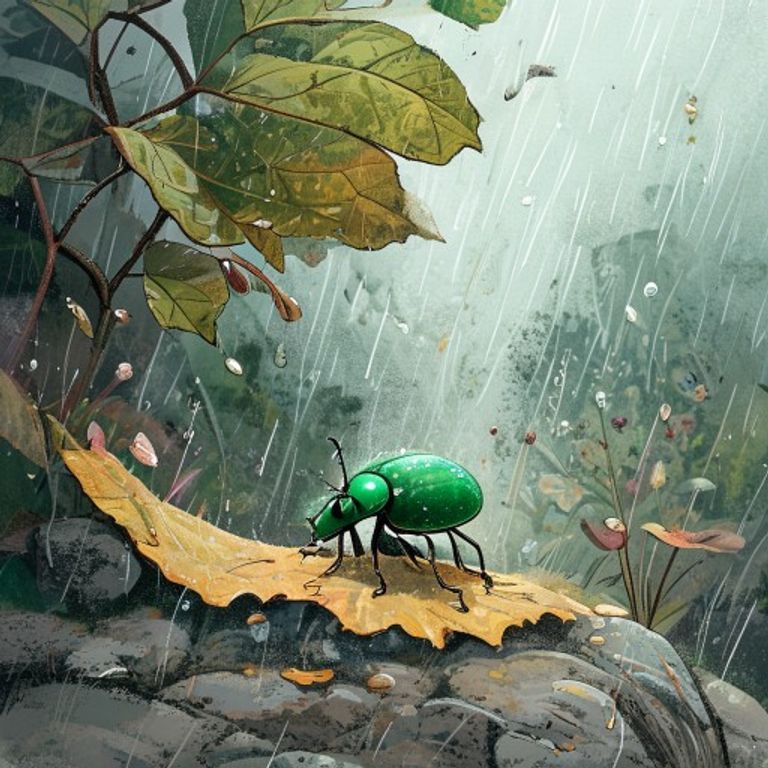
It happened on a Tuesday, though beetles do not know Tuesdays. It happened on a day when the sky turned gray and the wind began to whistle through the garden like a restless ghost. The rain came first—soft, then hard, then furious. The Grand Compost Heap, which had stood in the same corner for seven years, began to shift and slide.
Brio was near the top, as he always was, staring at the Flower Garden. He felt the heap move beneath him, and before he could scurry to safety, a river of mud and leaves and rotting tomatoes swept him up like a leaf in a stream. He tumbled and rolled and spun, his legs flailing, his emerald wing cases clattering, until he landed with a soft plop on cold, hard stone.
He was in the Flower Garden.
For a moment, Brio was amazed. The rain made everything glitter. The roses were indeed as big as his head. The daisies did glow white. The colors were more vivid than Flutter had described. He had done it! He had reached paradise!
But then the amazement turned to fear.
The stone beneath him was cold—colder than the deepest winter night in the heap. The rain, which had always been a gentle drumming on the warm roof of his underground home, was now a hammer pounding his shell. There was no earth to burrow into. No rotting apple to hide beneath. No warm layers to nestle in. He was exposed. He was alone. He was tiny.
And then he smelled it: a sharp, bitter smell that made his antennae curl in pain. Pesticide. The humans sprayed it on the flowers to keep bugs away. To them, Brio was a pest. Something to be eliminated.
Brio scrambled under the nearest leaf—a thin, crispy thing that offered no warmth at all. His legs trembled. His heart hammered. For the first time in his life, he was not just unhappy. He was terrified.
"Help!" he called, though he knew no one in the heap could hear him. "Mother! Old Worm! Someone!"
The wind answered, cold and indifferent.
Paradise Lost
Brio huddled under the leaf for what felt like forever. The rain slowed, then stopped, but the stone stayed cold. The sun came out, but instead of gentle warmth, it was harsh and burning. Brio's shell, which had always been protected by the cool darkness of the heap, began to feel tight and dry.
He tried to explore. He crawled across the stone path, his legs slipping on the smooth surface. In the heap, everything was textured—rough bark, crumbly leaves, gritty earth. Here, everything was flat and alien. He passed a rose, and it was beautiful, yes, but when he tried to climb its stem, a thorn pricked his leg. He passed a daisy, and it was white and glowing, but its petals were slick with pesticide, and the smell made him dizzy.
He saw a human walking toward him, and for a moment he thought the human might help. But the human did not see him. The human was too busy looking at the roses, too busy smelling the flowers, too busy admiring paradise to notice a tiny beetle scurrying for his life. A boot came down—Brio felt the vibration through the stone—and missed him by the width of a whisker. He fled under a crack in the pavement, his heart racing so fast he thought it would burst.
He was hungry. In the heap, food was everywhere—soft pear slices, sweet carrot tops, crumbly bread crusts. Here, there was nothing a beetle could eat. The nectar Flutter had described was high inside flowers he could not reach. The pollen was guarded by bees who would sting him without hesitation. The leaves were coated in chemicals.
"Is this paradise?" Brio whispered to himself, shivering in the crack. "Is this what I wanted?"
He thought of the heap. He thought of the warmth that wrapped around him like a blanket every night. He thought of the feast that waited in every direction. He thought of his mother's voice, rumbling like distant thunder, telling him the heap was a castle. He thought of Old Worm, feeling the heartbeat of the whole heap through his skin.
And for the first time, he understood what he had lost.
The Return
It was Flutter who found him. She was flitting from flower to flower, sipping nectar, when she spotted a glint of emerald green in a crack in the stone.
"Brio?" she gasped, landing beside him. "What are you doing here?"
"I... I got washed here by the storm," Brio said, his voice small and cracked. "Flutter, I thought the Flower Garden was paradise. But it is cold and dangerous and there is nothing to eat and the humans do not see me and I am so scared."
Flutter's beautiful wings drooped. "Oh, Brio. The Flower Garden is beautiful. But it is not kind. Not to everyone. It is beautiful for the humans who tend it. It is beautiful for the butterflies who sip its nectar. But for a beetle... for a beetle, it is a desert dressed as a garden."
"Can you take me home?" Brio asked, and the word "home" felt new and precious in his mouth. "Please, Flutter. Can you take me back to the heap?"
Flutter nodded. She was not strong enough to carry a beetle far, but she was clever. She found a dry leaf, curled it into a boat, and placed Brio inside. Then she pushed and pulled and guided the leaf-boat across the stone path, around the rose bushes, over the gravel, and down the gentle slope to where the Grand Compost Heap sat in its corner, warm and steaming and alive.
When Brio tumbled off the leaf and onto the familiar, crumbly earth of the heap, he felt something he had never felt before. It was not happiness. It was not relief. It was deeper than both. It was gratitude.
He was grateful for the warmth that wrapped around him like a mother's hug. He was grateful for the smell of rotting apples, which he had once found disgusting but now found sweet. He was grateful for the darkness, which was not frightening but protective. He was grateful for the food—everywhere, abundant, free. He was grateful for the community—the ants who marched in lines, the worms who tunneled deep, the beetles who scurried beside him, all of them sharing this castle of decay.
He ran to his mother and buried himself in her purple wing cases, and he cried beetle tears, which are very small but very real.
"I am sorry, Mother," he whispered. "I am sorry I did not see what we have. I am sorry I called it garbage. I am sorry I dreamed of escaping. The heap is not garbage. The heap is... it is everything."
His mother held him close, and her rumbling voice was softer than he had ever heard it. "Welcome home, little Brio. Welcome to gratitude."
The Lesson of the Heap
The next morning, Brio woke up early. For the first time, he did not climb to the top of the heap to stare at the Flower Garden. Instead, he climbed to the top to look at the heap itself.
And he saw things he had never seen before.
He saw the apple core he had slept beside last night, and he noticed how the seeds inside it were already sprouting tiny white roots, reaching toward the earth. That apple tree would grow tall someday, because the heap had given it a place to begin. He saw the coffee grounds, dark and rich, and he noticed how the worms loved them, how they wriggled with joy in the gritty warmth. He saw the eggshells, white and fragile, and he noticed how they crumbled into calcium that made the soil strong.
He saw the community. The ants building highways. The spiders weaving webs between twigs. The millipedes marching in their hundreds. The beetles—his brothers and sisters and cousins—scurrying through tunnels, sharing food, raising babies, living lives as full and rich as any creature in any garden.
And he saw the beauty. The golden light that filtered through the gaps in the leaves. The emerald moss that grew on the north side of the pumpkin. The dewdrops that formed on spider webs in the morning, each one a tiny world. The way the heap steamed after rain, breathing like a sleeping giant. The way the colors of decay were not ugly but rich—browns and golds and purples and reds, a tapestry of transformation.
"It is a castle," Brio whispered. "It really is a castle."
He found Old Worm in the deep warmth, and he sat beside him, feeling the heartbeat of the heap through the earthworm's pale skin.
"You were right," Brio said. "Beauty is a way of seeing. I was looking at the Flower Garden with hungry eyes. But when I look at the heap with grateful eyes... it is more beautiful than any garden."
Old Worm smiled—a slow, wriggly smile. "The heap is not just a castle, young Brio. It is a miracle. Every day, it takes what humans throw away and turns it into life. Rot becomes soil. Waste becomes wealth. Garbage becomes garden. That is the magic of gratitude. It turns what we have into enough. It turns what we discard into treasure."
Brio nodded. He understood now. Gratitude was not about having roses. It was about seeing the roses in what you already had. And the heap, he realized, was full of roses—if you knew how to look.
The Grateful Beetle
From that day on, Brio was the most grateful beetle in the Grand Compost Heap. He did not stop dreaming—dreaming was part of who he was—but his dreams changed. He no longer dreamed of escaping. He dreamed of making the heap even better. He dreamed of building new tunnels. He dreamed of finding the sweetest apple cores for the youngest beetles. He dreamed of sharing the warmth with creatures who were cold.
When Flutter visited, she would find him not sulking under banana peels but dancing on pumpkin skins, his emerald wing cases catching the light. "Are you still sad you do not live in the Flower Garden?" she would ask.
And Brio would laugh—a beetle laugh, which sounds like a tiny clicking—and say, "The Flower Garden has roses. But the heap has everything else. And I have learned that everything else is enough."
He would tell the young beetles, when they hatched and looked around with the same hungry eyes he had once had, "Do not look at what you do not have. Look at what you do. The heap is warm. The heap is safe. The heap is full. And most of all, the heap is yours. Be grateful. Be grateful for every crumb, every shadow, every breath. Because gratitude is the light that turns darkness into home."
And the young beetles would listen, and some would understand right away, and some would need a storm of their own to understand. But Brio would be patient with them, because he knew. He knew that gratitude was not something you were born with. It was something you learned. Sometimes gently, like a mother beetle's voice. Sometimes fiercely, like a storm that washes you into a world you were not ready for.
But once you learned it—once you truly, deeply learned it—you never forgot.
Because the Grand Compost Heap, which had looked like garbage to Brio for so long, had become the most beautiful place in the world. Not because it had changed. But because he had.
The Moral of the Story: Gratitude is not about having the most beautiful things. It is about seeing the beauty in what you already have. Brio thought the compost heap was garbage because he was looking at it with eyes that wanted more. But when he lost it—and then found it again—he looked at it with eyes that were grateful. And suddenly, the garbage became a castle. The darkness became safety. The smell became sweetness. The decay became life. Gratitude is a kind of magic. It does not change what you have. It changes how you see what you have. And when you see with gratitude, even the smallest things become treasures. Even the humblest places become paradise. So the next time you look at your life and think, "I wish I had more," try looking again and asking, "What do I already have that I have not truly seen?" You might be surprised. You might find that you are living in a castle, too. You just have to open your eyes.