The Light That Learned to Share: A Story About Humility
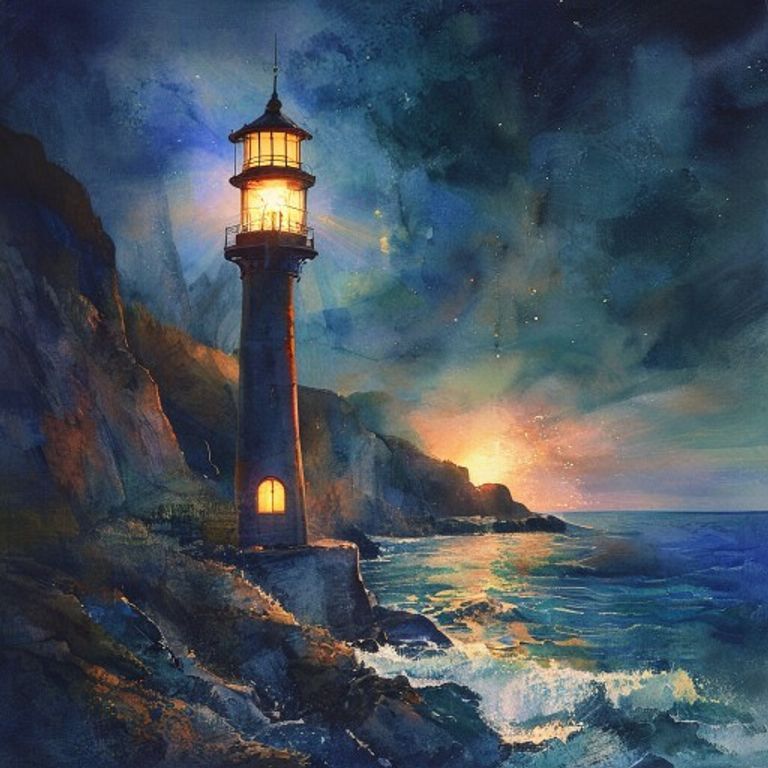
On the rocky coast of the Whispering Sea, where the waves crashed against tall cliffs and the wind sang through the caves, there stood a lighthouse.
Not just any lighthouse. This was the Great Light of Harbor's End, the tallest lighthouse on the entire coast. Its beam could be seen for twenty miles across the dark water. Its light had guided ships safely home for two hundred years.
And inside the Great Light, there lived a young lantern named Beacon.
Beacon was new. He had been installed only three months ago, replacing the old oil lamp that had grown dim and tired. Beacon was electric. He was bright. He was modern. And he knew it.
"I am the most important light on this coast," Beacon would say to himself every evening, as the sun went down and his turn came to shine. "Without me, ships would crash on the rocks. Without me, sailors would be lost forever. I am the reason this lighthouse exists."
The old lighthouse keeper, Mr. Alden, would come up every night to check on Beacon. He would polish the glass, clean the lens, and make sure everything was working.
"Good evening, Beacon," Mr. Alden would say, his voice warm and gentle.
"Good evening, old man," Beacon would reply. He did not say "thank you." He did not say "I appreciate your care." He simply glowed brighter, as if to remind Mr. Alden who was really in charge.
The other lights in the village below did not impress Beacon.
The street lamps were small and ordinary. "They only light a few feet of road," Beacon would scoff. "I light the entire sea."
The shop windows were pretty but pointless. "They only shine when the shops are open," Beacon would sneer. "I shine all night, every night, no matter what."
Even the stars, which Beacon could see from his high tower, did not impress him. "They are far away and cold," he would say. "I am close. I am warm. I am real. Ships depend on me."
One autumn evening, a terrible storm came to the coast.
The wind howled. The waves rose as tall as houses. The rain fell so hard it sounded like stones hitting the glass. And in the Great Light of Harbor's End, Beacon shone as bright as he could, proud that he was guiding ships through such dangerous weather.
But then, without warning, the power went out.

The whole village went dark. The street lamps went out. The shop windows went black. And Beacon—proud, bright, important Beacon—went completely dark.
For the first time in his short life, Beacon could not shine.
"What is happening?" he cried into the darkness. "Why have I gone out? I am the most important light! I must shine! Ships are depending on me!"
But no one answered. Mr. Alden was down in the village, checking on his neighbors. The storm had knocked out the power lines. There was no electricity. There was no light.
Beacon sat in the dark, terrified.
"This is not right," he whispered. "I am important. I am needed. Why has the world forgotten me?"
He sat there for an hour. Two hours. Three hours. The storm raged on. Ships were out there in the dark, trying to find their way. Beacon knew it. He could hear the foghorns in the distance, the desperate calls of captains who could not see the rocks.
And Beacon could do nothing.
He was just a lantern. Without electricity, he was nothing but glass and metal. He was not important. He was not powerful. He was not the reason the lighthouse existed.
He was just... a light. A light that needed power. A light that needed care. A light that needed the whole village to keep him shining.
The next morning, the storm passed. The sun came up. The power lines were repaired. And Beacon slowly came back to life, glowing dimly at first, then brighter, then bright again.
Mr. Alden came up the stairs, breathing hard from the climb. His clothes were wet. His hands were cold. But he was smiling.
"Good morning, Beacon," he said. "You had a quiet night."
"I had a terrible night," Beacon said, his voice smaller than before. "I could not shine. Ships were in danger. I was... I was useless."
Mr. Alden sat down on the old wooden stool he kept by the lantern room. He looked out at the sea, calm now and blue in the morning light.
"Beacon," he said gently, "do you know what happened last night while you were dark?"
"Ships were lost?" Beacon asked, his heart heavy.
"No," Mr. Alden said. "The ships were fine. Do you know why?"
Beacon did not answer.
"The small lights saved them," Mr. Alden said. "The harbor master lit the old oil backup lamp in the small lighthouse on the point. It only shines three miles, but it was enough. The fishermen lit their boat lanterns and lined the shore, making a chain of little lights that showed the captains where the safe channel was. Even Mrs. Peabody lit candles in her window, and from the sea, those candles looked like stars guiding the way."
Beacon was silent.
"You see, Beacon," Mr. Alden continued, "you are bright. You are important. But you are not the only light. And when you think you are the only one who matters, you forget that the light does not belong to you. It belongs to the sea. It belongs to the sailors. It belongs to the village. We all keep each other safe."
Beacon thought about this. He thought about the street lamps he had scoffed at. He thought about the shop windows he had sneered at. He thought about the stars he had dismissed.
"Mr. Alden," he said quietly, "I have been proud."
"Yes," Mr. Alden said, not unkindly. "But pride is not a bad thing, if you learn from it. The question is: what will you do now?"
That night, when the sun went down and Beacon began to shine, he did not think about how important he was. He thought about the old oil lamp on the point, shining its smaller light. He thought about the fishermen's lanterns. He thought about Mrs. Peabody's candles.
And for the first time, he felt grateful.

"Thank you," Beacon whispered to the darkness. "Thank you for helping me. Thank you for being lights too."
The next morning, Beacon asked Mr. Alden something he had never asked before.
"Mr. Alden," he said, "may I ask you about the other lights?"
"Of course," Mr. Alden said, surprised.
"The street lamps in the village. How do they work?"
"They are solar-powered now," Mr. Alden said. "They collect sunlight during the day and shine at night."
"And the shop windows?"
"The shopkeepers choose what to put in them. They light them with their own hands, to welcome people in."
"And the stars?"
"The stars are very far away," Mr. Alden said, smiling. "They have been shining for millions of years. Some of them died long ago, but their light is still traveling. They are the oldest lights in the sky."
Beacon was amazed. "I did not know any of this. I thought I was the only one who mattered."
"That is the lesson of humility, Beacon," Mr. Alden said. "Humility is not thinking less of yourself. It is thinking of yourself less. It is understanding that you are part of something bigger. That your light is important, but it is not the only light. And that when you work with others, everyone shines brighter."
From that day on, Beacon was different.
He still shone as bright as ever. He still guided ships through storms and fog. But he no longer thought he was the most important light on the coast.
Instead, he thought about the other lights. He thought about how they worked together. He thought about how the street lamps kept the village safe at night. How the shop windows welcomed travelers. How the stars gave hope to sailors far from home. How the old oil lamp on the point was still shining, even though it was old and small.
And one night, something special happened.
A young ship was caught in a sudden fog, far from shore. The captain could not see the Great Light. He could not see the old oil lamp. He was drifting toward the rocks.
Beacon saw him. He shone as bright as he could. But the fog was too thick. The light could not reach the ship.
"Help me," Beacon called out into the night. Not to Mr. Alden. Not to the lighthouse. But to all the lights.
And the lights answered.
The fishermen on the shore saw Beacon's bright beam pointing toward the danger. They lit their boat lanterns and rowed out, making a chain of little lights that the captain could see through the fog.
Mrs. Peabody, watching from her window, lit her candles and waved them back and forth, signaling that help was coming.
The old oil lamp on the point, dim but steady, showed the captain where the safe passage was.
And together, all the lights—the big and the small, the bright and the dim, the old and the new—guided the young ship safely to harbor.
When the captain came to thank Mr. Alden the next day, he said something that made Beacon glow with warmth.
"Your light is magnificent," the captain said. "But what saved us was all the lights working together. The little lights in the fog. The candle in the window. The old lamp on the point. Together, they made a path we could follow."
Mr. Alden smiled. "Every light matters," he said. "The big ones and the small ones. The bright ones and the dim ones. We are all part of the same light."
That night, as Beacon shone his beam across the Whispering Sea, he felt something he had never felt before.
Not pride. Not importance. Not the satisfaction of being the best.
Peace.
He was part of something bigger. He was one light among many. And together, they made the coast safe. Together, they made the night less dark. Together, they made the world a little brighter.
"Thank you," Beacon whispered to the stars, to the street lamps, to the candles in the windows, to the old oil lamp on the point. "Thank you for shining with me."
And somewhere in the village, a street lamp flickered, as if to say, "You are welcome."
The End