The Light on Lantern Hill: A Story About Love
The Light on Lantern Hill: A Story About Love
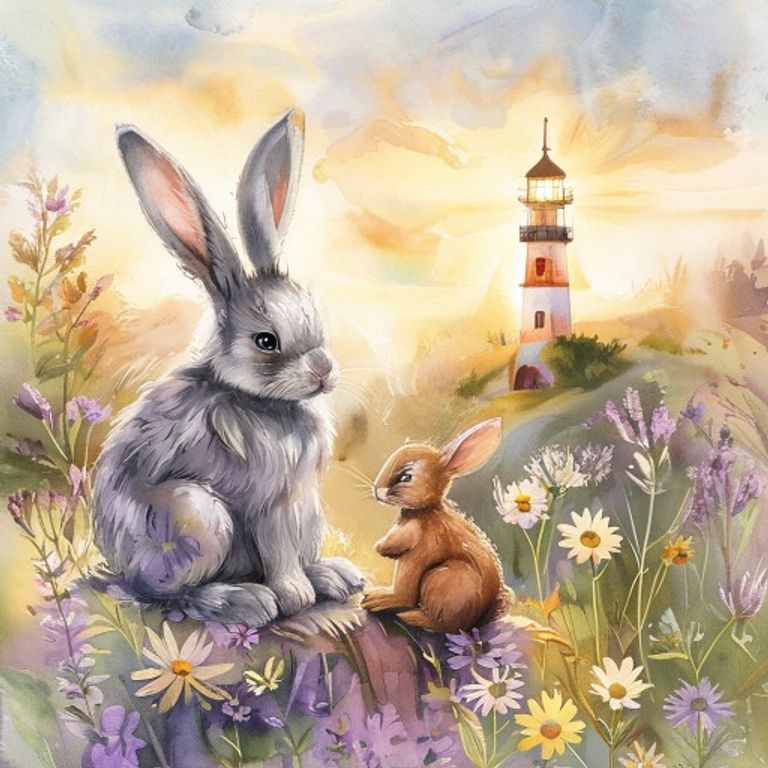
On the highest hill in all of Whispering Valley, where the grass grew soft as duckling down and wildflowers painted the slopes in strokes of violet, buttercup, and snow-white, there stood an ancient lighthouse. It was not a lighthouse for ships, for there was no sea for miles around. It was a lighthouse for hearts—a tall, round tower of honey-colored stone with a lantern room at the top that glowed every night with a light warm and golden as a mother's embrace.
This was Lantern Hill.
And the keeper of the light was an old rabbit named Lumen.
Lumen was not the original keeper. That had been his mother, Glow, who had tended the light for forty years before her paws grew too tired to climb the spiral stairs. Before Glow, it had been her mother, Beam, and before Beam, her mother, Spark. For as long as any animal could remember, the rabbits of Lantern Hill had kept the light burning—through storms and stillness, through summer heat and winter's biting cold.
But Lumen was growing old. His fur, once the color of autumn wheat, had faded to silver at the tips. His ears, once sharp enough to hear a dewdrop fall, now missed the softest sounds. Most of all, his legs—his poor, faithful legs—trembled on the winding stone stairs that spiraled up to the lantern room.
Lumen had a daughter. Her name was Ember.
Ember was small for her age, with fur the color of a sunset just before it fades into night—a warm blend of copper, rose, and the faintest touch of gold. Her eyes were the color of acorns, bright and warm and full of wonder. She was only seven seasons old, and the world still felt enormous and magical to her.
But lately, Ember had noticed something. She had noticed her father wincing as he climbed the stairs each evening. She had noticed him pausing to catch his breath on the landings. She had noticed, one terrible night, that he had nearly missed a step—and her heart had clenched like a fist.
"Papa," Ember said one morning as they sat together on the hilltop, watching the valley wake beneath a sky streaked with dawn. "I want to help you with the light."
Lumen smiled, but it was a sad smile, the kind that hides a worry behind it. "The light is a great responsibility, little flame. It is not just a lantern. It is a promise."
"What kind of promise?" Ember asked, her nose twitching with curiosity.
Lumen was quiet for a moment. The wind carried the scent of clover and distant rain.
"A long time ago," he said, "before even your great-great-grandmother Spark was born, there was darkness on this hill. Not the darkness of night—that is natural and good. This was a different darkness. A loneliness. The animals of the valley lived in fear and separation. They hid in their burrows and nests and dens, never visiting one another, never sharing warmth or stories or hope."
Ember shivered. "That sounds awful."
"It was," Lumen agreed. "But then the first keeper—a rabbit named Dawn—climbed this hill and lit a single candle in the window of a tiny cottage. She did not shout. She did not demand. She simply sat in her window with her light, night after night, so that any animal passing below would know they were not alone."
"And it worked?" Ember whispered.
"Slowly," Lumen said. "A fox saw the light and remembered that someone, somewhere, was awake like him. An owl flying past felt less lonely in the vast dark sky. A lost fawn spotted the glow and found her way home. One by one, the animals began to look for the light. And one by one, they began to visit one another, carrying their own small candles, sharing their own warmth. The valley changed. Not because someone forced it. But because someone cared enough to sit in a window with a light and say, without words, 'I am here. You are not alone.'"
Ember's eyes were wide. "So the light... the light is love?"
Lumen turned to his daughter, and his eyes were shining. "Yes, little flame. The light is love. And love is not a feeling that happens to you. It is a choice you make, again and again. It is climbing stairs when your legs ache. It is trimming wicks when your paws are tired. It is sitting in the cold so that someone, somewhere, can feel warm."

That evening, Ember followed her father up the spiral stairs. She counted them—one hundred and seven steps, each one worn smooth by generations of paws. Lumen moved slowly, leaning on the wall, his breath coming in small gasps.
"Let me carry the oil, Papa," Ember said.
"It is heavy," Lumen warned.
"I am stronger than I look," Ember replied. And she was. She lifted the small tin canister in both paws and climbed ahead of him, step by careful step, never complaining, never rushing.
At the top, the lantern room opened around them like a crown of glass. The great lantern sat in the center—a brass and crystal sphere large enough for Ember to curl up inside, with mirrors that caught and multiplied the flame into a beam visible across the entire valley.
Lumen showed her how to trim the wick, how to clean the soot from the glass, how to add just the right amount of oil. "Too much," he explained, "and the flame will smoke. Too little, and it will sputter and die. Love is like that, too. It needs the right amount of attention. Not so much that it smothers. Not so little that it fades."
Ember watched her father's paws—knotted with age, trembling slightly—as he struck the flint and lit the wick. The flame caught, small at first, then growing steadier, brighter, warmer. The mirrors caught it and sent it blazing out into the night, a golden finger pointing across the valley.
"There," Lumen whispered. "There is love, little flame. There is love."
In the weeks that followed, Ember became her father's shadow. She woke before dawn to help him prepare. She carried the oil. She cleaned the glass. She learned the rhythm of the light—the way it needed checking at midnight, the way the wind could make it flicker, the way rain could dim its brightness if the windows were not sealed just so.
But she also learned something else.
She learned that the light was not just about the lantern. It was about everything that surrounded it.
One rainy night, as Ember was descending the stairs after the evening lighting, she heard a sound—a small, frightened sound, like a whisper lost in thunder. She followed it to the base of the hill, and there, huddled beneath a gorse bush, she found a shivering field mouse no bigger than her own paw.
"I got lost," the mouse squeaked. "The rain... I couldn't see the path. But then I saw the light, and I knew which way was home."
Ember did not hesitate. She led the mouse into the lighthouse, wrapped him in a scrap of wool from the basket by the door, and gave him warm chamomile tea from the little stove. She sat with him until the storm passed, talking about flowers and stars and the best places to find seeds.
When the mouse left, he turned back and said, "You are the light now, little rabbit. Not just the one in the tower. The one in here." And he touched his tiny paw to his chest.
Ember understood something then. The light in the tower was important. But the light in her heart—the willingness to stop, to help, to care—was just as important. Maybe more.
The next week, a young squirrel fell from a tree and broke her tail. She could not climb to her nest, and her family was away gathering winter stores. Ember found her crying beneath the oak and built a soft nest of moss and feathers right there on the ground. She brought acorn mash and fresh water. She told stories to distract the squirrel from her pain. She stayed all night, keeping watch, until the squirrel's family returned at dawn.
"Why did you do that?" the squirrel's mother asked, amazed. "You did not even know her."
"Because," Ember said simply, "the light does not ask who deserves to see it. It just shines."

Word spread through the valley. The animals began to talk about the little rabbit on Lantern Hill who did not just keep a light burning—she kept hearts warm. She visited the sick. She sat with the lonely. She helped the lost find their way. She shared her food, her time, her stories, and her listening ears.
But Lumen was growing weaker. One autumn morning, he could not rise from his bed. His breathing was shallow, and his eyes, though still warm, had lost their familiar sparkle.
Ember sat beside him, holding his paw. "Papa," she whispered. "I am scared."
"Of what, little flame?"
"Of being alone. Of not being enough. Of letting the light go out."
Lumen squeezed her paw with what little strength he had. "Ember. Listen to me. Love is not about being enough. It is about being present. You do not have to be the brightest light. You do not have to be the biggest or the strongest or the wisest. You only have to be here. To try. To care. That is enough. That has always been enough."
He closed his eyes. "Your mother used to say that love is the only thing that grows when you give it away. The more you share, the more you have. I did not understand that when I was young. I thought love was something you kept, something you protected, something you hoarded like acorns in winter. But it is not. Love is a light. The more windows you open, the brighter the world becomes."
Ember wept. She pressed her face against his silver fur and whispered, "I love you, Papa. I love you so much."
"And I love you, little flame," Lumen breathed. "More than all the stars. More than all the lights that ever burned on this hill. You are my greatest light. You always have been."
Lumen did not wake again. But Ember did not let the light go out.
That evening, as the sun bled into the horizon and the first stars pricked the darkening sky, Ember climbed the spiral stairs alone. One hundred and seven steps. Her legs were small but steady. Her heart was heavy but determined.
She trimmed the wick. She cleaned the glass. She added the oil—just the right amount. She struck the flint.
The flame caught.
The mirrors caught it and sent it blazing out across the valley, warm and golden and unwavering.
And as Ember stood in the lantern room, looking out at the valley she loved, she whispered into the night: "I am here. You are not alone."
Below, in the darkness, a fox looked up and felt less lonely. An owl flying past remembered that someone, somewhere, cared. A lost fawn spotted the glow and found her way home.
And on the hilltop, in the lighthouse that had stood for generations, a small rabbit with fur the color of sunset kept the light burning. Not because she was the biggest or the strongest or the wisest. But because she had learned the secret that her father, and his mother, and her mother before her, had all known:
Love is not a feeling. It is a choice.
It is climbing stairs when your legs ache.
It is wrapping a stranger in warmth when you are tired.
It is sitting with pain when you would rather look away.
It is whispering into the dark: "I am here. You are not alone."
And sometimes—most times—that is enough to change the world.
Moral of the Story: Love is not something that simply happens to us. It is a choice we make every single day—to show up, to care, to help, to listen. True love is not about grand gestures or perfect words. It is about small, steady acts of kindness that tell others, "You matter. You are not alone." A warm blanket for someone who is cold. A listening ear for someone who is sad. A hand to hold when the world feels dark. These are the lights that change the world, one heart at a time. So be the light. Be the love. Even when you are small. Even when you are tired. Even when you are scared. Because someone, somewhere, is looking for your glow. And your love might be the very thing that helps them find their way home.
Age Range: 4-8 years | Reading Time: ~10 minutes | Core Value: Love