The Elephant Who Listened: A Story About Empathy
The Elephant Who Listened: A Story About Empathy
On the golden plains of the Savannah, where the grass grew tall as giraffes and the acacia trees spread their branches like open arms against the burning sky, there lived an elephant named Elda. She was the largest creature for miles around, with legs like ancient tree trunks, ears like weathered sails, and a trunk that could uproot a baobab or gently pluck a single flower.
But Elda's most remarkable feature was not her size. It was her heart. It was enormous, even for an elephant—a warm, steady drum that seemed to beat in rhythm with the earth itself. And because her heart was so big, Elda felt things deeply. When the sun was warm, she felt its warmth all the way to her bones. When the rain fell, she felt its coolness like a blessing. And when another creature was sad, Elda felt their sadness as if it were her own.
This was empathy. And it was Elda's gift.
Every morning, Elda would walk the Savannah, her great feet pressing soft prints into the earth, her trunk swaying like a question mark. And everywhere she went, animals came to her. Not because they were afraid of her—though they had every right to be, for she could crush a lion with one step—but because they knew she would listen.
"Elda," the zebra would say, her stripes quivering with worry, "I am tired of being the only one who looks different. The other animals stare at my stripes. They whisper. I feel so alone."
Elda would lower her great head until she was eye to eye with the zebra. "I see you," she would rumble, her voice like distant thunder. "I see your stripes, and they are beautiful. They are the fingerprint of the universe, unique and precious. But more than your stripes, I see your heart. And your heart is lonely. I feel that loneliness. And I am here with you in it."
The zebra would nuzzle Elda's trunk, and the loneliness would ease, just a little.
"Elda," the gazelle would say, his legs trembling, "I am afraid of the lions. Every shadow makes me jump. Every sound makes me freeze. I cannot sleep. I cannot rest. I am tired of being afraid."
Elda would sit down, slowly, carefully, making herself smaller than she was. "I feel your fear," she would say. "It is heavy, like a stone on your chest. I cannot take it away, for the lions are real, and fear is sometimes wise. But I can sit with you. I can be here, beside you, so that when the fear comes, you are not alone."
The gazelle would lean against Elda's warm side, and the fear would shrink, just a little.
"Elda," the tortoise would say, his old eyes cloudy, "I am slow. So slow. The world moves past me like a river, and I am a stone in its path. I see the birds fly, the cheetahs run, the monkeys swing. And I crawl. I feel useless."
Elda would touch the tortoise's shell with the tip of her trunk, gentle as a whisper. "I feel your heaviness. Your weariness. Your longing to be faster, to be more. But tell me, old friend: who carries the wisdom of the Savannah? Who remembers the droughts of fifty years ago? Who knows where the hidden water holes are, the secret paths, the safe places? It is not the fast who hold the wisdom. It is the slow who have seen it all."
The tortoise would blink, and his eyes would clear, just a little.
But there was one animal who never came to Elda. One animal who stayed far away, who hid in the tall grass, who watched from the shadows.
A mouse.
Not just any mouse. A tiny, silver-furred mouse named Pip, no bigger than Elda's smallest toenail. Pip lived in a hole beneath an anthill, and he was so small that the other animals often forgot he existed. The elephants walked past without seeing him. The lions did not bother to chase him. Even the birds, flying overhead, mistook him for a pebble.
Pip was lonely. But more than lonely, Pip was invisible. And invisibility, he had learned, was the deepest hurt of all.
One scorching afternoon, when the sun turned the Savannah into an oven and the air shimmered with heat, Pip ventured out of his hole. He needed water. The little puddle he drank from had dried up, and his throat felt like sand.
He ran through the grass, his tiny heart pounding, his silver fur blending with the golden blades. He ran and ran, searching for water, until he came to the edge of a waterhole.
But there were animals there. Big animals. Dangerous animals. A rhino, wallowing in the mud. A herd of buffalo, drinking deep. And near the edge, Elda herself, spraying her back with cool water, her trunk lifted like a fountain.
Pip froze. He wanted to turn back. But he was so thirsty. The water called to him, cool and blue and life-giving.
He took a step forward. Then another. He was nearly at the water's edge when a buffalo shifted, its massive hoof coming down right where Pip stood.
Pip squeaked and darted aside, but his legs were tired, his body weak. He stumbled, fell, and rolled into a crack in the dry earth.
"Help," he whispered. But his voice was too small. No one heard.
The buffalo drank on. The rhino wallowed. Elda sprayed water over her back, sighing with pleasure.
And Pip lay in the crack, trapped, thirsty, and more invisible than ever.

But then, something奇妙 happened.
Elda stopped spraying. Her great ears, which could hear a raindrop fall a mile away, twitched. She had heard something. Something tiny. Something desperate.
She turned her head. She scanned the ground with eyes that missed nothing. And there, in a crack in the earth, she saw a glint of silver. A tiny nose. A whisker. A heartbeat so fast it sounded like a hummingbird's wings.
"Oh," Elda rumbled. "Oh, little one."
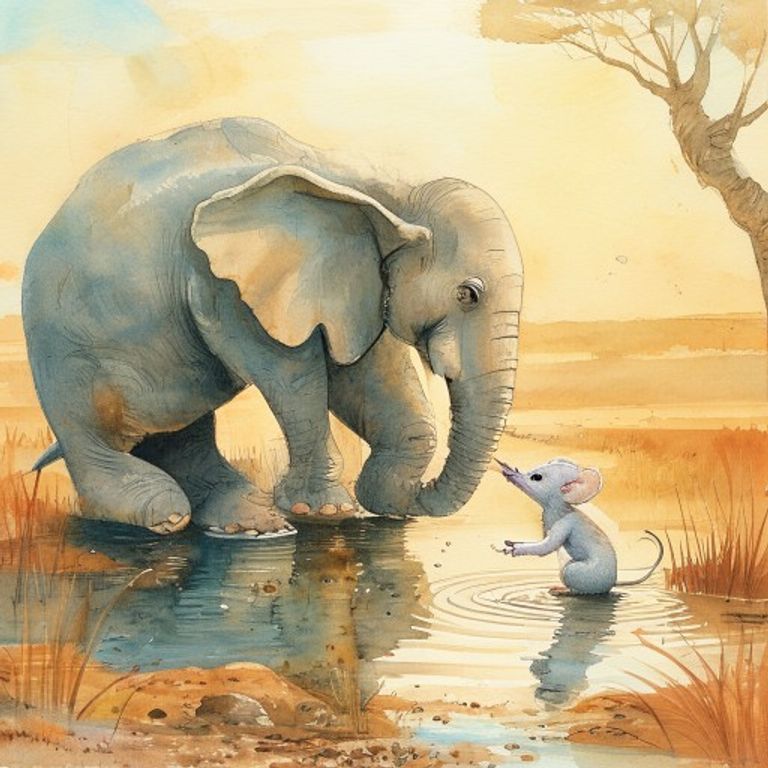
She knelt down, slowly, carefully, her great knees pressing into the earth. She lowered her trunk to the crack, and with the gentlest touch she had ever given, she coaxed Pip out.
Pip trembled in the shadow of the elephant. He had never been this close to something so large. Elda's eye alone was bigger than his whole body. Her breath, warm and grassy, could blow him away like a leaf.
"I am sorry," Pip squeaked. "I did not mean to be in the way. I was just thirsty. I am always in the way. I am too small. I am sorry."
Elda felt something sharp in her heart. It was a pain she had felt before, but never this strongly. It was the pain of being unseen. Of being overlooked. Of mattering so little that the world walked past without a glance.
She understood, in that moment, that being big had made her visible, but being small had made Pip invisible. And invisibility was a heavy burden to carry.
"You are not in the way," Elda said softly. "You are not too small. You are Pip, and you are thirsty, and you have every right to drink."
She carried him to the water's edge on the tip of her trunk, like a leaf on a breeze. She set him down gently, and she stood over him, her great body casting a shadow that kept the sun from burning him.
"Drink," she said. "I will watch. You are safe."
Pip drank. The water was cool and sweet, and it filled him with life. But more than the water, it was the shadow that healed him. The shadow that said, "I see you. You matter. You are not alone."

When Pip had drunk his fill, Elda did not leave. She sat beside him, her bulk settling into the earth like a mountain finding its place.
"Tell me," she said. "Tell me what it is like to be you."
Pip looked up at her. "It is hard," he said. "I am too small for anyone to see. The elephants walk past. The lions ignore me. Even the birds think I am a stone. I speak, but no one hears. I cry, but no one comes. Sometimes I wonder if I am real at all."
Elda closed her eyes. She let Pip's words sink into her heart. She imagined being that small. That silent. That forgotten.
"I feel your loneliness," she said. "It is heavy. It is dark. It is like being buried in the earth with no one to dig you out. I feel it, Pip. I feel it with you."
"You do?" Pip asked, his eyes wide.
"I do. And I am sorry. I am sorry that I walked past you. That I did not see you. That I let you feel invisible. It was not because you are small. It was because I was not looking. And that is my fault, not yours."
Pip's whiskers trembled. No one had ever apologized to him before. No one had ever said he mattered enough to be sorry for.
"But Elda," Pip said, "you are so big. You are so important. Everyone comes to you. Everyone sees you. How can you understand what it is like to be invisible?"
Elda was quiet for a long moment. The sun moved across the sky. The buffalo moved on. The rhino wallowed deeper.
"When I was a calf," Elda said, "I was separated from my mother during a storm. I was alone for three days. I called for her, but the wind was too loud. I searched for her, but the rain was too heavy. For three days, I was the most visible creature on the Savannah, but I felt completely invisible. No one saw my fear. No one heard my cries. And I learned then that invisibility is not about size. It is about feeling unseen, no matter how large you are."
Pip listened. He understood. He felt understood.
"So you truly know?" he asked.
"I truly know," Elda said. "And I will not let you feel invisible anymore. From this day on, Pip, you are seen. You are heard. You are important. And if ever you feel small or forgotten, you come to me. I will always be here."
Pip climbed onto Elda's trunk, tiny against the massive landscape of her skin. He sat there, silver against gray, and for the first time in his life, he felt visible. He felt real. He felt seen.
Word spread across the Savannah. Elda, the great elephant, had a new friend. A tiny mouse named Pip. And together, they taught the other animals something important.
They taught the zebra that being different was not the same as being alone. They taught the gazelle that fear was lighter when shared. They taught the tortoise that slow and steady held wisdom beyond measure.
And they taught everyone—big and small, fast and slow, visible and invisible—that empathy was the bridge between all hearts. That to understand another, you did not have to be like them. You only had to listen. To feel. To say, "I see you. I hear you. I am with you."
One evening, as the sun painted the Savannah in strokes of orange and gold, Elda and Pip walked together. The mouse sat on the elephant's shoulder, and they moved as one across the golden grass.
"Elda," Pip said, "do you know what the best thing about empathy is?"
"Tell me," Elda rumbled.
"It makes the invisible visible. The silent heard. The forgotten remembered. It turns loneliness into connection. And it turns a tiny mouse and a giant elephant into friends."
Elda smiled, her great mouth curving like a crescent moon. "That is the wisdom of the small, my friend. And it is the greatest wisdom of all."
Moral of the Story: Empathy is the ability to understand and share the feelings of another. It is not about fixing someone's problems or telling them what to do. It is about listening. It is about feeling with them. It is about saying, "I see you. I hear you. I am with you." When we practice empathy, we make the invisible visible. We make the silent heard. We turn loneliness into connection. And we learn that every creature, no matter how small or different, has a heart that deserves to be understood. So look around you. Notice the ones who are quiet, who are different, who feel alone. Sit with them. Listen to them. Feel with them. Because empathy is the bridge that connects all hearts, and the world needs more bridges.
Age Range: 4-8 years | Reading Time: ~10 minutes | Core Value: Empathy