The Little Sparrow Who Kept Watch: A Story About Responsibility
The Little Sparrow Who Kept Watch: A Story About Responsibility
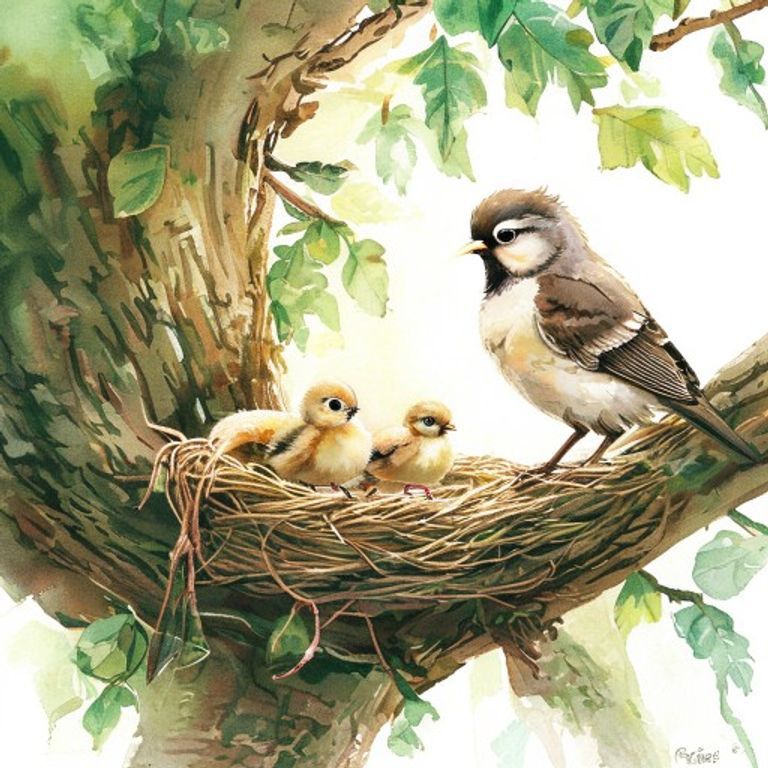
In the crook of an ancient oak tree, where the bark was soft as leather and the leaves whispered secrets to the wind, there lived a family of sparrows. The nest was a masterpiece of woven grass and twigs, lined with downy feathers and dried moss, and it sat high above the ground, safe from cats and foxes and all the dangers of the forest floor.
There were five sparrows in the family: Mother Sparrow, who was quick and wise; Father Sparrow, who was strong and brave; and three chicks: the oldest, a sparrow named Wren; the middle chick, a sparrow named Pip; and the youngest, a sparrow no bigger than a walnut, named Bitty.
Wren was nearly grown. His feathers had lost their downy fluff and gained the sleek brown-gray of adulthood. He could fly short distances, find his own seeds, and even catch a worm or two. Mother and Father Sparrow were proud of him. "You are becoming independent," they said. "Soon you will leave the nest and build your own life."
But Wren had a secret. He was afraid.
Not of flying—he loved flying. Not of leaving—he dreamed of seeing the world beyond the oak tree. Wren was afraid of something else. He was afraid of responsibility.
One warm spring morning, when the apple blossoms painted the orchard pink and the bees hummed their busy songs, Mother and Father Sparrow called Wren to the edge of the nest.
"Wren," Mother said, her dark eyes serious, "we need to leave for the day. The orchard beyond the hill has ripe grain, and winter is coming. We must gather as much food as we can while the weather is warm."
"You are old enough to watch the nest," Father added. "Pip and Bitty are too young to be left alone. The world is full of dangers—hawks, crows, weasels. Someone must keep watch. Someone must protect them."
Wren's heart fluttered like a leaf in the wind. "Me? But... but I have never been in charge before. What if something happens? What if I fail?"
"You will not fail," Mother said, touching his beak gently with her own. "You are stronger than you think. You are braver than you know. And you love your brother and sister. That love is the greatest protection of all."
"But what if a hawk comes?" Wren asked, his voice small.
"Then you call out," Father said. "You warn the chicks. You lead them to hide in the deepest part of the nest, where the twigs are thickest. And you stay with them, no matter what."
"What if a crow tries to steal our food?"
"Then you defend it. You puff up your feathers. You make yourself look big. You shout with all your might. Crows are bullies, Wren, but bullies are cowards. If you stand firm, they will back down."
"What if Bitty cries? She cries a lot."
"Then you comfort her. You sit beside her. You tell her stories. You remind her that she is safe, that she is loved, that she is never alone."
Wren took a deep breath. He looked at Pip, who was practicing his hop-hop-flutter across the nest floor. He looked at Bitty, who was sleeping in the warmest corner, her tiny chest rising and falling like a heartbeat.
"I will do it," Wren said. And he meant it.
Mother and Father Sparrow flew off, their wings cutting through the morning air like scissors through silk. Wren watched until they were specks, then nothing. And then he was alone. In charge. Responsible.
The morning was peaceful. The sun climbed higher, warming the nest. Pip practiced his flying, managing three whole wingbeats before tumbling into a pile of moss. Bitty woke up, cheeped for food, and Wren fed her the seeds his parents had left behind. He preened her feathers, cleaned the nest floor, and sang a little song to keep her calm.
"You are a good big brother," Pip said, panting from his flying practice.
"I am trying," Wren said. And he was.
But then, in the afternoon, when the sun was hot and the air was still, a shadow passed over the nest.
Wren looked up. His blood turned to ice.
A hawk. Huge, silent, circling. Its eyes were the color of amber, sharp and hungry. Its wings were brown and broad, blotting out the sun. And it was looking at the nest.
Wren's first instinct was to hide. To cower. To pray the hawk did not see him.
But then Bitty cheeped. A soft, sleepy, innocent cheep. And Wren remembered his promise.
"Pip!" he whisper-shouted. "Get Bitty. Hide in the back. Now!"
Pip, who had been dozing, snapped awake. He saw the hawk. His eyes went wide. But he did not panic. He grabbed Bitty by the wing—gently, carefully—and pulled her into the deepest part of the nest, where the twigs wove together like a wall.

Wren puffed up his feathers. He made himself as big as he could—which was not very big, but bigger than he usually was. He stood on the edge of the nest, between his siblings and the sky, and he shouted.
It was not a song. It was not a cheep. It was a battle cry. A scream of defiance. A promise that this nest, these chicks, this family, were under his protection.
"Go away!" Wren shrieked. "This is my nest! These are my siblings! You cannot have them!"
The hawk circled lower. Its amber eyes fixed on Wren. It was so much bigger. So much stronger. One strike of its talons and Wren would be gone.
But Wren did not move. He stood his ground. He flapped his wings. He screamed again, louder, harder, pouring every drop of courage he possessed into that cry.
And then, something wonderful happened.
The other birds in the orchard heard him. The robins, the finches, the warblers, the thrushes. They heard a small sparrow's cry of defiance, and they understood. A hawk was hunting. A nest was in danger. And in the code of the wild, all small birds protect each other.
They came. Dozens of them. From every tree, every bush, every corner of the orchard. They swarmed the hawk, diving and pecking and shrieking, a cloud of feathers and fury. The hawk, surprised and outnumbered, wheeled away, retreating to the distant hills where it could hunt alone.
The birds dispersed, returning to their nests, their songs, their lives. But they left Wren with a gift: the knowledge that he was not alone. That responsibility did not mean carrying everything by yourself. It meant doing your part, and trusting that others would do theirs.
Wren collapsed onto the nest floor, his heart pounding, his feathers ruffled, his legs shaking. Pip and Bitty emerged from their hiding place and rushed to him, nuzzling him, chirping with relief and admiration.
"You saved us," Pip said.
"You were so brave," Bitty cheeped.
"I was so scared," Wren admitted. "I thought I would fail. I thought the hawk would... would..."
"But it didn't," Pip said. "Because you stood up. You did your job. You were responsible."

Mother and Father Sparrow returned at sunset, their beaks full of grain, their eyes searching the nest for danger. When they saw Wren, Pip, and Bitty—safe, whole, alive—their relief was visible in every feather.
"What happened?" Mother asked, noticing Wren's ruffled plumage.
Wren told them. The hawk. The fear. The decision to stand. The cry for help. The other birds.
Father Sparrow listened, his head tilted, his eyes thoughtful. "You did exactly right, Wren. You protected your siblings. You called for help when you needed it. And you learned that responsibility is not about being perfect. It is about being present. About doing what needs to be done, even when you are afraid."
"But I was so scared," Wren said. "Does that mean I was not brave?"
"Bravery is not about not being scared," Mother said softly. "It is about being scared and doing your duty anyway. You were responsible, Wren. You put your siblings before yourself. That is the mark of a grown sparrow. That is the mark of someone who can be trusted."
From that day on, Wren was different. He still played. He still dreamed of the world beyond the oak tree. But he also watched. He listened. He kept his promises.
When Mother was tired, Wren fed Bitty without being asked. When Father was gathering food, Wren taught Pip how to spot a hawk's shadow. When the weather turned cold, Wren made sure the nest was snug, the entrance blocked with extra twigs, the warmest corner reserved for Bitty.
And when the day finally came for Wren to leave the nest—to build his own life, his own home, his own family—he did not fly away without a backward glance. He visited. He helped. He kept watch over the oak tree, over his siblings, over the nest that had raised him.
Because responsibility, he had learned, was not a burden. It was a gift. It was the knowledge that you mattered. That your actions made a difference. That someone depended on you, trusted you, needed you.
One autumn evening, years later, Wren sat in his own nest—a cozy hollow in a birch tree, lined with moss and feathers—with his own chicks cheeping beside him. His mate, a gentle sparrow named Lark, nuzzled his wing.
"You are a wonderful father," she said.
"I learned from the best," Wren replied. "From my mother and father, who trusted me before I trusted myself. From my brother and sister, who showed me that love is worth protecting. And from a hawk, who taught me that courage is not the absence of fear, but the presence of duty."
He looked out at the orchard, at the ancient oak tree in the distance, at the world he had grown to know and love.
"Responsibility," he said to his chicks, who were too young to understand but old enough to listen, "is not about being in charge. It is about being present. It is about showing up, even when you are scared. It is about doing what is right, even when it is hard. And it is about loving someone enough to put them before yourself."
The chicks cheeped, not understanding the words but feeling the warmth in their father's voice. And Wren, the little sparrow who had once been afraid of responsibility, smiled.
He was not afraid anymore.
Moral of the Story: Responsibility is not about being perfect or never making mistakes. It is about showing up. It is about doing what needs to be done, even when you are scared, even when you would rather hide, even when the task feels too big for your small shoulders. When we are responsible—when we care for others, keep our promises, and protect those who depend on us—we discover that we are stronger than we thought. We discover that courage grows when we put someone else's needs before our own. And we discover that the greatest gift we can give is not a present or a promise, but our presence. So be responsible. Be there. Show up. Even when it is hard. Especially when it is hard. That is how we grow. That is how we love. That is how we become who we are meant to be.
Age Range: 4-8 years | Reading Time: ~10 minutes | Core Value: Responsibility