The Girl Who Would Not Quit: A Story About Determination
The Girl Who Would Not Quit: A Story About Determination
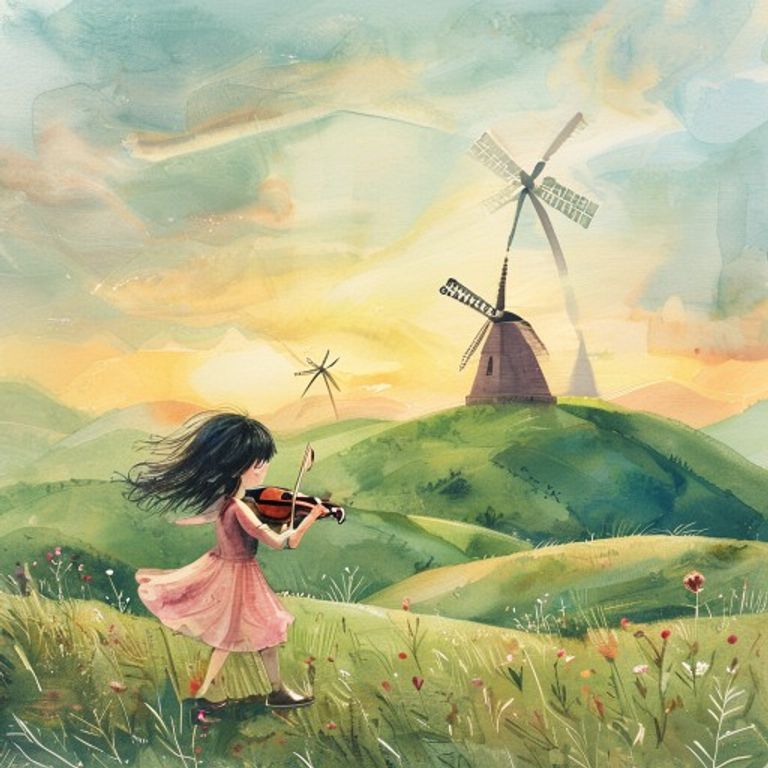
In the village of Hillcrest, where the windmills turned like giant pinwheels and the hills rolled green and gold to the horizon, there lived a girl named Mei. She was nine years old, with straight black hair that fell to her waist and eyes the color of dark chocolate. She was small for her age, quiet, and often overlooked. But Mei had something inside her that no one could see. Something bright and burning. Something unbreakable.
Determination.
Mei wanted to play the violin. Not just play it. Master it. She had seen a woman perform at the town square, her fingers dancing on the strings, her music soaring like birds taking flight. Mei had stood in the crowd, tears streaming down her face, not from sadness, but from wonder. She wanted to make music like that. She wanted to move people's hearts.
But there was a problem. Mei did not have a violin. Her family was poor. Her father worked in the fields from dawn to dusk. Her mother sewed clothes for the neighbors. There was no money for music lessons, no money for instruments, no money for dreams.
So Mei made her own violin.
She found an old wooden box in the barn, the kind that had once held tools. She sanded it smooth with stones from the river. She stretched wire across it, tied with knots she learned from her father. She made a bow from a birch branch and horsehair from the neighbor's old mare. It did not look like a real violin. It sounded even less like one. The notes were scratchy and sour, like a cat caught in a door.
But Mei did not care.
Every morning, before the sun rose, she sat on the hillside and played. Every evening, after her chores, she played until her fingers bled. The other children laughed at her. "That sounds terrible!" they shouted. "Stop playing! You have no talent!"
Mei did not stop.

Her mother found her one night, her fingers wrapped in rags, her eyes red from exhaustion. "Mei," she said softly. "Why do you do this to yourself? The violin is not for us. We are simple people."
"I am not simple," Mei said, her voice steady. "I am determined."
Her mother smiled, a sad, proud smile. "Then I will help you."
She took Mei to the town library, where an old woman named Mrs. Lin taught music to children who could not afford lessons. Mrs. Lin looked at Mei's homemade violin, at her bleeding fingers, at the fire in her eyes. She said nothing for a long time. Then she handed Mei a real violin.
"This was my daughter's," Mrs. Lin said. "She moved to the city and left it behind. It needs someone who loves it. Someone who will not give up."
Mei held the violin like it was made of glass. The wood was warm and smooth, the strings silver and true. She placed it under her chin, raised the bow, and played.
The sound was still scratchy. Still sour. Still terrible.
But Mei smiled. Because now she had a real instrument. And she was determined to make it sing.
Months passed. Mei practiced every day. Mrs. Lin taught her scales, bowing techniques, the way to hold her fingers just so. Mei's fingers grew calloused. Her arms grew strong. And slowly, almost imperceptibly, the scratchy sounds began to smooth. The sour notes began to sweeten. The cat in the door began to sound like a songbird.
One year after she first saw the woman in the town square, Mei stood on that same stage. Her hands trembled. Her heart pounded. The crowd watched, some curious, some skeptical.
She raised her bow. She closed her eyes. And she played.

The music that filled the square was not perfect. But it was beautiful. It soared and dipped, danced and wept. It told the story of a girl who would not quit, who practiced until her fingers bled, who refused to let poverty or mockery stop her dream.
When Mei finished, the square was silent. Then someone began to clap. Then another. Then the whole crowd was on its feet, their hands thundering, their faces wet with tears.
Mrs. Lin stood at the back, her own eyes shining. "You did it," she whispered. "You really did it."
Mei looked at her violin, at her calloused fingers, at the crowd that had once laughed at her. She thought about the mornings on the hillside, the bleeding fingers, the nights of exhaustion. She thought about determination, about never giving up, about the power of refusing to quit.
"I am not done," she said, her voice clear and strong. "I am just beginning."
And she was right. Mei went on to become one of the finest violinists in the land. She played in grand halls and humble villages, for kings and farmers. And everywhere she went, she told her story. Not to boast. But to inspire.
"I was small," she would say. "I was poor. I was told I had no talent. But I had determination. And determination is the seed from which all great things grow."
Moral of the Story: Determination means never giving up, even when things are hard. Mei wanted to play the violin, but she had no money for lessons or instruments. So she made her own violin from a wooden box and wire. People laughed at her. Her fingers bled. But she practiced every day, morning and night, for months and years. And eventually, she became a beautiful violinist. Determination is not about being talented or lucky. It is about refusing to quit. It is about getting up every day and trying again, even when you fail. So if you have a dream, do not let anyone tell you it is impossible. Work hard. Practice. Believe in yourself. And never, ever give up.
Age Range: 4-8 years | Reading Time: ~10 minutes | Core Value: Determination