The Elephant Who Listened: A Story About Empathy
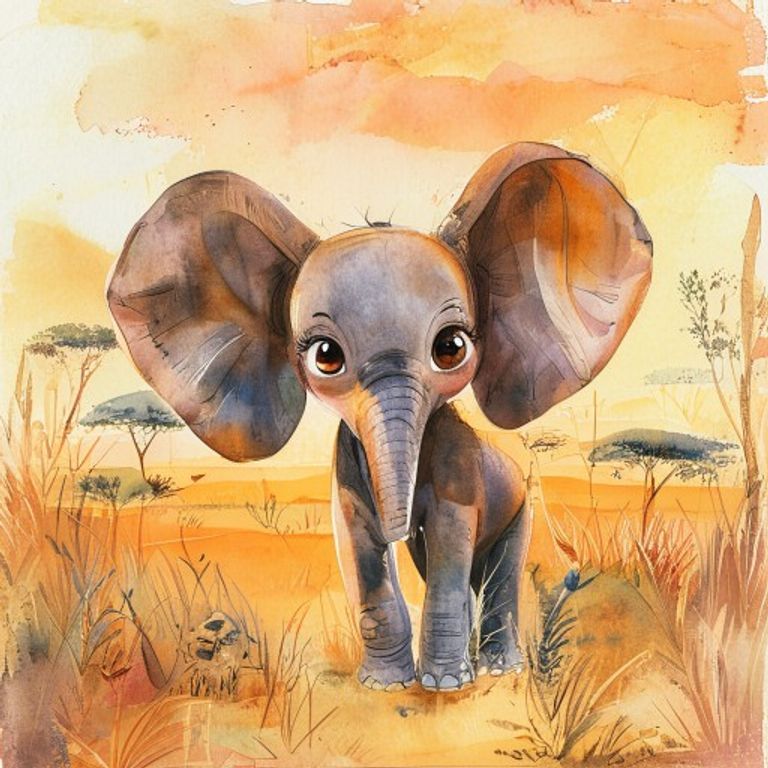
On the golden plains of the Serengeti, where the grass grew taller than a gazelle's shoulder and the acacia trees spread their branches like open arms against the endless sky, there lived a young elephant named Kioni. Her name meant "she who sees" in the old language of the wind, and it was a name that fit her perfectly. For Kioni had the largest ears of any young elephant in the herd—ears so big they could catch sounds from miles away, and eyes so warm and brown they seemed to hold the gentle light of a hundred African sunsets.
Kioni lived with her grandmother, Nia, who was the wisest elephant in all the savanna. Nia's tusks were long and curved like crescent moons, and her skin was etched with wrinkles that told stories of droughts and rains, of joy and sorrow, of a life fully lived.
"Your ears are not just for hearing, little one," Nia would often say, fanning herself with her own magnificent ears. "They are for listening. And listening is the beginning of understanding."
Kioni would nod, though she did not fully understand. How could she? She was young, and the world was vast, and there were so many things to explore.
The savanna was full of creatures great and small. Lions dozed in the shade of rocky outcrops. Zebras striped the plains in black and white patterns that dazzled the eye. Giraffes moved like slow dancers among the treetops. And everywhere, everywhere, there was life—bustling, breathing, beautiful life.
But not all was well on the savanna.
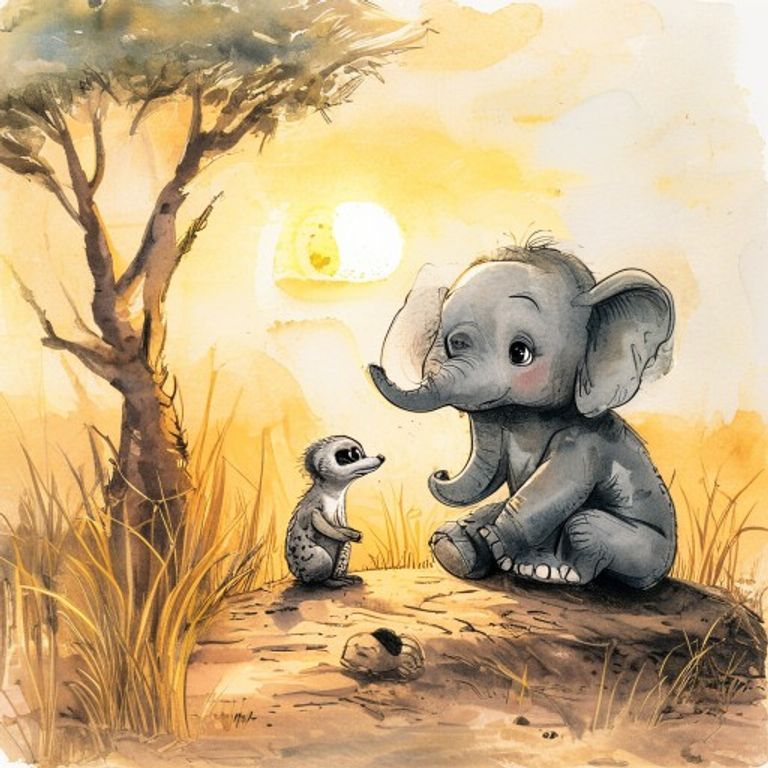
One morning, as the sun rose like a burning coin above the horizon, Kioni noticed something strange. A small meerkat named Pip was sitting alone on a termite mound, his tiny paws wrapped around his knees, his usually bright eyes clouded with sadness.
Pip was the smallest meerkat in his colony, a little thing no bigger than a rabbit, with golden-brown fur and dark rings around his eyes that made him look like he wore a tiny mask. He was usually the first to wake, the first to stand guard, the first to laugh. But today, he sat still as stone.
Kioni walked over, her massive feet making soft thuds against the dry earth. "Hello, Pip," she said, her voice a low rumble that vibrated through the ground. "Why do you sit alone?"
Pip looked up, and Kioni saw something that made her heart ache. His eyes were red. His whiskers trembled. "I lost my brother," Pip whispered. "Skitter. He went out hunting yesterday and never came back."
Kioni felt a strange sensation then, as if the sadness in Pip's heart had traveled through the air and settled in her own chest. It was heavy. It was cold. It was...
"I am sorry," Kioni said, and she meant it with every fiber of her being. She lowered herself to the ground, her great body creating a wall of warmth beside the tiny meerkat. "Tell me about Skitter."
Pip's eyes filled with tears. "He was brave. Too brave, maybe. He always wanted to go farther than the others. He said there were better hunting grounds beyond the old baobab tree. I told him not to go. I told him it was dangerous. But he laughed and said I worried too much."
Kioni listened. She did not offer advice. She did not say "everything will be okay." She simply listened, her great ears catching every word, every tremor in Pip's voice, every beat of his grieving heart.
And as she listened, she felt something remarkable. She felt what Pip felt. The fear. The worry. The crushing weight of not knowing. It was as if her heart had grown bigger, stretching to hold not just her own feelings, but Pip's as well.
This, she realized, was what Grandmother Nia meant. This was empathy.
Word of Kioni's listening spread across the savanna like wildfire. Soon, creatures began coming to her from all corners of the plains.
A zebra named Zara came next. Her stripes were beautiful, bold black lines on pure white, but her eyes were hollow. "The herd rejected me," Zara said, her voice flat. "I stumbled during the migration. I slowed them down. Now they treat me like I am nothing."
Kioni sat with her, feeling the sting of rejection as if it were her own. "You are not nothing," Kioni said softly. "You are Zara. You are unique. No other zebra has your pattern. No other zebra has your strength. And slowing down does not make you worthless. It makes you careful."
Zara's eyes brightened, just a little. "You really think so?"
"I feel so," Kioni said. "Because I feel what you feel. And what you feel is pain, not truth."
Then came a lion cub named Jengo, who had been cast out by his pride for being too gentle. "I do not like to hunt," Jengo admitted, his golden mane barely more than fluff. "I like to watch the birds. I like to feel the wind. The other cubs call me weak."
Kioni felt the loneliness in his heart, sharp as a thorn. "Being gentle is not weak," she said. "It takes courage to be different. To be yourself when the world wants you to be something else."
Jengo looked up at her, his amber eyes wide. "No one has ever said that to me before."
"Then they were not listening," Kioni replied.
Day after day, the creatures came. A lonely tortoise who had outlived all his friends. A frightened fawn separated from her mother during a stampede. A proud eagle who had lost his ability to fly and could not bear the pity of his flock.
Kioni listened to them all. She felt their joys and their sorrows, their fears and their hopes. And she discovered something extraordinary: the more she understood others, the more she understood herself.
But not everyone understood what Kioni was doing.
One evening, as Kioni sat with a sobbing hyena named Haji—who was despised by the other animals simply for being a hyena—an old buffalo named Kibo approached. Kibo was massive, with horns that curved like scythes and a temper that flared like dry grass in a wildfire.
"What are you doing, elephant?" Kibo demanded. "Consorting with hyenas? Feeling sorry for zebras? Comforting lion cubs? You are an elephant! The largest creature on the savanna! Act like one!"
Kioni looked up at him calmly. "And how should an elephant act, Kibo?"
"With strength! With pride! We do not coddle the weak. We do not waste our time on creatures who cannot survive on their own."
Kioni felt the anger radiating from the buffalo, but beneath it, she felt something else. Fear. Loneliness. A deep, gnawing worry that he was not enough, that his strength was all he had, that without it, he was nothing.
"You are afraid," Kioni said gently.
Kibo snorted. "I am not afraid of anything!"
"Not of lions or storms," Kioni agreed. "But you are afraid of being forgotten. Of growing old and having no one who cares. Of dying alone with no one to remember your name."
The buffalo's eyes widened. His angry stance faltered. "How... how did you..."
"Because I listened," Kioni said. "And listening is the beginning of understanding."
For a long moment, Kibo was silent. Then, slowly, he lowered his great head. "My wife died last season," he whispered. "The lions took her. And since then, I have been angry at everything. Because being angry is easier than being sad."
Kioni reached out with her trunk and touched his horn, a gesture of gentleness that made the old buffalo's eyes glisten. "I am sorry for your loss," she said. "And I am sorry that you have had to carry it alone."
Kibo wept then. Great, silent tears rolled down his weathered face. And Kioni sat with him, feeling his grief, sharing his burden, until the stars came out and the savanna grew quiet.
From that day forward, something remarkable happened on the savanna.
The animals began to change. Not because Kioni told them to, but because she showed them how. Zara the zebra, healed by empathy, began visiting the lonely tortoise to share stories. Jengo the lion cub, no longer ashamed, started a garden where all creatures could rest in safety. Even Kibo the buffalo softened, using his strength to protect the weak instead of intimidate them.
And Pip the meerkat?
One morning, as Kioni walked across the plains, she heard a familiar voice. "Kioni! Kioni!"
She turned to see Pip running toward her, his tiny legs pumping, his eyes shining with a light she had not seen in weeks. Behind him, limping slightly but very much alive, was another meerkat.
"Skitter!" Kioni trumpeted with joy.
Pip's brother had been trapped in an abandoned warthog burrow, unable to dig his way out. He had survived on insects and morning dew, clinging to hope. And when a passing tortoise had heard his weak cries and told the others, the whole colony had come to dig him free.
"I listened to you," Pip said, his voice thick with emotion. "You taught me that empathy is not just feeling sad with someone. It is feeling hope with them too. And so I hoped. I hoped every day. And my hope brought him back."
Kioni felt tears in her own eyes—great, warm tears that splashed onto the dry earth and made tiny flowers bloom where they fell. "You did this, Pip. Not me. You chose to hope. You chose to feel. That is the magic of empathy."
As the seasons turned and the rains came and went, Kioni grew from a young elephant into a magnificent matriarch. Her ears grew even larger, her heart even bigger. And everywhere she went, creatures came to her—not just to share their troubles, but to share their joys as well.
For empathy, Kioni learned, was not only for sorrow. It was for laughter. For triumph. For the quiet, beautiful moments that made life worth living.
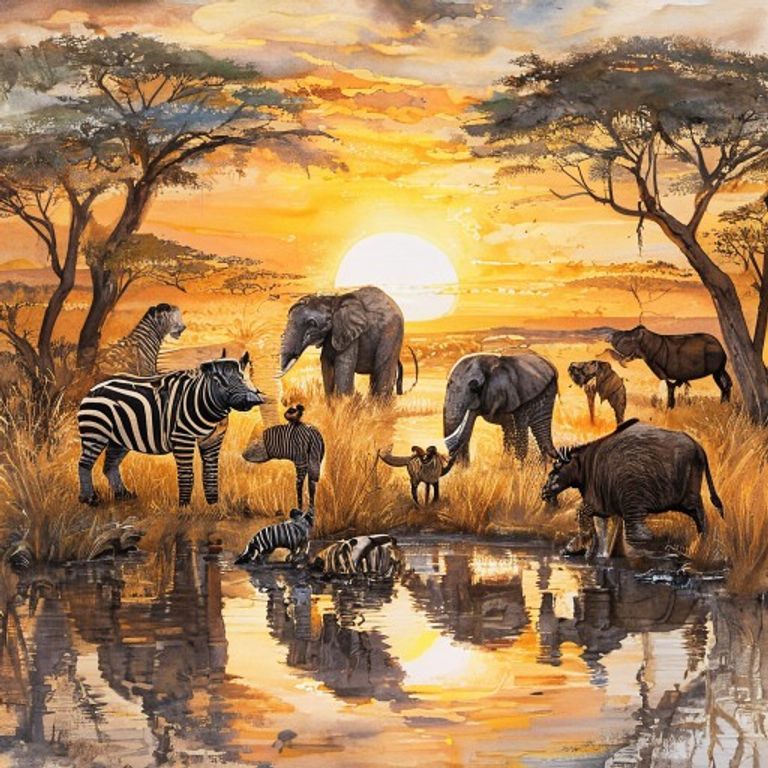
One evening, as the sun painted the savanna in shades of rose and gold, Kioni stood beside her grandmother Nia at the edge of a watering hole. The whole savanna had gathered—zebras and lions, meerkats and buffalo, eagles and tortoises—all drinking together in peace.
"You have done something extraordinary, little one," Nia said, her ancient eyes filled with pride. "You have taught the savanna to listen. And when we listen to each other, we cannot help but love each other."
Kioni watched the animals at the watering hole. She saw Zara nuzzling her new foal. She saw Jengo playing with a flock of birds. She saw Kibo standing guard over a family of warthogs, his massive horns gleaming in the sunset.
"I did not teach them," Kioni said. "I just showed them what was already in their hearts."
Nia smiled, a wise and knowing smile. "And that, my dear, is the greatest lesson of all. Empathy is not something we learn. It is something we remember. It is the voice inside us that says: 'Their pain is my pain. Their joy is my joy. We are not separate. We are one.'"
As the stars began to appear, one by one, like diamonds scattered across velvet, Kioni raised her trunk and let out a call—a deep, resonant sound that rolled across the savanna like a song. And from every corner of the plains, the animals answered. Not with words, but with presence. With understanding. With love.
Because when you truly listen—when you truly feel what another feels—the world becomes smaller. The walls between us crumble. And we realize that we are all, every one of us, just creatures trying our best to find our way home.
Empathy, little one. Empathy.
The End