The Giving Tree of Orchard Hill: A Story About Generosity
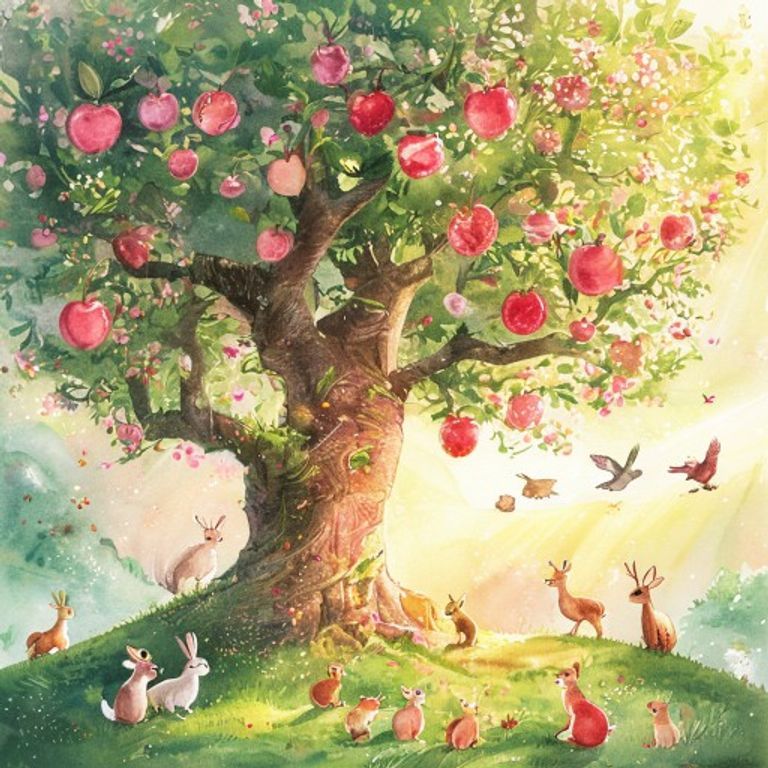
On the top of a gentle hill, where the morning sun painted the sky in shades of peach and gold, there stood an ancient apple tree. Her name was Alma, and she was the oldest tree in Orchard Hill.
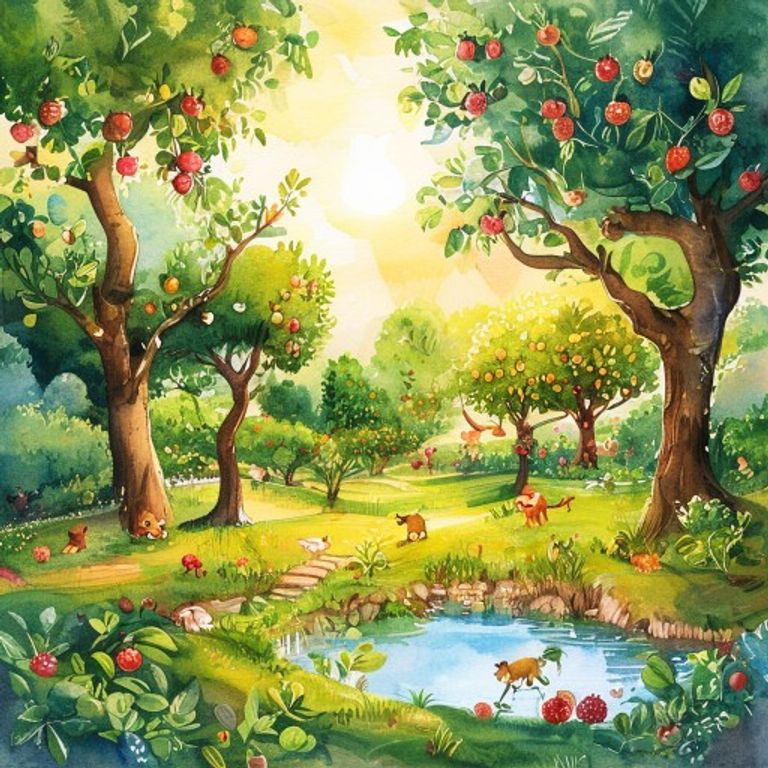
Alma's trunk was thick and silver-gray, with bark that looked like the wrinkles of a wise grandmother. Her branches stretched wide and welcoming, like arms open for a hug. In spring, she wore a dress of pale pink blossoms that smelled of honey and rain. In summer, her leaves were a deep, rich green, rustling secrets to the wind. And in autumn—oh, in autumn—she was magnificent. Her branches hung heavy with apples so red they seemed to glow, so sweet that a single bite made your eyes close with joy.
But what made Alma truly special was not her age, or her beauty, or even her delicious apples.
What made her special was her heart.
Alma loved to give.
She gave shade to the field mice who played beneath her roots on hot summer days. She gave blossoms to the bees, who turned her nectar into golden honey. She gave twigs to the sparrows, who wove them into nests for their babies. And she gave apples—oh, so many apples—to everyone who passed by.
"Take as many as you need," she would whisper to the rabbits who came hopping up the hill. "There is always enough."
The rabbits would nibble the fallen apples that dotted the grass like rubies. The deer would stretch their long necks to reach the lowest branches. The foxes would roll apples down the hill for their cubs to chase. Even the humans who walked the old dirt road would pause beneath Alma's canopy, reach up, and fill their baskets with fruit.
"Thank you, Alma," they would say, touching her trunk with gentle hands.
"It is my joy," Alma would reply, her leaves rustling with pleasure. "Giving is what I was made for."
Now, not far from Alma, at the bottom of the hill, there lived a young apple tree named Bramble.
Bramble was small and thin, with branches that were more thorn than leaf. He had apples too, but they were small and sour, hard as stones and pale as moonlight. He watched Alma with envy and confusion.
"Why do you give so much?" Bramble asked one autumn morning, as a family of hedgehogs waddled away with apples in their paws. "Don't you worry there will be none left for you?"
Alma laughed—a sound like wind chimes. "Left for me? But Bramble, I am not the apples. I am the tree. The apples are gifts, not treasures to hoard."
"But winter is coming," Bramble insisted. "What if you need those apples? What if you get hungry?"
"Trees do not eat apples, little one," Alma said gently. "We make them. And making them is the joy. Giving them is the purpose. When I give an apple, I do not lose something. I fulfill something."
Bramble shook his branches, unconvinced. "You are foolish, Alma. One day you will give everything away, and then what will you have?"
"Then I will have given everything away," Alma said, her voice warm and steady. "And that is the greatest wealth of all."
But that year, something changed.
The autumn was unusually dry. The rains did not come. The stream that watered the orchard shrank to a trickle. The soil grew hard and cracked. And the apples... the apples did not come.
Alma's branches, usually heavy with fruit, were bare. A few small, hard apples clung to the highest limbs, but they were bitter and brown, not fit for eating. The other trees in the orchard fared no better. Bramble had no apples at all.
The animals of the hill grew worried. The rabbits had no apples to nibble. The deer found no fruit to reach. The sparrows had no extra food to store for winter. And the humans, when they walked the old dirt road, looked up at Alma with disappointment and walked on, their baskets empty.
"You see?" Bramble said, his voice smug despite his own bare branches. "You gave everything away in the good years, and now you have nothing for the bad ones. If you had saved some apples, you would have food now. You would have something to trade, something to sell, something to keep you safe."
Alma was silent. Her leaves, usually so vibrant, had turned the color of old paper. Her trunk seemed thinner. For the first time in her long life, she looked... tired.
"Perhaps you are right," she whispered. "Perhaps I was foolish."
But even as she spoke, something was happening at the bottom of the hill.
A rabbit named Thistle, who had eaten Alma's apples every autumn of his life, sat outside his burrow and looked up the hill. He thought of Alma's shade, her blossoms, her endless generosity. And he felt a stirring in his heart.
"She gave to us when she had plenty," Thistle said to his family. "Now she has nothing. It is our turn to give."
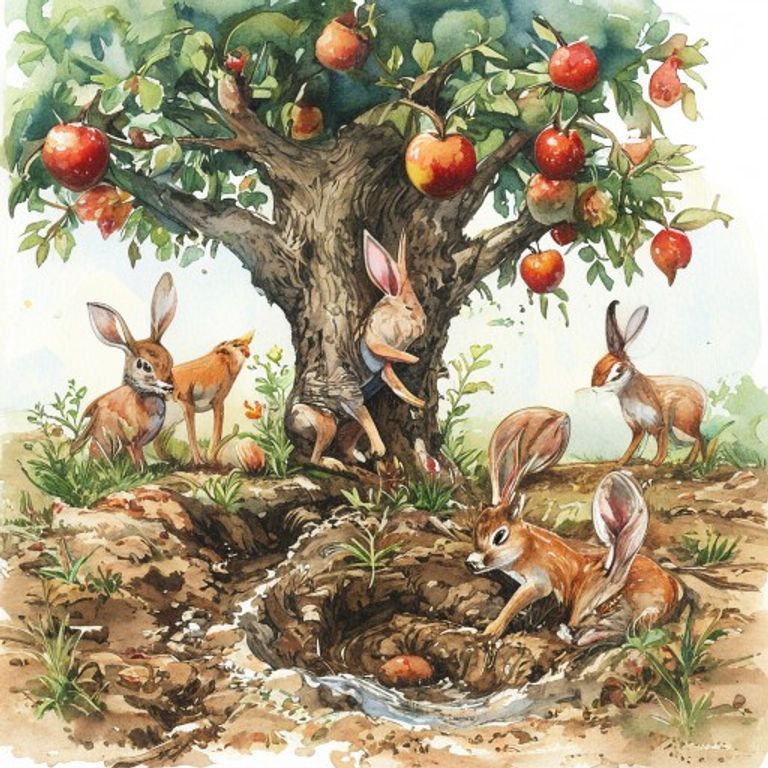
The rabbits, who were many, began to dig. They dug new channels from the stream, redirecting the trickling water toward Alma's roots. They dug through the hard soil, breaking it up so rain could sink in deeper. They worked all day, their paws blistered, their fur dusty, until the water flowed freely around Alma's trunk.
A deer named Willow, who had stretched her neck to Alma's branches since she was a fawn, gathered the other deer. "She fed us when we were hungry," Willow said. "Now we must feed her."
The deer did not eat apples—there were none to eat. But they knew where the best grass grew, the sweetest clover, the richest soil. They carried seeds in their mouths from the far meadows. They planted them around Alma's roots. They trampled the hard earth to make it soft, so the seeds could grow.
The sparrows, who had raised generations of chicks in nests made from Alma's twigs, took to the sky. They flew to distant orchards and brought back stories of rain. They told the clouds, in their chattering way, that Alma needed water. And perhaps the clouds listened, or perhaps it was coincidence, but that evening, the sky darkened. And it rained.
It rained for three days. Soft, steady, soaking rain that turned the cracked soil to mud, then to earth, then to rich, dark loam. The water flowed down the new channels the rabbits had dug, pooling around Alma's roots, seeping deep into the ground where she could drink.
And the humans—the humans did something too.
A farmer named Elias, who had filled his baskets with Alma's apples for thirty years, came with his wagon. He did not come to take. He came to give. He brought compost made from his kitchen scraps. He brought mulch from his woodpile. He brought a young sapling—a daughter of Alma's own seeds, grown in his greenhouse—and planted it beside her trunk.
"You gave me apples when my children were small," Elias said, patting Alma's bark. "You gave me shade when I was tired. You gave me beauty when I was sad. It is my honor to give something back."
Alma felt the rain on her branches. She felt the water in her roots. She felt the love, the care, the gratitude of every creature who had ever eaten her apples, warmed in her shade, or built a home from her gifts.
And she wept.
Not tears of sadness, but tears of joy—sap that ran down her bark like amber, glistening in the sun. For she understood, finally, what she had always known.
Generosity was not about giving away what you had. It was about creating a circle of love so strong that when you needed help, the circle would hold you. It was about planting seeds of kindness that would grow into forests of gratitude.
"You were wrong, Bramble," Alma said softly, her voice stronger now, her leaves beginning to bud despite the autumn season. "I did not lose by giving. I gained a family."
Bramble, watching from the bottom of the hill, felt something twist in his thorny branches. He saw the rabbits digging, the deer planting, the sparrows flying, the farmer working. He saw a community united not by taking, but by giving back.
And for the first time, Bramble wished he had something to give.
The next spring was the most beautiful Orchard Hill had ever seen.
Alma's blossoms were not just pink—they were every shade of sunrise, from palest cream to deepest rose. Her leaves were not just green—they were emerald, jade, and the color of new life itself. And when autumn came, her apples were enormous, perfect, glowing like lanterns in the sun.
But now she was not alone.
The sapling Elias had planted had grown into a young tree, already producing small, sweet apples of her own. The seeds the deer had planted had sprouted into berry bushes around Alma's roots. The channels the rabbits had dug had created a small pond that attracted frogs, dragonflies, and birds of every kind.
And Bramble?
Bramble had changed too. He still had thorns, but now they were fewer, and his branches had softened. He had begun to give what he could—shade to a family of moles, twigs to a young robin, and advice (grumpy but useful) to any tree who would listen.
"I still think you are foolish," Bramble would say to Alma, as they watched the animals play beneath their branches. "But I suppose... there are worse things than being foolish."
"What things?" Alma would ask, her leaves dancing.
"Being alone," Bramble would reply, very quietly. "That is worse."
Years passed. Alma grew older, her trunk wider, her branches more magnificent than ever. She gave apples to thousands of creatures. She gave shade to generations of animals. She gave beauty to everyone who climbed Orchard Hill.
And when she finally grew too old to make apples, when her leaves turned silver and her branches grew heavy with age, she was not sad. For all around her, in every direction, were trees she had inspired. Trees that gave. Trees that shared. Trees that understood that generosity was not a loss, but a seed.
The young tree Elias had planted was now tall and strong, giving her own apples to the rabbits and deer and foxes. The berry bushes fed the birds. The pond sustained the frogs. And Bramble, grumpy old Bramble, had become the most generous tree of all, giving every apple he made to anyone who asked, then grumbling happily about it afterward.
On her last autumn, as the sun set over Orchard Hill, Alma gathered her family around her—not just trees, but rabbits and deer and sparrows and humans, all the lives she had touched.
"I am leaving you soon," she said, her voice a whisper of wind. "But do not be sad. For I am not really leaving. I am in every apple you eat. Every seed you plant. Every act of kindness you perform. Generosity does not end when the giver is gone. It lives on in the hearts of those who received."
"What should we do?" asked Thistle, now an old rabbit with grandchildren of his own.
"Keep giving," Alma said, her last leaves glowing gold in the sunset. "Keep giving, and the circle will never break."
Alma fell asleep that winter, her trunk becoming home to mushrooms and moss, her hollows sheltering owls and squirrels. But in the spring, something miraculous happened.
Where her biggest apple had fallen, long ago, a sapling pushed through the soil. It was small and tender, with leaves the color of spring itself. And all the animals of Orchard Hill gathered around it, watering it, shading it, singing to it.
For they knew that inside that tiny sapling was the heart of Alma, the greatest giver Orchard Hill had ever known.
And they knew that one day, that sapling would grow into a tree that gave everything it had, just as Alma had. And the animals would eat her apples, and sleep in her shade, and build their nests in her branches. And when she grew old, they would dig channels and plant seeds and bring rain, just as she had taught them.
Because that was the circle.
Generosity, little one. Generosity.
The End