The Mole Who Wondered What Was Above: A Story About Curiosity
In the Kingdom Under the Hill, where the earth was warm and dark and the tunnels twisted like the thoughts of a dreaming giant, there lived a young mole named Digby. He was not like the other moles. Not at all.
The other moles loved the dark. They loved the safety of packed dirt walls, the comfort of knowing that above them lay only more earth, more roots, more solid, dependable brown. They loved their work—digging new tunnels, finding the juiciest worms, expanding the kingdom chamber by chamber, mile by mile. They were content. They were satisfied. They were, in the way of moles, complete.
But Digby was not complete. Digby was curious.
It had started when he was very small, barely old enough to push dirt with his nose. He had felt something strange while tunneling near the surface—a vibration, a hum, a whisper that did not come from worms or roots or other moles. It was faint, almost nothing, but it was different. And Digby, being Digby, had to know what it was.
"It's nothing," his mother had said, patting the dirt wall with her powerful paw. "Just the shifting of stones. The turning of the deep earth. There is nothing above us, Digby. Nothing but more earth, going on forever."
But Digby did not believe her. The whisper he felt was too light, too bright, too alive to be just stone. It felt like... like a question. And Digby had to find the answer.
The Digging Upward
For three years, Digby dug upward. Not constantly—he had duties, after all. He helped build new tunnels, he learned to find the sweetest roots, he attended the Council of Elders where the oldest moles told stories of the Deep Dark and the Beginning of Dirt. But every spare moment, every rest period, every quiet hour when the kingdom slept, Digby dug upward.
The other moles thought he was strange. They whispered behind their paws. "Digby has dirt in his brain," they said. "He thinks there's something above the earth. He's digging toward nothing."
His brother, Thud, was the worst. Thud was the strongest digger in the kingdom, capable of moving a boulder with his shoulders alone. He would find Digby's upward tunnels and collapse them, filling them with rubble and dust. "Stop wasting your strength," Thud would grunt. "There is nothing up there. The elders have said so for a thousand generations. Up is just more down."
But Digby did not stop. He could not stop. The whisper grew louder with every inch he climbed. It was not a sound, exactly—moles do not have sharp hearing—but a feeling. A tingling in his whiskers. A warmth on his nose that had nothing to do with the earth's natural heat. A sense that something vast and unknown and beautiful waited just beyond the next layer of soil.
And then, on a morning that Digby would remember for the rest of his long life, his paw broke through.
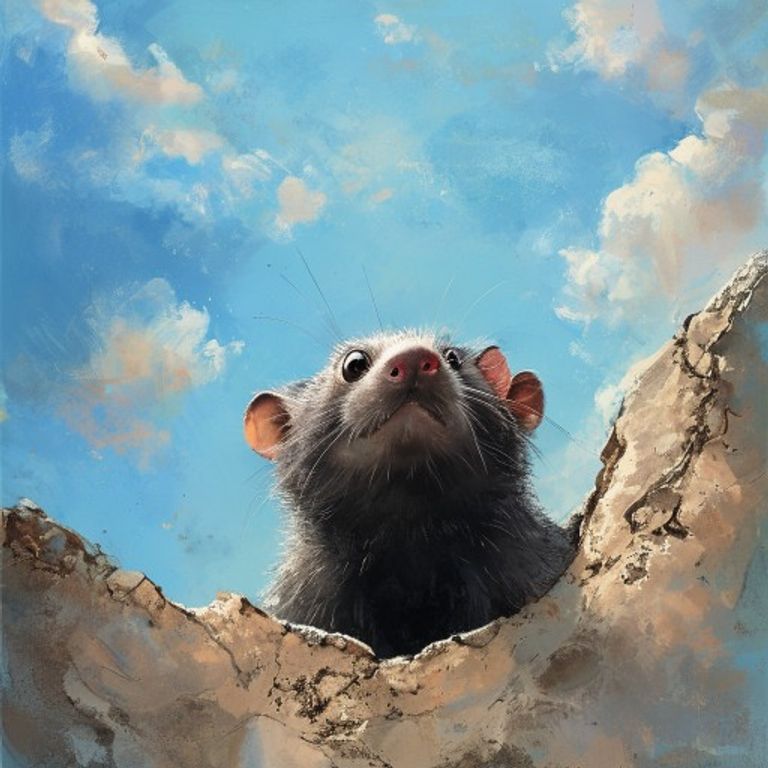
It was not earth his paw touched. It was air. Cool, moving, endless air. And there was something else. Something that made Digby's eyes, which had never seen anything but blackness, squeeze shut in shock. Light. Brilliant, overwhelming, impossibly vast light.
Digby poked his head through the hole.
And he saw the sky.
The World Above
It was too much. Too big. Too bright. Digby's eyes, designed for absolute darkness, could not process what they were seeing. He squeezed them shut, trembling, his heart hammering against his ribs. What was this? Where was the solid, comforting darkness? Where were the walls?
He forced his eyes open, just a crack. And slowly, very slowly, the world came into focus.
Blue. Endless blue. Not the blue of damp clay or the blue of deep minerals. A living, breathing blue that moved and shifted and went on forever. White shapes drifted across it—soft, slow, peaceful. Digby learned later that these were clouds, but in that first moment, he thought they were the spirits of old moles, wandering free above the earth.
Green. Everywhere, green. Not the green of moss or the green of certain roots. A thousand greens, layered and mixed and sparkling. Things that were not roots or stones or dirt rose from the ground in impossible shapes—thin, reaching, branching things that swayed in the moving air. Trees, he would learn. Grass. Flowers. The surface world.
And sound. Oh, the sound. Not the muffled thuds and whispers of the underground. Clear, sharp, endless sound. Birds calling. Wind sighing. Water running somewhere distant. The buzz of insects. The rustle of leaves. It was a symphony so rich and complex that Digby's ears, tuned only to the quiet dark, were overwhelmed with joy.
He climbed out, trembling, onto the softest thing he had ever felt. Grass. It bent under his paws, then sprang back up, tickling his belly. He walked forward, one step, then another, his nose twitching, his whiskers vibrating with the sheer impossibility of it all.
"Well," said a voice from above. "You're a funny-looking little fellow."
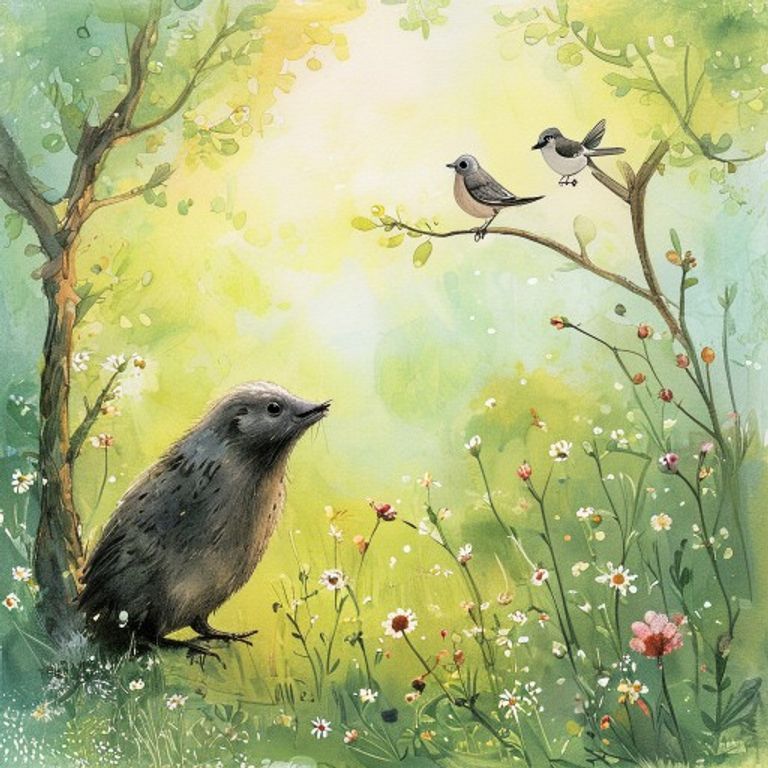
Digby jumped, ready to dive back into his hole. But the voice was kind, amused, not threatening. He looked up and saw a bird perched on a branch—a bird! A real, living, feathered creature!—staring at him with bright, curious eyes.
"I'm Digby," he said, his voice barely a whisper. "I came from... from down there." He pointed a paw at the hole.
The bird tilted its head. "Down there? You mean the ground? Goodness. I've never met anyone who came from inside the ground. What are you?"
"I'm a mole," Digby said. Then, because curiosity was stronger than fear, he asked: "What are you?"
"I'm a sparrow," the bird said. "And that"—it gestured with a wing at the vast blue—"is the sky. And that"—it gestured at the glowing orb that made Digby squint—"is the sun. And this"—it fluttered down to the grass beside him—"is the world. Welcome to it, little digger."
The Return
Digby spent the whole day above ground. The sparrow, whose name was Pip, showed him everything. The flowers that opened and closed with the sun. The ants marching in lines, carrying crumbs ten times their size. The brook that ran singing over stones. The butterflies that were not flowers but somehow flew. The spiderwebs that caught not prey but light, turning dewdrops into rainbows.
Every moment brought a new question. What is this? Why does it do that? How does it work? Pip answered what she could, laughed at what she couldn't, and together they explored a world that Digby had never known existed.
But as the sun began to sink—turning the sky into colors Digby had no names for, gold and pink and deep, deep purple—Digby felt a pull. The kingdom under the hill. His mother. His duties. The life he had left behind.
"I have to go back," he told Pip, his heart heavy. "They don't know. They don't know any of this exists."
"Will they believe you?" Pip asked gently.
Digby thought of Thud, of the elders, of the moles who had whispered about his "dirt-brain." "No," he said. "They won't. But I have to tell them anyway. Because curiosity isn't just about finding answers. It's about sharing them."
He asked Pip for three things. A seed from the tall tree, to show that things grew upward instead of just down. A feather, to show that creatures could fly. And a drop of water from the brook, to show that not all water came from underground springs.
Pip gave him all three. Digby held them carefully in his paws and climbed back down into his hole. The darkness embraced him like an old friend. But now, he knew, it was not the only friend he had.
The Council
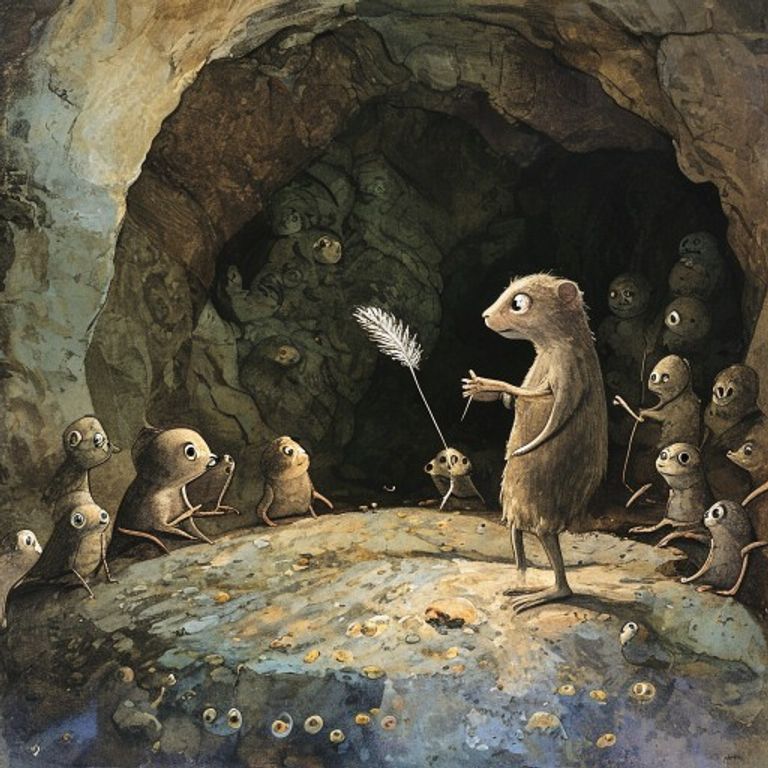
Digby called a meeting. Not a small meeting—a kingdom-wide gathering. Every mole, from the tiniest pup to the eldest elder, was required to attend. The Council Chamber, the largest space in the kingdom, had never been so full.
Thud stood at the back, arms crossed, scowling. "This better be important," he grumbled. "I was digging the Eastern Tunnel."
Digby stood on the Speaking Stone, his heart hammering. He held up the seed. "This," he said, "grows upward. Toward the light. It becomes something called a tree."
The moles murmured. Upward? Toward what?
He held up the feather. "This comes from a creature called a bird. It flies. In the air. Above the earth."
The murmuring grew louder. Above the earth? Impossible.
He held up the drop of water in a curled leaf. "This is from a brook. Water that runs over the ground, not under it. Water that sings as it moves."
The Council of Elders stepped forward. The oldest mole, Granite, who had lived for forty years and remembered the Great Cave-In, peered at the seed with milky eyes. "You have been above," he said. Not a question. A statement.
"Yes," Digby said. "And there is a world up there. A world of light and sound and color and creatures beyond counting. A world of questions I haven't even thought to ask yet."
Granite was silent for a long time. Then he said, "When I was young, I too felt the whisper. The vibration from above. I told myself it was nothing. I was afraid." He looked at Digby with ancient, sad eyes. "You are braver than I was, young mole."
Thud stepped forward, his face twisted with confusion. "But... but the elders said there was nothing up there."
"The elders," Granite said softly, "were wrong."
The chamber fell silent. Wrong? The elders? The idea was so shocking that no mole knew what to say.
Granite turned to Digby. "Tell us everything," he said. "Every detail. Every color. Every sound. We have lived in the dark so long, we have forgotten that darkness is not the only way to live."
And Digby told them. He told them about the sky, the sun, the clouds. He told them about birds and butterflies and flowers. He told them about the wind and the rain and the way the world smelled after a storm. He told them until his voice was hoarse and his heart was full.
And when he finished, the kingdom was changed forever.
The New Kingdom
The moles did not all rush to the surface. They were moles, after all. They loved the dark, the tunnels, the deep earth. But now, they knew. They knew that the world was larger than they had imagined. They knew that "up" was not a direction to fear, but a direction to wonder about.
Digby became the kingdom's Explorer. He made regular trips to the surface, each time bringing back new treasures. Seeds that grew into strange, sweet plants in the deeper chambers. Stories of the changing seasons. Warnings of floods and storms. Knowledge that helped the kingdom thrive in ways it never had before.
Thud, who had once mocked him, became his strongest supporter. Thud built the Upward Highway, a wide, safe tunnel that led from the kingdom to the surface, so that any mole who felt the whisper could follow it to the light. He could not understand Digby's curiosity—he was still a practical mole, deep in his bones—but he understood that Digby's questions had made the kingdom stronger.
And the young moles? The pups who grew up after Digby's discovery? They were different. They asked questions. They felt the whisper and followed it. Some became surface explorers like Digby. Others stayed below, but their tunnels were more clever, their kingdom more beautiful, because they had been inspired by the world above. They carved chambers in the shapes of flowers. They built echoing halls that mimicked the sound of wind. They created art from colored stones that Digby had described from the brook.
The Kingdom Under the Hill became the most famous mole kingdom in the world. Not because it was the biggest, or the deepest, or the richest in worms. But because it was the only kingdom that knew both the dark and the light. The only kingdom that looked up and asked, "What if?"
And Digby? Digby lived a long, long life. He made hundreds of trips to the surface. He learned the names of every bird, every flower, every star. He became friends with foxes and frogs and even a wise old owl who taught him the constellations.
But his favorite moment, the one he remembered most clearly on the last night of his life, was that first morning. The moment his paw broke through. The moment he saw the sky. The moment he realized that the world was not finished. That there were still blank spaces. That there were still questions waiting to be asked.
Because that, he knew, was what it meant to be alive.
The Moral of the Story: Curiosity is not a defect. It is not a phase. It is not something you outgrow. Curiosity is the voice inside you that says, "The world is bigger than I know." It is the force that pushes you to dig upward when everyone else is digging down. Digby was not strange because he asked questions. He was brave. He was alive. The moles who mocked him were not wrong to love the dark—they were wrong to believe the dark was all there was. The most dangerous thing in the world is not a wrong answer. It is the assumption that you already know everything. So ask. Wonder. Explore. Follow the whispers that others ignore. The world is not finished. It is waiting for your questions to fill in the blank spaces. And somewhere, above the dirt you think is the ceiling, there is a sky you have never imagined.