The Shell of Truth: A Story About Justice
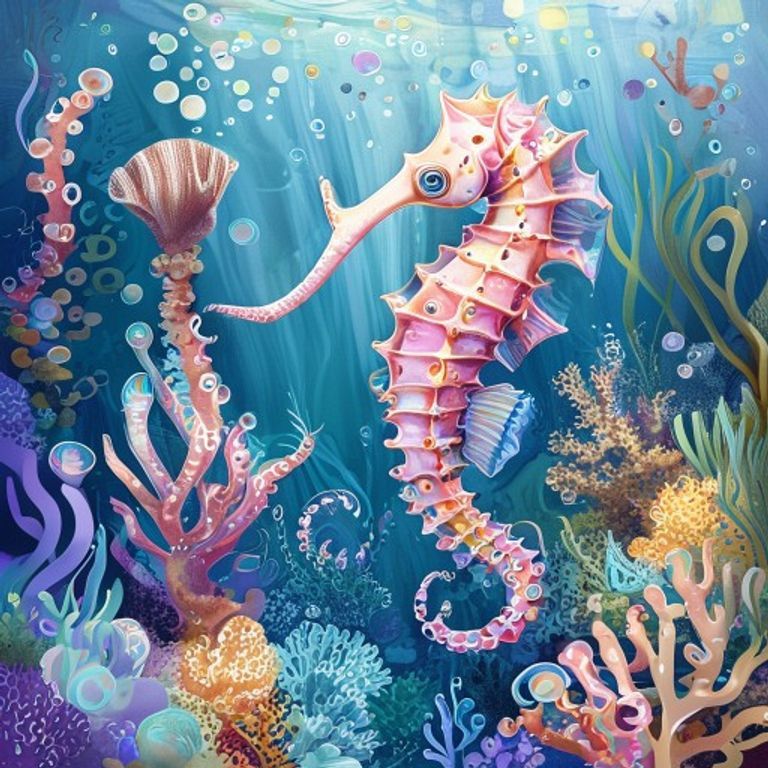
In the warm, sun-dappled waters of the Sapphire Reef, where corals bloomed in colors that had no names and fish swam in schools that painted the currents with silver and gold, there lived a young seahorse named Coral. She was no bigger than a human's thumb, with a body the color of ripe apricots and a tail that curled like a question mark. And she had a very important job: she was the Collector of the Reef.
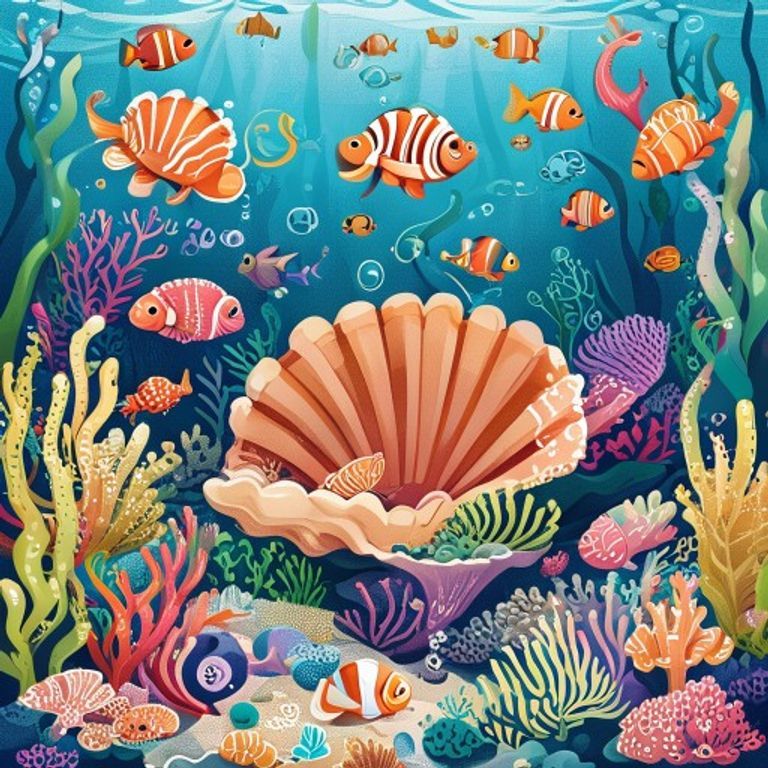
Every morning, while the anemones still yawned and the starfish stretched their arms, Coral swam through the reef gathering what the ocean left behind. A pearl that had worked loose from an oyster's grip. A shard of sea glass polished smooth by a thousand tides. A shell with a hole just perfect for a hermit crab's new home. Coral did not keep these treasures. She placed them in the Great Shell, a giant clam that sat at the heart of the reef, where any creature could come and take what they needed.
The Great Shell had kept the reef peaceful for as long as anyone could remember. When a young clownfish outgrew his anemone, he found a new one in the Shell. When a sea turtle's favorite grazing rock became too slippery with algae, she found a rougher stone in the Shell. When a dolphin's fin was scratched by coral, he found healing seaweed in the Shell. The reef worked because the creatures shared. They gave what they had, and they took what they needed.
At least, that was how it was supposed to work.
One morning, Coral arrived at the Great Shell and found something that made her tiny heart skip a beat. The Shell was empty. Every pearl, every stone, every strand of seaweed—gone. Not a single treasure remained.
Coral darted through the reef, her tail curling in panic. She found her friend Nimbus, a young cuttlefish who could change colors faster than thought.
"Nimbus!" Coral cried, her voice a tiny chirp in the water. "The Great Shell is empty! Someone has taken everything!"
Nimbus turned silver with shock, then red with anger. "Taken everything? But that is for everyone! Who would do such a thing?"
"I don't know," Coral said, her apricot body paling to a worried peach. "But we must find out. The reef depends on the Shell. Without it, creatures will stop sharing. They will hoard. They will fight. The reef will... break."
And she was right. Already, word was spreading. A group of damselfish were circling a clump of algae, snapping at any fish who came near. A crab had dragged a shell into a crevice and was standing guard with his claws raised. A moray eel who had always been gentle was now glaring at passersby, his body coiled around a cluster of rocks that had always belonged to everyone.
The reef was tearing apart.
The Accusation
Coral and Nimbus swam to the Cave of Echoes, where the oldest creature in the reef lived. Her name was Tendril, and she was an octopus so ancient that her skin had gone the soft, mottled grey of storm clouds. She had eight arms, each lined with suckers that could taste the ocean's memory, and one eye that had gone milky with age. But her other eye was sharp and clear, and it saw things that younger creatures missed.
"The Shell is empty," Coral told her, her voice trembling. "And the reef is turning cruel. We need justice, Tendril. We need to find who took the treasures and make them give them back."
Tendril was silent for a long moment, one arm gently stroking the cave wall. "Justice," she said slowly, her voice like bubbles rising through deep water. "You want justice. But tell me, little seahorse—what do you mean by justice?"
"I mean finding the thief and punishing them!" Nimbus said, flashing bright red. "Making them return what they stole!"
"Punishment," Tendril repeated. "Retrieval. These are parts of justice, yes. But they are not the whole. Come. Let us not decide who is guilty before we understand what happened. That is not justice. That is only anger wearing a mask."
She extended two arms, and Coral and Nimbus each took hold of a sucker—Coral on one arm, Nimbus on another. Tendril glided out of the cave, her body rippling like a banner in the current. She did not swim fast. She moved with the patience of deep water, feeling the reef's mood through her skin.
They passed the damselfish, still circling their algae. They passed the crab, still guarding his shell. They passed the moray eel, still coiled around his rocks. And as they passed, Tendril touched each of them with a trailing arm—not grabbing, just brushing. Feeling. Listening.
"They are afraid," Tendril said softly. "Not cruel. Afraid. The reef has always given them what they needed, and now they believe it has stopped. They are protecting what little they have because they think there will be no more."
"But someone did take everything from the Shell," Coral said. "That is not fear. That is theft."
"Perhaps," Tendril said. "Or perhaps it is something else. Let us look before we name it."
The Investigation
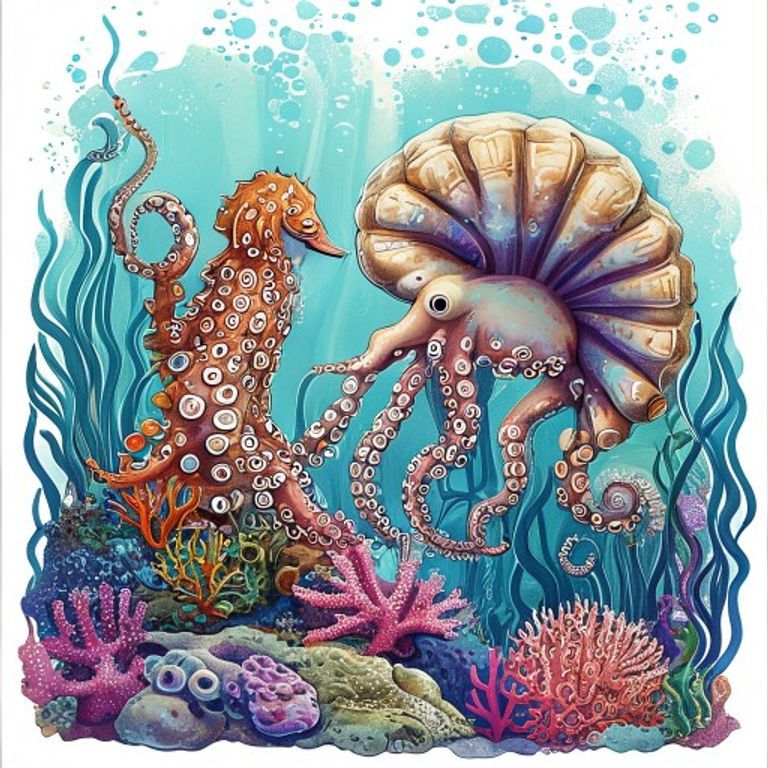
Tendril led them to the Great Shell. She wrapped one arm around its edge, her suckers tasting the water that had flowed through it. She closed her eyes—both the milky one and the clear one—and was still for so long that Coral thought she had fallen asleep.
Then Tendril spoke. "I taste worry. Deep worry. And I taste... love."
"Love?" Nimbus flickered confused purple. "Who steals out of love?"
"Many creatures," Tendril said. "A mother bird who steals food for her chicks. A wolf who takes territory for her pack. Love makes us do things we would not otherwise do. It is not an excuse. But it is a reason. And justice requires understanding reasons before it delivers judgment."
She turned to Coral. "You are the Collector. You know every creature who comes to the Shell. Who has visited most often in the past moon?"
Coral thought. "There is a young anglerfish named Deep," she said slowly. "He lives in the Midnight Trench, far below the reef. He cannot come often because the light hurts his eyes. But when he does come, he takes healing seaweed and smooth stones. He says they are for his mother. She is very old, and her scales have begun to fall off."
"Has he taken more than he needs?" Tendril asked.
"I... I don't know," Coral admitted. "I never counted. The Shell is for everyone. I thought counting would be unfair."
"Not counting can also be unfair," Tendril said gently. "When one creature takes so much that others have none, that is not sharing. That is taking. But let us not assume. Let us go to the Midnight Trench. Let us see."
The journey to the Midnight Trench was long and dark. The water grew cold. The light from above faded to a distant memory. Coral clung to Tendril's arm, her tiny heart beating fast, while Nimbus changed his skin to invisibility—matching the dark water so perfectly that only his eyes, like two floating moons, betrayed his presence.
At the bottom of the trench, they found a small cave. And in that cave, they found Deep.
He was a young anglerfish, barely older than Coral, with a bioluminescent lure that hung from his head like a tiny lantern. His mother lay beside him, an ancient anglerfish whose scales were indeed falling away, leaving patches of pale, vulnerable skin. Around them, arranged in careful piles, were the treasures from the Great Shell. Healing seaweed covered the mother's wounds. Smooth stones propped her body so she could rest without pain. Pearls reflected the light from Deep's lure, creating a soft, comforting glow.
Deep saw them and froze. His lure dimmed with fear. "I... I was going to bring them back," he whispered. "I only needed them for a little while. Until my mother was better. But she is not getting better. And I kept needing more. And I was ashamed to come back to the reef because I knew I was taking too much. So I took it all at once, thinking I would return what I didn't use. But she needs everything. She needs it all."
His voice broke. "I know I was wrong. But I didn't know what else to do."
The Truth
Coral felt anger and pity wrestling in her tiny chest. She looked at the mother anglerfish, so frail and sick. She looked at Deep, so young and desperate. And she looked at the piles of treasures—treasures that belonged to the entire reef, now hoarded in a dark cave for one creature's need.
"You should have asked," Coral said softly. "The reef would have helped. We help each other. That is why the Shell exists."
"I was afraid," Deep said, his lure flickering. "I was afraid you would say no. That you would tell me one creature cannot have so much. That you would judge my mother as too old to save."
"And now the reef is falling apart," Nimbus said, his color shifting to a stern blue. "Because you took everything, others have nothing. They are fighting. They are hoarding. The Great Shell was trust, Deep. And you broke it."
Tendril raised one arm, silencing them gently. "Justice is not a hammer," she said. "It is a scale. On one side, we weigh what was taken. On the other, we weigh why it was taken. And beneath the scale, we must ask: what will make the reef whole again?"
She turned to Deep. "You took what was not yours. That was wrong. You let fear guide your hands instead of trust. That was wrong. But your reason was love, and love is never wrong—only misplaced."
She turned to Coral and Nimbus. "And the reef has also been wrong. We created the Shell and called it sharing. But we did not create a way for creatures to ask for help. We did not make space for need. We assumed that if everyone took a little, there would always be enough. But what if someone needs more than a little? What then?"
Coral thought about this. She thought about all the times creatures had come to the Shell, taken what they needed, and left. She had never asked why. She had never wondered if someone needed more. She had simply collected and distributed, believing that equality was the same as fairness.
"Fair is not always equal," she said slowly, remembering something Tendril had once told her.
"No," Tendril agreed. "Fair is giving each creature what they need to thrive. Sometimes that means more for one and less for another. That is not unfair. That is justice."
The Restoration
They returned to the reef with Deep and his mother swimming slowly behind them, guided by Tendril's arms. The mother was too weak to swim fast, so they moved at her pace, resting on coral shelves, letting the current carry them where it could.
When they arrived at the Great Shell, the reef creatures had gathered. The damselfish, the crab, the moray eel, and dozens of others—angry, afraid, ready to accuse. They saw Deep and his mother, and the anger grew louder.
"The thief!" the crab shouted, waving his claws.
"Punish him!" a parrotfish cried.
"Banish him to the deep!" the moray eel hissed.
Tendril raised all eight arms, and her ancient presence commanded silence. "Justice is not punishment," she said, her voice carrying through the water like a tide. "Justice is repair. It is the act of making things right, not the act of making someone suffer."
She told them Deep's story. She told them about the sick mother. She told them about the fear. She told them about the love. And she told them something else—something that made every creature grow still.
"Deep took what was not his. But the reef also failed. We created a system of sharing without creating a system of caring. We made rules without making room. Deep's crime was taking too much. Our crime was not seeing that someone needed more."
The reef was silent. The damselfish stopped circling. The crab lowered his claws. The moray eel uncoiled.
"So what do we do?" Coral asked.
"We change," Tendril said. "Deep will return what he did not use. He will apologize for taking without asking. He will promise to ask in the future, even when asking is hard. And the reef... the reef will create something new. A second shell. A Care Shell, for those who need more than others. A place where need is not shameful, where asking is not weakness, where those who have little can receive without guilt and those who have much can give without resentment."
And so it was done. Deep returned the pearls and stones he had not used. He stood before the reef—small, frightened, but brave—and said he was sorry. He promised to ask next time. The reef creatures, one by one, came forward and touched him with their fins, their tentacles, their tails. Not in anger. In forgiveness.
The Care Shell was built beside the Great Shell. It was filled with the most precious treasures—healing seaweed, soft stones, comforting pearls. Any creature who needed more than their share could come, no questions asked, no shame, no judgment.
Deep's mother recovered. Slowly, over many moons, her scales grew back, and she swam again. Deep became the guardian of the Care Shell, the first to offer help and the last to judge those who needed it.
And Coral? She kept collecting. But now she asked questions. She noticed who came often, who took more, who looked ashamed. She told them about the Care Shell. She told them that needing more was not stealing. It was simply being alive.
The Lesson
Years later, when Coral was old and her apricot body had faded to a gentle gold, a young seahorse came to her with a question.
"Grandmother Coral," the little one said, "I heard the story of Deep and the Care Shell. But I don't understand. Deep stole. He did something wrong. Why wasn't he punished? Isn't that what justice means?"
Coral curled her tail around a strand of seaweed and smiled. "Justice is not a punishment, little one. Justice is a bridge. It connects what was broken to what can be whole again. Punishment breaks things further. Justice builds them back."
"But what about rules?" the young seahorse asked. "Don't rules matter?"
"Rules matter," Coral agreed. "But rules are meant to help, not to harm. When a rule makes someone suffer without helping anyone else, that rule is not just. When a rule is followed blindly while need goes unanswered, that rule is not just. True justice asks: does this help everyone be their best? Does this make the reef stronger? Does this create trust, or destroy it?"
She paused, watching a school of silver fish dance past in the current. "Deep broke a rule. But behind his rule-breaking was a need that the reef had not made room for. Justice said: the rule-breaking must stop. But justice also said: the need must be met. So we did both. We restored what was taken. And we built what was missing. That is justice. Not punishment. Repair."
The young seahorse thought about this, his tiny body bobbing in the water. "So justice is... complicated?"
Coral laughed, a sound like bubbles rising. "Justice is very complicated. It requires us to be angry when something is wrong, but compassionate when we learn why. It requires us to hold people accountable, but also to hold ourselves accountable for the systems we create. It requires us to see the thief and the victim, the rule and the need, the broken trust and the love that broke it."
She looked out at the reef, at the Great Shell and the Care Shell sitting side by side, at the creatures swimming peacefully between them. "Justice is not easy, little one. It is not a simple answer. It is a question we must keep asking: how do we make things right? And the answer changes, every time, because every story is different. But if we keep asking, if we keep listening, if we keep building bridges instead of walls... then we are doing justice."
The Moral of the Story: Justice is not about punishment. It is about understanding, repair, and creating systems that serve everyone's needs. Deep took what was not his, and that was wrong. But the reef had also failed by not making room for those who needed more. True justice required both accountability and compassion—making Deep return what he could and apologize, while also building the Care Shell so that need would never again have to steal. Fairness is not always equality. Sometimes fairness means giving more to those who need more. Justice requires the courage to look past anger and ask: what happened here? Why did it happen? And how do we make sure it doesn't happen again—not through fear, but through care? The strongest communities are not those with the strictest rules, but those with the most generous hearts. Rules without compassion become walls. Compassion without accountability becomes chaos. Justice is the balance between them. It is the wisdom to know when to hold firm and when to bend. It is the strength to forgive while also demanding change. And it is the love that builds bridges where walls once stood.