The Wind Who Loved a Seed: A Story About Love
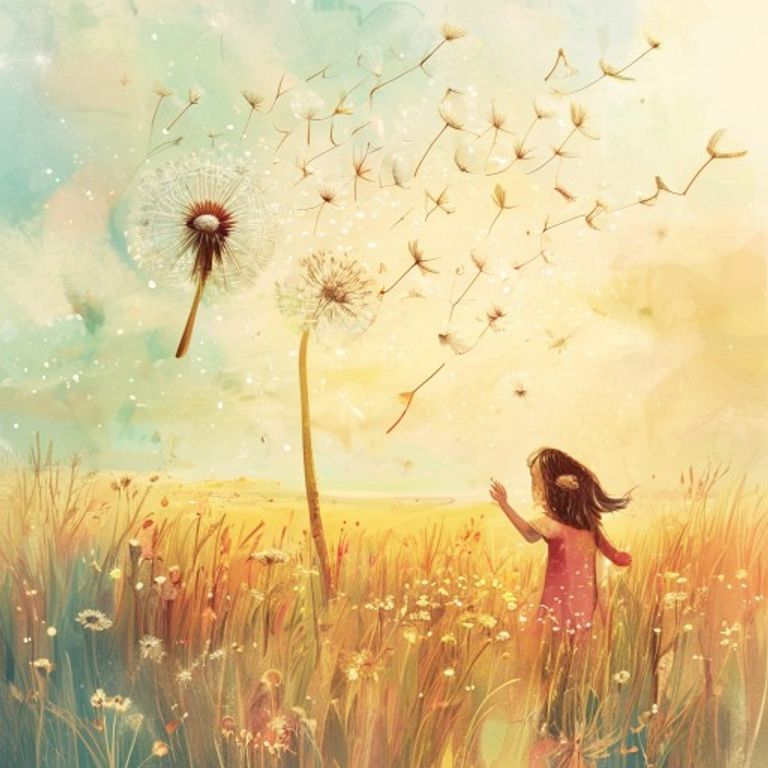
In the Golden Meadow, where the grass grew as tall as a rabbit's ears and the sun painted everything the color of warm honey, there lived a young dandelion seed named Wisp. She was the last one. All her brothers and sisters—hundreds of them, each fluffier and whiter than the last—had already flown away on the wind, dancing into the sky like tiny parachutes, off to find new hills and new valleys where they might grow.
But Wisp stayed. She clung to her mother, the Old Dandelion, with a determination that surprised them both.
"Wisp," Mother Dandelion said one morning, her voice creaky and kind. "Why do you not fly? The wind is gentle. The sky is clear. This is a perfect day to begin your journey."
Wisp shivered, though the air was warm. "I am afraid," she whispered. "Sister Fluff told me that seeds who fly west drown in the Great River. Brother Puff said that seeds who fly south burn in the Desert of Endless Sand. And Cousin Whisper... she said that birds eat seeds like us for breakfast."
Mother Dandelion sighed—a soft, rustling sound, like dry leaves falling. "Some seeds do drown," she admitted. "Some do burn. Some are eaten. That is the truth of being a seed. But most seeds, Wisp. Most seeds find soil. Most seeds find rain. Most seeds grow into flowers that make new seeds, and those seeds fly again, and the world keeps turning."
"But what if I am not most seeds?" Wisp asked. "What if I am the one who drowns?"
Mother Dandelion had no answer for that. She simply swayed in the breeze, holding Wisp close, and together they watched the sun travel across the sky.
It was on the third day of Wisp's refusal that the wind came.
The Old Wind
He was not a young wind. Young winds rush and tumble, knocking over buckets and blowing hats off heads and racing through cornfields until the corn bends in every direction at once. This wind was old. He moved slowly, carefully, like a grandfather climbing stairs. He had traveled around the world so many times that he had lost count, and he carried with him the scent of salt from distant seas, the chill of snow from mountain peaks, the warmth of deserts at noon, and the smell of rainforests so green they hurt to imagine.
His name was Zephyr.
Zephyr circled the Golden Meadow three times before he noticed Wisp. He stopped—well, as much as a wind can stop—and hovered around her, his ancient breath ruffling her fluff.
"Hello, little one," he said. His voice was the sound of waves on a shore far away. "Why do you cling so tightly? The world is wide. The soil is waiting. Do you not wish to grow?"
Wisp trembled. "I am afraid."
"Ah," Zephyr said. "Fear. I know fear. I have carried seeds who were afraid for a thousand years. Fear is not your enemy, little Wisp. Fear is simply the part of you that loves being safe. And love of safety is not a bad thing. But it is not the only love."
"What other love is there?" Wisp asked.
Zephyr was silent for a moment. Then he said, "The love of becoming. The love of the unknown. The love of trusting that the world will hold you, even when you cannot see how."
Wisp thought about this. "Are you going to blow me away?" she asked, a little frightened. "Young winds do that. They grab seeds and throw them and laugh while the seeds tumble through the air, terrified."
"I am not a young wind," Zephyr said, and there was something sad and beautiful in his voice. "I do not grab. I carry. And I only carry those who ask."
He circled her once more, gently, and then began to drift away. "I will come back tomorrow," he said. "And the day after. And the day after that. I have time, little Wisp. I am very old, and I have learned that the best gifts are the ones that are not forced. When you are ready—if you are ever ready—I will be here."
The Stories
True to his word, Zephyr returned every day. He did not push. He did not demand. He simply sat with Wisp and Mother Dandelion, and he told stories.
He told her about the Mountains of Mourning, where the clouds wept every afternoon, and the tears ran down the rocks and made waterfalls so tall that seeds who fell into them thought they were flying forever. "Those seeds," Zephyr said, "they landed in the Valley of Forever Flowers, where the soil is black and rich and the bees sing lullabies. They grew into dandelions so tall that rabbits used them as umbrellas."
He told her about the City of Wishes, where children ran through parks with cheeks puffed out, blowing dandelion seeds into the air and laughing as they danced. "Those seeds," Zephyr said, "they traveled on the breath of wishes. Some landed in garden boxes. Some landed in gutters. But one—one landed in a window box where an old woman with gray hair and soft hands tended it every morning. That dandelion lived in a clay pot and watched the city wake up every day, and the old woman called it her Sunshine Friend."
He told her about the Sea of Stories, where the water was so clear you could see fish the color of rainbows, and the islands were made of white sand. "A seed I carried long ago," Zephyr said, "she landed on one of those islands. She was the first dandelion ever to grow there. The crabs did not know what she was. The seagulls tried to eat her, then decided she was too bitter. But a little girl, walking with her father, saw the yellow flower and said, 'Look, Papa! A piece of home!' And she smiled, and her father smiled, and the seed knew—she knew—that being somewhere new was not the same as being lost."
Wisp listened to these stories, and slowly, something began to change inside her. The fear did not disappear. But it made room for something else. Something that felt like a small light, flickering in her seed-heart.
It was not courage, exactly. It was... curiosity. And curiosity, she realized, was a kind of love. The love of wondering what came next.
The Journey
On the seventh day, Wisp said, "I am ready."
Zephyr did not cheer. He did not rush. He simply wrapped himself around her, soft as a grandmother's shawl, and lifted her gently from Mother Dandelion's head.
"Goodbye, my little one," Mother Dandelion whispered. "Grow well. Grow tall. Grow into whatever you are meant to be."
"I will try," Wisp said. And then she was in the air, and the ground was falling away, and the sky was opening above her like a door she had not known was there.
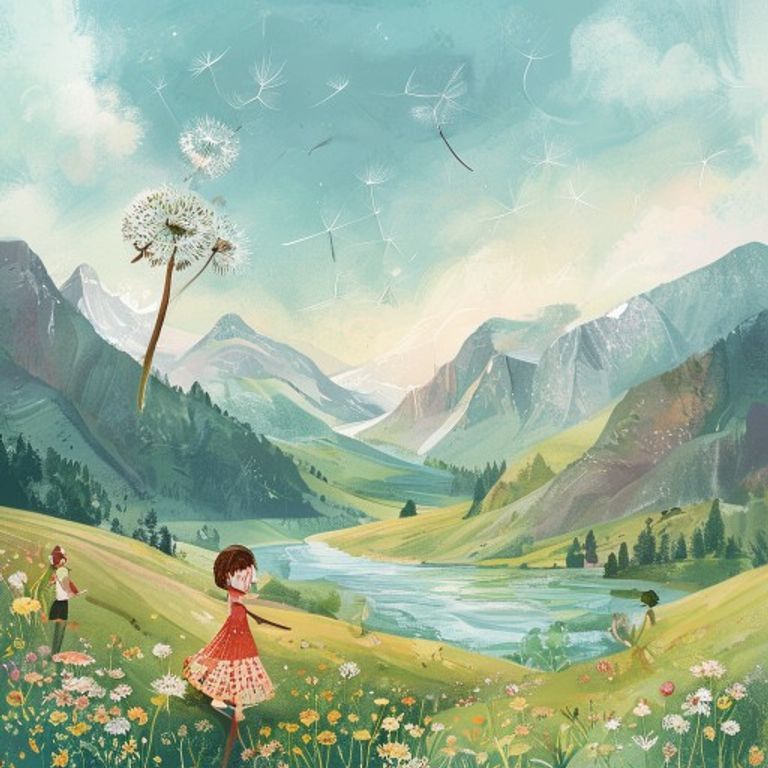
The journey was everything Zephyr had promised and more. They flew over the Golden Meadow, and Wisp saw it from above for the first time—saw how the grass made patterns like a quilt, saw the tiny streams that cut through it like silver thread, saw the shadows of clouds drifting across it like great soft animals. They flew over the Whispering Woods, where the trees bent and swayed and seemed to wave at her. They flew over the River of Many Colors, which was not one river but many, braiding together like the strands of a story.
Wisp was not afraid. Not completely. The fear was still there, a small cold knot in her center. But around it was wonder. Around it was joy. Around it was the feeling of being held by something ancient and kind.
"Zephyr?" she asked, as they soared over a valley of wildflowers.
"Yes, little one?"
"Why do you carry seeds? You are a wind. You could go anywhere, do anything. Why spend your time with small, frightened things like me?"
Zephyr was quiet for a long moment. They passed over a mountain range, and the air grew thin and cold. Wisp shivered, and Zephyr warmed her, wrapping himself tighter.
"I carry seeds," he said finally, "because long ago, when I was a young wind, a seed carried me."
Wisp did not understand. "A seed carried you? But seeds cannot carry winds."
"This one did," Zephyr said, and his voice was so soft that Wisp almost did not hear it over the rush of the air. "I was a wild wind then. I knocked down trees. I blew off roofs. I was strong, and I thought strength was the only thing that mattered. And then one day, I blew through the Golden Meadow, and I saw a dandelion. She was old, her seeds all gone, her stem brown and brittle. She should have been frightened of me. I could have snapped her in half without trying. But she did not bend away. She leaned into me. She let me blow through her leaves, and she rustled a song so gentle, so trusting, that I... I stopped."
He paused. They were over the sea now, and the water below was the color of sapphires and emeralds mixed together.
"That dandelion taught me," Zephyr continued, "that strength without gentleness is just destruction. And gentleness is a kind of love. She leaned into me, and she trusted me, and she showed me that I could be more than a storm. I could be a carrier. I could be a guide. I could be... gentle."
"What happened to her?" Wisp asked.
"She died," Zephyr said. "That winter. But she changed me. I have carried ten thousand seeds since then. And every seed I carry, I carry for her. Because love does not end when the body ends. Love continues in the acts it teaches us. She loved me by trusting me. And I love her by trusting others."
The Island
They flew for three days and three nights. Zephyr showed her the world—the great cities with their towers of glass, the tiny villages with their smoke curling from chimneys, the forests that stretched so far they seemed to have no end, the deserts where the sand sang when the wind blew across it.
And then, on the morning of the fourth day, Wisp saw something that made her seed-heart beat faster.
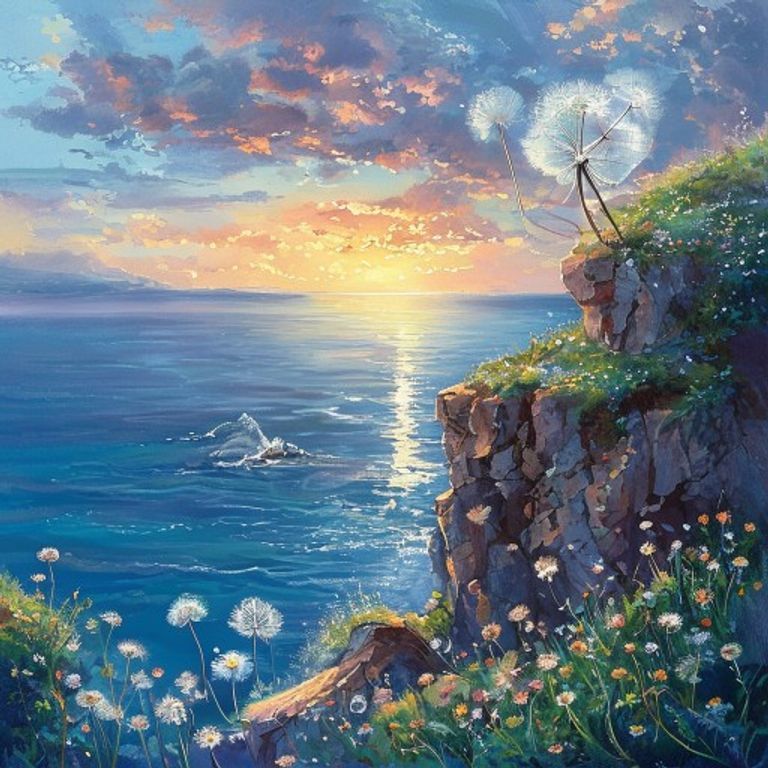
It was an island. A small island, alone in a wide blue sea. It was made of gray rock and white sand, and on one side, a cliff rose up, sharp and proud, like a finger pointing at the sky. There was no soil that Wisp could see. No trees. No flowers. Just rock and sand and the endless sound of waves.
But something about it called to her.
"Zephyr," she said. "I want to go there."
Zephyr paused. He hovered over the island, feeling its shape with his ancient senses. "It is hard there," he said. "The soil is thin. The salt wind is strong. The sun is fierce. Seeds who land there... most do not grow."
"But if I grow there," Wisp said, "I will be the first. The very first dandelion on that island. And someday, when other seeds pass by, they will see me, and they will know it is possible. They will know that even a hard place can become home."
Zephyr was silent. Then he said, "You are sure?"
"I am sure," Wisp said. And she was. The fear was still there. But now it was a small thing, a tiny shadow, and the light inside her was so much brighter.
Zephyr descended. He placed her gently in a crack of the cliff where a little soil had gathered, where rainwater pooled, where the sun reached but did not burn. He tucked her in, patting the earth around her with soft gusts of his breath.
"I will stay tonight," he said. "The first night is the hardest."
And he did. He wrapped himself around the cliff, shielding her from the salt wind, warming her when the air grew cold, singing her old wind-songs that his mother-wind had sung to him when he was young.
In the morning, he had to go. "I have other seeds to carry," he said. "Other frightened little ones who need stories."
"Will you come back?" Wisp asked. She tried not to sound small. She tried not to sound afraid.
"I will come back," Zephyr promised. "I am old, little Wisp. I have seen many seeds grow and many seeds fade. But the ones who matter... I return to them. I check on them. I bring them rain from distant storms, and news from far meadows, and the smell of places they cannot yet go. I will come back."
And he left. The sky was empty where he had been. Wisp was alone on her cliff, in her crack, with only the sound of the sea and the cry of the gulls.
But she was not lonely. Because love had brought her here. And love, she was learning, does not disappear when the one who loves you goes away. It stays. It becomes part of the soil. It becomes part of you.
The Return
Wisp grew. It was hard. The soil was thin, and she had to stretch her roots deep into the rock to find water. The salt wind burned her leaves, and she learned to grow small and tough instead of tall and soft. The sun was fierce, and she learned to open her petals only in the morning, when the light was gentle.
But she grew. She became a dandelion—not the biggest, not the prettiest, but the strongest. The first dandelion on the island. The one who proved it could be done.
And one spring morning, years later, she woke to find a soft breeze wrapping around her stem. A familiar breeze. A breeze that smelled of honey and distant meadows and a thousand stories.
"Zephyr," she said, and her voice was deeper now, fuller. She was not a seed anymore. She was a flower. A mother. She had seeds of her own, a full white head of them, ready to fly.
"Little Wisp," Zephyr said, and his voice was older, wearier. He had carried ten thousand more seeds since he last saw her. He had been to the top of the world and the bottom. He was tired. "You grew."
"You came back," Wisp said.
"I promised."
"I know. But I did not know if you would remember."
Zephyr laughed—a sound like leaves tumbling down a hill. "I remember every seed I have ever carried. How could I forget the one who chose an island?"
He stayed that day. He met her seeds—tiny, frightened, wonderful little things, each one clutching her stem, each one whispering questions about the world. And Wisp told them stories. Stories of the Golden Meadow. Stories of the River of Many Colors. Stories of cities and forests and mountains. Stories that Zephyr had told her, long ago, when she was small and afraid.
And then, one by one, her seeds let go. Zephyr caught them. He wrapped them in his ancient breath, and he carried them away—to new hills, new valleys, new places where dandelions had never grown. He carried them with the same gentleness he had shown Wisp. The same patience. The same love.
And as he flew away with the last seed, he called back to Wisp: "I will return."
"I know," Wisp called back. And she did know. Because that was what love did. It returned. Again and again, as long as there were seeds to carry and flowers to grow and stories to tell.
The Lesson
Many years passed. Wisp grew old. Her stem turned brown. Her leaves grew thin. But every spring, Zephyr returned. He brought her rain. He brought her stories. He brought her the smell of the Golden Meadow, which had never stopped being her home, even though she had made a new home here, on this hard, beautiful island.
And one day, when Wisp was very old indeed, a young seed asked her a question.
"Grandmother Wisp," the seed said, clinging to Wisp's white head. "The old wind who carries us... why does he do it? Why does he spend his life carrying small, frightened seeds to places we might not survive?"
Wisp smiled. She was so old now that her smile was just a gentle rustling of her remaining leaves.
"Because," she said, "long ago, when Zephyr was young and wild and did not know his own strength, a dandelion trusted him. She leaned into him. She showed him that he could be gentle. And he has spent every day since then proving that she was right."
"But that dandelion is gone," the young seed said. "She died."
"Yes," Wisp said. "But love does not end when the body ends. Love continues in the acts it teaches us. She loved Zephyr by trusting him. Zephyr loves her by trusting others. And now... now I love Zephyr by trusting him with you. And someday, if you grow, and if you have seeds of your own, you will love him by trusting him with them. And so it goes. Love is not a single act. It is a chain. It is a story that never ends. It is a seed that becomes a flower that becomes a seed that becomes a flower, on and on, forever, as long as there are winds to carry and soil to grow and hearts to trust."
The young seed thought about this. "Is that why you chose this island?" he asked. "Because it was hard?"
"I chose this island," Wisp said, "because I wanted to prove that love could grow anywhere. Even in rock. Even in salt. Even in loneliness. Love is not about easy places. Love is about making hard places into homes."
She looked out at the sea, where the waves rolled in and rolled out, as they had for a million years, as they would for a million more.
"Love is the wind that carries you when you are afraid. Love is the soil that holds you when you are alone. Love is the sun that warms you when you are cold. Love is the rain that feeds you when you are thirsty. Love is the story that someone tells you, again and again, until you are brave enough to fly. And love is the promise to return, not because you have to, but because you want to. Because somewhere, in a crack of rock on a lonely island, there is a dandelion who matters to you. And that is enough. That is everything."
And so the young seed let go. And Zephyr, old and tired but never too tired for this, caught him gently, and carried him away, and told him stories of his grandmother, the first dandelion on the island, who had been brave enough to love a hard place into home.
The Moral of the Story: Love is not about holding on. Love is about carrying someone to where they need to be, even when it means letting them go. It is about returning, again and again, to see how they have grown. It is about telling stories that make the afraid brave, and being gentle when the world is hard, and trusting that even a crack in a rock can become a home. Love does not require easy places. It creates them. It is the wind that carries, the soil that holds, the sun that warms, the rain that feeds, and the voice that says, "I will come back." Love is a chain that stretches across time and distance, connecting every seed to every flower, every wind to every dandelion, every story to every heart that hears it. It is the first note and the last echo. It is the reason the world keeps growing. And it never, ever ends.