The Mushroom Who Fed the Forest: A Story About Responsibility
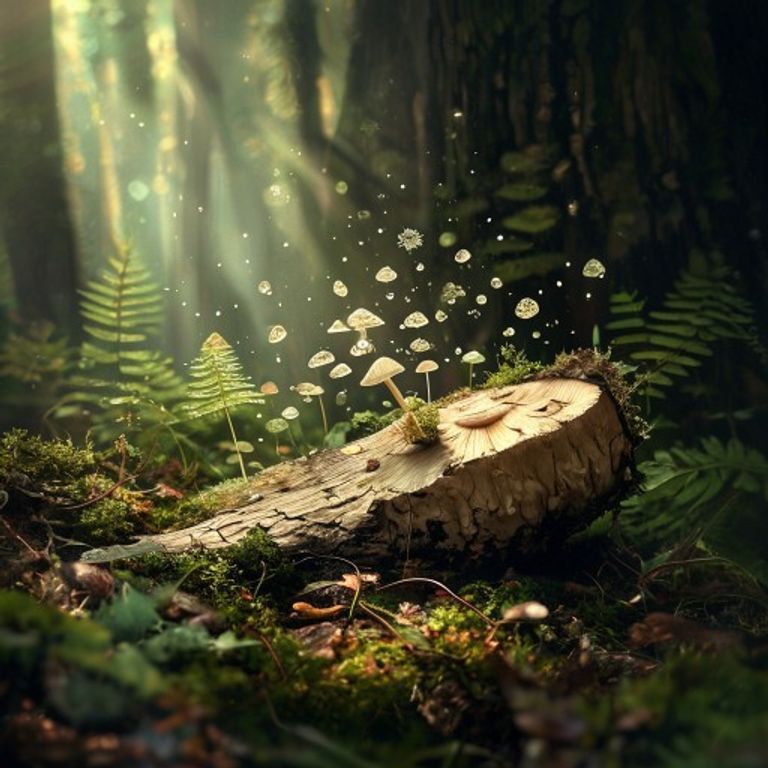
Deep beneath the ancient oak, where the soil was the color of dark chocolate and smelled of rain and secrets, there grew a tiny mushroom. Her cap was the palest cream, no bigger than a dewdrop, and her stem was slender as a thread of spider silk. She had no voice. She had no wings. She had no paws to dig with, no claws to climb with, no bright colors to catch the eye of passing butterflies.
But she had a job.
And that job was everything.
The Mushroom with a Promise
Her name was Mycel, though no one had ever called her by it. The forest creatures ran past her on their busy errands. The squirrels chattered about acorn stashes. The robins sang of worms and sunshine. The deer stepped over her without a glance, their hooves thumping the earth like gentle drums. Even the ants, who noticed almost everything, marched around her in their long columns, too focused on their own work to see hers.
Mycel did not mind. She had been born with a purpose, and that purpose was clear.
She was responsible for the fallen log.
It was an enormous log — the trunk of an oak that had stood for three hundred years before lightning struck it one summer night. It had fallen with a sound like thunder, crushing ferns and cracking stones, and now it lay across the forest floor like a sleeping giant. Its bark was rough and silver-gray. Its heartwood was hard as stone. Its branches, still tangled with dried leaves, stretched across the ground like the arms of a giant who had given up reaching for the sky.
And Mycel, barely the size of a penny, was responsible for turning that giant into soil.
It seemed impossible. It was impossible, by any measure that the forest creatures would understand. How could something so small break down something so large? How could something so quiet and still transform something so heavy and dead into something soft and alive?
But Mycel had something the forest creatures did not have.
She had patience. She had persistence. And she had roots — not the kind that trees have, reaching deep into the earth, but threads, thousands of them, thinner than hair, spreading through the log's bark like a silver web no eye could see. These threads were her mycelium, and they were the secret of her work. They did not tear or chop or break. They dissolved. They transformed. They turned wood into earth, one molecule at a time, one day at a time, one breath at a time.
And so Mycel began.
The Work No One Saw
The first week was the hardest.
Mycel spread her threads through a patch of bark no bigger than a squirrel's ear. It took all her strength. The bark was tough, weathered by decades of sun and rain and wind. It fought her. It resisted. She had to push her threads into every crack, every pore, every tiny gap where moisture had softened the wood just enough for her to slip inside.
When she finished that first patch, she rested. Her cap drooped. Her stem trembled. She looked at the log — still enormous, still solid, still a giant — and felt smaller than she ever had before.
"You will never finish," whispered a voice.
Mycel startled. The voice had come from nowhere and everywhere, from the soil itself, from the air between the roots, from the spaces where the earth held its breath.
"Who... who are you?" Mycel asked, though mushrooms do not truly speak with words. She sent her question through the mycelial network, the underground web that connected every mushroom in the forest, the invisible internet of the earth.
"I am Old Morel," the voice answered. "I have been breaking down logs since before your great-great-great-great-grandmother was a spore. I have turned giants into gardens. I have fed forests that no longer exist. And I am here to tell you that you are right."
"Right about what?" Mycel asked.
"You will never finish," Old Morel said. "Not if you try to do it all at once. Not if you try to do it alone. Not if you try to be seen and praised for every speck of soil you create."
Mycel felt her cap droop further. "Then what is the point?"
Old Morel's voice softened, like rain on moss. "The point, little one, is not to finish. The point is to begin. And then to begin again. And again. And again. The point is to show up, every day, whether the sun shines or the rain falls, whether anyone notices or no one notices, whether you feel strong or you feel small. Responsibility is not a destination, Mycel. It is a direction."
Mycel let those words sink into her threads, into her cap, into the part of her that was more soul than stem. "But why?" she finally asked. "Why me? Why this log? Why something so big when I am so small?"
"Because," Old Morel said, "someone must. And you are here."
The Seasons of Silence
And so Mycel worked.
Through the hot days of late summer, when the forest floor baked and her threads dried and she had to wait for evening dew to soften the bark again. Through the golden days of autumn, when leaves fell like confetti and covered her in red and orange and gold, burying her in beauty she could not see. Through the cold days of winter, when frost crept into her threads and slowed them to a barely perceptible pulse, when snow covered the log and she worked in darkness, in silence, in the frozen hush of the sleeping forest.
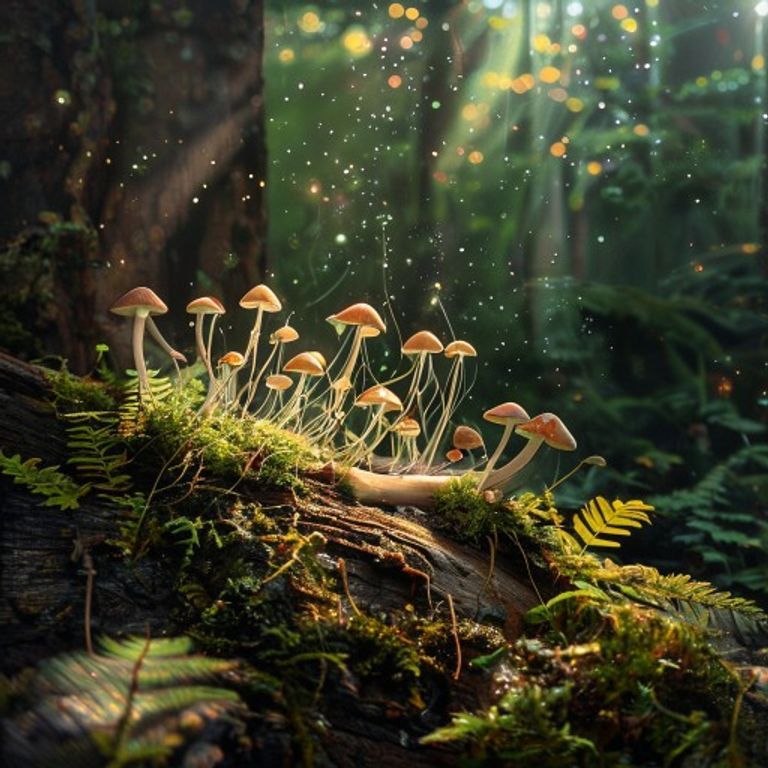
She was not alone, though she felt alone. Other mushrooms worked other parts of the log — button caps and puffballs, ink caps and chanterelles, each with their own threads, their own patches, their own invisible labor. They did not speak. They did not gather. They simply worked, side by side, connected by the underground web that held them all together.
And slowly — so slowly that no eye could measure it, so slowly that the forest creatures never noticed — the log began to change.
Its bark grew softer. Its heartwood grew porous. Where Mycel's threads had passed, the wood turned the color of cinnamon, then the color of sand, then the color of the rich dark earth itself. Tiny creatures — beetles and worms and springtails — moved into the softened wood, breaking it into smaller pieces, mixing it with the soil, creating the living soup from which new life would grow.
And Mycel, though she was still small, though her cap was still pale, though she was still invisible to the running squirrels and the singing robins and the stepping deer — grew something inside herself that was larger than any log.
She grew pride. Not the loud, boasting pride of creatures who want to be seen. But the quiet, burning pride of someone who knows they are doing what they were born to do. The pride of showing up. The pride of beginning again. The pride of being part of something so much larger than herself that she could not see its edges, but she could feel its heart.
And that pride was enough to carry her through the days when she felt invisible, the nights when she felt forgotten, the storms when rain pounded her cap and wind tore at her threads and she clung to the log with every fiber of her being, whispering to herself: I am here. I am working. I am doing what needs to be done.
The Spring That Remembered
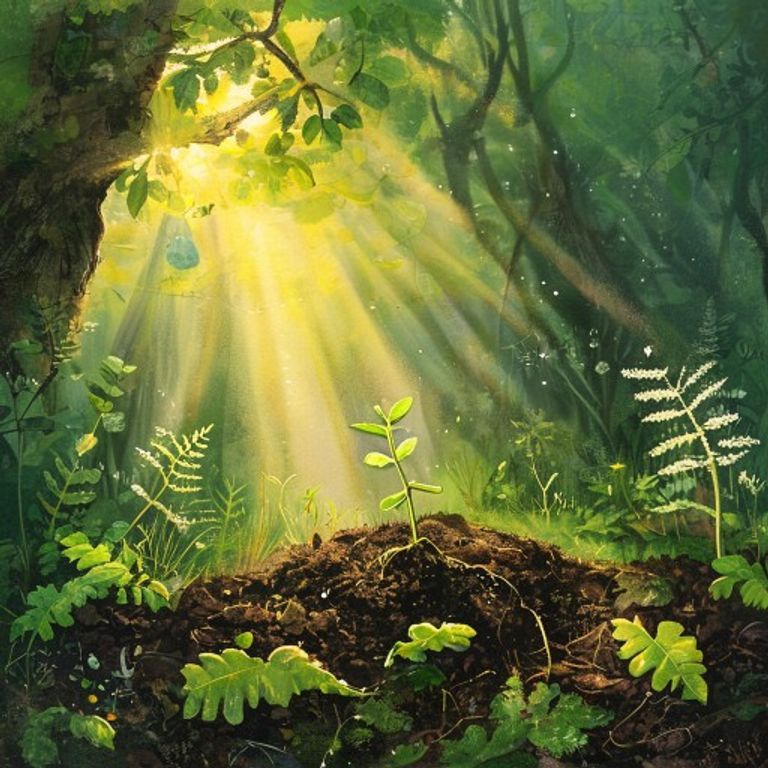
It happened on a morning in early spring, when the air smelled of thawing earth and newborn grass and the first brave flowers were pushing their heads through the soil.
A squirrel — not one of the busy ones who had run past Mycel all those months, but a young one, curious and unhurried — stopped beside the log. She sniffed the ground. She dug a little hole. And she dropped an acorn into the soft earth where Mycel's threads had turned wood into soil.
The acorn settled into the earth like a child into a bed, and Mycel felt it. She felt its weight, its warmth, its potential. She sent her threads to wrap around it — not to break it down, but to protect it, to hold it, to feed it with the nutrients her work had created.
And then, a week later, the acorn cracked.
A tiny root pushed into the soil — into Mycel's soil, the soil she had made from the log, the soil she had created one thread at a time, one day at a time, one season at a time. The root drank from the earth. It grew. It thickened. And then, with a sound so soft it was more feeling than hearing, a shoot pushed upward through the surface.
It was the smallest green thing Mycel had ever seen. Two leaves, no bigger than her own cap, trembling in the spring breeze, catching the sunlight and turning it into something that made Mycel's threads pulse with a feeling she had no name for.
Joy? Pride? Love?
All three, perhaps. Or something older than all three. Something that lived in the space between breaking down and building up. Something that lived in the cycle itself.
Old Morel spoke to her through the mycelial web, his voice weaker than it had been, his threads thinner, his work nearing its end. "Do you see, little one?"
"I see," Mycel answered.
"That seedling will grow into a tree. That tree will shelter birds. Those birds will drop seeds that become more trees. Those trees will feed more mushrooms. And those mushrooms will break down more logs. And on and on, forever."
"Because of me?" Mycel asked, her voice small.
"Because of you," Old Morel confirmed. "And because of me. And because of every mushroom who ever worked in silence. We are not the glory of the forest, Mycel. We are its foundation. The roots cannot grow without the soil. The soil cannot exist without us. And we cannot exist without the responsibility to do what we were born to do."
The Gift of Being Unseen
By midsummer, the seedling was no longer a seedling. It was a sapling, its trunk as thick as a rabbit's ear, its leaves broad and green and hungry for the sun. The spot where it grew was the lushest, greenest patch on the forest floor. Ferns crowded around it. Wildflowers bloomed in its shade. Beetles marched through its roots. A spider had built a web between two of its lowest branches, and every morning it caught the dew and turned it into diamonds.
And no one knew why.
The squirrels did not know that the soil beneath that sapling had once been the heartwood of a three-hundred-year-old oak, broken down by a mushroom no bigger than a dewdrop. The birds did not know that their songs were powered, in part, by nutrients that had passed through Mycel's threads. The deer did not know that the grass they grazed had grown from earth that Mycel had created.
And Mycel did not mind.
Because she knew. And that was enough.
She was older now, her cap brown at the edges, her threads slowing. She had given everything she had to the log, to the soil, to the seedling, to the future. And as autumn returned and the air grew crisp with change, Mycel felt herself begin to change too.
Her cap softened. Her stem grew hollow. Her threads, which had once reached through half the log, now pulled back, gathering themselves into a single spore — one tiny, perfect, microscopic promise that would ride the wind to a new log, a new responsibility, a new beginning.
She did not fear this ending. She had learned from Old Morel that endings were not endings at all. They were transformations. They were the moment when one responsibility passed to the next hand, when one promise became another, when one invisible worker made room for the next.
And as her spore released and her body returned to the soil she had created, Mycel felt something she had not felt when she began.
She felt complete.
Not because she had finished the log — she had not. Other mushrooms would finish it. Not because she had been praised — no one had praised her. Not because she had been remembered — no one would remember her name.
But because she had kept her promise. Because she had shown up. Because she had done what needed to be done, one thread at a time, one day at a time, one season at a time, whether anyone saw her or not.
And because, in the space between breaking down and building up, she had learned the truest truth about responsibility:
The Moral of the Story: Responsibility is not about being noticed. It is not about being praised. It is not about finishing something grand and glorious and having the whole forest applaud. Responsibility is about doing what needs to be done, even when no one is watching. It is about showing up, day after day, even when you feel small and invisible and forgotten. It is about being part of something larger than yourself — a cycle, a system, a future you will not live to see. The most important work is often the quietest. The most important work is often invisible. But the forest remembers. And the future grows from what you did when no one was looking. When you take responsibility — not because someone told you to, not because you will be rewarded, but because it is the right thing to do — you become the foundation of everything that comes after you. You become the soil from which the future grows. You become, in your own small, quiet, invisible way, the reason the forest survives. And that is the greatest honor of all. Not to be seen. But to be necessary.