The Orchestra of One Thousand Voices: A Story About Diversity
In the heart of the ancient Oakwood Forest, where the trees grew so tall their branches pierced the clouds and their roots tangled together like an old friend's hands, there was a place called the Acorn Amphitheater. It was not made of stone or wood, but of nature itself—a natural bowl formed by the roots of the Great Grandmother Oak, with moss for cushions and moonbeams for spotlights. And on every full moon, the creatures of the forest gathered there to hear the Orchestra of One Thousand Voices.
The Orchestra was not like a human orchestra with violins and trumpets. It was made of the forest itself. The crickets provided the rhythm. The nightingales carried the melody. The frogs added depth. The wind through the leaves created harmonies. The stream burbled percussion. Even the old trees creaked their wooden notes. And at the center of it all, conducting with a twig for a baton, sat Maestro Owl—a great horned owl with eyes like golden coins and a voice that could silence the wind.
But this story is not about Maestro Owl.
This story is about what happened when Maestro Owl lost his voice.
The Silence
It happened on the night of the Blue Moon—the most important concert of the year. The forest creatures had traveled from three valleys away. Deer brought their fawns. Foxes brought their kits. Even the grumpy badgers emerged from their burrows, dusting dirt from their whiskers. The Acorn Amphitheater was packed to the mossy brim.
Maestro Owl stepped to his podium, raised his twig, and opened his beak to give the opening downbeat.
Nothing came out.
He tried again. His beak moved. His throat worked. But his famous voice—that deep, resonant hoot that could make a pine needle shiver—was gone. The forest healer, a young doe named Juniper, examined him and shook her head. "A strain," she said gently. "You have conducted every concert for forty years without rest. Your voice needs silence to heal. A month, perhaps two."
A murmur rippled through the crowd. No Maestro? For two months? The Blue Moon concert was ruined. The creatures began to drift away, disappointment hanging over them like a thundercloud.
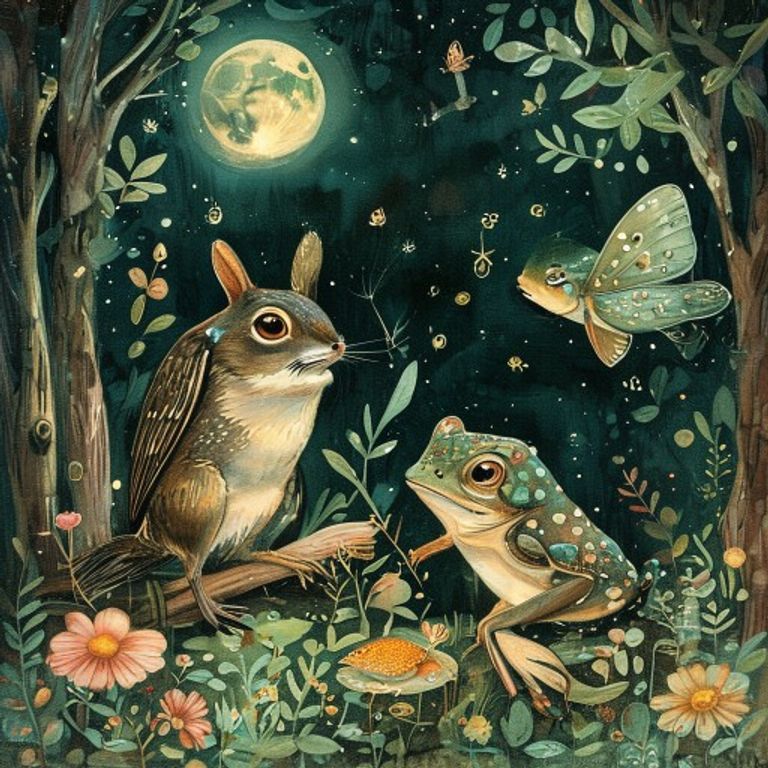
But a small cricket named Tempo hopped onto a fallen acorn and cleared his throat—a tiny sound, like a pebble dropping into a pond.
"Wait," he said.
The creatures turned. A cricket? Speaking up? Tempo was so small that most creatures had never noticed him. He was the color of dry grass, with antennae that trembled when he was nervous. And he was very nervous now.
"We don't need Maestro Owl to make music," Tempo said, his voice barely audible. "We just need... us."
A nightingale named Aria laughed—a bright, musical sound like wind chimes. "Us? Without Maestro? We would sound like a storm in a tin can! He is the only one who knows how to make our different voices work together."
"Does he?" asked a deep, rumbling voice.
Everyone turned. A great bullfrog named Bass sat at the edge of the nearby stream, his throat pulsing like a heartbeat. "I have played in this orchestra for thirty years," Bass said. "And I have never once played the same note as the cricket. My voice is too low. His is too high. Maestro Owl always puts us far apart so we don't clash. But what if... what if our difference is not a problem? What if it is the point?"
The creatures blinked. A moth named Whisper fluttered down from the branches, her dusty wings catching the moonlight. "I sing so softly," she said, "that Maestro Owl never gave me a solo. He said no one would hear me over the frogs. But what if... what if soft is not the same as unimportant?"
A squirrel named Rustle dropped from a branch, an acorn cap in his paws. "I don't even sing," he said. "I tap. I rustle. I drop acorns. Maestro Owl always told me to be quieter, that I was disturbing the melody. But rhythm is music too, isn't it?"
The creatures looked at each other. For the first time, they were not seeing an orchestra with one leader. They were seeing... themselves. Each different. Each unique. Each with a sound that no one else could make.
The First Rehearsal
Maestro Owl, voiceless but smiling, nodded from his perch. He could not conduct. But he could listen. And so the creatures tried something that had never been tried in the history of the Oakwood Forest.
They played without a conductor.
It was chaos.
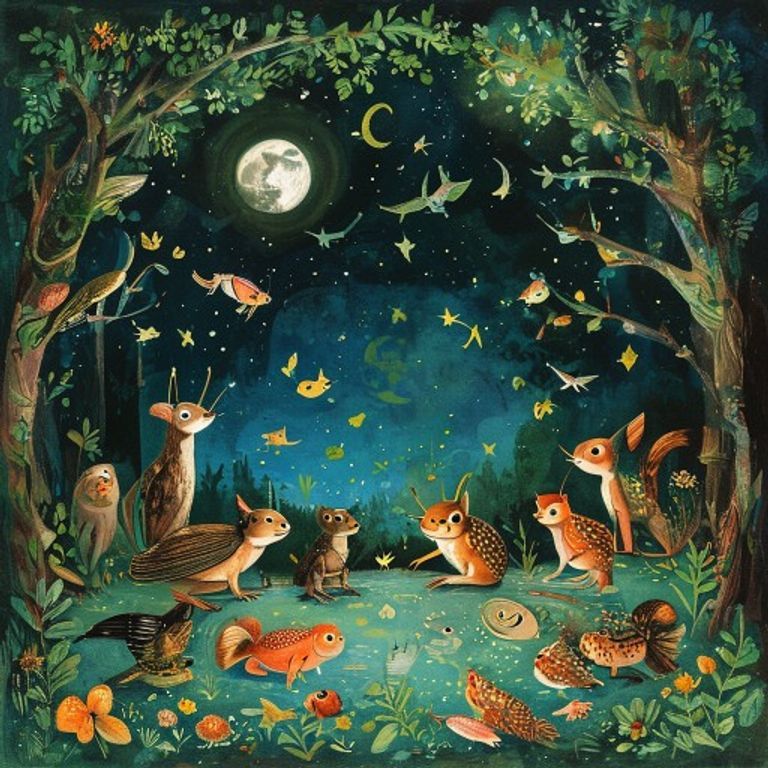
Tempo the cricket began his rhythm—chirp-chirp-chirp—but he was used to following Maestro Owl's beat, and without it, he sped up. Aria the nightingale tried to sing her melody over him, but she couldn't hear herself. Bass the bullfrog croaked his deep notes, which vibrated through the ground and made Tempo's antennae wobble. Rustle the squirrel dropped acorn caps in what he thought was rhythm, but they landed on Aria's head. Whisper the moth tried to harmonize, but her voice was swallowed by the frog chorus. A fish named Splash leaped from the stream, adding water-droplet percussion, but he splashed Rustle and the squirrel chattered in annoyance.
It sounded, as Aria had predicted, like a storm in a tin can.
The creatures stopped. The silence was heavy.
"This is hopeless," Aria sighed, preening a ruffled feather. "We are too different. Maestro Owl was right to keep us apart."
But Tempo chirped again—a single, clear note. "No," he said. "We are not too different. We just don't know how to listen to each other yet. Maestro Owl always told us when to play. But he never taught us to hear."
He turned to Bass. "Your deep notes make the ground hum. If I feel the hum in my legs, I can match my rhythm to it instead of guessing."
He turned to Aria. "Your melody is beautiful, but you sing too loud to hear the rest of us. What if you sang softer, and let the spaces between your notes be filled by others?"
He turned to Whisper. "Your voice is soft, yes. But soft can be powerful if it comes at the right moment—when everything else pauses."
He turned to Rustle. "Your acorn taps are not noise. They are punctuation—the exclamation marks of our music. But they need to come at the end of a phrase, not in the middle."
He turned to Splash. "Your water drops are like tiny bells. But bells need space to ring. Leap when the others rest."
The creatures stared at the little cricket. He was no bigger than a thumbnail. He had no special voice, no dazzling color, no impressive size. But he had listened. He had heard what each of them could do, and he had imagined what they could do together.
"How do you know all this?" Aria asked, amazed.
Tempo adjusted his antennae. "I am a cricket. I hear everything. The high notes, the low notes, the loud and the soft. I have spent my whole life in the background, listening to all of you. And I have learned that music is not about being the same. It is about... fitting together."
The Song Emerges
They tried again.
This time, Bass began alone—a deep, thrumming note that seemed to rise from the earth itself. The ground vibrated. The creatures felt it in their bones. Then Tempo joined, his cricket rhythm locking into the pulse of the frog's call. Not the same rhythm—different, but complementary. The cricket's chirps filled the spaces between the frog's croaks like stars filling the spaces between clouds.
Then Aria sang. But she sang softly, her nightingale melody weaving around the rhythm like ivy climbing a tree. She left spaces—beautiful, breathless spaces—and into those spaces, Whisper the moth drifted, her voice so delicate it was like moonlight on water. The contrast was breathtaking: Aria's bright, bold notes against Whisper's ghostly harmonies.
Rustle waited. He listened. And when Aria reached the end of a phrase, he dropped an acorn cap—TAP!—right on the beat. It was sharp, surprising, perfect. It made the other creatures jump, then smile. The rhythm had punctuation now. It had exclamation points.
Splash the fish watched from the stream. He saw the others pause, taking a breath between phrases, and he leaped—SPLASH!—sending silver droplets into the air that caught the moonlight like tiny chimes. The water drops rang out, clear and bright, in the silence between sounds.
And then something happened that no one expected.
The old trees began to creak.
They had always creaked, of course. The wind made them groan and sigh. But now, listening to the creatures, the trees seemed to join in—deep, wooden notes that rose from the roots and traveled up the trunks. The Great Grandmother Oak herself added a low rumble, like a cello made of bark and time.
The forest was singing.
Not one voice. Not ten voices. A thousand voices. Each different. Each necessary. Each fitting together like pieces of a puzzle no one had known existed.
Maestro Owl sat on his perch, his golden eyes wide with wonder. For forty years, he had conducted this orchestra. He had told them what to play, when to play, how loud, how soft. He had been the bridge between their differences. And now, without him, they had built their own bridge. They had learned to hear each other. To make room for each other. To celebrate the spaces where their voices overlapped and the spaces where they did not.
The Blue Moon Concert
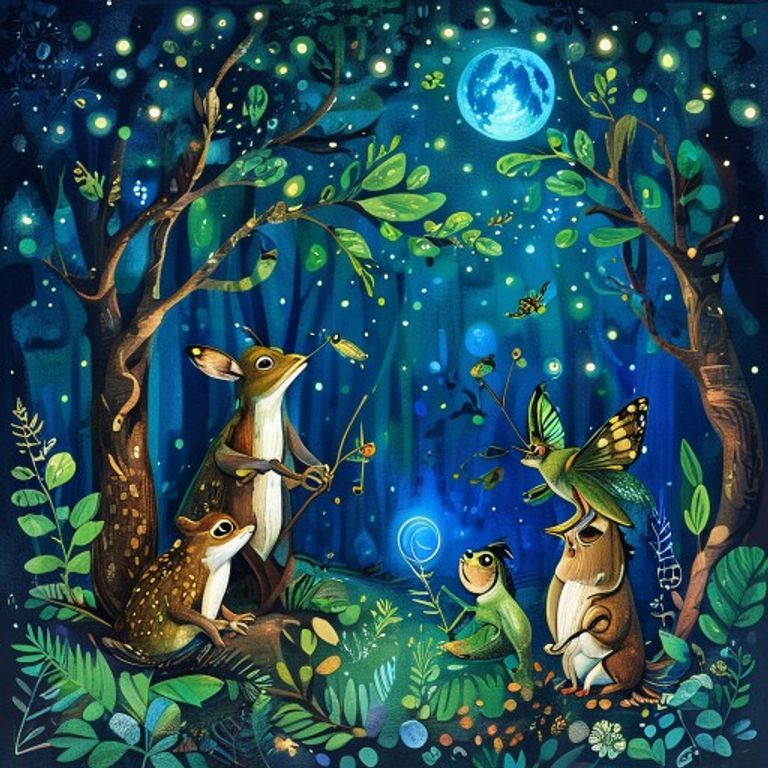
The night of the Blue Moon arrived. The Acorn Amphitheater was more crowded than ever—creatures from five valleys, from the mountains, from the distant sea shore. They had heard rumors. They had heard that the Orchestra of One Thousand Voices was different now. That something had changed.
The moon rose, huge and blue, casting silver light through the branches.
Tempo stood on his acorn podium. He was still small. He was still nervous. But he raised one antenna like a conductor's baton, and he looked at each member of his orchestra.
Bass nodded, his throat pulsing.
Aria ruffled her feathers, ready.
Whisper fluttered her dusty wings.
Rustle held an acorn cap in his paws.
Splash watched from the stream, his scales catching the moonlight.
And Tempo began.
The music that filled the forest that night was unlike anything any creature had ever heard. It was not the polished, perfect music of Maestro Owl's conducting—every note in its place, every instrument in its role. It was wilder. More surprising. More alive.
There were moments when Aria's melody soared so high it seemed to touch the stars, while Bass's rumble was so low it made the ground shake. There were moments when Whisper's voice was so soft that every creature held its breath to hear her. There were moments when Rustle's acorn taps made everyone laugh, and moments when Splash's water chimes made them cry.
The music rose and fell, changed and returned, built towers of sound and then let them crumble into silence. It was not one song. It was a hundred songs, a thousand songs, all happening at once, all aware of each other, all making room for each other.
When the final note faded—a cricket chirp that hung in the air like the last star before dawn—the forest was silent for a long, long moment.
Then the applause began.
It was not clapping—creatures don't clap. It was wings fluttering, paws stamping, tails thumping, throats trilling. The forest itself seemed to vibrate with joy. Deer danced. Foxes yipped. Badgers rolled on their backs, kicking their paws in the air. Even the old trees creaked their approval.
Maestro Owl flew down from his perch and landed beside Tempo. He could not speak—his voice was still healing. But he bowed his great horned head, and Tempo bowed his tiny cricket body, and in that bow was everything that needed to be said.
The Lesson
Maestro Owl's voice returned, as Juniper had promised, two months later. But something had changed. When he stepped back to his podium for the next concert, he did not raise his twig and demand silence. He looked at Tempo. He looked at Bass. He looked at Aria, Whisper, Rustle, Splash, and all the others. And he said:
"For forty years, I thought my job was to make you sound the same. To blend your voices into one. But I was wrong. My job is not to make you the same. My job is to help you hear how beautiful you are... together."
He turned to the audience, to the creatures who had come from valleys and mountains and shores. "Diversity is not a problem to be solved. It is not a flaw to be fixed. It is a gift to be celebrated. The cricket is not a failed frog. The nightingale is not a failed owl. The moth is not a failed bird. They are themselves. And when they are themselves—truly, fully, unapologetically themselves—they create something that none of them could create alone."
He raised his twig. "Now. Let us make music. All of us. Different. Together. Beautiful."
And they did.
The Moral of the Story: Diversity is not about being different for the sake of difference. It is about recognizing that every voice, every perspective, every way of being in the world has something unique to offer. The cricket was small, but his listening made him wise. The nightingale was loud, but her softness made her melodies soar. The bullfrog was low, but his rumble anchored them all. The moth was quiet, but her harmonies filled the spaces between. The squirrel was chaotic, but his rhythm gave them punctuation. The fish was wet, but his splashes gave them light. Each of them was different. Each of them was necessary. And together, they were music. The world will often tell you to be the same. To blend in. To quiet your difference. But the most beautiful symphonies are not made of one instrument playing one note. They are made of many instruments, each playing their own part, each listening to the others, each making room for the music to breathe. Your difference is not your weakness. It is your song. And the world needs your song. So sing it. Loudly, softly, high, low, fast, slow. Sing it. And listen for the songs of others. That is how music is made. That is how the world becomes beautiful. Together.