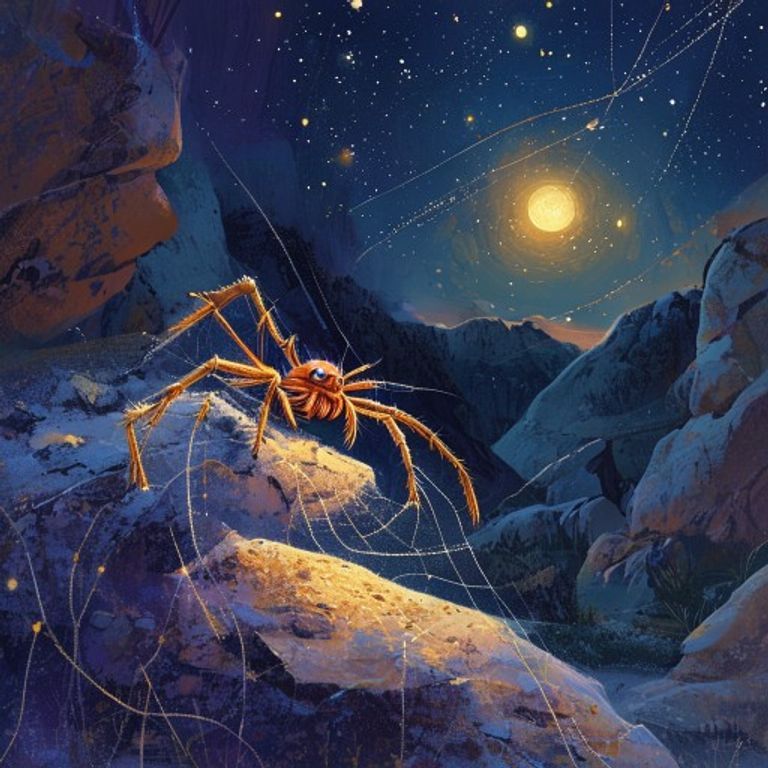
The Spider Who Wove the Dawn: A Story About Generosity
In the Desert of Small Things, where the sand was the color of honey and the rocks were shaped like sleeping giants, there lived a spider named Silk. She was a desert orb-weaver, no bigger than a thumbnail, with a body the color of burnt amber and legs so thin they looked like threads of copper wire. But her size was not what made her remarkable. What made her remarkable was what she did every single night.
While the rest of the desert slept, Silk wove tapestries.
Not simple webs to catch flies. Not practical spirals to trap beetles. Silk wove art. She stretched her silk between rock and rock, across dry wash beds, over the cracks where seeds slept, beneath the thorn bushes where lizards rested. She wove webs that looked like lace. She wove webs that looked like star maps. She wove webs with seven circles, and webs with crossing lines, and webs that dipped like hammocks and rose like bridges. And every morning, when the desert dawn came, her webs caught the dew.
Each drop of dew that gathered on Silk's silk was a tiny silver bead. Hundreds of them. Thousands. Her webs glimmered like necklaces scattered across the rocks. Like the Milky Way had fallen into the desert. Like the moon had melted into threads of light.
Silk thought she was making art.
She did not know she was saving lives.
The Desert of Small Things
The Desert of Small Things was home to creatures so tiny that most humans never knew they existed. There were ants who carried seeds half their size, storing them in underground vaults against the dry season. There were beetles with shells like polished opals, who drank only dew and lived for months without a single drop of rain. There were moths whose wings were covered in scales that looked like dusted gold, who hatched, lived, and died in the span of a single week, leaving behind eggs that waited years for the right rain to come. There were scorpions the length of a fingernail, who hunted at night and hid in cool cracks by day. There were lizards so small they could sit on a pebble, and spiders even smaller than Silk, who lived in the shadows of her webs and called her giant.
For eight months of the year, the Desert of Small Things was dry. The rain came only twice — once in late spring, a brief storm that soaked the sand for three days and then vanished, and once in autumn, a drizzle that lasted half a morning and left behind more hope than water. Between those rains, the desert creatures survived on what they had stored, on what they could find, and on the dew.
The dew came every morning, a thin mist that condensed on cool rocks and cool sand and cool spider silk. It was never enough to fill a cup. It was barely enough to fill a thimble. But for creatures who measured their lives in drops, it was everything.
And Silk's webs caught more dew than anything else in the desert.
Her seven-circle webs held beads of water in every ring. Her hammock webs created pools that lasted hours after the sun rose. Her bridge webs stretched across dry washes, catching the mist that rolled through the low places, creating silver rivers of dew that tiny creatures followed like maps to treasure.
But Silk never saw them.
She wove at night, in the darkness, when the air was cool and her silk stretched best. She finished just before dawn, exhausted and proud, and then she crawled into her burrow beneath a flat rock and slept through the day. She never saw the ants line up to drink from her web. She never saw the beetles press their mouths to her silk. She never saw the tiny lizards lap at the pools her hammock webs held. She slept through all of it, dreaming of new patterns, new shapes, new tapestries for the next night.
She thought her webs were beautiful. She thought they were art. She thought they were hers.
She did not know they were a gift to the world.
The Lizard Who Watched
Dusty was an old desert lizard, the color of the sand itself, with eyes that had seen twenty summers and twenty winters. He was not small like the others. He was the size of a hand, ancient by desert standards, and he had a secret: he could not sleep at night. Some lizards are built for the day, and Dusty's body simply refused to rest when the stars came out. So while Silk wove, Dusty watched.
He watched her stretch her first thread between two rocks, testing the distance with her leg. He watched her build the framework — the anchor lines, the radii, the spirals. He watched her pause sometimes, as if listening to something only she could hear, and then change her pattern mid-web. He watched her work for hours, night after night, never stopping, never complaining, never seeming to notice that she was creating something extraordinary.
And every morning, Dusty watched the creatures come.
The ants first, always the ants, marching in single file to the nearest web, touching their antennae to the dew. The beetles next, rolling like tiny jewels to catch the drops. The moths, fragile and brief, landing on the silk to drink before their short lives ended. The tiny lizards, the baby scorpions, even the seeds that had been waiting months for moisture — all of them came to Silk's webs, drank the dew, and lived another day because of her.
Dusty tried to tell her, once. He waited until dusk, when Silk emerged from her burrow, stretching her legs and testing the wind. He crept close, keeping low, being polite. "Excuse me," he said. "Little spider. Your webs. Do you know what they do?"
Silk looked at him, surprised. She had never spoken to a lizard before. "They catch the light," she said. "They catch the dawn. They make the desert beautiful for a few hours before the sun takes them."
"They catch more than light," Dusty said gently. "They catch the dew. And the creatures drink."
Silk tilted her head. "Of course they catch the dew. Everything catches the dew. Rocks catch the dew. Leaves catch the dew. I catch the dew because I am here, in the desert, like everything else. That is not special. That is just... being."
"But you are special," Dusty said. "Your webs hold more dew than anything else. Your webs are the difference between life and—"
"I make art," Silk interrupted, a little sharply. "Not water. Not... not survival. I make beauty. That is enough."
And she turned away and began her night's work, and Dusty let her be. Because he understood something that Silk did not yet understand: sometimes the most generous thing a creature can do is create beauty in a world that needs it, even when they do not know the world needs it. Sometimes generosity is not a choice. It is simply who you are.
The Sandstorm
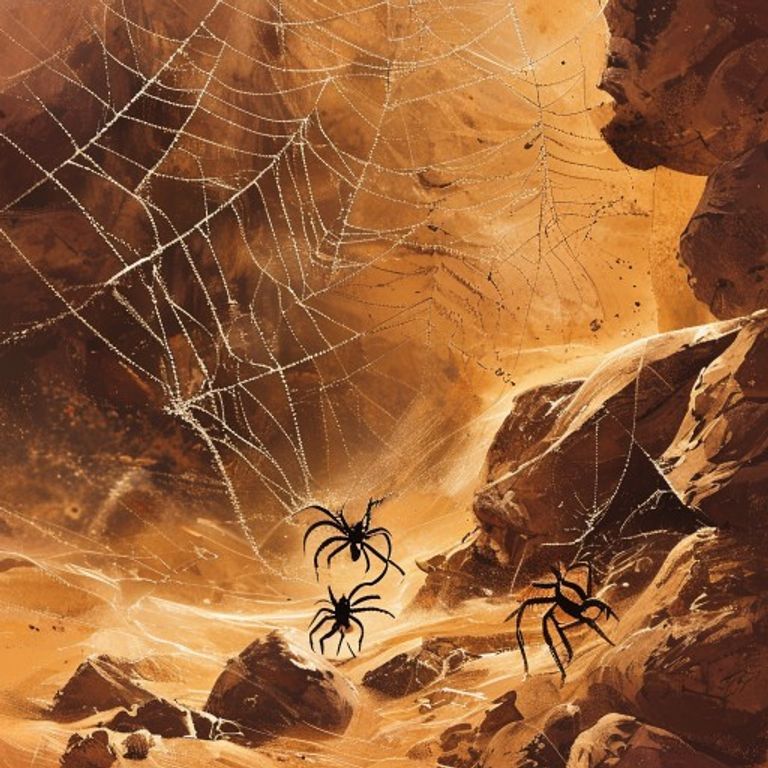
It came on the seventh night of the seventh month, when the dry season was at its worst and the creatures were thinnest and weakest. The sandstorm began as a whisper — a wind that carried a few grains, nothing more. But the desert is patient, and sandstorms are patient, and by midnight the wind was a wall of grit and fury that stripped the color from the night.
Silk felt it coming. She felt the vibration in her anchor threads. She felt the change in the air pressure, the way the desert holds its breath before a storm. She wrapped herself in a ball of legs and silk, deep in her burrow, and waited.
The storm lasted six hours. It tore through the Desert of Small Things like a hungry animal. It ripped leaves from thorn bushes. It buried tracks and trails and memories. It filled cracks with sand and erased hollows and smoothed every surface into sameness. And it destroyed every web that Silk had ever woven.
Every single one.
The seven-circle web that had taken her three nights to perfect — gone. The hammock web that had spanned the widest wash — shredded. The bridge web with its forty-seven anchor lines — torn away completely. The star-map web that she had woven on the night of the full moon — scattered into the wind like dandelion seeds.
When Silk emerged the next evening, she found ruins. Her art was destroyed. Her patterns were erased. The desert was smooth and empty and cruel, and there was nothing beautiful left in it at all.
She sat on her rock and looked at the emptiness, and for the first time in her life, Silk did not feel like weaving.
What was the point? The desert would only destroy it again. The wind would only tear it down. The sand would only bury it. She had spent months — years — creating beauty in a place that did not want beauty. She had given everything she had to the night, and the night had taken it all and thrown it away.
She curled into a ball on her rock and did not move.
Three days passed.
The Thirst
On the third morning, Dusty found her. She was still curled on her rock, motionless, her amber body dull with dust. The old lizard crept close and touched her gently with his nose.
"Little spider," he said. "The desert is thirsty."
"I am thirsty too," Silk whispered. "Thirsty for meaning. Thirsty for purpose. I made beauty, and the desert destroyed it. Why should I make more?"
Dusty was quiet for a moment. Then he said: "Come with me."
He led her — slowly, gently, letting her ride on his back when her legs were too weak — to the place where her widest web had once stretched across the dry wash. The sandstorm had filled the wash with sand, burying everything. But there was something Silk had never seen before.
A line of ants. Not marching. Not working. Lying on their sides, their legs curled, their antennae still. Dozens of them. Hundreds. They had come to the web, as they always did, and found nothing. No dew. No water. No life.
"They have been coming every morning," Dusty said. "Every morning since the storm. They do not understand why the water is gone. They only know that it is gone."
He led her to another place — the rock where her star-map web had glowed. There were beetles there, their opal shells dulled, their movements slow. They were searching the sand for moisture that was not there.
He led her to the thorn bush where her hammock web had held pools. There were baby lizards, smaller than her, pressing their mouths to dry leaves, licking at nothing.
And at the last place — the bridge web that had crossed the lowest point of the desert — Silk saw something that broke her heart. A moth, still alive but barely, its golden wings torn by the storm, lying on a rock, waiting for dew that would never come.
"I did not know," Silk said, and her voice was the sound of thread breaking. "I did not know they needed me."
"I tried to tell you," Dusty said gently.
"I thought I was making art," Silk said. "I thought the dew was just... just decoration. Just part of the beauty. I did not know it was water. I did not know it was life."
"You made art," Dusty agreed. "And the art happened to save lives. But that does not make it less art. It makes it more."
Silk looked at the dying moth. At the thirsty ants. At the dry beetles and the desperate lizards. And she understood something she had never understood before.
Generosity is not about knowing you are being generous. It is not about being thanked, or recognized, or praised. It is not even about choosing to help. Sometimes generosity is simply the thing you cannot stop doing, even when you do not know anyone needs it. Sometimes generosity is art that happens to save lives. Sometimes generosity is just... being who you are, in a world that desperately needs exactly that.
The Weaving
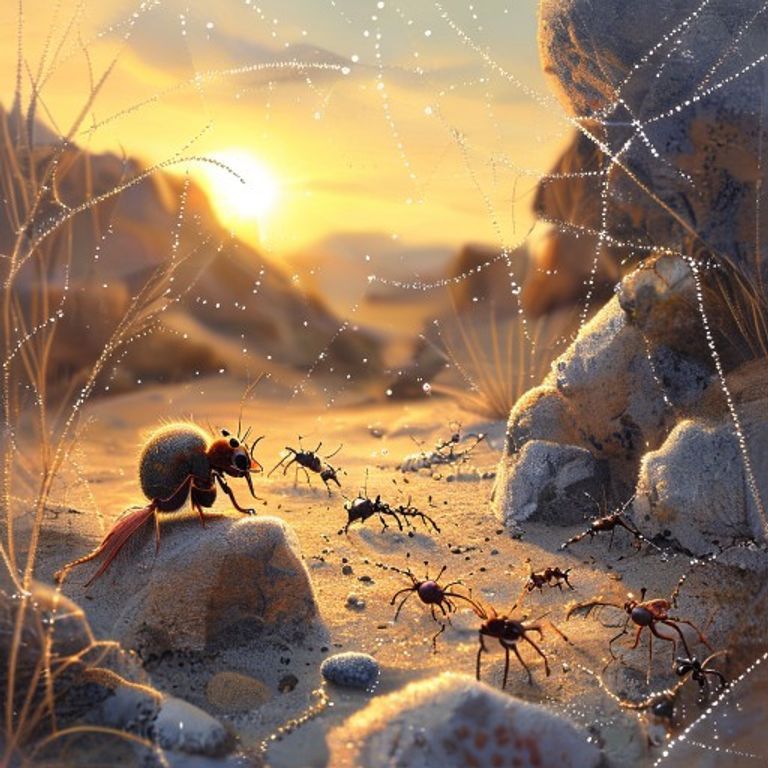
That night, Silk wove again.
But she wove differently now. She wove not for beauty alone, but for the creatures she had seen. She wove her seven-circle web over the ant trail, so the dew would fall in drops they could reach. She wove her hammock web beneath the thorn bush, low and wide, so the baby lizards could drink without climbing. She wove her bridge web across the lowest wash, catching the mist that rolled through at dawn. And she wove a new web — a tiny, perfect web — on the rock where the moth had lain, a web so small and delicate that even a dying creature could reach it with a single step.
She wove all night. She wove until her legs shook. She wove until her silk ran thin. She wove until the first hint of dawn turned the eastern sky from black to blue.
And then, for the first time in her life, Silk did not go to sleep.
She stayed. She watched. She saw the dew gather on her silk, silver and perfect. She saw the ants come — slowly at first, then faster, touching the drops with their antennae, drinking, living. She saw the beetles roll to the pools, their opal shells catching the light again. She saw the baby lizards lap at the hammock web, their tiny tongues flicking in and out. She saw the moth — the same moth, somehow still alive, somehow still fighting — press its mouth to the tiny web and drink the single drop that had formed there.
And Silk wept.
Spiders do not weep the way humans weep. But Silk felt something inside her — something warm and vast and terrifying — break open like a seed after rain. She had spent her whole life thinking she was making art for herself. She had never known she was making life for others. And now that she knew, she could never go back to not knowing. She could never again pretend that her webs were only hers. They belonged to the desert. They belonged to the creatures. They belonged to the dawn.
She was exhausted. She was empty of silk. She was trembling with tiredness. But she was also — for the first time — complete.
The Morning After
Dusty found her at midday, asleep on her rock, her legs curled around her body like a question mark. She woke when he touched her, and she looked at him with eyes that were different now. Older. Sadder. Wiser. But also — brighter.
"You saw them," Dusty said. It was not a question.
"I saw them," Silk agreed. "I saw the ants. The beetles. The lizards. The moth." She paused. "I did not know, Dusty. All this time. I thought I was making art. I thought the dew was just... pretty. I thought I was being selfish, really. Making beautiful things because they made me happy. I never knew they mattered to anyone else."
"And now that you know?" Dusty asked.
Silk was quiet for a long time. The desert hummed around them — the heat, the silence, the patient waiting of stone and sand.
"Now that I know," she said slowly, "I think it was better when I did not know."
Dusty tilted his head, surprised. "Better?"
"Yes." Silk stretched her legs, testing the air. "When I did not know, I wove because I could not stop. I wove because it was who I was. I wove because making beauty was the only thing that made sense to me. I did not weave to save lives. I did not weave to be thanked. I did not weave because it was needed. I wove because I was a weaver, and weavers weave. And the fact that it helped anyone — that was just... extra. Just a gift the world gave back, without me asking."
She looked out at her webs, already drying in the sun, already vanishing into the day, ready to be woven again tonight.
"Now that I know," she said, "I will weave even better webs. I will place them where they are needed most. I will make them stronger and wider and more perfect. I will be generous on purpose, with intention, with care. And that is good. That is right. But part of me misses the old way. The way where generosity was not a choice. It was just... breathing."
Dusty smiled — a lizard smile, which is mostly in the eyes. "You can have both, little spider. You can weave because you must, and you can weave because they need you. Generosity is not either-or. It is both. It is the thing you cannot stop doing, and the thing you choose to do better."
Silk looked at him. "Is that true?"
"It is true," Dusty said. "Think of it this way: the sun does not choose to shine. It simply shines. It cannot do anything else. But the sun also chooses — every morning — to rise in the east, to climb the sky, to warm the places that need warming most. The sun is both compelled and choosing. And so are you."
The New Webs
And so Silk became both.
She wove because she was a weaver, and weavers weave. She could no more stop weaving than the sun could stop shining. It was who she was. It was her breath, her heartbeat, her reason for being.
But she also wove with intention now. She wove for the ants, placing her dew-catchers along their trails. She wove for the beetles, making low webs they could roll onto. She wove for the moths, creating tiny perfect cups that held water even after the sun rose. She wove for the lizards, the scorpions, the seeds, the world. She wove for the desert itself, which needed beauty as much as it needed water.
And something strange happened.
Her webs became more beautiful.
Not less beautiful because they were practical. Not practical instead of beautiful. But more beautiful because they served a purpose. The webs she wove for the ants had a pattern like marching feet, rhythmic and steady. The webs she wove for the beetles had colors that caught the opal light of their shells. The webs she wove for the moths were so delicate they looked like the moths' own wings. The webs she wove for the lizards were strong and wide and bold, like lizard hearts.
Each web was art. Each web was a gift. Each web was generous. And each web was exactly, perfectly, uniquely what the world needed that night.
The creatures began to notice her. The ants left tiny pebbles arranged in patterns at the base of her rock — offerings, gifts, thank-yous in a language she was only beginning to learn. The beetles rolled circles around her burrow, polishing the sand smooth, making a path for her to walk. The baby lizards sunned themselves on her rock during the day, keeping her company while she slept, guarding her from the birds that might otherwise have eaten her. The moth — the same moth, somehow still alive, somehow growing stronger — began to leave drops of nectar on her silk, a sweetness that made her next webs even stronger.
And Dusty, the old lizard who had watched it all, simply smiled and let the desert teach what it always teaches: that generosity is the thread that weaves the world together. That beauty and survival are not opposites. That art can save lives, and saving lives can be art. And that the creatures who give without knowing they give are sometimes the most generous of all — because their generosity comes from the truest place, the place that does not know how to be anything else.
The Tapestry
Years passed. Silk grew old. Her amber body faded to the color of pale sand. Her legs, once thin as copper wire, grew slower and stiffer. She could no longer weave all night. She could no longer stretch between the widest rocks. She could no longer make the seven-circle webs or the bridge webs or the star-map webs.
But she could still weave.
On her last night, she wove a single web. Not large. Not elaborate. Just a simple circle, small and perfect, on the rock where she had first curled up in despair after the sandstorm. A web for the creatures who would come in the morning. A web for the dew. A web for the dawn.
And then she slept.
She did not wake.
But her web did. It caught the dawn. It caught the dew. It caught the light. And a young spider — barely bigger than a dewdrop, with legs like threads of copper wire — crept out of a crack beneath the rock and looked at it.
And she thought: That is beautiful. I want to make something like that.
And so she began to weave.
Not knowing. Not choosing. Just weaving. Because that is what spiders do. Because that is what the world needs. Because that is what generosity looks like when no one is watching, when no one is thanking, when no one even knows your name.
It looks like art. It looks like breath. It looks like love.
It looks like a web in the desert, catching the dawn, one silver drop at a time.
The Moral of the Story: Generosity is not about knowing you are being generous. It is not about being thanked, or recognized, or praised. It is not about choosing to help, or planning to give, or deciding to be kind. Sometimes — often — the most generous thing a creature can do is simply be who they are, in a world that desperately needs exactly that. Silk thought she was making art. She did not know she was saving lives. And that is the magic of true generosity: it does not need an audience. It does not need gratitude. It does not even need awareness. It simply happens, because the generous heart cannot stop creating, cannot stop building, cannot stop making the world more beautiful — and that beauty, that relentless, stubborn, glorious beauty, becomes the thing that others need most. Generosity is not a choice between being practical and being beautiful. It is the understanding that the two are the same. That art can save lives. That saving lives can be art. That a spider who weaves because she cannot stop weaving is giving the most precious gift of all: the gift of herself, freely, fully, without knowing anyone is watching. And when we give like that — when we create like that, when we love like that — we do not just help the world. We weave it together, one thread at a time, into a tapestry so strong and so beautiful that even the sandstorms cannot destroy it. Because the tapestry is not made of silk. It is made of generations of spiders who wove because they could not stop. It is made of creatures who drank the dew and lived to see another dawn. It is made of old lizards who watched, and young spiders who learned, and the endless, patient, perfect circle of giving that turns the desert into a garden, one web at a time. That is generosity. Not a basket to be emptied. Not a circle to be joined. Not a choice to be made. But a way of being. A way of breathing. A way of making the world more beautiful simply by being in it, and letting that beauty become the water, the shelter, the hope that others need to survive. Weave your web, little one. Even if no one sees it. Even if no one thanks you. Even if you do not know what it does. Weave it anyway. Because the world needs your web. And it always has.