The Pebble Who Would Not Roll: A Story About Humility
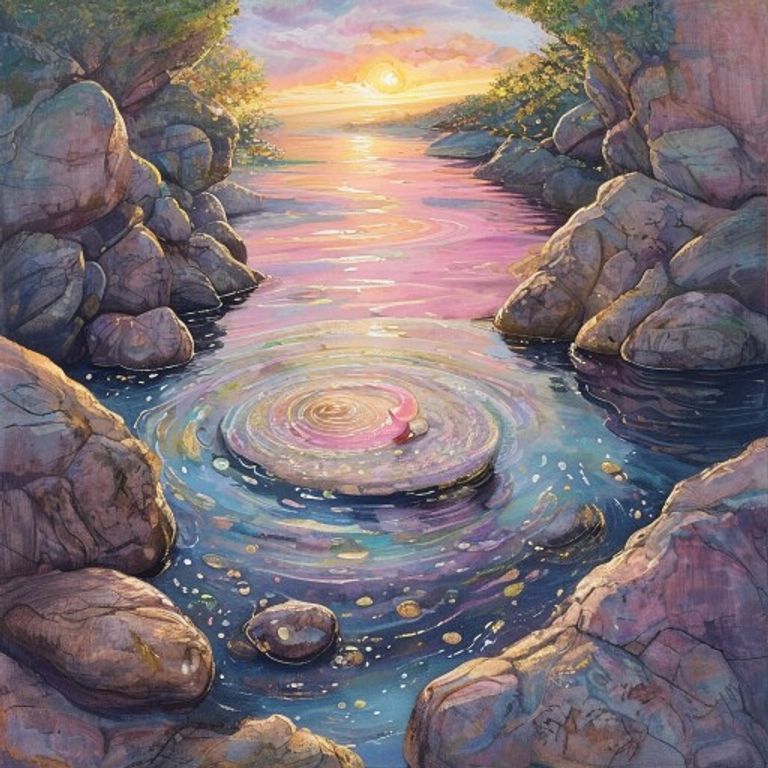
In the middle of Crystal River, where the water ran quick and cold over stones worn smooth by centuries, there lived a pebble named Ripple. He was no bigger than a robin's egg, the color of sunset—pink and gold and deep amber all swirled together like someone had painted the sky onto a stone. And he was stuck.
Not stuck in a bad way, Ripple told himself. Stuck in a special way. Wedged between two ancient rocks in the very center of the river, where the current was strongest and the water sang the loudest. He had been there since the spring floods of three years past, when the mountain snow had melted all at once and the river had roared like a dragon. Every other pebble in that flood had tumbled downstream, rolled and battered and carried away to who-knew-where. But not Ripple. Ripple had lodged himself in this perfect crevice, this crack between the two great stones, and there he had stayed.
"I am the roundest pebble in the river," Ripple would say to anyone who passed. And many pebbles passed. Hundreds every day. Tumbled by the current, bumped and battered and polished, rolling downstream toward the wide delta where the river met the sea. "Look at you," Ripple would call out to them. "You're all jagged edges and chipped corners. You've been banged about so much you've lost your color. You're ordinary."
The passing pebbles rarely answered. They were busy rolling. But sometimes one would pause in an eddy and call back: "Aren't you lonely, stuck there all alone?"
"Lonely?" Ripple would laugh, a hard pebble laugh that sounded like two stones clicking together. "I am not lonely. I am chosen. The river put me here because I am special. The most perfect, most beautiful, most round pebble it has ever carried. Why would I want to roll away and become ordinary like you?"
And the other pebble would shrug—a difficult thing for a pebble to do, but they managed—and roll on, and Ripple would settle deeper into his crack, content and proud and very, very still.
The Boulder
On the eastern bank of Crystal River, half-buried in mud and moss, sat Boulder. Boulder was not a pebble. Boulder was a boulder—a stone the size of a cottage, covered in lichen that glowed silver and green, with cracks that held ferns and tiny flowers. Boulder had been there for four hundred years. He had watched the river change its course three times. He had seen forests grow and fall and grow again. He had felt the footsteps of bears, deer, wolves, rabbits, and children across his wide back. He had heard ten thousand springs and ten thousand winters. Boulder did not move. Boulders do not move. But Boulder saw everything.
And he had been watching Ripple.
"Little pebble," Boulder rumbled one morning, his voice like stones grinding underwater. "Why do you stay in that crack?"
Ripple puffed up with pride. Or at least, he tried to. Pebbles do not puff up easily. "Because I am special," he said. "The river tried to carry me away, but I was too perfect to leave. I found this spot, and I chose to stay. I am the only pebble in Crystal River who knows where he belongs."
Boulder was quiet for a moment. A blue heron landed on his back, preened her feathers, and flew away. A family of otters slid down his mossy side into the water. A beetle crawled across his lichen, searching for shade. Then Boulder said, very gently, "Do you know where the other pebbles go?"
"Downstream," Ripple said, with a dismissive click. "To the delta. To the beach. To be stepped on by crabs and seagulls. To be lost in the sand. To become ordinary."
"Some do," Boulder agreed. "But some become the floor of a heron's nest, warm and safe for eggs. Some become the dam that holds back a flood, saving a village. Some are picked up by children and skipped across the water, teaching a little one about joy. Some settle in a garden and hold dew for thirsty bees. Some are carried by ants to build homes. Some rest in a frog's throat and become his song. Some are swallowed by fish and returned to the earth as something new." Boulder paused. The river murmured around him. "The river does not carry pebbles away to lose them, little one. It carries them to use them."
Ripple clicked his hardest click. "I do not need to be used. I am perfect where I am. I am round. I am colorful. I am beautiful. I am the most beautiful pebble in Crystal River, and everyone who passes can see me. If I rolled away, I would just be one more stone in a beach of millions. Here, I am seen."
Boulder said nothing more. He had learned, over four hundred years, that stones must learn their own lessons. The river teaches. Time teaches. Experience teaches. Words only help when the listener is ready. So Boulder let the river speak for him, and he waited.
The Flood
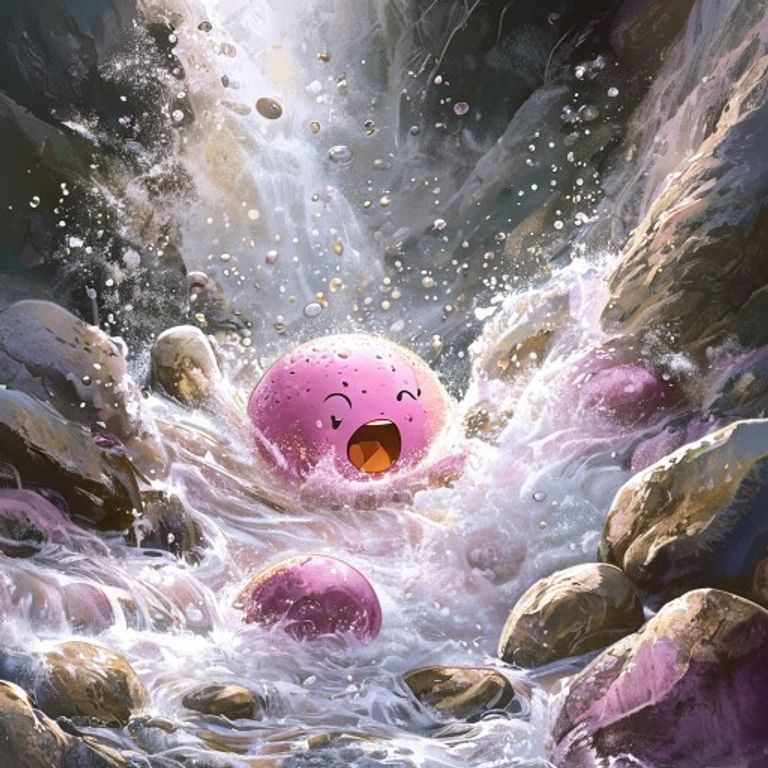
It came on the seventh night of the seventh month, when the mountain snow had melted early and the spring rains had been heavier than anyone remembered. The river did not roar. It screamed. It rose in the darkness, a wall of water and mud and branches and stones, and it tore through Crystal River valley like a living thing.
Ripple felt it first as a vibration—a hum in the rock beneath him, a song of power building. Then he felt the water rising, pressing against his crevice, trying to dislodge him. He pressed back. He wedged himself deeper. He was not going to move. He was the most perfect pebble. The river had put him here. The river would not take him away.
But the river did not care about Ripple's perfection. The river did not care about his color or his roundness or his pride. The river only cared about flowing. And when the flood reached its peak—a wall of brown water twice the height of Boulder himself—it lifted the two ancient rocks that held Ripple in place and rolled them downstream like dice.
Ripple was free.
And he was terrified.
The current seized him and spun him and threw him. He tumbled over stones that scraped his perfect pink-and-gold surface. He crashed against rocks that chipped his round edges. He was buried under mud, then free, then buried again. He could not see. He could not stop. He could not think. The river had him, and the river was not gentle.
"Help!" Ripple cried, but pebbles do not cry the way humans cry. His voice was a click and a clatter, lost in the roar of water. "Please! I want to go back! I want my crevice! I want to be still!"
But there was no going back. The flood carried him past Boulder—Ripple caught one glimpse of the great stone, calm and unmoving in the chaos—and then past the oak grove, and past the meadow, and through the narrows where the river squeezed between cliffs and pebbles spun like tops. Ripple was battered and bruised and chipped. His perfect pink-and-gold swirls were scratched. His roundness was dented. He was no longer the most beautiful pebble. He was just a pebble, tumbling, spinning, lost.
And then he felt another pebble beside him.
"Roll with the current," the other pebble said. "Don't fight it."
"Who are you?" Ripple gasped, spinning end over end.
"I'm Creek," the other pebble said. She was gray and plain and small, nothing special to look at. "I've been rolling for ten years. I know this river. If you fight the current, it will batter you. If you roll with it, it will carry you."
"I don't want to be carried!" Ripple shouted. "I want to go back!"
"There is no back," Creek said gently. "Only forward. The river knows where it's going. Trust it."
"But I'm special!" Ripple wailed.
Creek laughed—a soft, rolling sound. "Little pebble, we are all special. And we are all ordinary. That is the magic of the river. It doesn't care if you're pink or gray or round or jagged. It carries us all. And we all end up exactly where we need to be."
And Ripple, exhausted and chipped and terrified, stopped fighting. He let the current take him. He rolled with the other pebbles. He stopped trying to be perfect and started trying to survive. And something strange happened: the battering became less painful. The spinning became almost... rhythmic. He was still scared, still lost, still far from his crevice. But he was no longer alone.
The Delta
The flood lasted three days. On the fourth morning, the water slowed. The current softened. The river widened. And Ripple found himself in a place he had never seen before.
The delta.
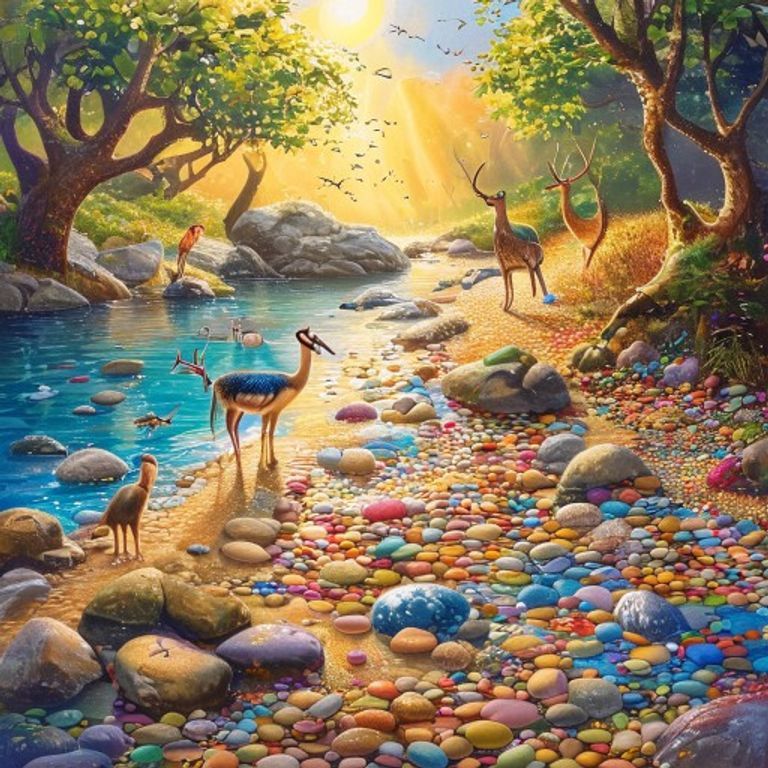
It was not what he had imagined. He had thought the delta would be a place of loss—pebbles scattered and forgotten, washed up and useless, buried in sand and ignored by the world. But the delta was alive. It was a garden of stones.
Millions of pebbles. Billions, maybe. Gray ones and pink ones and gold ones and white ones and black ones and pebbles with stripes and pebbles with spots and pebbles that glowed like moonlight in the shallow water. They were not scattered randomly. They had arranged themselves into patterns over years—ridges and valleys and smooth stretches and rough patches. The beach was a mosaic. The river had spent centuries painting it with stones.
And the creatures were everywhere.
A heron stood on a collection of flat stones at the water's edge, her long legs folded beneath her, watching for fish. A family of otters slid down a pebble-slide they had built themselves, landing with splashes in a tidal pool. Children—human children, Ripple had never seen humans before—were building a castle with the pebbles, stacking them in towers and walls and bridges, laughing as the waves knocked them down and they built them up again. A crab carried a tiny white pebble to her burrow, placing it carefully at the entrance like a decoration. A sandpiper pressed her beak into the wet sand between pebbles, pulling up worms. A seal lay on a bed of smooth round stones, sunning herself, her pup nursing beside her.
And in the center of the beach, where the largest stones had gathered over centuries, Ripple saw something that made his chipped heart ache with wonder.
A path.
Not a path made by feet. A path made by pebbles. Thousands of them, arranged in a winding line from the water's edge to a dry mound above the tide line. Each pebble touched the next, fitting together like a puzzle. The path was not straight. It curved around driftwood, around dunes, around tide pools. But it was clear and solid and real. And walking on it—carefully, slowly, one foot in front of the other—was a family of deer, leading their fawns to fresh water that pooled in the mound's shadow.
"The Stepping-Stone Path," Creek said, rolling up beside Ripple. She had survived the flood too, a little more chipped than before but still rolling. "Built by pebbles over two hundred years. No one planned it. No one designed it. Pebbles just... settled where they were needed. Where they could help. And after centuries of being exactly where they were needed, they became a path."
Ripple looked at the path. He looked at the children building castles. He looked at the heron fishing, the crab decorating, the seal resting, the deer walking safely to water. And he understood something that no words could have taught him.
His crevice had been a prison, not a palace. His stillness had been loneliness, not greatness. His perfection had been a lie he told himself because he was afraid to roll. Afraid to be chipped. Afraid to become ordinary. Afraid to become part of something.
"I was wrong," Ripple whispered. "I thought being the most beautiful pebble in the river made me special. But I was just... alone."
"You weren't wrong about being beautiful," Creek said. "You were wrong about what beauty is for."
The Place
That afternoon, a child found Ripple. She was a girl with brown hair and bare feet and a dress the color of the sky. She was collecting pebbles for her castle, and when she saw Ripple—still pink and gold despite his chips, still round despite his dents—her eyes went wide.
"Oh," she breathed. "You're perfect."
Ripple felt something stir in his chipped heart. Pride? Yes, a little. But something else too. Something warm and open and ready.
The girl lifted him carefully. She carried him to her castle—a magnificent structure of towers and walls and courtyards, built from thousands of pebbles. She placed Ripple not at the top of the tallest tower, not at the center of the grand gate, but at the entrance to a tiny courtyard where a toy horse could rest in the shade. Where a pebble was needed. Where a pebble could be useful.
"You'll be the resting stone," the girl said, as if Ripple could understand. "For my horse. He gets tired after long journeys."
And Ripple settled into the sand of the courtyard, touching the pebbles on either side of him, feeling the warmth of the sun, the cool of the tide, the press of a thousand other stones all around him. He was no longer the most beautiful pebble in the river. He was one of thousands on a beach. He was chipped and dented and imperfect. And he had never been happier.
Because here, in this courtyard, in this castle, on this beach, he was not alone. He was part of something. He was helping. He was needed. He was home.
That night, the tide came in and washed the castle away. The girl laughed and began building again. And Ripple—along with all the other pebbles—rolled back into the delta, settling into new places, becoming part of new patterns, helping in new ways. Some became the floor of a heron's nest. Some held dew for bees. Some warmed a seal's belly. Some became part of the Stepping-Stone Path. And Ripple, pink and gold and chipped and round, settled into a shallow pool where tadpoles swam in circles around him, using him as an island, a resting place, a home.
And every morning, when the sun rose over the delta and turned the water to gold, Ripple would look at the millions of pebbles around him—all shapes, all sizes, all colors, all chipped and dented and beautiful—and he would think: I am not the most perfect pebble. I am not the most beautiful. I am not the roundest or the pinkest or the most special.
But I am here. And I am part of this. And that is enough. That is more than enough. That is everything.
The Moral of the Story: Humility is not about thinking you are less than others. It is not about hiding your gifts or pretending you are not special. It is about understanding that being special does not mean being separate. Ripple thought his perfection made him better than the other pebbles. He thought staying still and being admired was the highest purpose a stone could have. But he learned that the highest purpose is not to be seen. It is to be useful. It is to roll with the river, to become part of the path, to help others cross, to hold dew for a bee, to warm a seal, to build a castle for a child, to become an island for a tadpole. Humility is knowing that your beauty, your roundness, your color, your gifts—they are not for showing off. They are for giving away. They are for becoming part of something bigger than yourself. The most beautiful pebble in an empty crevice is just a lonely stone. The chipped, dented, imperfect pebble in a beach of millions—helping, belonging, rolling with the current—that pebble is alive. That pebble is humble. And that pebble, in the end, is the happiest of all. Because humility is not a reduction. It is an expansion. It is not about being less. It is about making room for more. More stones. More paths. More castles. More love. Roll with the river, little one. You will find your place. And it will be better than any crevice you ever dreamed of.