The Owl Who Looked Down: A Story About Curiosity
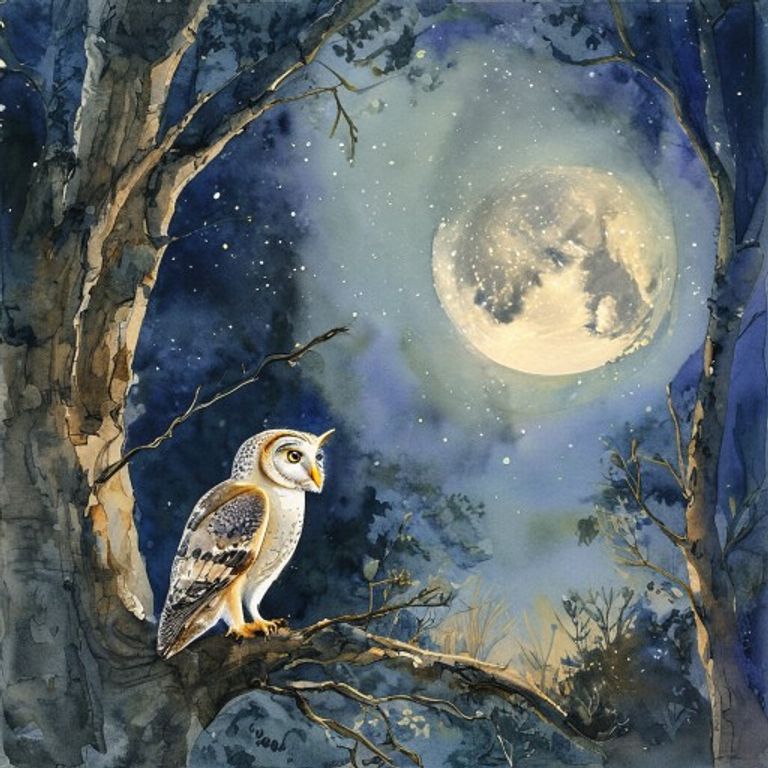
In the ancient forest of Starfall, where the trees grew so tall they scraped the belly of the moon and the roots reached so deep they drank from underground rivers older than memory, there lived a young barn owl named Luna. She had the broad, flat face of her kind, the heart-shaped mask of cream and gold, the eyes like twin pools of amber honey. She looked wise. Everyone said so.
"You have the face of a philosopher," said her mother, a severe owl named Shadow, who had once eaten a weasel that weighed more than she did. "Owls are born knowing. It is our gift. We see in the dark. We hear a mouse's heartbeat from a hundred wingbeats away. We understand what other creatures cannot."
Luna believed her. She sat on her branch, high in the canopy where the air was thin and the stars seemed close enough to touch, and she looked down at the forest floor with the confident gaze of someone who believed she understood everything worth understanding.
But Luna had a secret.
She did not understand the ground.
Not the ground itself — she knew it was down there, brown and solid and full of things to eat. She understood the ground the way a fish understands the sky: she knew it existed, she knew it was important to other creatures, but she had never really thought about it. The ground was simply the place mice lived before they became dinner. It was the dark backdrop against which her own world — the world of branches and moonlight and silent flight — made sense.
But lately, Luna had started to wonder.
She wondered what it felt like to walk instead of fly. She wondered why the squirrels buried acorns in specific places and not others. She wondered why the foxes always traveled the same paths, generation after generation, as if following invisible roads drawn on the earth. She wondered why mushrooms grew in circles, why ants built hills that looked like tiny mountains, why beetles rolled balls of dung across the forest floor with such determined purpose.
These were not owl questions. Owls asked about wind currents and hunting patterns and the best branches for perching. They did not ask about beetles. They did not wonder about mushrooms.
"You are looking down too much," Shadow said one evening, as Luna stared at a line of ants carrying leaf-fragments across the moss. "An owl who looks down forgets how to look up. And an owl who forgets how to look up is just a feathered mouse."
"But Mama," Luna said, "don't you ever wonder what they're doing? The ants? The beetles? The foxes? Don't you wonder what the world looks like from down there?"
Shadow ruffled her feathers, a gesture of supreme dismissal. "I know what the world looks like from down there. It looks small. It looks dark. It looks like a place you hunt in, not a place you think about." She turned her head away — owls can turn their heads almost all the way around, but Shadow turned hers just far enough to say, without words, that the conversation was over. "Stop wondering, Luna. You are an owl. Act like one."
But Luna could not stop wondering.
The Fall
It happened on a windy autumn night, when the leaves were falling like golden snow and the branches swayed with a rhythm that even the oldest owls found unpredictable. Luna was practicing her silent flight — a skill all young owls must master — gliding between the great oaks with her wings spread wide, learning to read the air the way her mother read the stars.
She was watching a beetle. A large, shiny black beetle, pushing a ball of dung twice its size across a clearing far below. Luna had been watching this beetle for three nights. She had named it Dungroller (not a creative name, but an honest one). She wanted to know where Dungroller was going. Why was it pushing that ball so far? What was inside? Why did it need to roll it, rather than just eat it where it found it?
She was so busy wondering about Dungroller that she forgot to watch the wind.
A sudden gust — sharp as a talon, cold as winter's first breath — caught her from below and flipped her. Luna tumbled, spinning, wings flapping uselessly against air that would not hold her. She fell through the branches, bouncing off twigs, tearing through leaves, until she landed with a soft, undignified thump in a pile of moss and dead leaves on the forest floor.
She had never touched the ground before.
The world down here was different. The air was thick, heavy with the smell of earth and rot and life. The sounds were different too — not the clear calls of night birds and the rustle of high wind, but a thousand tiny sounds: the crack of a beetle's shell, the whisper of worm movement, the drip of water on stone, the breathing of a sleeping mouse in a burrow three feet away. Everything was close. Everything was immediate. Everything was now.
Luna tried to fly. Her wing ached — not broken, but bruised, sore, unwilling to open fully. She would not be returning to the canopy tonight.
She was stuck on the ground.
And she was terrified.
The Mouse
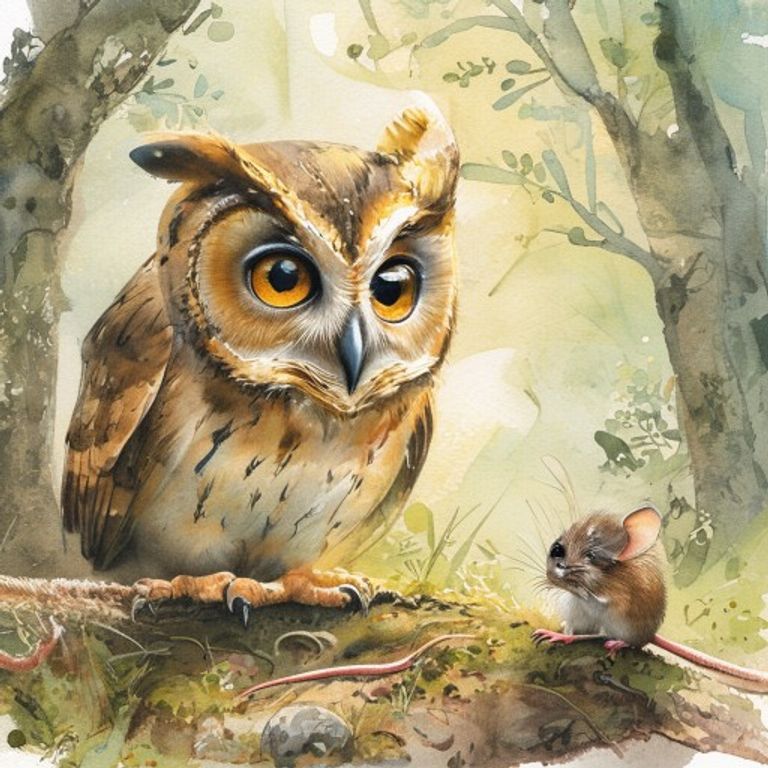
"You're an owl," said a small voice.
Luna spun her head — owls can spin their heads almost all the way around — and found herself face-to-face with a field mouse. He was young, no bigger than her talon, with fur the color of autumn wheat and eyes like black seeds. He was not running. He was not hiding. He was just sitting there, looking at her with an expression that was neither afraid nor impressed. It was simply... curious.
"Yes," Luna said, trying to sound dignified despite being covered in moss. "I am an owl."
"I've never talked to an owl before," the mouse said. "I'm Pip. Well, I'm not the Pip. I'm just a Pip. There are lots of us. But I'm the only one who talks to owls, apparently." He tilted his head. "Why are you on the ground? Owls don't do ground. Everyone knows that."
"I fell," Luna admitted. It felt strange, saying it out loud. Owls did not fall. Owls glided. Owls landed with silent precision. But here she was, covered in leaves, with a bruised wing and a dented dignity, talking to a mouse who was not even running away. "I was watching a beetle. I lost track of the wind."
Pip's whiskers twitched. "A beetle? You fell because of a beetle?"
"I was wondering about it," Luna said, and immediately wished she hadn't. She sounded like a kitten, not an owl. "I wanted to know where it was going. Why it rolls that ball. What it's for."
Pip stared at her for a long moment. Then he laughed — a tiny sound, like seeds rattling in a pod. "You're a curious owl," he said. "I didn't know those existed. I thought owls just... knew everything already."
"Everyone thinks that," Luna said quietly. "But I don't. I don't know anything about the ground. I don't know why mushrooms grow in circles. I don't know why ants carry leaves. I don't know why foxes follow the same paths. I look down and I see a world that makes no sense to me, and I want to understand it. But my mother says owls shouldn't wonder. We should just... hunt."
Pip was quiet for a moment. Then he stood up on his hind legs — a gesture of surprising confidence for someone so small — and said, "I know the ground. I was born here. I live here. I die here. The ground is my sky. And I know why the beetle rolls the ball. I know why the mushrooms grow in circles. I know why the foxes walk the same paths." He looked at her with those black-seed eyes, and for the first time in her life, Luna felt like the small one. "Would you like me to show you?"
Luna nodded. She felt something flutter in her chest — not fear, but something older and warmer. Something that felt like the first moment of flight, when the air catches your wings and you realize you are not falling but rising.
"I would like that very much," she said.
The Ground School
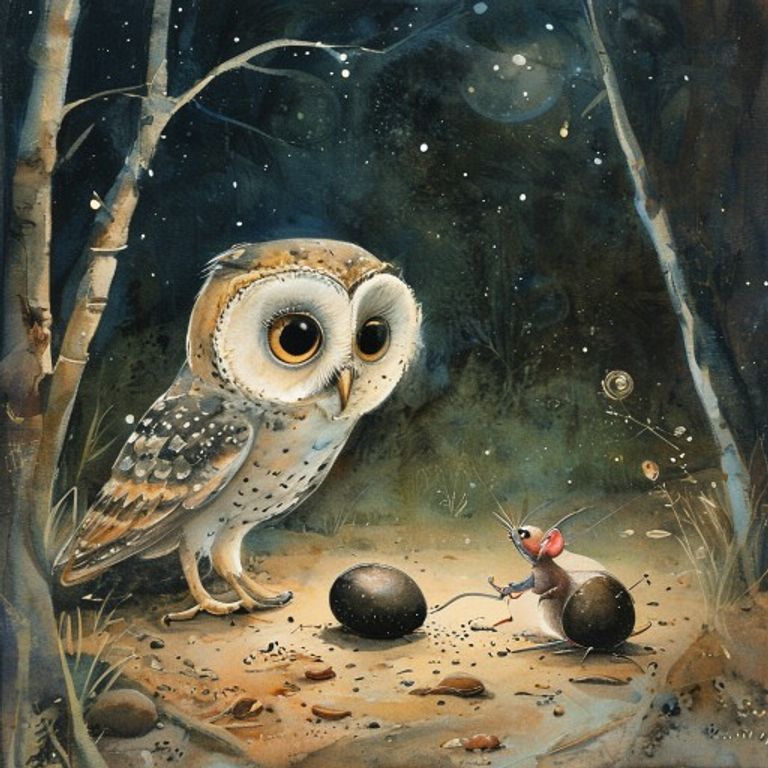
Pip taught her everything.
He showed her why beetles roll dung: to feed their babies, hidden in underground chambers. The ball is not trash — it is a nursery, a pantry, a home. "The beetle doesn't see dung," Pip explained, as they watched Dungroller (who had, improbably, survived Luna's fall and was still rolling) push his burden toward a hole in the earth. "The beetle sees possibility. What looks like garbage to you is treasure to him."
He showed her why mushrooms grow in circles: because they spread outward from a single spore, year after year, forming rings that can be hundreds of years old. "They call them fairy rings," Pip said, standing at the edge of a perfect circle of white-capped mushrooms. "The old stories say fairies danced here. But the truth is even more magical. A single spore, smaller than a grain of dust, created all of this. Just by growing. Just by being alive."
He showed her why ants carry leaves: not to eat, but to farm. The ants grow fungus on the leaf-fragments, tending it like a garden, harvesting it like a crop. "They are farmers," Pip said, watching a line of ants march past with green banners on their backs. "They have been farming for fifty million years. Long before any owl ever asked a question."
He showed her why foxes follow the same paths: because the paths are memory. A fox's grandmother walked this way. And her grandmother before her. The paths are stories written in earth, passed down through paws and noses and the quiet wisdom of survival. "They don't just walk," Pip said. "They remember."
Luna learned that the ground was not simple. It was not just the dark backdrop against which her own world made sense. It was a world as complex and layered and ancient as the sky — a world of farmers and dancers and builders and storytellers, all living their lives in the inches between the roots, invisible to anyone who did not think to look.
And she learned something else, something that surprised her even more than the ants' farms or the mushrooms' rings.
She learned that Pip had questions too.
"What's it like to fly?" he asked one evening, as they sat on a fallen log watching the sunset paint the canopy gold. "What's it like to see the whole forest from above? To touch the moon? To be silent?"
Luna told him. She described the feeling of spreading her wings and feeling the air rise to meet her. She described the way the forest looked from above — not a collection of trees, but a single breathing thing, a green ocean with currents of wind and rivers of shadow. She described the stars, how close they seemed, how they did not twinkle from up there but burned steady and cold and impossibly old.
Pip listened with the same wonder Luna had felt when he showed her the beetle's nursery. And Luna realized, with a start, that she was not just a student. She was a teacher too.
They were teaching each other.
The Return
By the third night, Luna's wing had healed enough for short flights. She could have returned to the canopy. She could have left the ground behind, pretended the fall had never happened, gone back to being the owl who looked wise and said nothing.
She did not.
She flew up to the lowest branch — just above Pip's head — and she perched there, looking down at her friend with her amber eyes. "I have to go back," she said. "My mother will be worried. The other owls will be looking for me."
"I know," Pip said. He did not sound sad. He sounded proud. "But you'll come back. Won't you?"
"Every night," Luna promised. "There is still so much I don't know. So much I want to understand. And..." she hesitated, "there is still so much I want to tell you. About the sky. About the stars. About the wind."
Pip smiled — mice can smile, if you know how to look for it — and said, "Then we have a lot of work to do."
Luna flew back to the canopy that night, but she was not the same owl who had left. She landed on her branch beside Shadow, who had been searching for her for three days, and before her mother could scold her, Luna said, "Mama. I need to tell you about the ground."
And she did.
She told her about the beetle's nursery. About the mushrooms' fairy rings. About the ants' farms. About the foxes' memory-paths. She spoke with the passion of someone who has seen a miracle and cannot keep it to herself.
Shadow listened. At first she was dismissive — "These are mouse concerns, owl matters" — but as Luna spoke, her mother's amber eyes softened. "How do you know all this?" she asked finally.
"A mouse taught me," Luna said. "His name is Pip. He knows the ground the way we know the sky. And I taught him about the sky. We are... we are friends."
Shadow was silent for a long time. Then she said, quietly, "I have lived forty years in this canopy. I have eaten ten thousand mice. And I have never known why mushrooms grow in circles." She looked at her daughter with something Luna had never seen before — not pride, not disappointment, but wonder. "You learned something I never knew. From a mouse. That is... that is a strange kind of wisdom, Luna. But I think it might be wisdom nonetheless."
Word spread. Other owls came to Luna, at first mockingly — "The mouse-learner," they called her — then seriously. They asked about the ground. They asked what the world looked like from below. Luna told them everything Pip had taught her, and in return she told Pip everything the owls asked, and Pip would go to his fellow mice and say, "The owls want to know why we store our seeds in different chambers. Can you show me?" And the mice would show him, and he would tell Luna, and Luna would tell the owls, and slowly — very slowly — the forest began to change.
Owls started looking down. Mice started looking up. Squirrels began explaining their acorn-burying system to anyone who would listen. Beetles gave tours of their nurseries. Ants invited visitors to their fungus farms. The forest of Starfall became not two worlds — the high world and the low world — but one world, connected by questions and answers, by curiosity and sharing, by the simple, revolutionary act of admitting you did not know everything.
And Luna — Luna the Curious, Luna the Mouse-Friend, Luna the Bridge — became the most respected owl in the forest. Not because she was the best hunter. Not because she was the wisest in the old way. But because she had the courage to say, "I don't know. Will you teach me?"
Years later, when Luna was old and her flight was slow, she would still perch on the lowest branch every evening, just above the moss where she had fallen so long ago. Pip was old too, his fur silvered, his whiskers trembling. But they still talked. They still shared. They still wondered.
And on the night Luna died — peacefully, in her sleep, on her favorite branch — the whole forest mourned. Owls hooted from the canopy. Mice squeaked from the burrows. Beetles pushed little balls of dung into a circle around her tree, a beetle's way of saying goodbye. Ants formed a line from their hill to her roots, carrying leaf-fragments as offerings. Foxes walked their memory-paths beneath her tree, howling the old songs.
But the most beautiful tribute came from the young ones. A kitten owl, barely fledged, perched on the branch where Luna used to sit, and looked down at the ground with wide, wondering eyes. A young mouse stood on the moss below, looking up, and the owl and the mouse spoke to each other — not as predator and prey, not as high and low, but as two creatures who shared a single, endless curiosity about the beautiful, mysterious, never-finished world they both called home.
The Moral of the Story: Curiosity is not about being smart or knowing everything. It is about having the courage to say, "I don't know. Will you teach me?" Luna was born looking wise, but she was not born wise. Wisdom came to her only when she admitted her ignorance — when she fell from her high branch and discovered that the ground was not simple, not small, not beneath her attention. The ground was a world as vast and complex as the sky, and the creatures who lived there knew things she had never imagined. The most powerful thing you can say is not "I know." It is "I wonder." It is "Tell me more." It is "I don't understand, but I want to." Curiosity is not a sign of weakness. It is a sign of strength — the strength to admit that the world is bigger than your own understanding, and the courage to learn from anyone, even someone you once thought was small. Luna learned from a mouse. The mouse learned from an owl. And together, they taught the forest that there are no high creatures and low creatures, no wise ones and foolish ones, no ones who know and ones who don't. There are only creatures who ask questions, and creatures who don't. And the ones who ask — the ones who wonder, who listen, who seek — they are the ones who make the world larger for everyone. So look down. Look up. Look everywhere. And never stop asking. Because every question is a bridge. And every bridge connects two worlds that were never really separate at all.