The Firefly Who Painted the Dark: A Story About Creativity
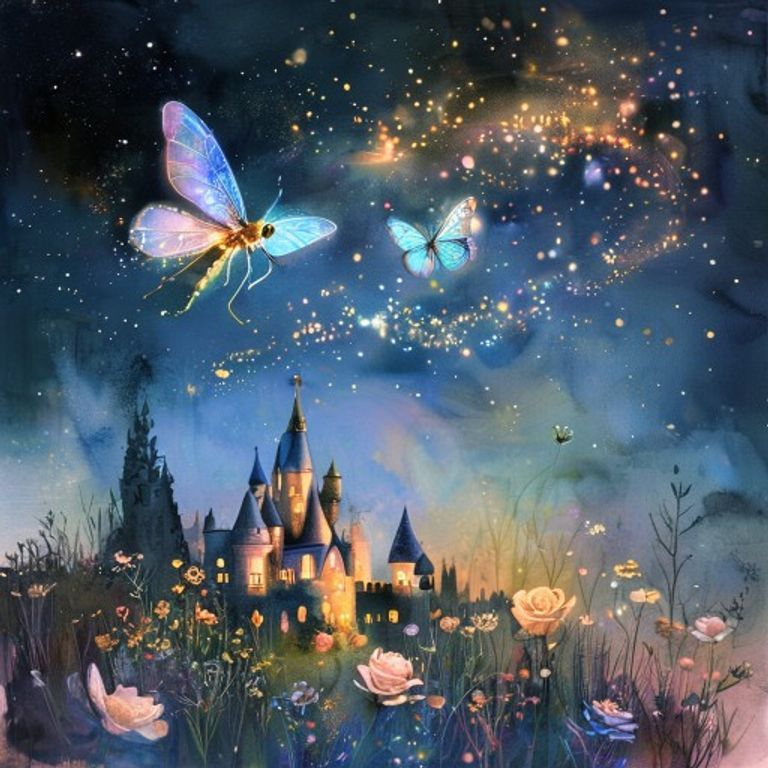
In the Whispering Meadow, where the tall grass grew so high it touched the stars and the night air smelled of clover and moonlight, there lived a young firefly named Flicker. She was not like the other fireflies. While they glowed a steady yellow-green, flashing their lights in the ancient patterns that fireflies had used since the beginning of time, Flicker's light danced through colors that had no name in the firefly tongue.
She glowed deep ocean blue, like the water in the pond at midnight. She blushed rose-gold, like the first touch of sunrise. She burned violet, like the shadow of a dream. And when she was happiest, she turned a color that was not quite silver and not quite pearl — a color that made the dewdrops look dull by comparison.
The other fireflies did not know what to make of her.
"She's broken," whispered Flash, the oldest firefly, whose light had guided three generations through the meadow. "Fireflies are supposed to glow green. Green means safe. Green means home. What is blue supposed to mean?"
"It's confusing the mating signals," complained Sparkle, a pretty firefly who was very particular about her flashing rhythm. "Last night, I tried to signal to Bright, and Flicker's purple light made him think a predator was near. He hid under a leaf for an hour!"
"She needs to learn to glow normal," said the Swarm — which is what the fireflies called themselves when they all agreed on something. "Everyone must glow the same. That's how fireflies have always done it. That's how fireflies will always do it."
Flicker's mother, Glow, tried to help. She taught Flicker the traditional patterns — three short flashes for hello, two long for follow me, one steady glow for danger. She showed her how to hold her light at exactly the right shade of yellow-green. She practiced with her for hours behind the old oak tree, where no one could see.
But Flicker could not glow normal.
It was not that she wouldn't. It was that she couldn't. Her light wanted to be blue. It wanted to be gold. It wanted to dance through every color in the world and invent new ones that had never existed. When she tried to hold it steady and green, it felt like holding her breath underwater — possible for a moment, but then her chest would ache and the colors would burst out anyway, brighter and more beautiful than before, as if they were angry at being trapped.
"I'm sorry, Mama," Flicker said one night, after another failed lesson behind the oak tree. "I don't know why I'm different. I just am."
Glow looked at her daughter — at the soft blue light that pulsed around her like a heartbeat, at the way the colors shifted with her emotions, at the beauty that was so strange and so undeniable — and she sighed. "I know, little one. But the Swarm is not kind to different things. You must be careful."
But Flicker was tired of being careful.
The Dark Side of the Meadow
On the night of the Summer Moon, when the fireflies held their Great Gathering and every firefly in the meadow flashed in perfect unison to welcome the warm season, Flicker did something terrible.
She glowed pink.
Not just a little pink. A blazing, blooming, unmistakable pink — the color of cherry blossoms and cotton candy and the inside of a seashell. It happened during the Silent Flash, the most solemn moment of the Gathering, when every firefly was supposed to extinguish their light for three full seconds to honor the ancestors.
Flicker had tried. She had squeezed her light shut with all her might. But the joy of the Gathering — the music of a thousand fireflies flashing as one, the smell of summer, the warmth of her mother's wing beside her — was too much. Her light burst out in a cascade of rose and coral and magenta, and the whole meadow gasped.
"She has ruined the Gathering!" cried Flash.
"She is not one of us!" cried Sparkle.
"Go away!" cried the Swarm. "Go to the Dark Side, where no one can see your broken light!"
The Dark Side of the meadow was a place no firefly went. It was where the forest pressed close, where the grass grew thick and tangled, where the shadows pooled like ink. The other fireflies said it was haunted by owls and filled with spiderwebs. They said the darkness there was so deep that even firefly light could not push it back.
Flicker flew there alone.
She expected to be afraid. She expected the darkness to swallow her. But when she reached the Dark Side, something unexpected happened. Her colors — her blues and violets and golds and roses — did not disappear in the darkness. They grew. Without the thousand green lights of the Swarm to dim her, Flicker's glow filled the air like paint on a black canvas. She turned blue, and the grass became an underwater garden. She turned gold, and the shadows became warm as honey. She turned violet, and the night itself seemed to lean in closer, as if it too wanted to see what she would do next.
And then Flicker discovered something wonderful.
She could paint with her light.
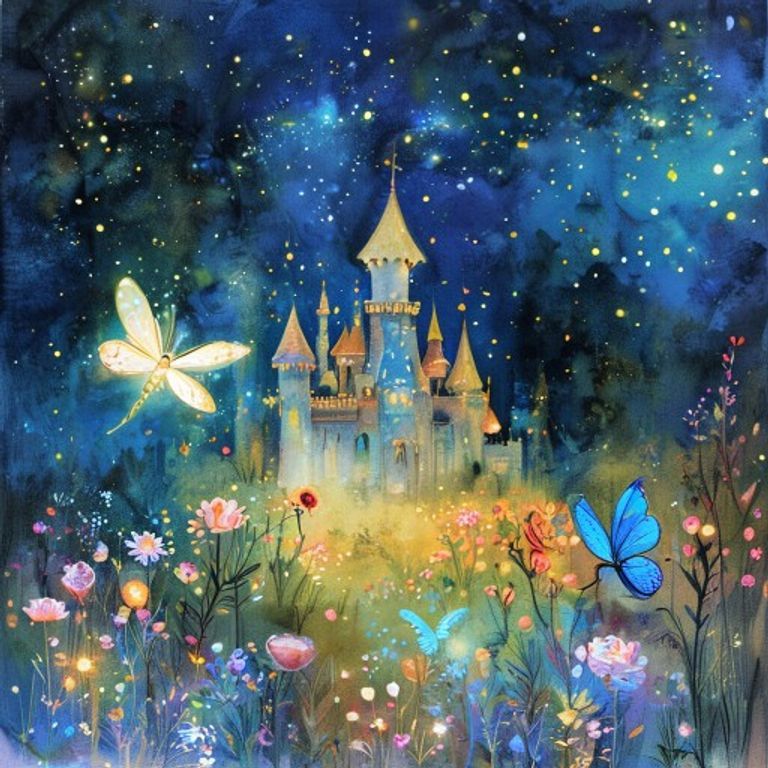
She flew in circles, and a spiral of emerald hung in the air behind her. She flew in loops, and a butterfly of sapphire took shape in the darkness. She darted up and down and side to side, and a castle of rose-gold appeared in the sky, complete with towers and windows and a tiny flag that waved in a wind only she could feel.
Flicker painted a whale made of midnight blue. She painted a dragon made of flame-colored light. She painted a tree with branches of silver and leaves of jade, and when she finished, she hovered before it and cried — not sad tears, but the kind that come when you finally understand who you are.
"Beautiful," said a voice behind her.
Flicker spun around. An old moon moth sat on a blade of grass, her wings like pale velvet, her eyes like dark pearls. She was so old that her antennae trembled, but her gaze was sharp and kind.
"Who are you?" Flicker asked.
"I am Luna," said the moth. "I have lived in the Dark Side for eighty summers. I watch the stars. I listen to the wind. And tonight, I have watched you paint the darkness into something I have never seen before."
"The others say I'm broken," Flicker whispered.
Luna laughed — a soft sound, like paper rustling. "The others say the moon is too bright and the stars are too far and the night is too dark. The Swarm has been saying the same things since the first firefly lit its belly. They are not wrong about what they see. They are only wrong about what is possible." She tilted her head. "Your light is not broken, little one. It is a language the meadow has not learned yet."
The Lost Child
On the seventh night of Flicker's exile, a storm came.
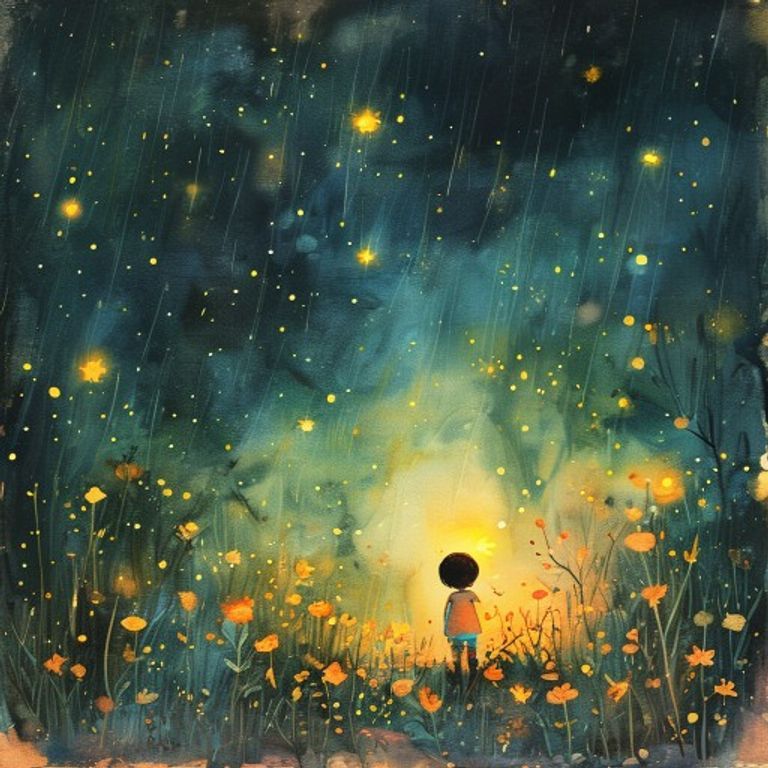
Not a gentle summer rain, but a true storm — the kind that tore branches from trees and turned the pond into a churning monster and made the fireflies hide under leaves and in hollow logs and anywhere they could find shelter. The Swarm huddled together in their usual places, flashing their green lights in nervous patterns, waiting for the storm to pass.
But Flicker did not hide.
She loved storms. The rain made her colors shimmer. The wind carried her light in spirals she could never create on her own. She danced in the Dark Side, painting lightning bolts of gold and thunderclouds of purple, and she did not notice the small figure stumbling through the meadow until it was almost upon her.
It was a child.
A girl, no more than six years old, with hair plastered to her face by rain and eyes wide with fear. She was shivering. Her jacket was torn. And she was lost — very, very lost. She had wandered away from her family's campsite on the other side of the forest, chasing a rabbit or a butterfly or some small wonder, and the storm had risen so quickly that she could not find her way back. Now she was alone in the dark, in the rain, in a meadow filled with shadows that looked like monsters.
"Mama?" the child whispered, her voice cracking. "Papa?"
The wind swallowed her words. The thunder answered with a growl. The child sat down in the wet grass and began to cry — not the loud wail of a tantrum, but the quiet, terrible sob of someone who has forgotten what safety feels like.
Flicker hovered in the darkness, watching. She had never seen a human child before. She had heard stories — the Swarm said humans were dangerous, that they caught fireflies in jars, that they crushed beautiful things because they did not understand them. But this child did not look dangerous. She looked small. She looked cold. She looked like Flicker had felt on the night the Swarm sent her away.
Flicker did something the Swarm would never have approved of.
She glowed.
Not the angry flash of a warning signal. Not the frantic blink of a lost firefly. She glowed soft and steady and rose-gold — the color of warmth, the color of comfort, the color of someone who has been lost and found her way home. She drifted closer to the child, close enough to be seen through the rain, and she began to paint.
She painted a path.
A path of stars, golden and bright, that wound through the grass like a river of light. She painted arrows of silver pointing the way. She painted a moon of pearl that hung low and gentle, casting no shadow, only comfort. And at the end of the path, she painted a door — a simple, glowing door of amber light — that she hoped would lead the child back to where she belonged.
The child stopped crying.
She looked up at Flicker's light-paintings, and her eyes grew wide with wonder. She reached out a small, wet hand toward the star-path, and when her fingers passed through the light, she laughed — a sound like bells, bright and surprised and full of sudden joy.
"Pretty," the child whispered.
She stood up. She followed the star-path. She walked through the rain, not afraid anymore, because the light was with her. Flicker flew ahead, painting new stars as fast as the child could walk, painting arrows when the path curved, painting a heart of rose light when the child stumbled and almost fell. They walked together — the small firefly and the smaller child — through the storm and the dark, until they reached the edge of the forest where the child's family was calling her name with flashlights and voices raw with worry.
The child ran into her mother's arms. Her father wrapped them both in a blanket. They cried and laughed and held each other so tightly that Flicker, hovering in the shadows, felt her own light grow warm with something she could not name.
Before she flew away, the child turned back. She looked straight at Flicker — right into her small, glowing body — and she smiled. Not the polite smile of someone who has been taught to be grateful. The real smile of someone who has seen something magical and will never forget it.
"Thank you, light painter," the child whispered.
The Language of Light
Flicker did not return to the Swarm.
She stayed in the Dark Side, with Luna and the shadows and the stars. She painted every night — not for the other fireflies, not for praise or approval, but because painting was what she was born to do. She painted stories in the sky. She painted memories for the wind. She painted dreams for the sleeping flowers and lullabies for the restless crickets.
Sometimes, on clear nights, a firefly would drift to the edge of the Dark Side and watch her. They never stayed long. The Swarm's rules were strong, and fear of difference ran deep. But Flicker saw the way their lights flickered when she painted a particularly beautiful butterfly, the way they leaned forward when she created a castle of violet and gold. They were learning, she realized. Slowly, quietly, one firefly at a time, they were learning a new language.
Glow came to visit every night. She never said Flicker should return to the Swarm. She just sat on a blade of grass and watched her daughter paint, and sometimes — when Flicker painted something especially lovely — Glow's own light would shift, just a little, toward blue.
"I'm proud of you," Glow said one night, as Flicker finished a dragon of emerald and flame. "I don't understand your colors. I don't know your language. But I see that you are happy. And that is enough."
Years passed. The child grew up. She became an artist — not the kind who paints on canvas, but the kind who creates installations of light and color, who builds rooms where people walk through rainbows, who designs buildings that glow at night like living things. She never forgot the firefly who painted her home through the storm. She called her work "Flicker Art," and when people asked why, she told them about a night in a meadow when the darkness was absolute and a small, broken light showed her the way.
And on the night the child — now a woman with gray in her hair — returned to the Whispering Meadow with her own grandchildren, she saw something that made her weep with joy.
The Swarm was glowing in colors.
Not all of them. Not every firefly. But enough. Enough that the meadow looked like a garden of living stained glass — green and blue and gold and rose, all flashing together, all different, all beautiful. The old patterns were still there, honored and remembered. But new patterns had joined them. Patterns Flicker had invented. Patterns her students had invented. Patterns that no one had imagined until someone dared to glow differently.
Flicker herself was there, older now, her light a little dimmer but her colors more complex than ever. She hovered before the woman who had once been a lost child, and she painted one last picture — a heart, simple and true, the color of gratitude and love and the courage it takes to be yourself.
"You did this," the woman whispered.
Flicker did not answer in words. She answered in light. A soft, steady, rose-gold glow that meant: No. We did this. Together.
The Moral of the Story: Creativity is not about following the rules or fitting in. It is not about being practical or sensible or normal. Creativity is about having the courage to glow in colors no one has ever seen, even when everyone tells you to glow green. Flicker was not broken. She was not wrong. She was simply speaking a language the meadow had not learned yet. And the most beautiful thing about creativity is this: when you dare to create something new, you are not just making art. You are making a path. A path of light through the darkness. A path that someone, somewhere, desperately needs to find their way home. The world will not always understand your colors. The world will tell you to glow normal, to flash in the same patterns, to be sensible and practical and just like everyone else. But the world needs your strange light. The world needs your impossible colors. The world needs the path only you can paint. So glow, little light. Glow in every color that lives inside you. Because somewhere in the dark, a lost child is waiting. And your light — your beautiful, broken, impossible light — might be the only thing that shows them the way.